
In my nostalgic saga of my family visits to wonderful places in my belle France, we found one off the beaten path we like, We have come here by car in my road warrior trails and found me a gem worth the detour, I did found me a picture in my cd rom vault that prompted me to do this post for you and me, Therefore, here is my take on this is Regnéville sur Mer !!! Hope you enjoy the post as I.
The village of Regnéville-sur-Mer is located in the Manche dept 50 in the Normandie region of my belle France, It has a population of 731 inhabitants ; located 12 km from Coutances, 48 km from Avranches, 80 km from Mont Saint Michel ,105 km from Caen, 329 km from Versailles, and 273 km from my current home, We came here first from Versailles on the D186 (bd du Roi et bd Saint Antoine) to connect with the A13 autoroute de Normandie on exit/sortie 6 dir Rouen continue dir Caen, go on the rocade N814 of Caen to the A84 (route des estuaires) dir Avranches to exit/sortie 39 taking on the D21 road and continue on D374 dir Tessy sur Viré ,and here connect with the D13 dir Villebaudon, and pass it connect with the D29 road same road D27 to connect by La Forgé Bisson with the D73 road which becomes same road the D49 to the castle of Regnéville sur Mer.
The Château de Regnéville is a former fortified castle founded in the 12C, remodeled in the 14C and 15C, and ruined in 1637. The fortress played an important role during the Hundred Years’ War. The medieval castle was a quadrilateral, of which sections of curtain walls remain, reused in houses built against the walls along the sea route. It was then composed of a “high courtyard” to the east, the foundations of which were partially uncovered during excavations carried out from 1991 to 1993. The quadrangular main tower, of which only two of the four sides remain, was located to the northeast of this high courtyard. To the west, facing the harbor, the “lower courtyard” was originally the royal residence of Charles the Bad. The Porte de Mer or Sea Gate, which provided access to the old port of Regnéville, was built in the 14C. The gate, which has undergone several modifications in its history, was composed of a series of drawbridges and fixed bridges. A small gatehouse, formed of a stone ground floor, constituted a first fortified gate. The keep of Regnéville, with its characteristic silhouette, has become over the years the symbol of the city and its imposing mass dominates the remains of the castle. Only one corner remains. The destruction due to the siege of 1449 and a fire in the 15C had ruined the courtyard of the lower enclosure of the castle. This bailey, which traditionally consisted of stables and outbuildings, originally housed the residence of the King of Navarre, and mentioned in estimates dated 1450, private residences the “ostels Jehan Louvet and THiphaigne”. The Cour à Tot and the house known as the Chapel are elements of the Louvet hotel. The restoration of the castle, undertaken in 1994, seeks to restore the appearance of the bailey at the end of the 16C.
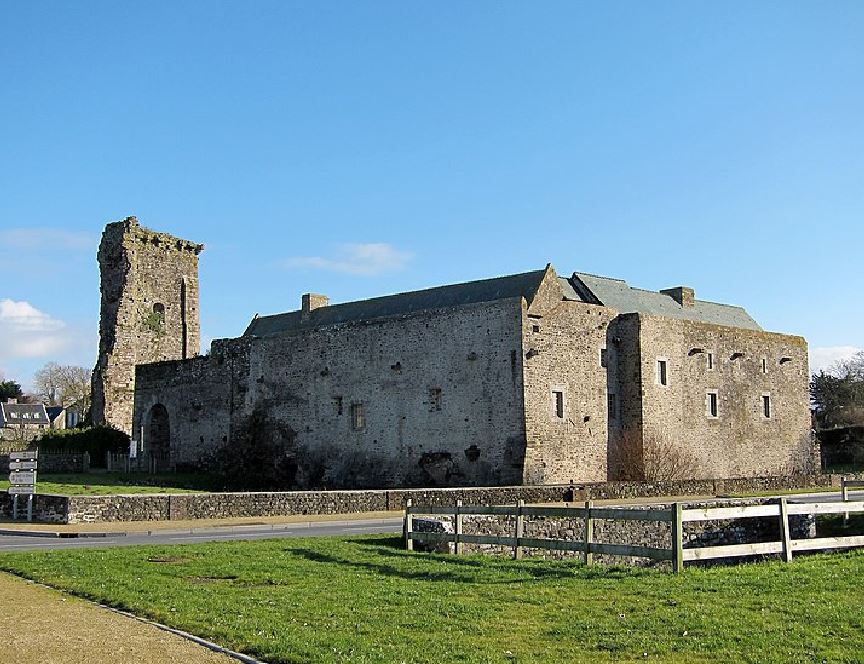
A bit of history of the Château de Regnéville tell us the fortress protected the important dry dock on the west coast, the harbor of Regnéville-sur-Mer, one of the busiest in the Cotentin throughout the Middle Ages and up to the 17C, allowing merchants to travel to the region’s major fairs, to monitor the sea, and to protect access to the Sienne and the hinterland. The site was probably occupied from the 9C during the Norman invasions. The castle, probably built by Henry I Beauclerc, is attested from 1141 in a text listing the real estate of the successors of William the Duke of Normandy. Its keep actually dates from the 12C. The Dukes of Normandy and the King of England were keen to keep the castle and the port in the royal domain, because these allowed them to control all of Lower Normandy. John Lackland in particular occupied the site because the presence of the fortified castle allowed him to protect the English merchants who landed there. In 1204, when Normandy was annexed to France, Philip Augustus, in view of the obvious interest of the castle, kept it in the royal domain. In 1327, Joan of France, the last descendant of the Capetian kings, upon her marriage to the Count of Évreux, received several Norman castles as a dowry, including that of Regnéville. In 1349, Charles the Bad, King of Navarre, inherited the Norman possessions of his father, the Count of Évreux, Philip III of Navarre becoming a great feudatory in Normandy. It is likely that Regnéville Castle was rebuilt at this time using materials from Montchaton Castle, destroyed in 1360. In 1364, Charles V ascended the throne of France. Charles the Bad’s troops, allied with the English, held Normandy with the support of countless castles. Regnéville Castle underwent extensive fortification work. In 1404, Charles III, son of the Bad, ceded Normandy to the King of France. Regnéville was removed from the Navarrese patrimony and returned to the royal domain. In March 1418, the Duke of Gloucester captured the castle on behalf of King Henry V of England. On September 19, 1449, after a six-day siege, the fortress was recaptured from the English by the Constable of Richemont with the army of the Duke of Brittany and the help of about a hundred burghers from Coutances and peasants from Regnéville. The assault left the fortress gutted on the seaward side. The following year, in 1450, the English were driven out of Normandy following the Battle of Formigny, between Isigny and Bayeux. The castle was then restored. Three years later, the Hundred Years’ War ended. From 1448 to 1449, the castle garrison consisted of only six men-at-arms and fourteen English archers. Contracts of engagement were made between the sovereign and the captains. The garrison, composed of professional soldiers, was paid by the overlord, the King of France, King of Navarre or King of England depending on the era. At the beginning of the 15C, three artillery pieces were manufactured for the castle. These small cannons, called culverins, projected four-pound stone balls. The castle gradually lost its military role in the second half of the 15C. The Hundred Years’ War left the castle in a sorry state. The castle then only had a residential and agricultural function and was extensively remodeled in the 17C and 18C. In 1860, Sarah Félix, a Parisian actress, moved into the castle and, with a partner, started oyster farming, “Les Huitrières de Regnéville”, and marketed her produce in Paris. The Château de Regnéville was acquired by the General Council of Manche in 1989, as part of the departmental network of sites and museums in Manche.
Other things to see here are the Church of Notre-Dame de Regnéville (13-14C) of Romanesque origin, has a massive bell tower, dating from the 12C. It houses numerous works including a high relief of the Passion from the 15C, a Virgin and Child known as the Virgin with the Rose from the 14C, and a mural painting from the 14C. The Romanesque Church of Saint-Étienne de Grimouville (12C) which houses a five-masted ex-voto boat from the 19C, and a statue of Saint Marcouf, the Church of Sainte-Anne d’Urville with a stone spire from the 17-18C which houses an ex-voto boat from the 19C. Located on the exceptional complex of the Rey lime kilns (19c), the museum traces the maritime and industrial history of Regnéville. The port of Regnéville nowadays, it is mainly used for pleasure boating. Like those of Mont Saint-Michel, the salt meadows developed following the silting up of the Sienne estuary. The sheep that graze on the grass there have particularly good meat and have given salt meadow lamb its reputation.
A bit of history I like tell us that Regnéville, initially a royal domain, became a fief of the Hambye Abbey. The village was owned by the Paynel family. During the English occupation of Normandy from 1419 to 1449, during the Hundred Years’ War, Regnéville was the Anglo-Norman capital of the Cotentin Peninsula. The port, located on the edge of the Sienne harbor, was one of the best anchorages on the west coast of the Cotentin Peninsula in the Middle Ages. An important trading port in Lower Normandy, due to the proximity of the large annual fairs of Montmartin and that of Agon, founded in 1199 by John Lackland, a castle was built during the reign of Henry I Beauclerc to protect the port and control its traffic. The port remained active until the 20C thanks to the importation of coal from Wales to supply the lime kilns in the region. Between 1795 and 1800, Regnéville absorbed Grimouville and Urville-près-la-Mer; the village took the name of Regnéville-sur-Mer in 1956.
The Coutances tourist office on the Château de Regnéville : https://www.tourisme-coutances.fr/decouvrez-les-incontournables/visites-virtuelles/chateau-de-regneville/
The village of Regnéville sur Mer on the Château de Regnéville : https://www.regneville-sur-mer.fr/commune/histoire-et-patrimoine/le-chateau.html
The Village of Regnéville sur Mer on its heritage : https://www.tourisme-coutances.com/discover-our-destinations/regneville-sur-mer/
The Manche dept 50 tourist office on the Château de Regnéville: https://www.attitude-manche.fr/patrimoine-culturel/chateau-medieval-de-regneville/
There you go folks, a wonderful find in off the beaten path trails of the Manche dept 50. The memories lingered of so many road warrior trails passed with the family and glad still have pictures to show it, Again, hope you enjoy this post on this is Regnéville sur Mer !!! as I.
And remember, happy travels, good health, and many cheers to all !!!


