
Let me bring you back to post with new pictures from my cd rom vault and older paper pictures to share with you and me, A wonderful memory to the nostalgic Lisle sur Tarn, in the Tarn deparment no, 81 of the Occitanie region of my belle France. Like I have said,the region is full of amazing small towns all with a rich history on its own,and worth your layover I am sure. The town sits between my other nostalgic cities of Toulouse and Gaillac and in the middle of a wine region, Therefore, this is my take on the Church Notre Dame de la Jonquiére of Lisle sur Tarn !!! Hope you enjoy this post as I.
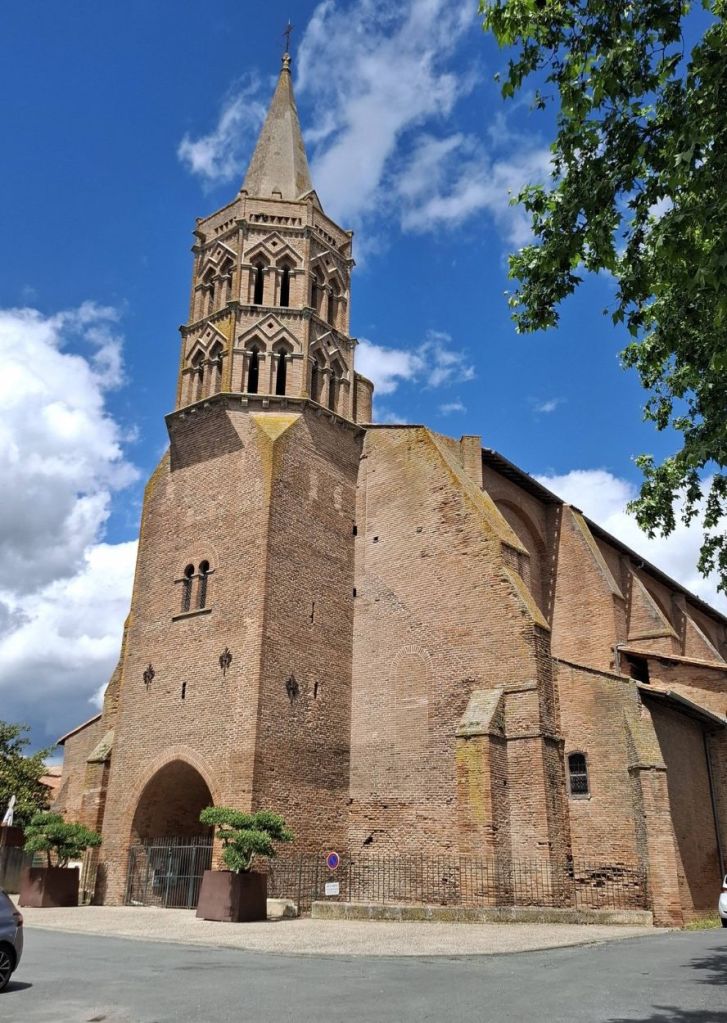
The Gothic Church Notre Dame de la Jonquière was built in the 13-14C on the site of a Romanesque church, of which only a portal and a few windows on the side façade remain. It is one of the finest brick buildings in the country; it is a vast and beautiful nave, 42 meters long, 14 meters wide, and 17 meters high at the vault, comprising a heptagonal sanctuary and a nave divided into four bays, each with a chapel between its buttresses. The Stations of the Cross are from 1877, the baptismal font from 1881, and the clock, located behind the organ, from 1870. The 50-meter-high bell tower is at the rear of the nave. Square at the base, it becomes octagonal from the church roof and ends in a spire. The openings of the octagonal section are often reproduced and attributed to the 14C.
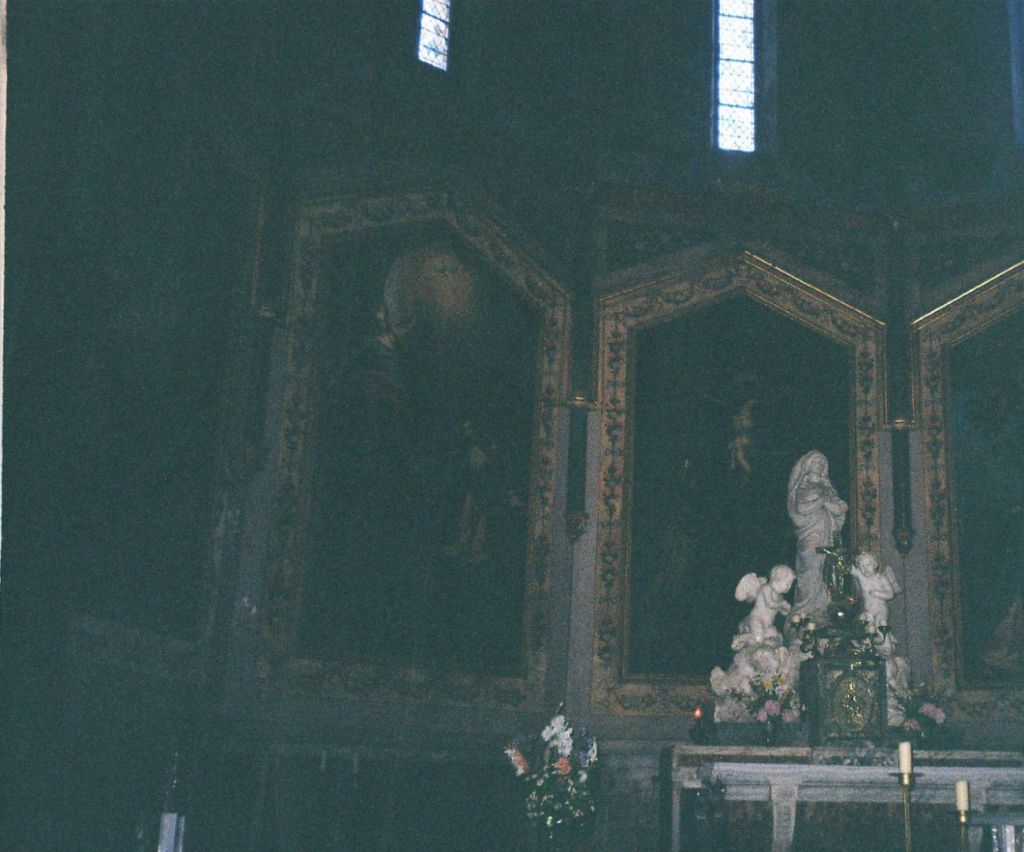
The Church Notre Dame de l’Assomption was named as such in 1282. Of the construction of that time, only the Romanesque side door remains, which would have been the entrance to the original church. The current church was completed in the 16C and regularly enriched throughout the 17-18C. The 18C high altar, polychrome marble, and wainscoting come from the Augustinian chapel. The adoring angels ,and the statue of the Virgin Mary, placed there in 1873, are also featured. The tabernacle, with its chased copper door, is surmounted by a crucifix with the shroud and the orb of the world resting on the Gospel bearing the seven seals of the Apocalypse. The small red votive candle reminds Christians that the body of Jesus, living in the Eucharist, is present in the tabernacle.
The Church Notre Dame de l’Assomption has several chapels, briefly they are the Chapel of Saint Roch, protector of plague victims, is adorned with a painting by Ambroise Fredeau (1650), an Augustinian friar from Toulouse, painter, and miniaturist. Restored in 1992. The Chapel of Our Lady of the Rosary, stalls from 1868, crafted by a carpenter from Lisle. The Chapel of the Good Shepherd. The words visible on the wall with traces of the former baptistery chapel are from the Gospel of Saint Matthew. The Chapel of Saint Eutropius, weavers’ confraternity: Priest’s stall from 1884. In the center of the canvas: “Praised be the Most Blessed Sacrament of the Altar.” Altarpiece in the Spanish style and influence, carved, painted, and gilded wood. The Chapel Notre-Dame de la Pitié or Our Lady of Pity: It features a very beautiful Pietà, dated, according to specialists, to the beginning or middle of the 17C. Pietàs depict the Virgin Mary holding the body of Christ on her lap after the Descent from the Cross and before the Entombment. It is life-size, made of painted and gilded wood. Mary, dressed in a large, pleated cloak, cradles her son’s body on her right knee, supporting his torso and holding his left arm at the wrist, while his right arm hangs limp. The Virgin’s face, with half-closed eyes, conveys profound sorrow and perhaps a touch of astonishment. The Chapel of the True Cross is in the Jesuit style, dating from the Louis XVI period. The Chapel of Saint Joseph, the third chapel upon entering, immediately catches the eye with its large niche illuminated by a skylight, housing a life-size plaster group depicting the death of Saint Joseph, flanked by the Virgin and Christ. The Chapel of Saint Michael: 18C ornamentation.
The murals were painted between 1692 and 1702. Concealed during the French revolution by a thick layer of whitewash, they were rediscovered in 1863 by Joseph Engalières and the parish priest at the time, Canon Faucon. These paintings depict a concert of angels in late 18C costume, singing the praises of the Virgin Mary. In the dome: musical angels escort Mary, taken up to heaven at her Assumption. On the chancel arch: Assumpta Maria in Cælum… (Mary is taken up into heaven…). Dedication of the church celebrated on August 15. Above the paintings: verses from the Lenten antiphon in honor of the Virgin Mary. The paintings in the choir, including their frames, date from 1869 and were restored in May-June 1992. From left to right, they depict: The Baptism of Saint Augustine, The Translation of his Relics, The Annunciation, Christ on the Cross (1616), The Visitation, The Death of Saint Monica, Augustine’s mother, and The Conversion of Saint Augustine.
The great organ was built in 1880 and restored in 2002. Its facade features a fairly classic neo-Gothic case. Statues include King David (from the Bible) with his harp and Saint Cecilia (a Roman martyr, patron saint of musicians and of the Diocese of Albi) with her lyre.
The Diocese of Albi on the Church Notre Dame de la Jonquiére of Lisle sur Tarn (most my text is from the site) : https://albi.catholique.fr/eglises-du-tarn/lisle-tarn-dame-de-jonquiere/
The town of Lisle sur Tarn on its heritage : https://www.ville-lisle-sur-tarn.fr/tourisme-culture/histoire-et-patrimoine
The Tarn dept 81 tourist office on the heritage of Lisle sur Tarn : https://www.la-toscane-occitane.com/en/visiter/villes-villages/lisle-sur-tarn/
There you go folks, a wonderful in Lisle sur Tarn and the Sud Ouest (southwest) of my belle France. An off the beaten path town that is worth the detour me think. Again, hope you have enjoy this post on the Church Notre Dame de la Jonquiére of Lisle sur Tarn !!! as I.
And remember, happy travels, good health, and many cheers to all !!!


