
Another spot that need to show in my blog combining older pictures from older post and new paper picture found in my albums ! This is nice Montpellier in the Herault dept 34 of the Occitanie region (old Languedoc) of my belle France. After all, this is was in my extended road warrior trails that is part of my life’s story and like to share it with the world. Therefore, here is my take on this is Montpellier !!! Hope you enjoy this post as I.
The city of Montpellier is on a major communication axis joining Spain to the west and Italy to the east. The city is located 19 km by road from the Mediterranean Sea in the town of Palavas-les-Flots, 56 km from Nîmes, 96 km from Avignon, 86 km from Béziers, 749 km from Versailles, and 188 km from Castres from where we came on an extended road warrior trails round trip, We left the town along avenue René Cassin to connect first with the D85 road which later becomes the D60 road or ancienne route de Labruguière to connect with the N112 road dir Béziers but go around Aussillon to connect with the D612 road continue dir Béziers passing the wine town of Saint Chinian bear left upon entering beltway of Béziers to continue to connect at exit/sortie 63 with the A75 autoroute La Méridienne to bearing right go into exit/sortie A750 road Montpellier continue get on exit/sortie 7 to get onto the N109 highway continue past Juvignac bear right onto a big descending circle to take the M65 road into Montpellier you come in onto the M21 road or Avenue Jean Jaurés continue same road changes name go over the pont François Delmas bridge and continue bearing right onto centre historique panel with the opéra Berlioz on your right hand side continue on Bd Sarrail and continue to the place de la Comédie,
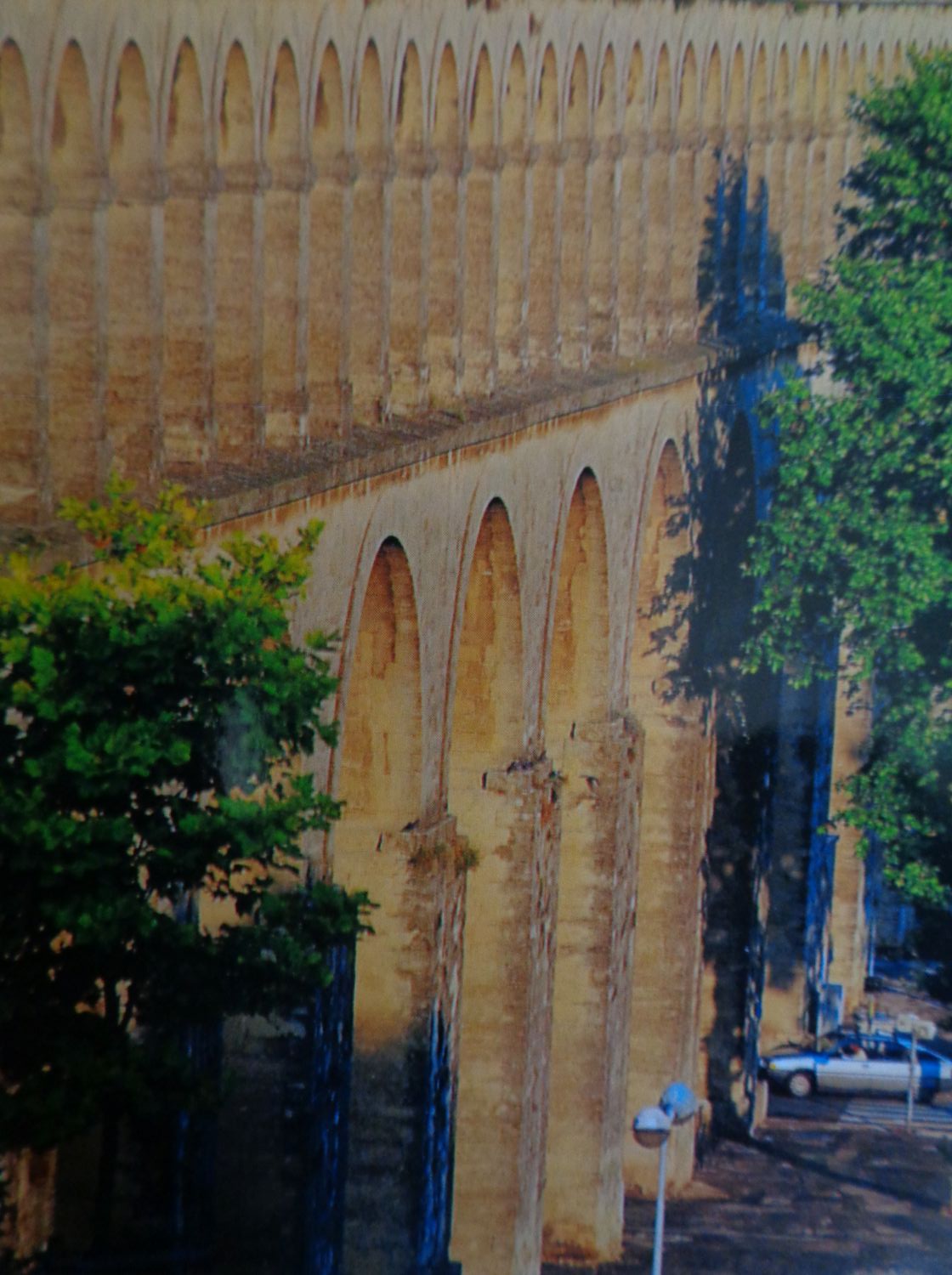
There are wonderful places for walks such as the Place de la Comédie and the Arc de Triomphe-esplanade du Peyrou date from the 17C. This is also the case of Place Jean-Jaurès, built on the site of the former Church of Notre-Dame-des-Tables, destroyed during the Wars of Religion, and the Promenade Royale du Peyrou built by order of Louis XIV and in his honour, outside the fortifications. To supply the city and its gardens, an aqueduct, called “Les Arceaux”, carries water from Saint-Clément-de-Rivière. Developed in the middle of the 18C, inaugurated and put into service on December 7, 1765, it culminates in the superb water tower which dominates the Peyrou esplanade, From the medieval hostal to the classic 18C hotel, Montpellier today has nearly eighty mansions.
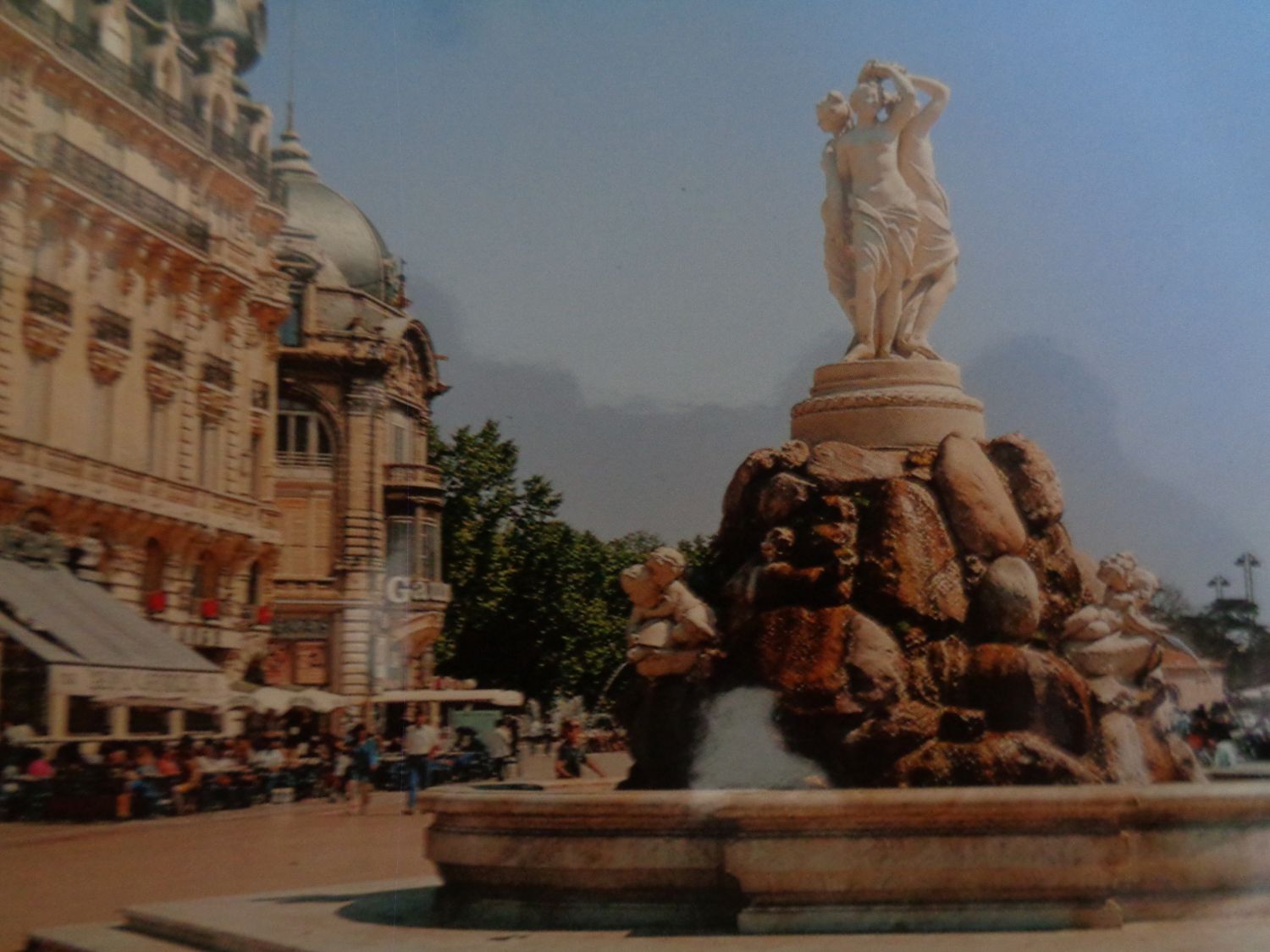
You cannot miss coming here, great ambiance and beautiful architecture. The Place de la Comédie dating from 1755 and completely refurbished after the fire of the theater in 1881 is the central place of the city. It takes its name from the municipal theater whose monumental facade adorns the square, and is embellished with the fountain of the Three Graces, . It should be noted that the Place de la Comédie obtained, several years ago, a prize rewarding the quality and enhancement of its architecture by the nocturnal lighting of its facades and of the theatre. This square is also nicknamed “place de l’œuf” because of the pattern drawn on the ground, in front of the Opéra de la Comédie.
Another we rush by was the Arceaux aqueduct, whose real name is the Saint-Clément aqueduct, built in the 18C is one of the most beautiful monuments in the city. This building, largely inspired by the Pont du Gard, allowed the arrival of drinking water from the source of Boulidou, then later that of Lez, located in Saint-Clément-de-Rivière. When it was built, it brought 25 liters of water per second to the city of Montpellier.
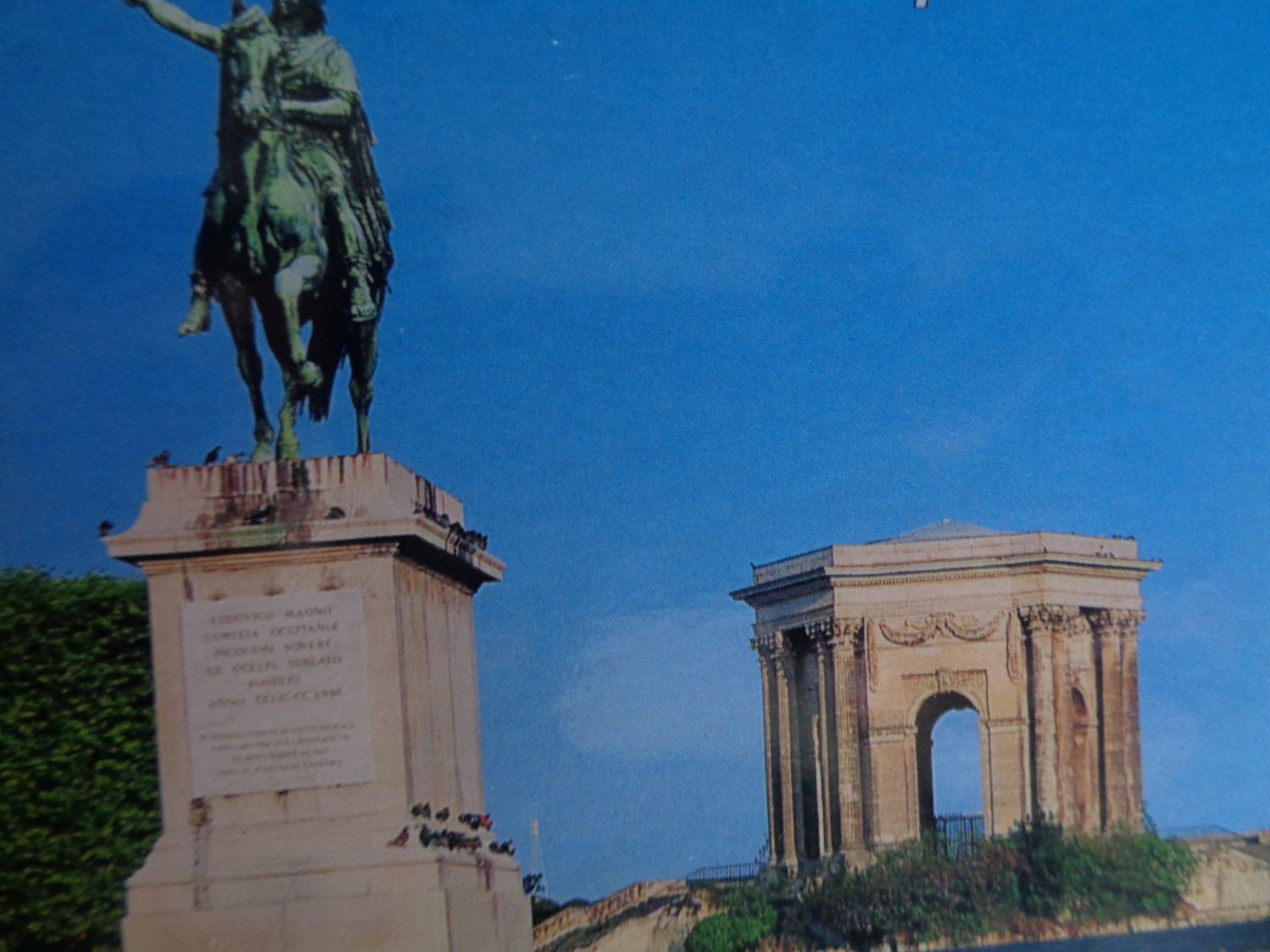
The Promenade du Peyrou , aka Place Royale du Peyrou, with a length of 289.50 meters and a width of 160.56 meters, representing 4.59 ha, it has four entrance gates, three on its eastern part and one at the top of the stairs on its western part is located on rue François Franque, place Giral and streets: Clapiès, du Maréchal de Castries, Hilaire Ricard, Pitot and de la Blottière. The Arceaux parking lot at place Max-Rouquette is a good spot to parked. Being on the upper part of Montpellier, it represents a conjunction of five works: the promenade and its terraces allowing one to contemplate the Cévennes and the Pyrenees which was laid out in 1689, the Peyrou gate or the Arc de Triomphe with its bridge and access ramps, built in 1691, the equestrian statue of Louis XIV (see pic) represents 152 years of history on the promenade between the order of the first statue on October 31, 1685, erected in 1718, the symbolic laying of the first stone of the second statue on October 13, 1814 by the Count of Artois, future Charles X and the inauguration of this second work in all discretion, on August 29, 1838, the Saint-Clément aqueduct and its reservoir built from 1753, the water tower (see pic) whose project was retained in 1766, the child and lion statues of Injalbert and the entrance gates in 1883. Later, in 1927, the construction of an analemmatic sundial, carried out on the initiative of Professor Pierre Humbert and in 1939, the taking of the symbolic photo of the resistance fighter Jean Moulin.
Other things to see in my opinion are the Fabre Museum , the Comédie Opera; the Jean-Vilar theatre, municipal theater , the Saint-Pierre Cathedral, Saint-Roch Church; Notre-Dame des Tables Basilica, Sainte-Foy Chapel , known as the Chapel of the White Penitents.
A bit of history I like tell us that it was the first land of the counts of Melgueil, who gave it in 985 to a certain Guilhem in exchange for his devotion, the lordship of Montpellier passed at the beginning of the 13C to the Crown of Aragon King Jacques I of Aragon was born there in 1208 then to the Kingdom of Majorca, before being purchased in 1349 by the King of France Philippe de Valois. Sold in 1365 to the King of Navarre, Charles the Bad, Montpellier returned definitively to the Kingdom of France in 1383. The date of June 9, 1907, with a gigantic rally in Montpellier, marks the peak of winegrower protest in the South of France. The Place de la Comédie is invaded by a crowd estimated between 600,000 and 800,000 people. It is the greatest manifestation of the Third Republic. During WWII, the city was part of the free zone, gradually subject to Nazis interests, through the collaboration of the regime in place. On February 13, 1941, Marshal Pétain, accompanied by Admiral Darlan, met General Franco in Montpellier. The city had always been an important center of resistance. Evidenced by the activity of Jean Moulin, a famous French resistant established in Montpellier for a large part of the war and whose most famous photographic portrait was taken in front of a pillar of the Arceaux aqueduct. The city of Montpellier was bombed several times during WWII: The city was liberated by the 1st DFL (Free French Division).
The city of Montpellier on things to see: https://www.montpellier.fr/3775-decouvrir-montpellier.htm
The Montpellier tourist office on must sees: https://www.montpellier-france.com/Prepare-Book/Discoveries/Must-sees-in-Montpellier
There you go folks, a dandy wonderful region of my belle France , and its huge inventory of wonderful cities/towns/villages to visit for a long time, with many memories from visiting with the family over the years. Again, hope you enjoy the post on this is Montpellier !!! as I
And remember, happy travels, good health, and many cheers to all !!!


A city I’ve visited many times generally during the Tour de France.
LikeLiked by 1 person
Good for you , thanks for stopping by Cheers
LikeLiked by 1 person