
And wow, got me again some pictures in my cd rom vault that should be in my blog for you and me. My idea is to keep a log in my blog of all the places I or my family have gone, like a living testament for generations to come. In the meantime, a great source of info for future travelers/visitors and locals alike. This is a quant little village off the beaten path but worth the detour, me think, Therefore, here is my take on this is Hautefort ,and its castle !!! Hope you enjoy the post as I.
The village of Hautefort is located in the Dordogne department no 24, in the Nouvelle-Aquitaine region of my belle France. The village is comprise of two hamlets: Saint-Agnan in the valley, crossed by the D704 road, and the village of Hautefort, at the intersection of the D 62, 62E1 and 72 roads, on the hill dominated by the castle. It is 43 km from Périgueux, 50 km from Brive-la-Gaillarde, 77 km from Limoges, 187 km from Bordeaux, 460 km from Versailles, and 528 km from my current home, We came from Versailles going out of town by Potager du Roi and Parc Balbi to connect with the N12 dir Vélizy-Villacoublay which continues on the A86 to connect with the N118 road dir Biévres, Les Ules to connect with the A10 autoroute d’Aquitaine dir Bordeaux ,then past Orléans get on the A71 autoroute de l’Arvene dir Vierzon, bear right to get into the A20 just above Vierzon dir Châteauroux continue dir Limoges bear left to get onto the D704 around Limoges continue dir Saint-Yrieix-la-Perche continue to turn right on the D62E1 road dir Perigueux ,but before in the village of Hautefort bear right onto Place Marquis Jacques François or D62 road becomes Rue Bertran de Born then bear right onto Rue Maxence de Damas and the castle,
The Château de Hautefort was from 1160 to 1398 in the Born-Hautefort family. Then from 1398 until 1887, the house of Gontaut-Hautefort owned it. The castle is located on a rocky spur overlooking the village of Hautefort. Built over a period from the end of the 16C to the end of the 17C on the foundations of an old fortified castle, its architecture clearly evokes the castles of the Loire. It is one of the rare classical buildings in the Dordogne. In 1670, the second tower of the eastern wing of the castle was built, mirroring the existing one. The chapel was moved to this tower. In 1695, it was completed the development of the castle, who had the main staircase built, inspired by the Ambassadors’ staircase at Versailles. In 1792, during the French revolution, the castle was protected by the inhabitants of Hautefort, who opposed the sans-culottes of Excideuil, who wanted to destroy it. The castle was used as a prison for a time.
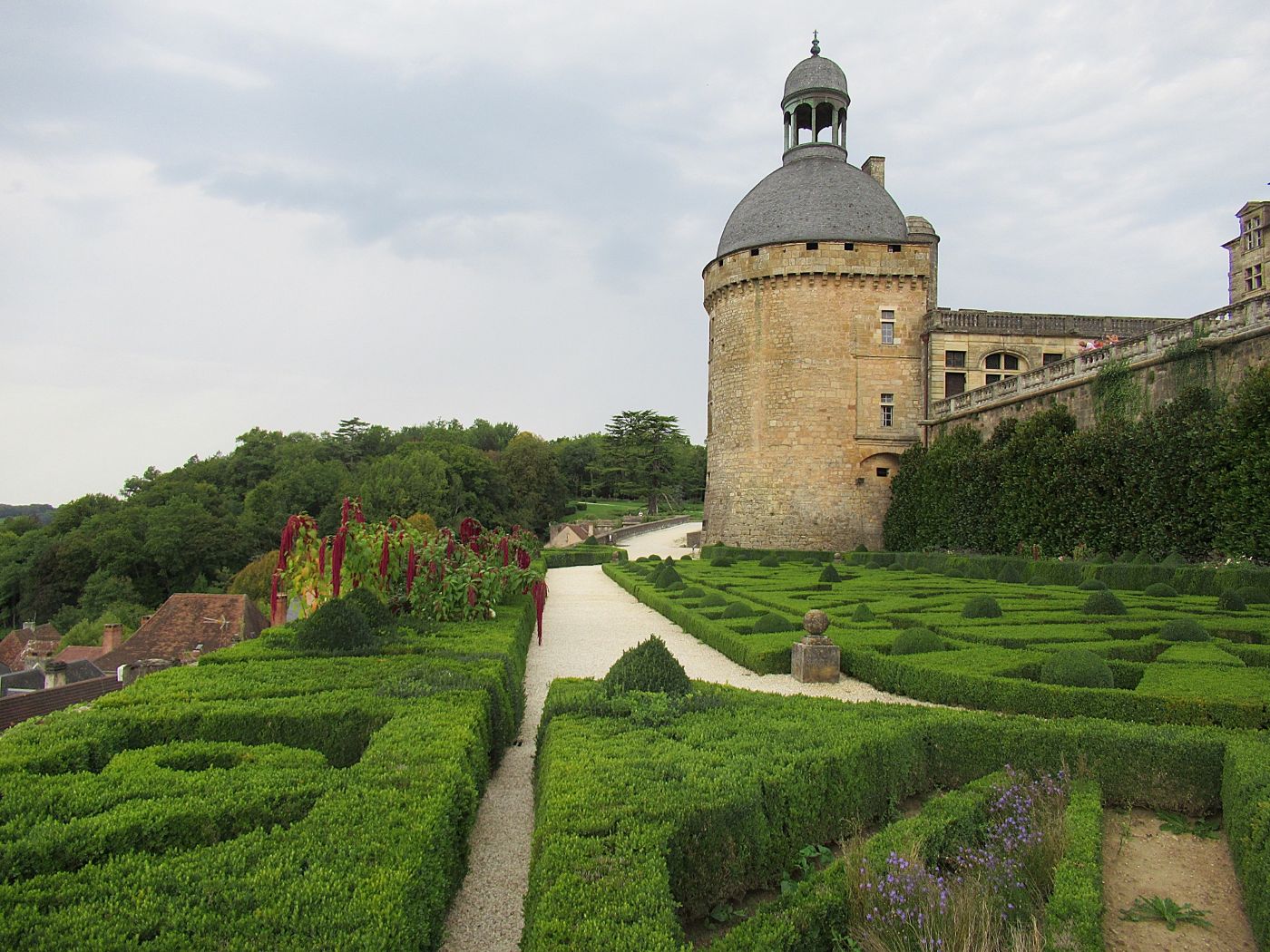
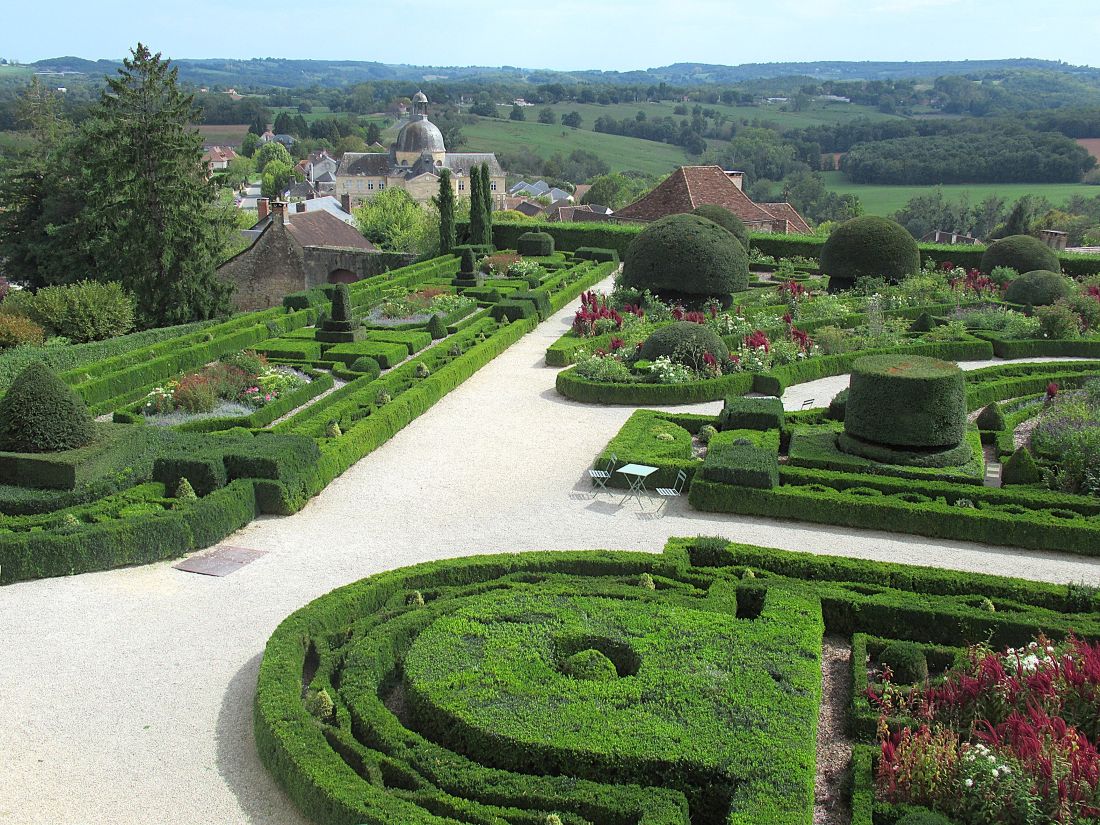
The Château de Hautefort has French-style gardens, recreated by Baron and Baroness de Bastard, extend in terraces all around the château, divided into flowerbeds of boxwood. An English-style park extends over 30 hectares on the hill to the west of the château. In 1958, the château and gardens were opened to the public. Today, the part of the interior that is not open to the public.
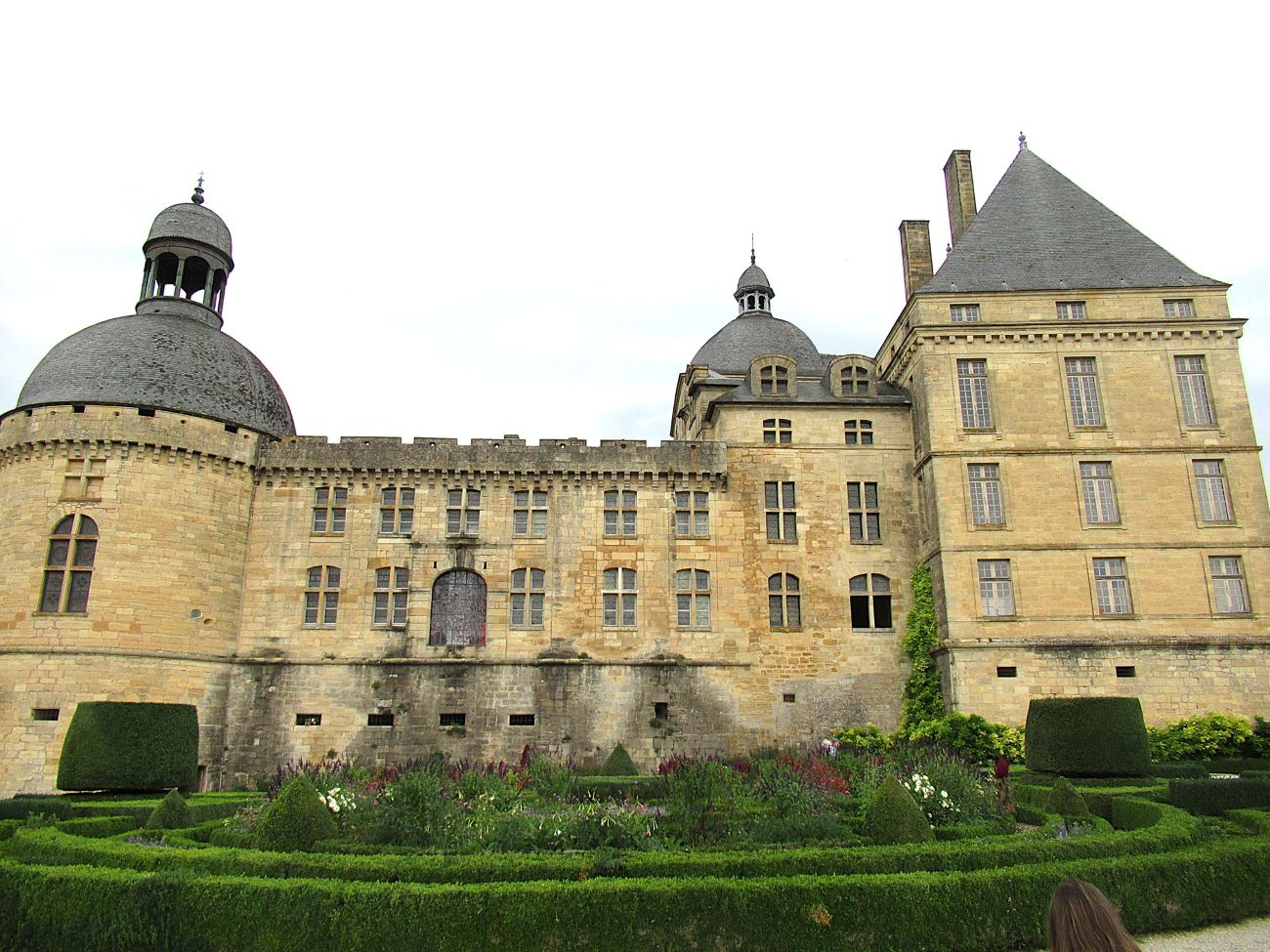
The village really is the castle but here is a bit more on the lordship village having belonged successively to the families of Lastours, Laron-Lastours, and Born ,the troubadeur Bertran de Born, Lord of Hautefort, it felled in the 14C to the Gontaut family, through the marriage of the last heiress Marthe de Born with Hélie de Gontaut. Their posterity substituted their names and arms with those of Hautefort. This house of Gontaut-Hautefort obtained in 1614 that the village of Hautefort be erected into a marquisate. Some other things to see here are the Charreaux Castle, 17-18C, Hautefort Hospital (1670-1717) transformed into a medical museum, open to the public. And the Saint-Aignan Church, rebuilt in 1620,
A bit of history I like which for a small village and castle it has a lot ! Pierre II de Gontaut married Marguerite de Born in 1303. They bore the Gontaut coat of arms. Their children did the same. Their grandson, Hélie de Gontaut, Lord of Hautefort (died 1420), married Mathe de Born, Lady of Hautefort, in 1383. They quartered the Gontaut coat of arms (quarterly or and gules; shield as banner) with those of the Hautefort gold with 3 sable forces (shield as banner). Their descendants later substituted their names and coat of arms for those of Hautefort. In 1588, during the Wars of Religion, the castle was a Catholic stronghold. Construction of an entrance castle with two crenellated watchtowers preceded by a drawbridge. In 1614, Marie de Médicis, regent of the kingdom for her son Louis XIII, established the estate as a marquisate for the benefit of François de Hautefort, son of Gilbert. In 1640, François de Hautefort, 1st Marquis, died at the age of 92. He had served under five kings. His son Charles-François died in 1616, and his grandson Jacques-François de Hautefort, already a marquis, having been emancipated by his grandfather, succeeded him, and work resumed on the castle. His sister, Marie de Hautefort, was a favorite of King Louis XIII. In 1794, the new castellans, Count Abraham-Frédéric and his wife, née Jeanne-Marie Bertrande d’Hautefort de Vaudre, were arrested in Paris and sentenced to death; like the Marquis, who was also arrested. Thanks to the help of the prison doctor’s wife, the latter was transferred to the Scots the day before the execution. The next day, three Hauteforts were called for the guillotine. The Countess had the presence of mind, to save her brother-in-law’s life, to say: three people are called, but there are only two of us: I was counted twice, my maiden name also being d’Hautefort. It passed. The castellans were guillotined on July 7, while the Marquis survived. He will have descendants to this day, but the castle now belongs to an orphan: Amédée d’Hautefort, aged 18. He will leave for a time in emigration Upon her arrival in France in 1816, the Duchess of Berry had as lady-in-waiting Adèle de Maillé La Tour Landry , Countess of Hautefort, who following her arrest in Nantes on November 7, 1832, shared her captivity in the citadel of Blaye, to leave it in 1833 during her expulsion to Palermo. In 1887, Maxence de Damas d’Hautefort willed and died without descendants. He is the last owner of the castle descended from the Hautefort family. The castle, sometimes passed down through women, remained in the family for more than 800 years.
At the beginning of the 20C, the castle had fallen into a pitiful state, having lost its furniture, all its woodwork and even its parquet floors. After being bought in 1929 by the Baron and Baroness de Bastard, it was completely restored and refurnished by the new owners. The Baroness continued the work alone after the Baron’s death in 1957, and was only able to move into the castle in 1966, for two years. On August 30, 1968, the central building of the castle was destroyed by fire. It was then restored a second time by Madame de Bastard, who, until her death in 1999, devoted her entire life to preserving the château, investing her personal fortune and selling her works of art to raise the funds necessary for reconstruction. The facades and roof frames were rebuilt, as were the ceilings, decor, and rooms, which were restored and reconstructed identically based on photographs. The château was completely refurnished. The woodwork from the Château de Kerlaudy, the abandoned Léon residence of the Governor of the Mascarene Islands, was recovered. Baroness de Bastard moved back into the château in 1977 and opened it to the public.
In 1984, the Baroness de Bastard created the Château de Hautefort Foundation, to which she donated the building and its vast estate, as well as its furniture and all its contents. Hautefort Castle is a place frequented by directors for their films or fictions. Some of my favorites with present here are the in 1978, Molière, a film by Ariane Mnouchkine, In 1998, Ever After, a Cinderella Story, a film by Andy Tennant, In 2009, Cartouche, the Magnificent Robber, a TV film by Henri Helman, and in 2016, The Death of Louis XIV, a film by Albert Serra.
The official Château de Hautefort : https://chateau-hautefort.com/en/
The village of Hautefort on the castle (more see tourisme) : https://www.hautefort.fr/chateau-de-hautefort/
The official Petite cités de caractére (small towns of character) on Hautefort : https://petitescitesdecaractere.com/en/explore-petites-cites-de-caracterer/hautefort-saint-agnan
The local Vézère Perigord Noir tourist office on Hautefort : https://www.vezere-perigord.fr/fr/decouvrir/vezere-perigord-noir-en-dordogne/hautefort-saint-agnan
The official Dordogne dept 24 tourist office on the castle : https://www.dordogne-perigord-tourisme.fr/offres/chateau-de-hautefort-hautefort-fr-2940691/
There you go folks, another dandy spot in my belle France. This is beautiful country indeed all around, the Dordogne and Hautefort is worth the detour , me think. Again, hope you enjoy this post on this is Hautefort ,and its castle !!! as I.
And remember, happy travels, good health, and many cheers to all !!!


W🤩w!!! 🍃💚🙌🏼
LikeLiked by 1 person
Thanks for stopping by Cheers
LikeLike