
We bring you back to my dear Spain again !! love it !! We came to the wonderful City of Valladolid, I like to continue my road warrior stories with a wonderful building in a great square ,This was a stray pic that should have a post of its own in my blog for you and me, The City of Valladolid, province of Valladolid, in the Autonomous Community ofCastilla y Léon, and in the kingdom of Spain, Therefore, here is my take on the Casa Consistorial or City Hall of Valladolid !!! Hope you enjoy the post as I.
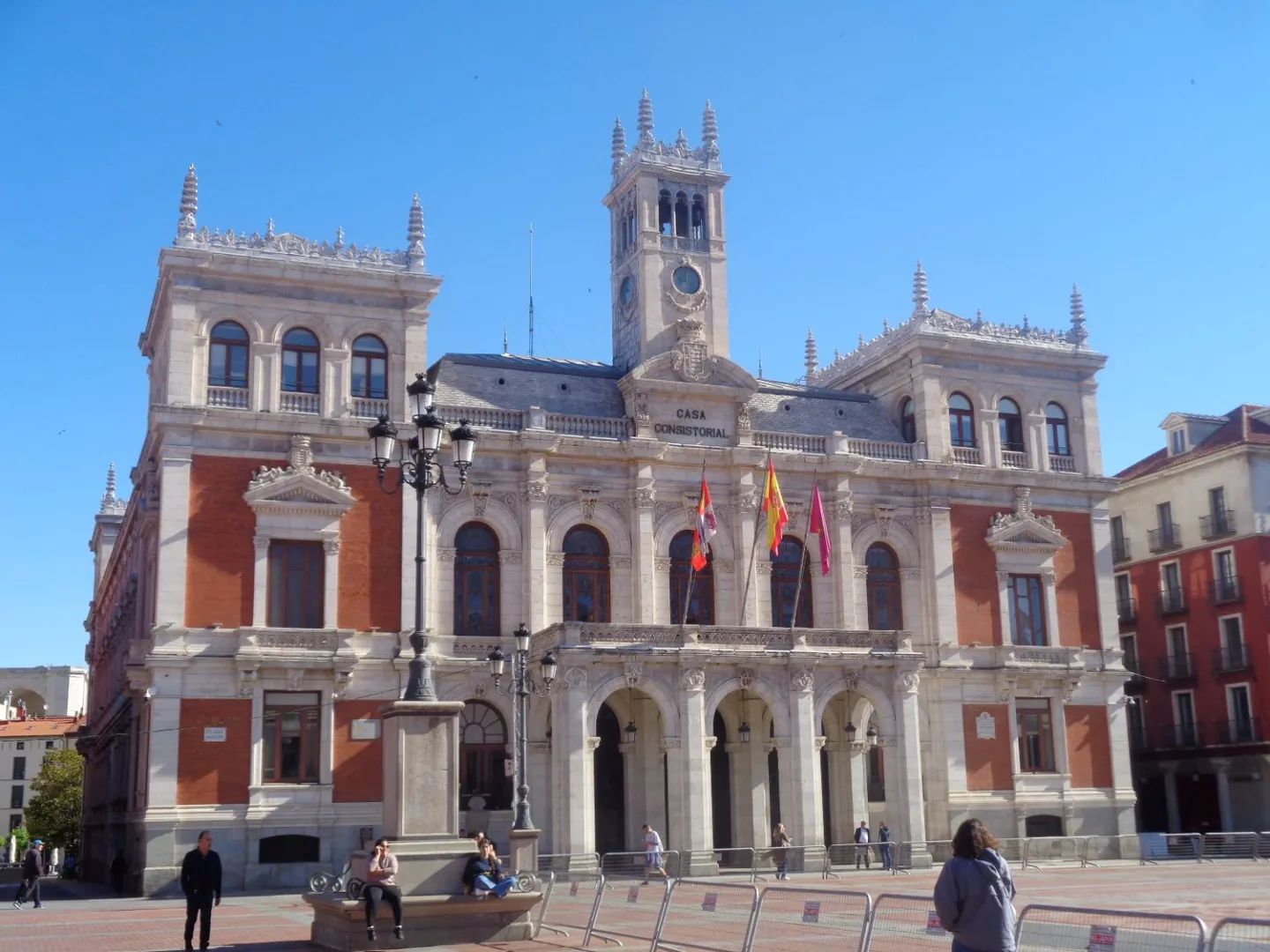
The Casa Consistorial or City hall is located in the plaza Mayor.(see post), It will take 15 years to finish it, between 1562 and 1577. Threatening ruin in the 19C, the building was destroyed in 1879 to give way to that which we can admire today, in the same location. The current, eclectic style building will not be inaugurated until 1908. It is a large, rectangular building, measuring 2,598 square meters. It has four stories, a basement, and three upper floors, preceded by a balcony on its main façade, with rectangular towers and an interior courtyard. In the central section stands a tower, more slender than the corner towers, which houses the clock,and the coat of arms of Valladolid. The new building was inaugurated with an official ceremony and a Mass from the main balcony on August 19, 1908. The interior was designed with historicist aspirations, decorated with paintings of the same genre, original works by the Cuban artist Gabriel Osmundo Gómez. On the main floor are two tapestries depicting scenes from the lives of the Catholic Monarchs linked to the city, and beneath them are the old municipal coffers, where the City Council’s documents and funds were kept for many years. Doors located on either side of these elements lead to the reception hall, a rectangular room that opens onto the balcony overlooking the Plaza Mayor. The vault houses frescoes by Gabriel Osmundo Gómez depicting allegorical scenes from the founding of the town. A tapestry with the coat of arms of Valladolid and a full-length portrait of Pedro Ansúrez, the town’s first lord, complete the room’s decoration. The reception hall is used for formal meetings, institutional events, and other formal occasions. Adjacent to the reception hall are the councilors’ room, currently used for press conferences and meetings of municipal committees, and the mayor’s office.
This office is where the Local Governing Board meets and where councilors meet with the delegation. In the anteroom to the office are the mayor’s secretary, the visitors’ room, and the office of the Chief of Staff for Government Relations. At the rear of the building, facing the Plaza de la Rinconada, is the Council Chamber or Plenary Hall. Of rectangular floor plan, it is decorated in the historicist style of the rest of the town hall. The offices and reception rooms house a remarkable collection of paintings, some on loan from the Prado Museum; among them are a Vase of Flowers by Benito Espinós and The Pilgrimage of Saint Ignatius by Inocencio Medina Vera. The municipal collection includes a 17C Saint John the Baptist by Jusepe de Ribera and paintings by Valladolid artists such as Castro Cires and Aurelio García Lesmes, among others. The main hall, or reception room, faces the square, while the council chamber is located at the rear.
A bit of history I like tell us that originally, before the arrival of Count Ansúrez in 1095, the open council of the residents met in the atrium of the now-demolished church of San Miguel. From the 13C onwards, Valladolid already had its City Council established as a closed political body composed of nobles who met in a house purchased from the friars of the now-demolished convent of San Francisco. From 1338, the meetings were held in the cloister of the Collegiate Church, the year in which their own buildings were constructed in the old Plaza de Santa María ,today Plaza de la Universidad. Following the fire of 1561 and the total destruction of the surrounding area, the City Council decided to relocate the City/town hall to its current site, overlooking the renovated Plaza Mayor.(see post), The building was designed in 1561 and followed the austere style imposed by the House of Austria. Its silhouette was distinguished by two towers at the ends and a bell tower with a clock in the center, which was added in the mid-19C using materials from the demolition of the convent of San Francisco. Construction began in 1562 and was completed in 1577. The side towers were built in the 17C, and the clock tower was erected in 1833.
The old town hall consisted of two sections; the lower section had three balconies on each side and a central doorway, while the upper section featured a series of 17 successive arches. By the 19C, the building was in a deplorable state of disrepair. Demolition of the old town hall began on August 28, 1879. The City/Town Hall was then located in the Ortiz Vega Palace on calle Duque de la Victoria, and later in the Conciliar Seminary, adjacent to the now-demolished Teacher Training College on Calle López Gómez. On July 18, 1936, when the army rose up against the Second Spanish Republic (1931-1936), the municipal building was attacked by soldiers and Falangist militia from the Plaza Mayor. The facade of the City/town hall retains some 53 traces of bullet impacts from that day, concentrated in the window of the office of the then mayor of the city
The City of Valladolid on cityhall information : https://www.valladolid.es/es/ayuntamiento/atencion-ciudadana/atencion-presencial/oficina-informacion-casa-consistorial
The Valladolid tourist office on the city/town hall: https://info.valladolid.es/en/enjoy/heritage/monuments/town-hall
The Castilla y Léon region tourist office on the city hall of Valladolid: https://www.turismocastillayleon.com/en/heritage-culture/town-city-halls/town-hall
There you go folks , another wonderful nostalgic, sentimental trip to my dear Spain, Valladolid is nice, awesome will say back after so many years it seems all for the first time, and love it ! We will be back, eventually, Very convenient on off the A62 A6 highways connecting to all of Castilla y Léon and Comunidad de Madrid regions, Again, hope you enjoy this post on the Casa Consistorial or City Hall of Valladolid !!! as I
And remember, happy travels, good health, and many cheers to all !!!


Lovely town
LikeLiked by 1 person
I agree of course, thanks for stopping by Cheers
LikeLiked by 1 person