
Let me tell you on a beautiful region of my belle France, which I have been lucky to criss cross all over it for several years. The area is well known to me for family and historical reasons I like,therefore, I am talking about the old quant town of Saint Affrique. I found me a couple pictures in my cd rom vault that should be in my blog for you and met, Therefore, here is my take on this is Saint Affrique !!! Hope you enjoy it as I.
The town of Saint-Affrique is located in the Aveyron department, no 12 in the Occitanie region of my belle France. The town is crossed by the Sorgues river, which, with its tributaries, has carved out seven mountains and peaks: the Anglais, the Quille, the Fous, the Serre (ridge), the Cazes, the Nougayrolle, and the Rocher de Caylus. Five bridges allow traffic, in order of age: the Pont Vieux, the Pont Neuf, the Centenaire (or des Frères), the Ferroviaire (Railway), and the Résistance . It is 105 km from Gaillac, 75 km from Rodez, 92 km from Castres, 157 km from Toulouse, and 665 km from Versailles, We came on our road warrior trails from Gaillac trying to get to Albi but we continue as we heard this interesting name town, We took the D87 road dir Montans which we know well as family is from all over this area, before reaching Montans we bore left onto the D13 road and quickly right onto the D968 to get on exit/sortie 9 of the A68 autoroute or Avenue du Pastel past Albi it becomes the N88 road continue and bear right dir Millau on the D999 road or Route de Millau continue dir Millau passing Villefranche d’Albigeois continue same road on curvy turns passing by Saint-Sernin-sur-Rance coming into Saint Affrique on Bd de Verdun bearing right at roundabout into Bd Aristide Briand or D225 road change name to Bd Carnot same road cross La Sorgue river on the pont de Centenaire and bear left onto Rue du Quai du Pont Vieux to Place de l’église and the church,
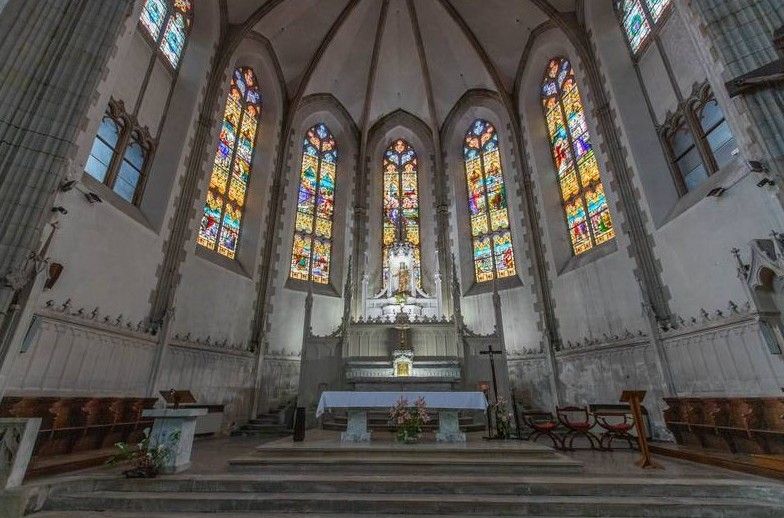
The Church Notre Dame de la Miséricorde or of Our Lady of Mercy, dating from the 19C, built from 1894 to 1905; in Gothic style, inside there is a 15C gilded wooden Notre Dame de la Miséricorde. Impressive elevation of the neo-Gothic spire rich in lace sculptures, which culminates at 71 meters (other sources put it at 81 meters…) The choir’s stained-glass windows depicting the legend of Africanus, a 16C altar, the carved oak pulpit, and the statue of Saint Affricanus. The church is a spiritual and artistic center of rare beauty.
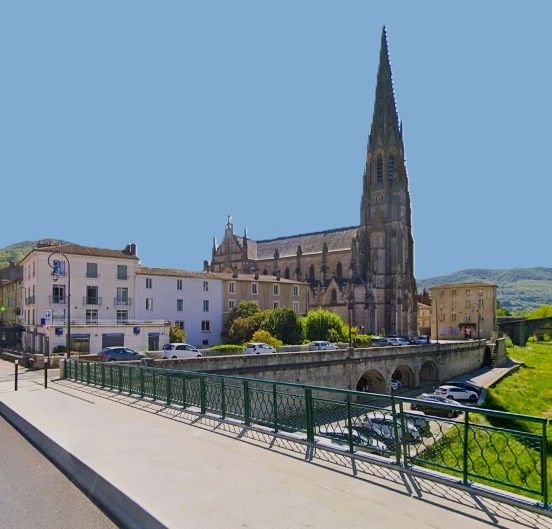
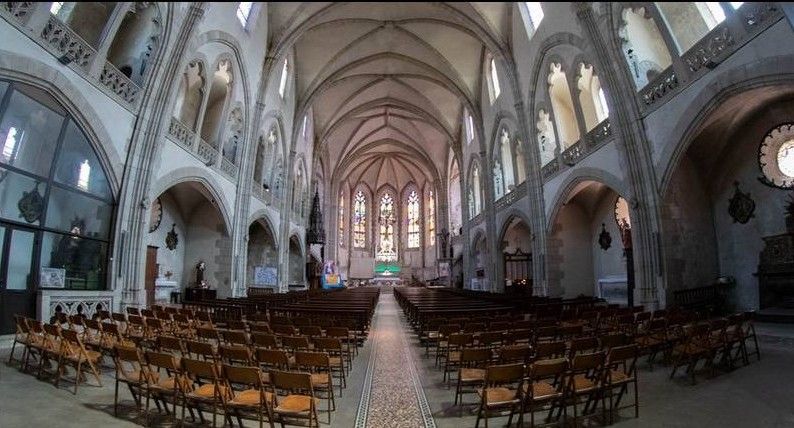
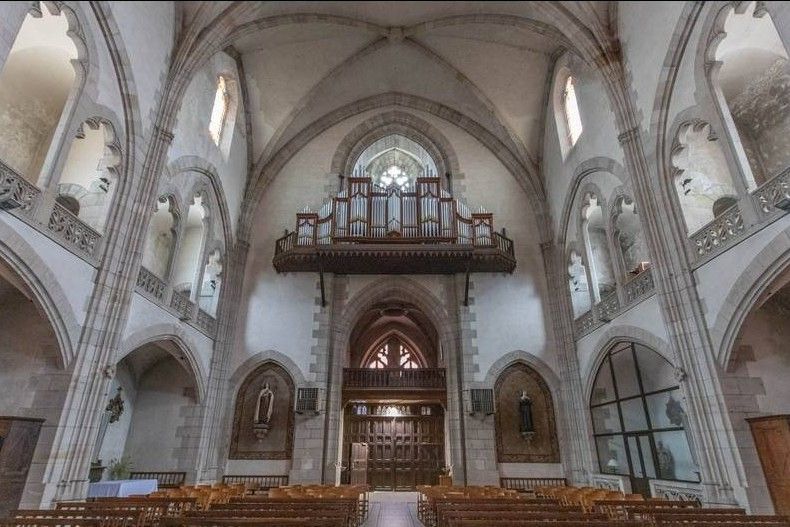
Five churches were built on the same site: the first, likely built by Affricanus, was erected in the 5C. The second was built in 1214. The third in 1396. The fourth in 1620, and finally the fifth from 1894 to 1905. A titanic project for the latter, it required the demolition of riverside houses and the construction of a quayside to accommodate the imposing bell tower. The rear of the church is almost flush with the neighboring houses; a narrow alley runs around it. The bell tower and nave were built first, followed by the choir and sacristy. An imposing organ located on the balcony above the main entrance, and another smaller one to the right of the choir. Its stained-glass windows recount the miracles of Affricanus, the Bishop of Commingues, who was persecuted by the Visigoths and settled in Saint-Affrique, performing miracles there. In this neo-Gothic church, the only visible Romanesque vestige is the altar from the old church, located in one of the chapels. The alleys surrounding it are among the oldest in the city.
Other things to see here are the Church of Saint-Julitte-et-Saint-Cyr in Vendeloves. 19C. Church of Saint-Germain in Bournac. 12C and 19C. Church of Notre-Dame in Tiergues. 19C. Church of Bedos. 16C, with Romanesque remains. Church of Saint-Martin du Cambon. 19C. Church of Saint-Étienne-de-Naucoules ; the church existed in 1678, The dolmen of Tièrgues, Remains of the old fortifications: enclosure tower, traces of the ramparts (today Boulevard Victor-Hugo, Boulevard de la République, Place de la Liberté and Boulevard Charles-de-Gaulle. Ruins of the castle of Caylus on the rock of Caylus which dominates the city. The Pont Vieux or Old Bridge, was built around 1270. The Pont Neuf or New Bridge, late 17C. The House of Memory of the Pays Saint-Affricain installed in the premises of the former sub-prefecture and birthplace of Émile Borel, a French mathematician, professor at the Faculty of Sciences of Paris. As a mathematician, he is known for his fundamental work in the fields of the theory of measurement and probability. Member of the Academy of Sciences, French politician, deputy and minister, his actions for the League of Nations and within its Federal Committee for European Cooperation make him one of the precursors of the European idea. The museum and library where the documentary collection of Pierre and Marie-Louise Cabanes, tireless discoverers of the heritage of South Aveyron, is deposited.
A bit of history tell us that local tradition has it that around 470, Affricanus, bishop of Comminges persecuted by the Arian Visigoths, took refuge in the Vicaria Curiensis which then took the name of Saint-Affrique. In fact, if several charters of the cartulary of the abbey of Vabres mention the Vicaria Curiensis from 868, the exact location of this viguerie is still debated among historians, In 942, the name of Saint-Affrique is attested for the first time in the cartulary of the abbey of Vabres , Until the middle of the Middle Ages, the territory and its town were under the domination of the Caylus family. The first mention of a lord of Caylus and his castle dates back to a charter dated 1102 in which a certain Seguin de Caylus appears. In the 14C, thanks to its ramparts, the city resisted the attack of the English. On September 14, 1572, the day after Saint-Barthélemy’s Day, the inhabitants of Saint-Affrique, informed of the massacres in Paris, refused violence, and sealed an urban pact of tolerance between themselves. In 1628, against the policy of Richelieu, the predominantly Protestant population used the ramparts to resist the royal troops of the Prince of Condé and the Duke of Epernon. Women and girls of the city distinguished themselves in the battle and the attackers were forced to lift the siege. After the surrender of La Rochelle and the Peace of Alès in 1629, all places of safety had to be removed. The city walls were destroyed on the orders of Richelieu between 1632 and 1655. During the French revolution, the city took the name of Montagne-sur-Sorgue. The decree of December 22, 1795 abolished this name and gave the city back the name Saint-Affrique.
The town of Saint Affrique on its heritage : https://ville-saintaffrique.fr/la-ville/monuments/
The local Roquefort tourist office on Saint Affrique :https://www.roquefort-tourisme.fr/en/your-stay/discover/localite_1/page_1
The Aveyron dept 12 tourist office on Saint Affrique : https://www.tourisme-aveyron.com/fr/decouvrir/villes-et-villages/saint-affrique
There you go folks, another dandy in my road warrior trails and my travels of our world, This is beautiful countryside and worth the detour, me think. Again,hope you enjoy the post on this is Saint Affrique as I.
And remember, happy travels, good health, and many cheers to all !!!


