
Why not head for a park in Paris, and even better with a rosary. The beautiful city has plenty of parks and places of wonders , and I like to tell you about a favorite of my family. I walked and drove all over this woods on many occassions just across the Seine river. I found me a couple pics in my cd rom vault that made me do this post for you and me. Therefore, let me tell you a bit on the Parc de Bagatelle of Paris !!! Hope you enjoy it as I,
The Parc de Bagatelle is located in the 16éme arrondissement of Paris , in the Bois de Boulogne. It is near the southern edge of the city of Neuilly-sur-Seine. You can access by the Grille d’Honneur, east side, via Allée de Longchamp or Grille de Sèvres, east side, via Route de Sèvres-à-Neuilly, There are bus line 43 arrêt/stop: Parc de Bagatelle – Operates on public holidays and weekends, and bus line 244 arrêt/stop: Bagatelle-Pré Catelan. The train line from Paris-Saint-Lazare to Versailles-Rive-Droite with arrêt/stop Longchamp – Goodplanet ,this in the City of Suresnes.(see posts)
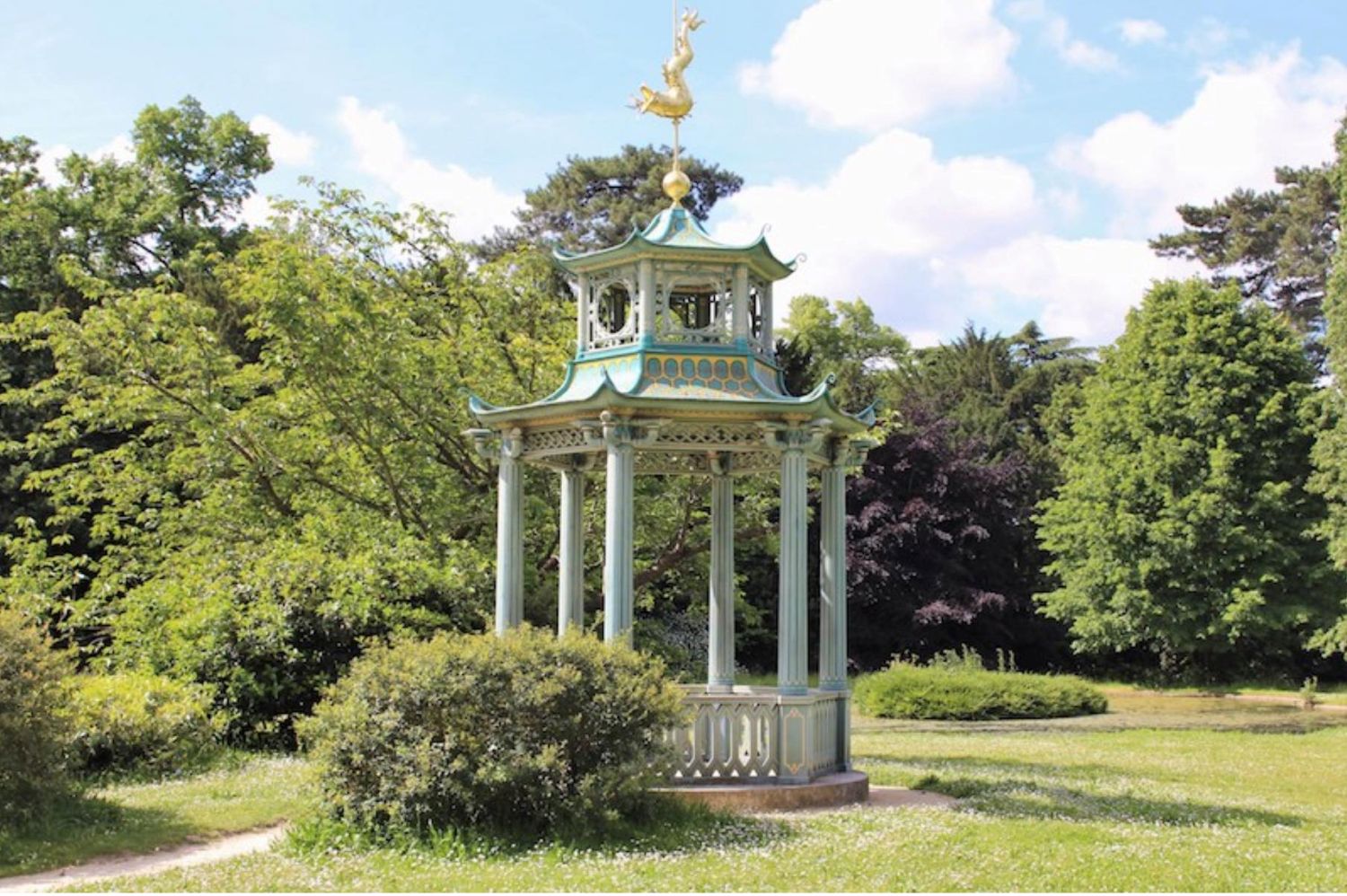
The Parc de Bagatelle has one of the largest and oldest rose gardens in France. It was inaugurated in 1907, with more than 1,500 species and varieties offered by Jules Gravereaux, collector and creator. At the initiative of the curator of parks and gardens of the City of Paris, Jean-Claude-Nicolas Forestier, the first international competition for new roses was born in 1907 in Bagatelle. Open to the public, the competition awards three new roses each year for their beauty and one for its fragrance. See the magnificent Chinese pagoda dating from the 19C The Chinese Kiosk, also called the pagodon or the pagoda, is a factory in the garden. It was installed in 1996 and is a replica of a pagoda purchased in the 19C during a universal exhibition by Lord Hertford. The original kiosk was purchased by Lord Astor to be installed on his property in Cliveden, England.
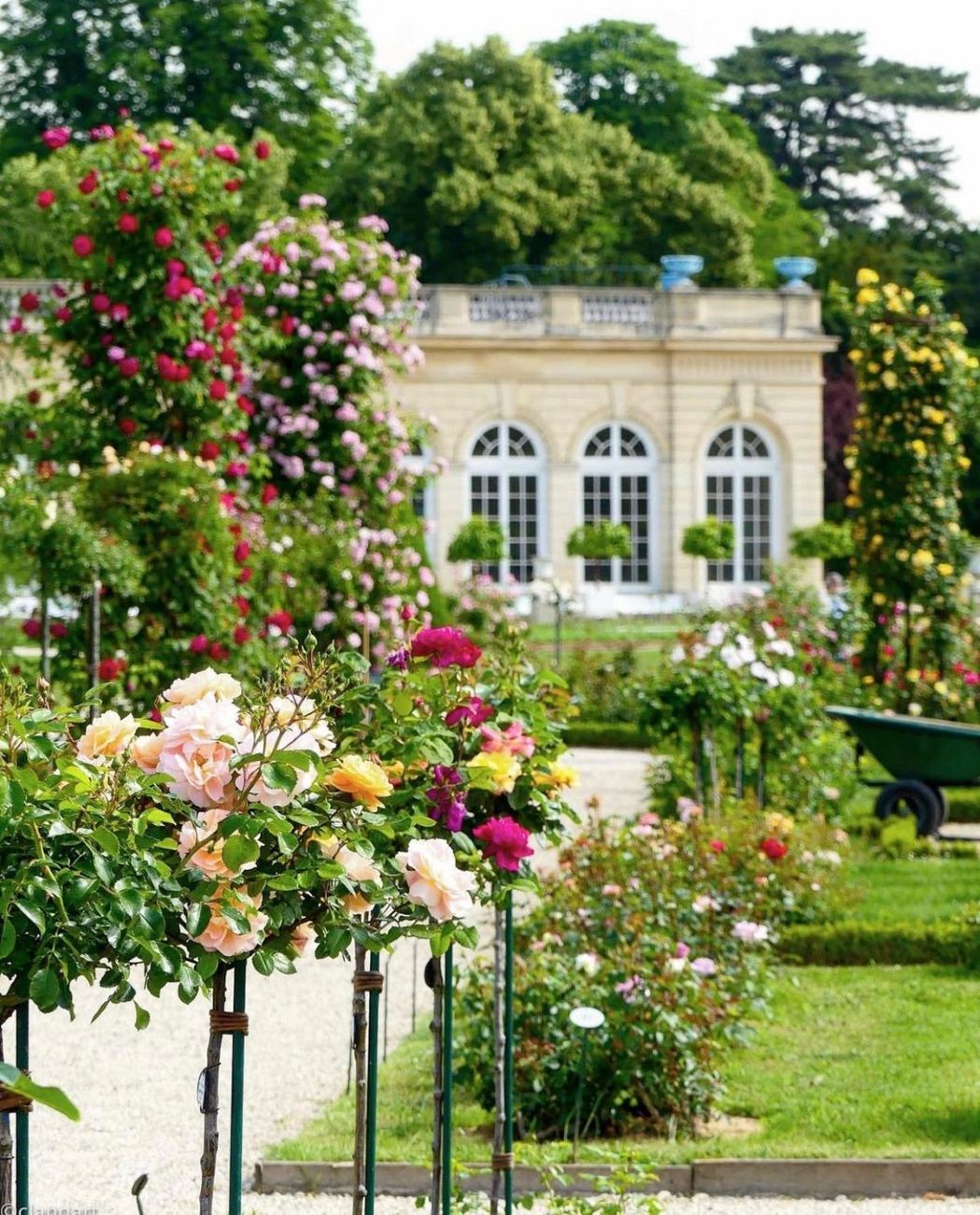
The park and the Château de Bagatelle, also known as the “Folie d’Artois,” were built in just sixty-four days, The long history tell us that around 1716, a small estate consisting of two pavilions was granted to a certain Louis-Paul Bellanger by the king. He gave it in 1720 to the Duke of Estrées, Marshal of France, who offered it to his wife after having it transformed and improved the original building. This work cost him a tidy sum and the estate was called “Bagatelle”. Upon his death, Bagatelle passed through several hands: a lawyer then a marquise, two gentlemen and then to a prince of the court of the Count of Artois; the latter was a frivolous man rather given to… trifles. He fell in love with the estate and bought it from her in 1775, in order to have a quiet retreat to receive his conquests. The Count of Artois, brother of Louis XVI, was the future King Charles X. The anecdote about the construction of the Folly (castle) is very famous: the estate was very dilapidated, which greatly amused Marie-Antoinette, who declared to her brother-in-law that she hoped to be received there two months later, upon her return from her trip. The Count of Artois took up the challenge and even bet her a sum that he would indeed be able to build a castle in such a short time , a bagatelle or trifle! He spent lavishly on this crazy undertaking: the project was entrusted to the architect François-Alexandre Bélanger (not to be confused with the first owner of the estate mentioned above, Louis-Paul Bellanger!), who drew up the plans in record time . He drew up plans for an Anglo-Chinese garden for the estate, which was very fashionable at the time. The garden’s creation was entrusted to Thomas Blaikie, a renowned landscape designer, who made minor changes to the latter’s plans . The garden was adorned with fabriques ; many of which have now disappeared. The result, a skillful blend of two very different conceptions of garden art, is a pure marvel. However, the landscape you can admire today is not quite the one Marie-Antoinette raved about…
The Count of Artois was driven from his home by the French revolution. Bagatelle was left almost abandoned for a time. The State recovered it and then sold it under the Directory, where, true to its reputation as a place of amusement, it was used as a place for strolling and popular festivals. It was very popular with the Merveilleuses and the Incroyables. A restaurant was established there. In 1806, Napoleon requisitioned the estate to turn it into a hunting lodge. During the Restoration, the Count of Artois, who had become King Charles X, reclaimed his property and gave it to his son. François-Joseph Bélanger designed the park, and Thomas Blaikie oversaw its construction in the Anglo-Chinese style, which was very fashionable at the time. This trend was linked to the arrival in Europe of images of pagodas from China, but also reflected a reaction to the rigor of French gardens.
After nearly disappearing during the French revolution, In 1835, Bagatelle’s English period began, transforming this frivolous and superficial place into a romantic haven. The park was given the orangery, the main gate, and the stables, then the guards’ pavilions, the Trianon, and the two terraces, It was that year that Bagatelle was sold to Lord Richard Seymour-Conway, Marquess of Hertford, an Englishman, who restored the château and expanded the estate. He had built, among what is still visible today, the Orangery, the entrance from the Bois de Boulogne, the gatehouse, the head gardener’s house, and more. He died in 1870, the year of the Siege of Paris, and it was his son, Sir Richard Wallace, who inherited it, along with a rather colossal fortune. Sir Richard Wallace provided extended by 10 hectares them with material support during the siege. At Bagatelle, he had old buildings razed and the Trianon built near the folly. Sir Richard Wallace died in 1890. His wife bequeathed Bagatelle to their secretary, Sir John Murray, who lacked the means to maintain the estate. He considered selling it in lots. The City of Paris stepped in and purchased it from him in 1905. The park provides a remarkable cross-section of garden design spanning three centuries, The English garden with its undergrowth, ponds and shady areas, a French style garden with parterre and an extraordinary rose garden built in 1904 by JCN Forestier the warden of parks and gardens and a friend of Monet. The park was restored by the curator of the Bois de Boulogne, Jean Claude Nicolas Forestier, In 1907, the International Competition for New Roses was created. The park’s rose garden, which contains some ten thousand rose bushes representing one thousand two hundred different cultivars, has hosted an international competition. Exhibitions are regularly held in the Parc de Bagatelle. It took place in the Rose Garden and did much to enhance its reputation. Today, the park covers 25 hectares ,and is run by the Department of Parks and Gardens of the Paris City Hall ,responsible for Bagatelle’s preservation.
The City of Paris on the parc Bagatelle : https://www.paris.fr/lieux/parc-de-bagatelle-1808
The Paris tourist office on the parc Bagatelle : https://parisjetaime.com/eng/culture/parc-de-bagatelle-jardin-botanique-de-paris-p1162
There you go folks, a dandy in beautiful Paris, a huge park of many parts to be enjoy fully, all of it, this is the whole of the Bois de Boulogne, and within it the beautiful parc de Bagatelle,you will have a good time here for sure. Again, hope you enjoy this post on the Parc de Bagatelle of Paris !!! as I.
And remember, happy travels, good health, and many cheers to all !!!

 Paris1972-Versailles2003
Pero que maravilla! Hermosas fotos, las flores, los colores. Espero algun dia visitarlo, y tu argentina! Un abrazo bien grande
LikeLiked by 1 person
Gracias por su comentario. En mi otra edad en las Americas visite Argentina Puerto Madero , Mendoza sobre todo. En esos tiempos no estaba para fotos solo postales! Saludos
LikeLiked by 1 person