
I told you how much I have walked all over Paris and that I worked in it for almost 10 years while living just next door in Versailles! Well, I have, also told you that there is so many things to see here that you will need a lifetime. This is another wonderful monument on the off the beaten path and glad to have it in my blog for you and me ; after finding me this picture in my cd rom vault, There is always time to indulge in Paris. Therefore, let me tell you about the former Abbey of Port-Royal of Paris !!! Hope you enjoy the post as I.
The former Abbey of Port-Royal was founded in the 17C to relieve congestion at the mother house located at the Abbey of Port-Royal des Champs. It was closed in 1790 during the French revolution, following the expulsion of the nuns, who were later replaced by the Visitandine sisters. The abbey, now located within the grounds of the Cochin Hospital, is bordered by the Boulevard de Port-Royal. The former abbey of Port Royal was the center of Cistercian life in the first half of the 17C and the focus of French Jansenism. Indeed, at the beginning of the 17C, there were two abbeys of the Cistercian order, founded in the 12C by the Cistercian reform with Saint Bernard, father abbot of Claiveaux: the abbey of Port Royal des Champs, in Magny-les-Hameaux, Chevreuse valley, (Yvelines 78), and that of Port Royal, in Paris.
The Abbey Notre-Dame des Champs was founded in 1204, on the advice of the Bishop of Paris, Eudes de Sully, at the request of Philippe Auguste. The latter had gotten lost in the marshes of the Chevreuse Valley during a hunting trip, and owed his salvation only to the sight of a small chapel dedicated to Saint Lawrence. To thank providence, he decided to build a monastery around this chapel. The place was called “the king’s port” or Port Royal. The first nuns who settled there were part of the Citeaux order, an order with strict rules. But the game-rich surroundings and the frequent comings and goings of young horsemen transformed the monastery into a place more conducive to the rest of the warrior than to the salvation of souls! The abbey’s abbess, Angélique d’Estrées, was none other than the sister of the royal favorite, Gabrielle d’Estrées. She took the name Mother Angélique, and was enthroned abbess by the abbot of Citeaux. In 1609, she decided to reestablish the strict rule of Citeaux and the enclosure. In 1619, Madame Arnaud, widow of Antoine Arnaud, decided to enter religion and acquired on rue de la Bourbe, on the current site of boulevard de Port Royal, the small hotel of Chagny, surrounded by gardens, belonging to Pierre Lescot, architect of the west facade of the Louvre and the fountain of the Innocents, chaplain to the king and lord of Chagny. She donated it to the abbey and the community of the sisters of Notre Dame des Champs came to settle there. In 1625, Louis XIII, at the request of the queen mother Marie de Médicis, accepted the installation of the nuns in Paris, sensitive to the Cistercian precepts of Saint Bernard.
Madame Arnaud was a nun there with her six daughters and six nieces, while two of her sons, Robert Arnaud d’Andilly, the 20th child, and Antoine Arnaud, the famous theologian, philosopher, and staunch Jansenist, occupied the Port Royal des Champs with other famous figures known as “the Gentlemen of Port Royal” or “the solitaries of Port Royal.” Among them was Pascal, who wrote “The Provincials” there. The two brothers lived there from 1637 to 1660. Mother Angélique had also obtained permission from the Archbishop of Paris, Jean François de Gondi, to settle in Paris and take the abbey under her own jurisdiction, freeing the nuns from their dependence on the monks of Citeaux. The abbey required significant expansion work. A gallery and the attics were converted into cells, and a makeshift chapel was installed in a room. Construction of the monastery began in 1645. The first stone of the church was laid in 1646 and the Archbishop of Paris blessed it in June 1648. The cloister and the rest of the buildings were not completed until twenty years later.
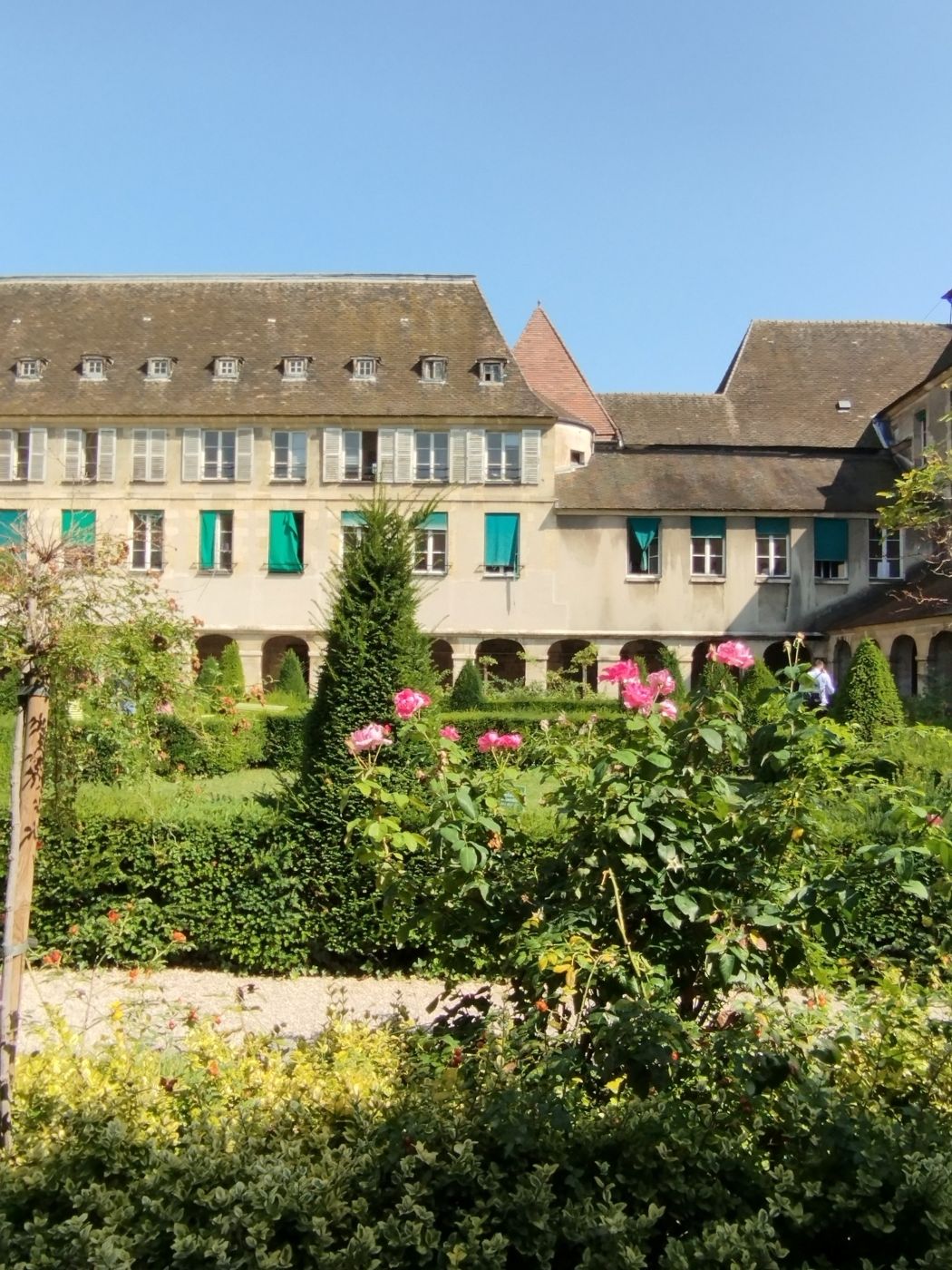
From 1668, the Parisian monastery was entrusted to the Ladies of the Visitation. Their mission was the education of girls from good families. In 1795, the Convention founded the Maternity Hospice: childbirth took place in the former novitiate of the Oratory and breastfeeding was organized in the Port-Royal Abbey. From 1814, the Maternity Hospice took the name of Port-Royal Maternity. In 1890, the Baudelocque Clinic was created on land adjacent to the abbey. In 1966, the Port-Royal Maternity moved to new premises. The cloister, chapel, and chapter house were integrated into the Cochin Hospital located next door. Invisible from the Boulevard de Port-Royal, the cloister, (see pics) built between 1652 and 1655, retains its gallery on three sides, resting on rather austere arches, in the image of Jansenism. On the north side, it backs onto the chapel. The old cloister with its planted garden is today a peaceful place freely accessible to the public. The abbey chapel at 123 Boulevard de Port-Royal was built between 1646 and 1647. Comprising a single nave, it is covered with a barrel vault. The entrance was through the left arm of the transept and not through the main façade. This entrance has now lost this function due to the removal of the steps. Mother Angélique Arnauld rests under the choir of the chapel. The nuns’ chapter house (not accessible) also remains next to the chapel. A portrait of Mother Angélique still hangs there. It is open to the public on Monday-Friday from 14h30 to 18h, and Sunday from 10h to 12h, The above text credit the Association Paris Historique official webpage : https://www.paris-historique.org/association-paris-historique/
This is a wonderful area of my eternal Paris, with the Port-Royal RER B station located in the 5éme arrondissement of Paris, on the border of the 6éme and 14éme arrondissements near the former Port-Royal Abbey . The exit is on Boulevard de Port-Royal. They have near bus lines 38, 83, and 91 with the Port-Royal – Saint-Jacques stop, Also, nearby is the quant Port-Royal Market on Boulevard de Port-Royal, open Tuesday-Thursday from 7h to 13h30,and Saturday from 7h to 14h30, The Port Royal kiosk at 86 Boulevard de Port-Royal is part of the network of tourist information points with specific signage. They become ambassadors for the destination and relay local tourist information. Opening hours are 7h to 19h30, every day.
A bit of history I like tell us that the Hôtel de Clagny was built by Pierre Lescot between 1566 and 1569 in the Faubourg Saint-Jacques in Paris. The Hôtel de Clagny was remodeled around 1626 to accommodate the Cistercian convent of Port-Royal and thus relieve congestion at the mother house of Port-Royal des Champs in Magny-les-Hameaux in the Chevreuse Valley. The Chapel of the Blessed Sacrament was built between 1646 and 1648. The cloister was erected between 1652 and 1655. The institution was a center of Jansenism. The sisters who refused to retract in August 1664 were expelled and replaced by the Visitandines until the French revolution. The convent of Port-Royal was closed in 1790; It served as a prison from 1790 to 1795 under the name of Port-libre or La Bourbe prison. Chrétien Guillaume de Lamoignon de Malesherbes (Louis XVI’s lawyer at his trial) and Madame de Tourzel, former governess to Louis XVI’s children, were detained there. The Maternity Hospice, a public hospital, combined two services previously located at the Hôtel-Dieu in Paris: the service for helping women in childbirth (delivery service) and the service for combating the abandonment of newborns. Deliveries were shared between Port-Royal and the Hôtel-Dieu until December 9, 1797; from that date, deliveries took place at the Oratory, and Port-Royal housed the breastfeeding section. In 1814, the maternity services were transferred to Port-Royal, which was officially named Maternité de Port-Royal. In 1890, the Baudelocque clinic was created by the Faculty of Medicine and built in the gardens of the Maternité, to the west of the cloister. On May 14, 1897, one of the very first radiography laboratories in France was inaugurated there. In addition to being a department dedicated to childbirth, enhanced by a consultation service, the Faculty’s obstetric clinic became a teaching center for medical students and a research center. New buildings were constructed from 1922 to 1929. In the early 1950s, pediatrician neonatologist Alexandre Minkowski created the first care center for premature babies at the Baudelocque maternity hospital. Alongside this clinical service, the “Biology of fetal and neonatal development” research laboratory of the INH/Claude-Bernard association was created in 1955, which in 1964 became Inserm Research Unit 29 (National Institute of Health and Medical Research). From 1960, the two maternity hospitals Baudelocque and Port-Royal held joint admission registers and were gradually attached to the Cochin hospital, forming part of the same hospital group. In 1966, the Port-Royal Maternity Hospital was moved into new buildings. The cloister, chapel and chapter house of the former abbey were preserved and integrated into the Cochin hospital. The cloister currently houses the management of the establishment. In 1966, Alexandre Minkowski created the first intensive care and neonatology department in the Port-Royal building, a department that today bears his name. He directed it until 1986. The Baudelocque clinic buildings were demolished in 2007. Above text credit wikipedia.
The Catholic Diocese of Paris on the aumonie Cochin-Port Royal: https://dioceseparis.fr/-cochin-port-royal-.html
The official private societé des amis de Port Royal : https://www.amisdeportroyal.org/societe/
The official hôpital Cochin-Port Royal : https://hopital-cochin-port-royal.aphp.fr/decouvrir-cochin/
The Paris tourist office on main hôpital Cochin : https://parisjetaime.com/eng/pro/hopital-cochin-p2693
There you go folks, another nice find in my eternal Paris, often overlook and totally bypassed by visitors is always amazing to find these gems. Glad to have it in my blog for you and me, Again, hope you enjoy this post on the former Abbey of Port-Royal of Paris !!! as I.
And remember, happy travels, good health, and many cheers to all !!!

 Paris1972-Versailles2003