
We have driven and walked in my eternal Paris, and would like to have an imprint in my blog on the wonderful family times we had there, There is so much to see , doing my best, and glad found me these pictures in my cd rom vault ,which now transposing in my blog for you and me, This was my former worked city, so glad to post more memorable spots on it, I thank you for your readership over the years and to bear with my rants! After all Paris is to rant, shout and yelled about, me think. Therefore, here is my take on curiosities of Paris, part LXV !!! Hope you enjoy the post as I.
The Rue des Archives is located on the border of the 3rd and 4th arrondissements of Paris. 900 meters long, from the Rue de la Verrerie to the Rue de Bretagne. It is served by the Hôtel de Ville metro station on lines 1 and 11, and the Rambuteau metro station on line 11. The street owes its name to the fact that it runs alongside the National Archives.(see post), The Philippe Auguste city wall originally intersected the street at No 54 before a gate, the Porte du Chaume , was opened at the end of the 13C. In 1874, the Rue des Archives was created by merging: the section of the Rue du Chaume between the Rue Rambuteau and the Rue des Haudriettes; the Rue du Grand-Chantier, between the Rue des Haudriettes and the Rue Pastourelle; the Rue des Enfants-Rouges, between the Rue Pastourelle and the Rue Portefoin; and the Rue Molay, between the Rue Portefoin and the Rue Perrée. In 1890, the street was extended between the Rue Rambuteau and the Rue de Rivoli by incorporating: the Rue des Deux-Portes-Saint-Jean, between the Rue de Rivoli and the Rue de la Verrerie; the Rue des Billettes, between the Rue de la Verrerie and the Rue Sainte-Croix-de-la-Bretonnerie; and the Rue de l’Homme-Armé, between the Rue Sainte-Croix-de-la-Bretonnerie and the Rue des Blancs-Manteaux. The section of Rue du Chaume between Rue des Blancs-Manteaux and Rue Rambuteau. Before 1910, Rue des Archives ended at Rue Dupetit-Thouars. At that time, the section of Rue des Archives between Rue de Bretagne and Rue Dupetit-Thouars was renamed Rue Eugène-Spuller. In 2019, three sections of Rue des Archives were officially named: Place Patrice-Chéreau (3éme arrondissement): the square at the Fontaine des Haudriettes,on Rue des Haudriettes; Place Ovida-Delect (4éme arrondissement): the square at the intersection with Rue des Blancs-Manteaux; and Place Harvey-Milk (4éme arrondissement): the intersection of Rue des Archives and Rue de la Verrerie.
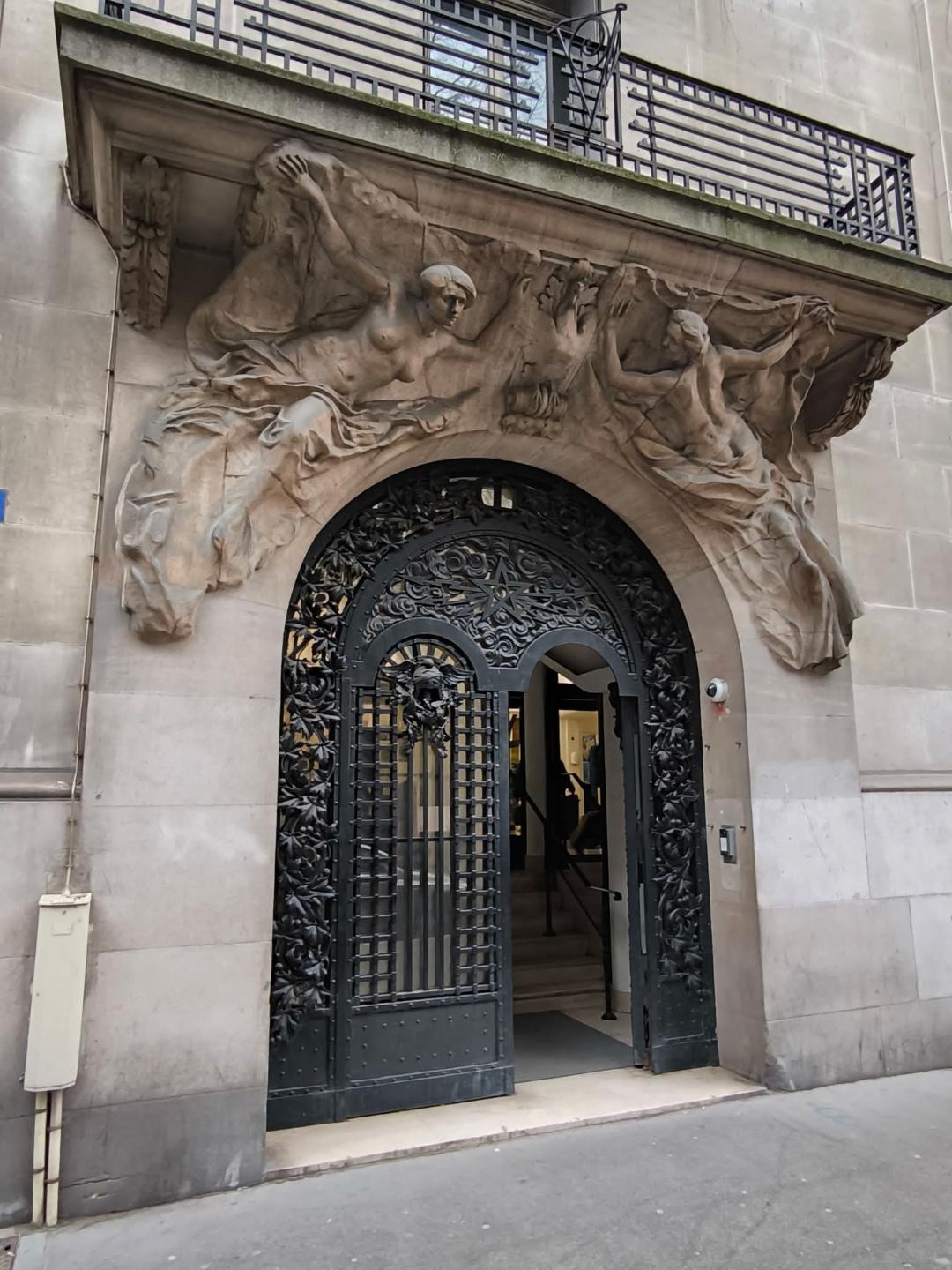
Notable buildings here are at Nos. 22 to 26: the part of Rue des Billettes, primarily including the cloister and the Church of Les Billettes,(see post), a Lutheran church since 1808 and a member of the United Protestant Church of France. The Carmelite convent of Les Billettes was built on the site of the house of Jonathan, a Jew who had been condemned to be burned alive following the Miracle of Les Billettes. No. 40: the house known as “Jacques Cœur’s House” because it was owned by one of his descendants (formerly Rue de l’Homme-Armé). It now houses a public nursery school. No. 45: the former convent of the Fathers of Mercy; two sundials are mounted on the walls inside the courtyard, only one of which is visible from the street. No. 54: site of the former gate, called the Chaume, opened in 1288 within the Philippe Auguste city walls at the request of the Knights Templar to facilitate access to the Temple’s “New Town.” This gate was destroyed around 1535 on the orders of Francis I. A building was constructed at No. 54 in 1777-1778 for Maurice Ducrest, head of the Count of Provence’s fruit shop. At the corner of the intersection of Rue des Archives and Rue des Francs-Bourgeois: remains of a fountain transformed into a manhole during the reconstruction of the Hôtel de Soubise, then remodeled in 1959 after a doorway was opened in this chamfered corner. A plaque indicates the sea level measured in the Marseille harbor basin, as well as its difference from the zero level of the Tournelle bridge. No. 58: Hôtel de Soubise (National Archives) and Haudriettes fountain, rue du Chaume. No. 60: Hôtel de Guénégaud, also known as the “Hôtel de l’Hermitage,” a private mansion built in 1652 and 1653 by François Mansart, the only one built by this famous architect to survive today in its entirety. No. 61: Caryatids in relief (see pic) The site of a former mansion belonged in 1632 to President François Lefèvre, who sold it in 1642 to Charles de Machault. It remained in this family until the French revolution. As such, it belonged to the Comptroller General and Keeper of the Seals, Jean Baptiste Machault d’Arnouville, who notably presided over the trial of the regicide Damiens, and to his son, Field Marshal Machault. The playwright Picard, who later became an academician and director of the Paris Opera, died there in 1828. A telephone exchange has stood on the site of this former mansion since 1934.Through the fluidity of its design and its flowing curves, this ensemble is linked to Art Nouveau It is in the 3éme arrondissement, No. 62: Hôtel de Mongelas, Museum of Hunting and Nature. (see post), No. 70: Hôtel Montescot (or Hôtel de Michel Simon). Lamennais, a French priest, theologian, writer, philosopher, and politician, died here in 1854. No. 76: Hôtel Le Pelletier de Souzy, rue du Grand-Chantier. No. 78: Hôtel de Tallard (or Amelot de Chaillou), rue des Enfants-Rouges, built in the 18C. No. 79: Henri Cartier-Bresson Foundation dedicated to the memory, preservation and promotion of this couple,
The Paris tourist office on Paris Centre (arrond 1-4) de Paris : https://parisjetaime.com/eng/article/explore-the-centre-of-paris-a846
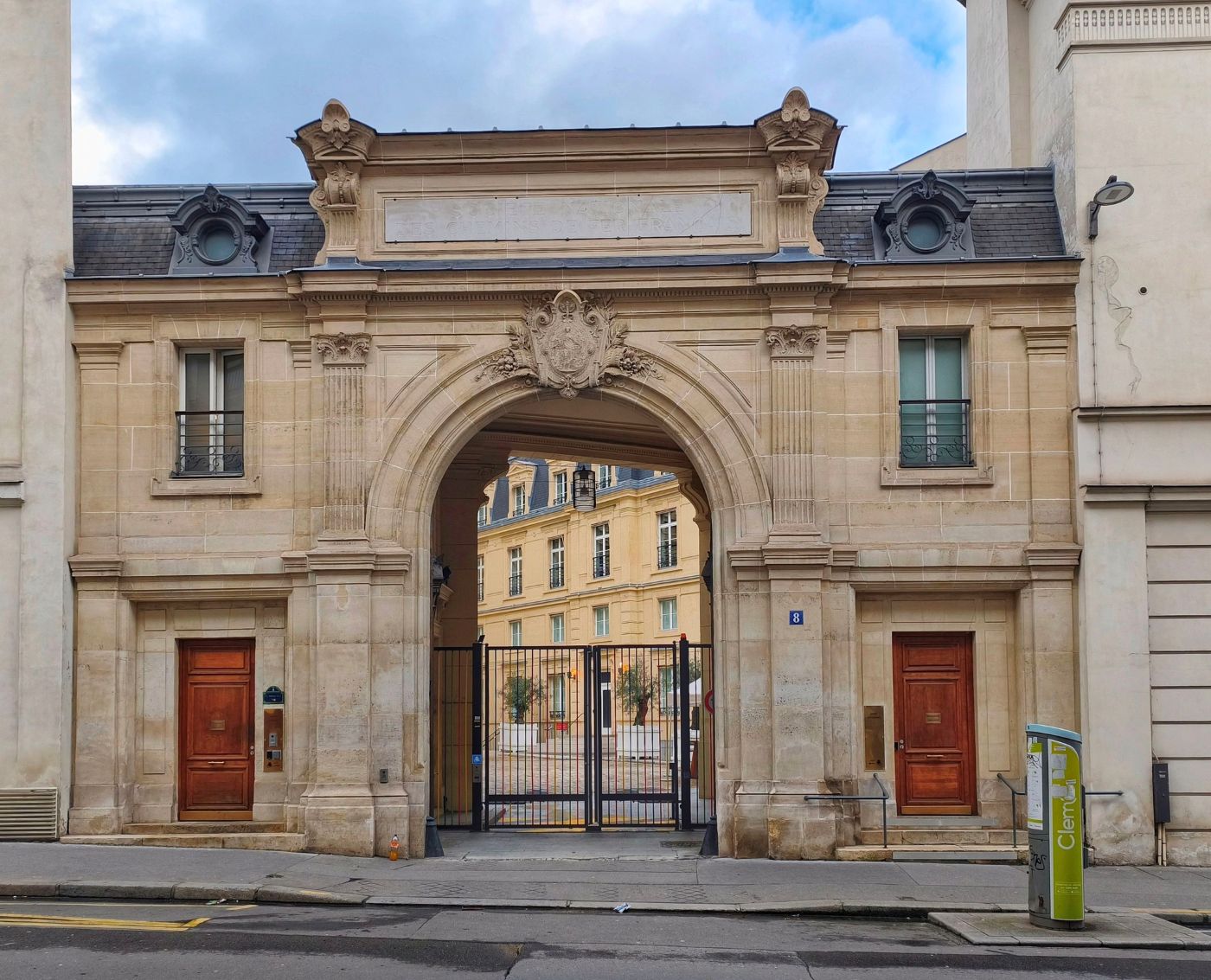
The Rue de Londres is located on the 8éme and 9éme arrondissements of Paris. It begins at 1 Rue de Clichy and ends at Place de l’Europe. The section between Rue d’Amsterdam and Place de l’Europe is in the 8éme arrondissement, while the section between Rue de Clichy and Rue d’Amsterdam is in the 9éme arrondissement. The street is named after London, the capital of the United Kingdom. Its name was given as part of the urban development project for the Quartier de l’Europe neighborhood. The area is served by metro lines 3 at Europe station, line 13 at Liège station, and line 12 at Trinité – d’Estienne d’Orves station. The Gare Saint-Lazare is also nearby, where I did my early walks in Paris and when by car parked at Parking Paris Saint-Lazare Station – EFFIA , 29 Rue de Londres, The construction of Rue de Londres was authorized by royal decree on February 2, 1826, and the new street was immediately opened on land belonging to Jonas-Philip Hagerman and Sylvain Mignon they have joined forces to create, on the site of Simon-Charles Boutin’s Tivoli, a new quartier, which they named Quartier de l’Europe , and whose streets would be named after European capitals. Notable buildings here are at No. 6: Alphonse Liébert, a French naval officer and photographer, had his studio here. No. 8: former Hôtel de Vatry, headquarters of the Compagnie du Chemin de fer de Paris à Orléans (Paris-Orléans Railway Company) from 1861 until 1938 when it was absorbed by the SNCF (French National Railway Company). Headquarters of Google France since 2011 (see pic). Earlier it was the residence of Mr. and Mrs. de Vatry. Alphée Bourdon de Vatry in 1821, he married Rose-Pamela Hainguerlot, daughter of one of the founders of the Ourcq Canal Company. In January 1861, the Vatrys sold their residence to the Paris-Orléans Railway Company, later SNCF. Today, Google France occupies the building. No 16: Crédit de France, built in 1881, it features a Renaissance façade. The vestibule is still adorned with columns and mosaic medallions representing the continents or bearing the bank’s monogram. The local post office was established at no 33 in 1847; it was moved in 1868 to no 19 rue d’Amsterdam. Around 1855, the painter Frédéric Millet and his wife, Eugénie Rioult, moved into the same building. Frédéric produced a considerable number of portraits and miniatures; Eugénie played a significant role in the introduction of English infant schools to France, becoming Inspector General of the City of Paris’s nursery schools in 1830. Their son, the sculptor Aimé Millet, created, among other works, the group Apollo, Poetry, and Music atop the Opéra Garnier. At no 35, now demolished, Hector Berlioz moved in in September 1836 with his first wife, the Irish actress Harriet Smithson, and their son Louis. This wasn’t their first time living on the rue de Londres: in October 1834, they had rented an apartment opposite, at no 34, In October 1837, they moved a little further down the street, to no 31; it was there that they would live until their separation in 1844. No. 42: Claude Debussy lived there between 1884 and 1892.
The Paris tourist office on the 8éme arrondissement de Paris : https://parisjetaime.com/eng/article/explore-paris-s-8th-arrondissement-a826
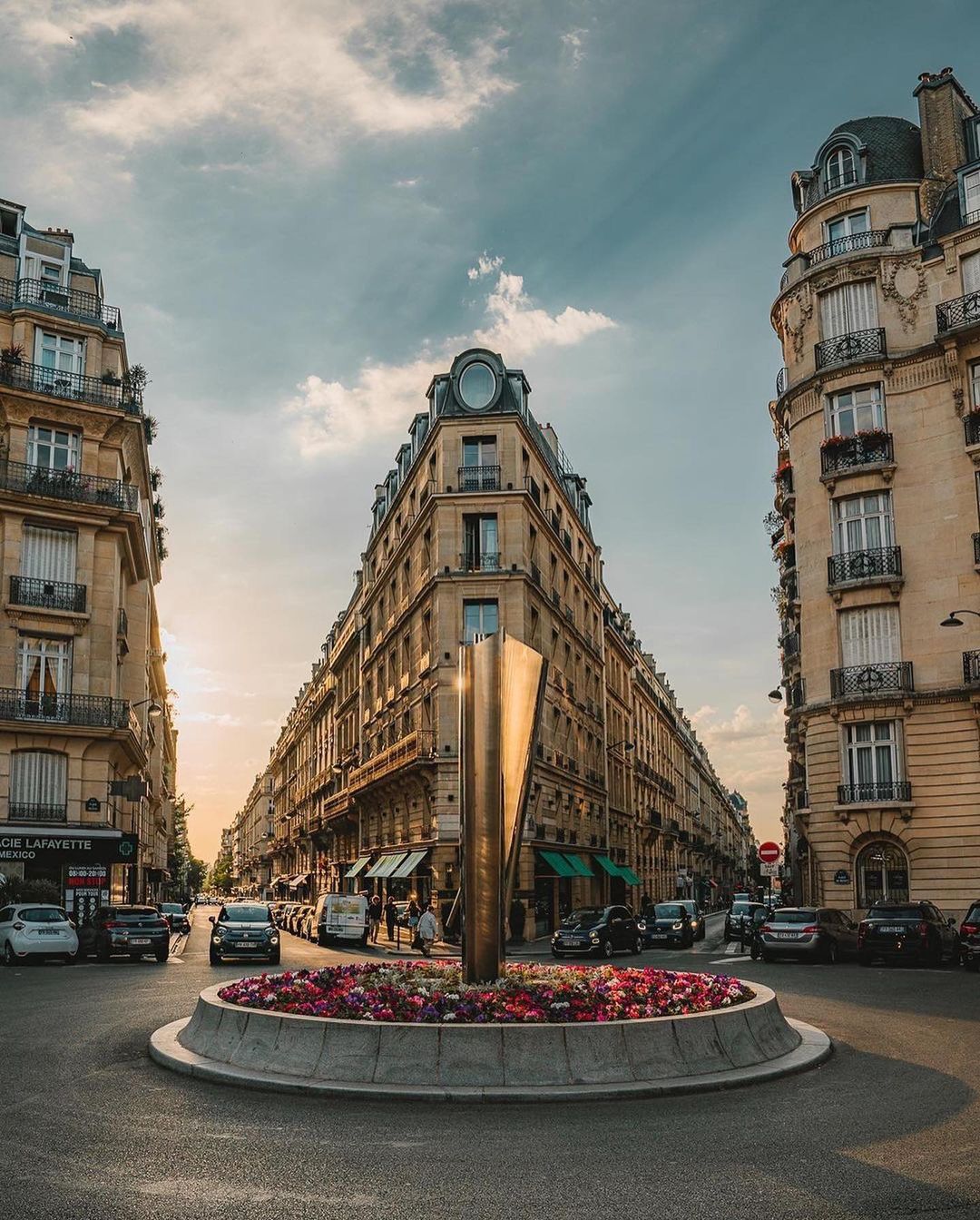
The Place de Mexico is located in the 16éme arrondissement of Paris. It is at the intersection of Rue de Longchamp, Rue des Belles-Feuilles, Rue des Sablons, Rue Decamps, and Avenue d’Eylau. The square is served by metro line 9 at the Rue de la Pompe station and by lines 6 and 9 at the Trocadéro station. This square pays homage to Mexico, whose embassy is located nearby at 9 Rue de Longchamp. It is an old crossroads in the Passy plain, where paths once converged. In April 1829, the village of Passy financed the construction of a triumphal arch in the square, under which King Charles X of France passed on his return from Lunéville. The village would not be integrated into Paris until 1860, and saw late urbanization of this area, and the square only began to be subdivided and take on its current appearance from 1905 onwards. The square was formerly called rond-point de Longchamp and was renamed by a decree of May 7, 1957. Its radius is 25 meters. At its center is a sculpture by Águeda Lozano, Land of Mexico in land of France, a gift from Mexico in 2006.(see pic) At no 9, it is mentioned that in the 17C there was an agricultural establishment there, the Magu farm ,destroyed in 1904, where Boileau and La Fontaine used to come to drink fresh milk. At the beginning of the film Frantic directed by Roman Polanski, released in 1988, the car of Doctor Walker (Harrison Ford) and his wife Sondra (Betty Buckley) crosses the Place de Mexico towards the Avenue d’Eylau.
The Paris tourist office on the 16éme arrondissement de Paris : https://parisjetaime.com/eng/article/a-la-decouverte-du-16e-arrondissement-de-paris-a830
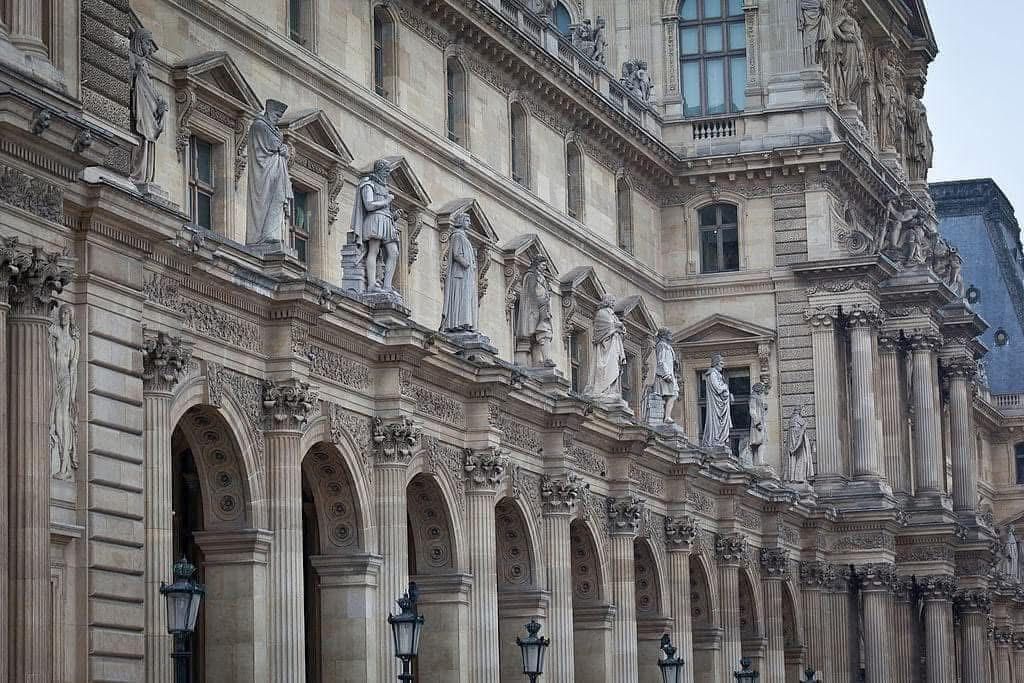
The Cour Napoléon was created following the construction of the new Louvre, which began in 1852 and was completed in 1857. Emperor Napoleon III, who inaugurated the Musée du Louvre on August 14, 1857, intended to connect the Louvre to the Tuileries Palace (burned down 1871 and demolished 1882 see post). The Louvre Squares were created in the center of the courtyard, but these were replaced in 1984 by the pyramid designed by architect I.M. Pei. The courtyard is bordered along the Rue de Rivoli, from west to east, by the Aile Turgot Wing (see pic) , and Pavilion, the Richelieu Pavilion, the Colbert Wing and Pavilion, and the Beauvais Rotunda. To the east bordering the Cour Carrée, from north to south, it is bordered by the Henri IV Wing, the Sully Pavilion, and the Henri II Wing. To the south along the Seine river, from east to west, are the Apollo Rotunda, the Daru Pavilion and Wing, the Denon Pavilion, and the Mollien Wing and Pavilion. The Hommes illustres ou Hommes célèbres or the Illustrious Men or Famous Men are a series of 86 statues installed on the wings of the Cour Napoléon between 1853 and 1857. Most represent figures of French culture (25 men of letters, 20 artists, 13 architects), but the series also includes about ten scientists, 9 statesmen, and 8 clergymen. There are no military figures, with the exception of Vauban, who can nevertheless be considered an economist. The statues are installed on the balustrades of the Cour Napoléon, on the first floor of the palace. The Aile Turgot (see pic) contains 18 statues Jean de La Fontaine, Blaise Pascal, François Eudes de Mézeray, Molière, Nicolas Boileau, Fénelon, François de La Rochefoucauld, Pierre Corneille, Gregory of Tours, François Rabelais, François de Malherbe, Pierre Abélard, Jean-Baptiste Colbert, Jules Mazarin, Georges-Louis Leclerc de Buffon, Jean Froissart, Jean-Jacques Rousseau, and Montesquieu. My pic shows a section of it,
The official Musée du Louvre : https://www.louvre.fr/en/explore/the-palace
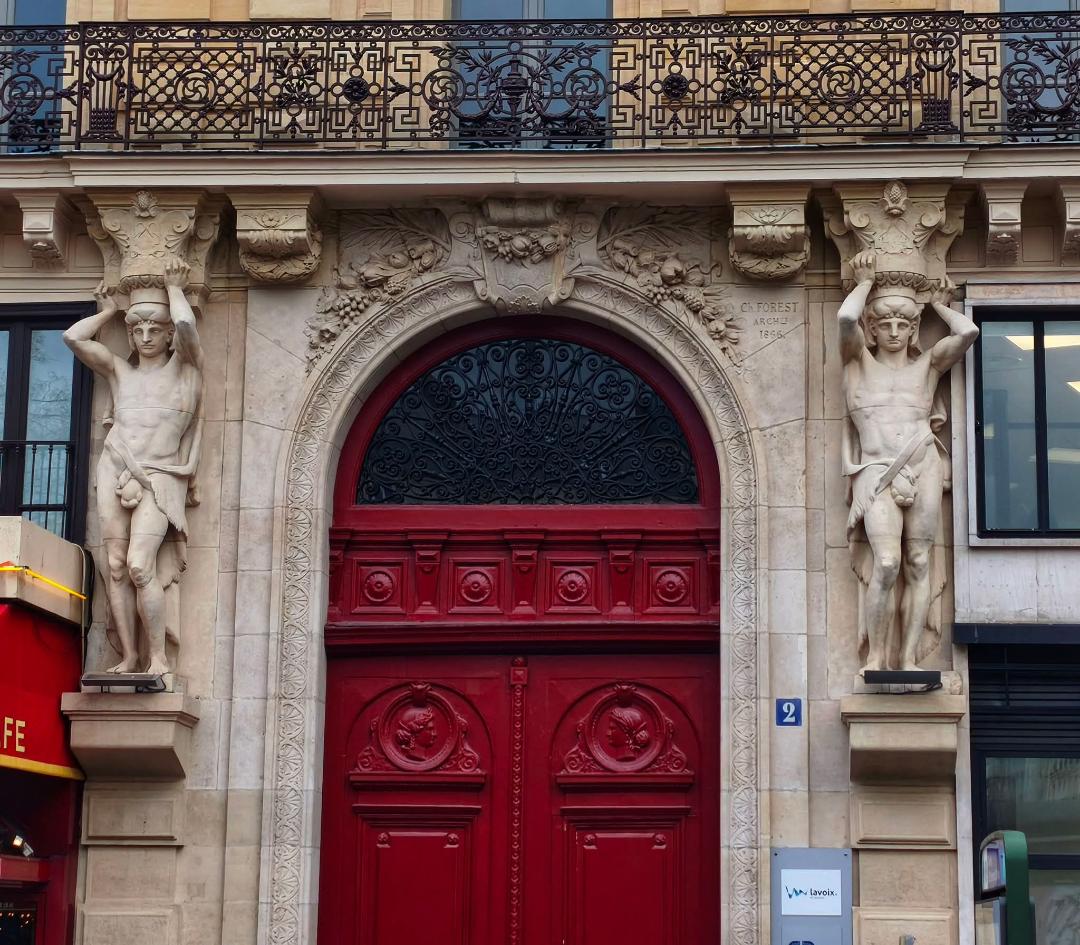
The Place d’Estienne-d’Orves is located between the Chaussée-d’Antin and the Saint-Georges quartiers or neighborhoods of the 9éme arrondissement or district of Paris. This square was created by decree of December 19, 1860, at the same time as the Trinity Church (see post), under the name of “Place de la Trinité”, and in 1944 included part of the streets of Clichy and Blanche, which border it. It took the name of Place d’Estienne-d’Orves by decree of December 18, 1944. In 1994, the extent of the square was extended to the Square d’Estienne-d’Orves (formerly Square de la Trinité). Notable buildings here are theChurch of the Holy Trinity. The Square d’Estienne-d’Orves, aka Trinity Square. No. 2: building constructed in 1866 with atlantes framing the entrance (see pic). Two full-length atlantes, perhaps statues of Hercules or Heracles, male figures as was the fashion at the time, with perfect anatomy and remarkable execution, stand on the mezzanine level, supporting the semicircular arch of the carriage entrance and the first-floor balcony. Their hairstyles are extravagant and voluminous. The keystone of the portal is adorned with a decorative sculpture of vegetal motifs, including fruit and pine cones. Branches are located on either side of the medallion, along with a cartouche; similarly, the corbels on either side are decorated with laurel wreaths. The painter Pierre-Auguste Renoir painted the square several times during his lifetime. Guy de Maupassant’s character, the journalist Bel Ami, is set here. In the church, Madame Walter, his boss’s wife, confesses her love to him.
The Paris tourist office on the 9éme arrondissement de Paris: https://parisjetaime.com/eng/article/explore-paris-s-9th-arrondissement-a828
There you go folks, a dandy city to explore and enjoy with the family, Memorable moments in my eternal Paris, driving and walking all over in my road warrior trails brings out sublime awesome spots with nice memorable family visits of yesteryear always remember and always looking forward to be back, eventually. Again hope you enjoy the post on curiosities of Paris , part LXV !!! as I.
And remember, happy travels, good health, and many cheers to all !!!

 Paris1972-Versailles2003
Love rue des Archives
LikeLiked by 1 person
Very nice old world street indeed. Thanks for stopping by Cheers
LikeLiked by 1 person