
I am again to tell you about more streets of my eternal Paris. I have many many posts on Paris and several on the streets of the most beautiful city in the world. I have come up with a picture from cd rom vault that should be here for you and me. This is a unique memorable street for me ,read below, Therefore, will have one post alone for it, As always thank you for following my blog some since November 2010. Therefore, here is my take on the Rue Saint Denis of Paris !!! Hope you enjoy it as I.
The Rue Saint-Denis is located in the 1er, 2éme and 10éme arrondissements or districts of Paris, is one of the oldest streets in the city: its axis was traced as early as the 1st century by the Romans. It is the triumphal route of royal entries into the city. Parallel to Boulevard de Sébastopol and Rue Saint-Martin, the street is part of the 1er arrondissement, Saint-Germain l’Auxerrois quartier or neighborhood, for the section between Avenue Victoria and Rue de Rivoli, Les Halles quartier or neighborhood, for the section between Rue de Rivoli and Rue Étienne-Marcel, and the 2éme arrondissement, Bonne-Nouvelle quartier or neighborhood from Rue Étienne-Marcel to Boulevard Saint-Denis. This street is so named because it is the road that leads directly from the Pont au Change to the city of Saint-Denis (Saine Saint Denis dept 93), where the necropolis of the kings of France was/is located, and from which it took its name. It was through Rue Saint-Denis that kings and queens solemnly entered Paris. All the streets, as they passed, up to the cathedral, were lined with silk fabrics and tinsel sheets. Jets of scented water perfumed the air. Wine, hippocras, and milk flowed from all the fountains.
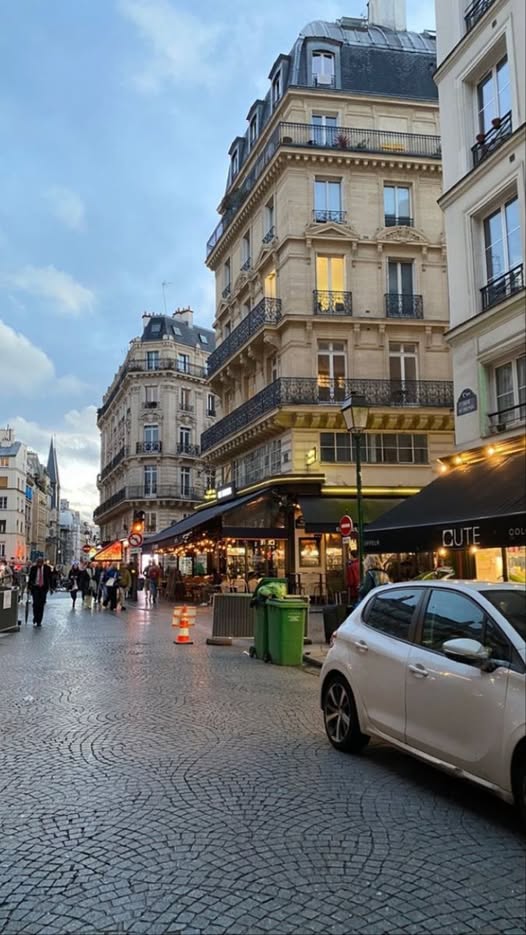
Remarkable buildings on this street me think are the:Au Trappiste bar restaurant, 4 rue Saint Denis (see post), this was my first encounter with this street as many friends over the years gather here for encounters, meetings just fun time into the wee hours, and one reason I came thereafter to Paris by car not needed to submit to public transport times, Sublime memories forever, At No. 20 (corner of 33 bis rue des Lombards): site of the Sainte-Catherine hospital. No. 32 (corner of rue de La Reynie): former “Au Chat Noir” store, occupied in turn by a silk merchant and then a confectioner. No. 41: site of the former Passage de l’Empereur. Nos. 43 to 45 (between rue des Innocents and rue Berger): site of the Church of the Saints-Innocents, the recluse of the Saints-Innocents and the cemetery of the Saints-Innocents. No. 60 (corner of rue de la Cossonnerie): site of the Church of the Holy Sepulchre, No. 82: site of the abbey of Saint-Magloire in Paris, active from around 1150 until 1572. Its monks then moved to the former church of Saint-Jacques-du-Haut-Pas, rue Saint-Jacques; They were succeeded by the convent of the Augustinians of the Order of the Penitence of the Magdalen (convent of the Penitent Daughters), closed in 1790. The church and the buildings of the convent were replaced by an inn, later demolished. No. 92: Saint-Leu-Saint-Gilles Church, No. 133 and rue Mauconseil: location of the Saint-Jacques hospital for pilgrims, recalled by the statues of Saint-Jacques on the facade at the corner of rue Étienne-Marcel. Former section of rue Mauconseil, opened in the 1850s. Nos. 110-112-135: location of the Porte aux Peintres, also called Porte Saint-Denis, located on the Philippe Auguste enclosure. No. 142 (corner of 28 rue Greneta): location of the Hôpital de la Trinité, founded in the 12C under the name of “Hôpital de la Croix-de-la-Reine” to accommodate travelers who arrived after the closure of the gates of the Philippe Auguste enclosure; the establishment, its gate and its church were demolished in 1817 . At the same time, the Fontaine de la Reine was built on its facade. The current fountain, the second of the name, was built in 1732. No. 144: site of the church of the Trinity Hospital, sold in 1812 as national property and destroyed in 1817. No. 183: site of the Saint-Sauveur Church. No. 188: outlet of the Rue du Ponceau, at the site of the “culvert” which spanned an open sewer. This circular sewer ran along, inside the Charles V enclosure, the enclosures of the Temple and the Abbey of Saint-Martin-des-Champs then headed towards the Rue du Faubourg-Montmartre to flow into the Grand Sewer. It was covered in 1605 between the Rue Saint-Denis and Rue Saint-Martin, which led to the disappearance of the culvert. A fountain was installed nearby. Nos. 224-226: site of the convent of the Daughters of Saint-Chaumont or convent of the Daughters of the Christian Union, founded in 1673, rebuilt in 1734-1735 by Jacques Hardouin-Mansart de Sagonne, the walls of which are partly preserved. It is the only vestige of the pious or charitable establishments which lined the rue Saint-Denis. No. 266: site of the Church of the Trinity. Nos. 285 and 248, at the crossroads of the Grands Boulevards: Porte Saint-Denis.(see post)
A bit of history I like tell us that as early as 1134, the street lined with houses replaced the path leading to the rue d’Avignon. From this point, one could see a city gate that was part of the second city wall of Paris, probably built following the great siege of 885 by the Vikings. Around 1197, the rue Saint-Denis still only went between the gate of the second city wall, a little below the rue Troussevache and reached the rue Mauconseil where there was a gate of the third city wall of Paris begun in 1188, by order of Philippe Auguste. The part between the place du Châtelet and the rue de la Ferronnerie, that is to say what was included of this street in the second city wall of Paris was called in 1284 “rue de la Sellerie-de-Paris”; in 1293, “rue de la Sellerie-de-la-Grand’rue”; in 1310, “Grand’rue de Paris” and, in 1311, “Grand’rue des Saints-Innocents” because it led directly to the church of the Saints-Innocents. It was then called “Grant chaussée de Monsieur”, “Grant chaussée de Monseigneur Saint-Denis”, “Grant chaussée de Monsieur Saint-Denis”, “Grand’rue Saint-Denis” and finally rue Saint-Denis. The name “Grant-Chaussiée-Monsieur-Denis” and its derivatives are due to the pilgrimage to the tomb of Saint Denis honored in the 5C by Saint Genevieve. It is mentioned in Le Dit des rues de Paris by Guillot de Paris under the name of “Grant’rue” in its southern part and by “rue Saint-Denis” from the rue des Lombards to the gate of the enclosure of Philippe Auguste, which was opposite the impasse des Peintres.
In 1418, this public road was almost entirely lined with buildings and extended from Rue Mauconseil to Rue des Deux-Portes, where a gate of the fourth wall built during the reigns of Charles V and Charles VI stood. Through a further extension of Paris under Louis XIV, it encompassed the “Rue de la Sellerie” which followed it outside Paris, ending at the monumental gate that has survived from this reign and took the name “Rue de la Sellerie-de-Paris”. It was a gala street, through which kings and queens traditionally made their solemn entry into Paris. The convents, religious centers and hospitals that were numerous there, such as the Saint-Sépulcre, Saint-Magloire, the Sainte-Opportune cloister or the Saints-Innocents. But this did not prevent commerce from flourishing there. It is mentioned under the name of rue Saint Denis in a manuscript of 1636. During the French revolution, it was called “rue de Franciade”. The horse-drawn post office retains its role as an essential route for long journeys, since the only relay station installed in Paris is on rue Saint-Denis, at the Hôtel du Grand-Cerf. It is therefore through rue Saint-Denis that many travelers, arriving in Paris by post carriage, discover the city. In 1817, rue Saint-Denis, 1,349 meters long, began at 2 rue Pierre-à-Poisson and 3 place du Châtelet and ended at 1 boulevard Bonne-Nouvelle and 19 boulevard Saint-Denis. The street numbers were black. The last odd number was 395 and the last even number was 408. On June 6, 1824, on the occasion of the solemn entry into Paris of Charles X, the rue Saint-Denis was in jubilation. In 1830, during the Three Glorious Days, the road was covered with barricades. Until the end of July, the street was the scene of bloody clashes between the insurgents and the troops.
The Paris tourist office on Paris Centre (arrond 1-4) : https://parisjetaime.com/eng/article/explore-the-centre-of-paris-a846
The Paris tourist office on the 10éme arrondissement de Paris : https://parisjetaime.com/eng/article/explore-paris-s-10th-arrondissement-a843
The RestaurantGuru Reviews on Au Trappiste : https://restaurantguru.com/Au-Trappiste-Paris
The privateaser site on the Au Trappiste : https://www.privateaser.com/lieu/52527-au-trappiste
There you go folks, another dandy beautiful ,memorable street of my eternal Paris. I have criss cross them many and have many in my blog already, This one is special and you should try walking it , lots of goodies here, Again, hope you enjoy this post on the Rue Saint Denis of Paris !!! as I.
And remember happy travels, good health, and many cheers to all !!!

 Paris1972-Versailles2003