
I have been by here very often and had lunch just across from it on several occasions and even a dinner! The area was very close to my way to work for several years ,and very convenient close to the Gare Saint Lazare train station which I took to come to work in Paris for about 8 years. The Church Saint Augustin sits in an area of my first coming to Paris when came to live in France. From my beloved Versailles rive droite train station The area is dear to me for this reason, and memories to last a lifetime! I found me a new picture in my cd rom vault that should be in my blog for you and me ; and thanks for reading me since Nov 2010! Therefore, let me tell you again on the Church Saint Augustin of Paris, part I !!! Hope you enjoy the post as I.
The Church Saint Augustin was built between 1860 and 1871, in the neighborhood of Petit Pologne (little Poland),at place Saint-Augustin in the 8éme arrondissement or district of Paris. Official address of 46, Boulevard Malesherbes . It was the first church in Paris to use a metal structure covered with a stone siding the work of Victor Baltard , also architect of the old Halles of Paris. This church is a composition of several architectural styles, such as Romanesque, Gothic, Byzantine and Renaissance. It has 94 meters long and 60 meters high on the Dome. On the façade, the symbols of the four evangelists above the arcades and, under the Rosette, the Twelve Apostles.
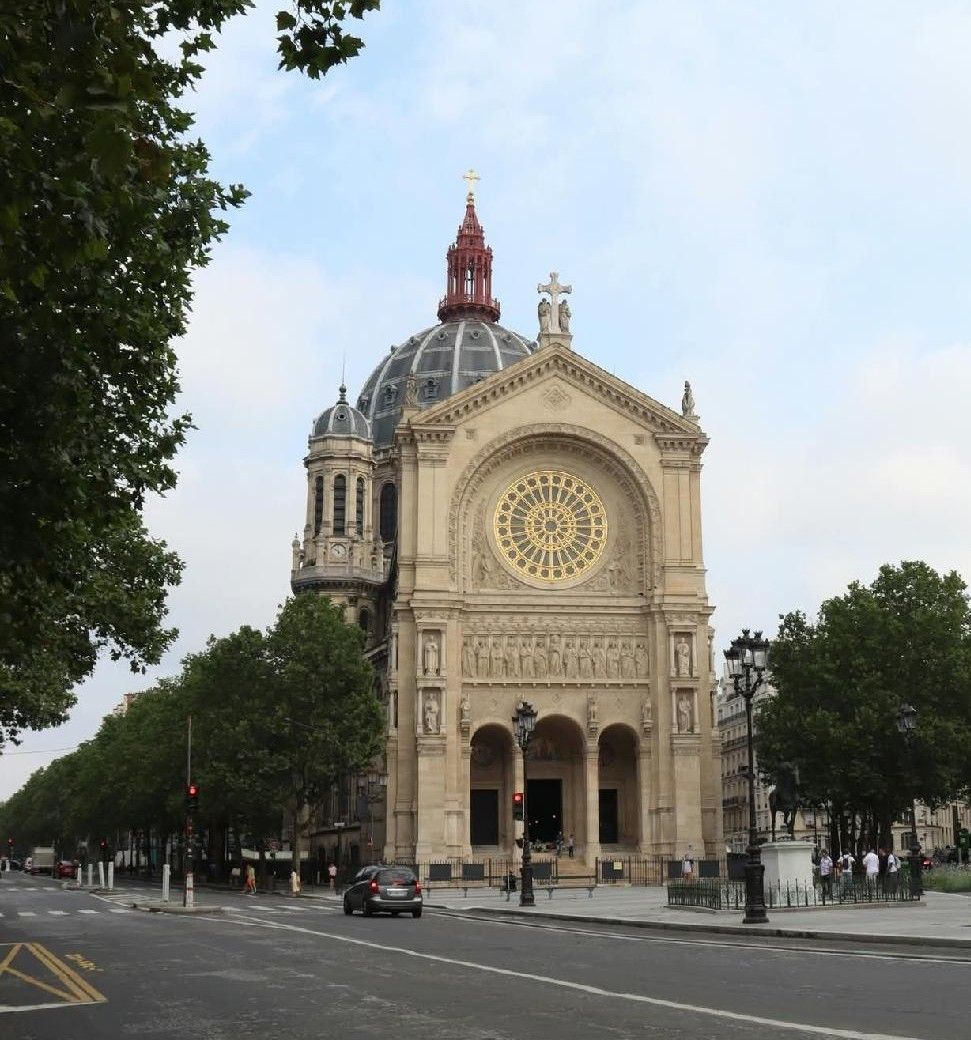
The Church Saint Augustin is arranged in Romano-Byzantine style, sometimes eclectic: Romanesque for the nave with its arches in full hanger, Byzantine for the choir with its dome, but also antique for the ciborium and Renaissance vaguely elsewhere. See, the equestrian statue of Jeanne d’Arc in front of the church.
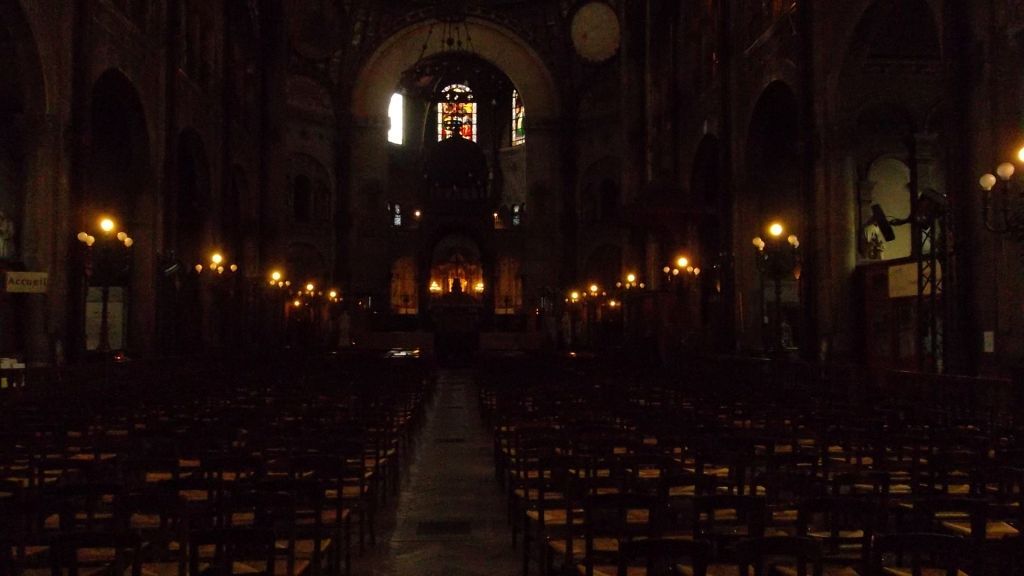
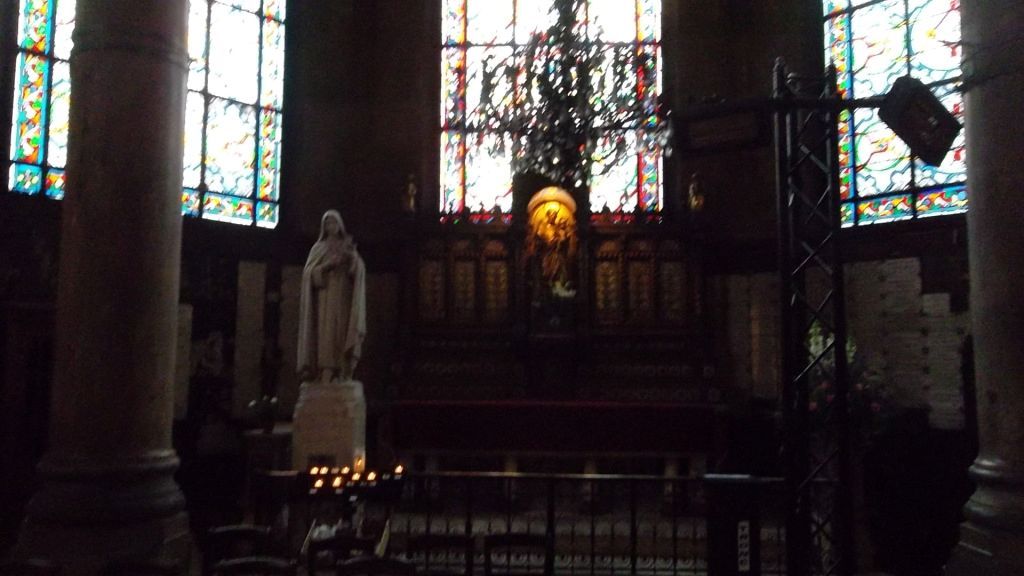
The Church of Saint Augustin designed in trapeze, is original; It is the result of the difficulty in exploiting the triangular parcel along Bd Malesherbes and avenue César Cairo. Behind a monumental gate, the nave and oblique aisles flare up to join the choir, of square plan, topped by a dome with up to date lantern. The nave is lined with arcades in full hanger, surmounted by a triforium. Leaves a vast nave without a aisle which gradually widens to the octagonal transept flanked by two side chapels . It is indeed the first religious building of such magnitude using cast iron, these new building materials then in vogue in the second half of the 19C. Inside, the cast that supports the vault and the dome is at the same time decorative element with its polychrome angels. The windows of the nave align bishops and martyrs of the 1C. The central part of the transept houses a sanctuary surrounded by a balustrade full of stone and marble; in the middle rises a rich ciborium of cast iron and the master altar adorned with bronze grates, marble columns and mosaics of Lyon. A bronze statue of 16 figures painted under the dome adorning the façade, the symbols of the four evangelists above the arcades and, under the Rosette, the Twelve Apostles. There is a Rosary of 8 meters in diameter and 20 meters high.
The emperor Napoléon III himself had chosen the Church of St. Augustin to house his burial and it was in this building so representative of the Second Empire by its metallic architecture and by the eclecticism of its style that the supporters of the repatriation of the remains of Napoleon III in France would like to see the ruler buried. Napoleon III decided that the crypt of the church would house his burial and those of the princes of the Imperial family, that of the emperors and empresses to remain in the Basilica of St. Denis. (see post) Finally, the emperor died in exile in England and was buried with his wife and son at the Abbey of Saint-Michel (Farnborough).
A bit on the construction I like tell us that it was Napoleon III’s willingness to create major traffic routes in the capital, bordered by modern buildings, reshaped the population profile. The need to endow it with a church worthy of the standing of its inhabitants was pressed. The space was not wide: there was just a trapezoid delimited by bd Malesherbes and Ave Caesar Cairo. Moreover, if you look at a map of Paris, you will see a change of angle in the Boulevard Malesherbes at this place. To build a large church, thought Baron Haussmann, would conceal this obliquity from the perspective. This task was entrusted to
Victor Baltard He had managed to settle, to the satisfaction of the Prince-President, the problem of the Halles in 1852. The construction began in 1860. He was followed closely by the emperor. Resuming the innovation of the Saint-Eugène Church, Baltard proposed a metal frame covered with stone walls and a brick vault. This method of construction was, he argued, economical and solid. There was no need for buttresses or arch-tips. Using the metal to build, it was modern. And it was also what the Parisian Catholics wanted at the time: to combine modernity with spiritual needs without losing sight of the usual stylistic formulas. Victor Baltard chose neo-Romanesque porches, Byzantine dome, arched arcades in the nave, ciborium to the antique, while emphasizing the new artistic techniques. The Church of St. Augustin was inaugurated in 1868 and did not unleashed enthusiasm. Very quickly, the architect was blamed for the too important part given to the technique. Others regretted that the route of the streets was to his architecture and not the other way around, depriving the building of a harmony. Finally, during the War of 1870, the mockers did not hesitate to assimilate the lantern to a Prussian helmet and mock the Calvinist religion of the architect, which disqualified him, it was said, to build Catholic churches.
The great organs of this magnificent Saint Augustin Church are the work of the factor Charles Spackman Barker, famous in the world of the organ for his invention of the “machine Barker” which revolutionized the mode of transmission. They were built in 1867-1868 and inaugurated in 1868. This organ was also one of the first to integrate electricity. The instrument was restored by Cavaillon-Coll (1899), Beuchet-Debiere (1961) and Dargassies (1987).
The parish of Saint Augustin on the church: https://www.saintaugustin.net/architecture-saint-augustin
The Paris tourist office on the Church Saint Augustin: https://parisjetaime.com/eng/culture/paroisse-saint-augustin-p1233
There you go folks, another dandy in beautiful Paris. It is a wonderful church in a nice area close to the Madeleine and the gare Saint Lazare and the Big department stores ,all that glitter in Paris!! Again, hope you enjoy this post on the Church Saint Augustin of Paris, part I !!! as I.
And remember, happy travels, good health, and many cheers to all !!!


