
The village of Henvic is located in the Finistère department no, 29, in my lovely region of Bretagne and in my belle France. It occupies a central position in the Bay of Morlaix, between the two estuaries of the Penzé and the Morlaix river. This is one of those first visit that on my local road warrior mode got me to come in. So many wonders in my Brittany alone. Glad to find these pictures in my cd rom vault that should be in my blog for you and me. Therefore, let me tell you my take on this is Henvic !!! Hope you enjoy the post as I.
The Pont de la Corde or Rope Bridge, inaugurated on October 30, 1927, spans the Penzé and has since connected the Henvic-Carantec peninsula to Saint-Pol-de-Léon and Roscoff via the D58 road. This road, part of the Roscoff-Lorient axis, now an expressway, also connects Henvic to Morlaix The village is 4,5 km from Carantec, 9 km from Saint Pol de Léon, 12 km from Morlaix, 16 km from Roscoff, 66 km from Brest, and 150 km from my current home, I came from home on my way to Roscoff but took a road warrior side trail to come to Henvic on the D33 road to the N165 expressway dir Lorient, here on exit/sortie 42 take the D769 road dir Plouay continue dir Le Faouët continue dir Carhaix continue on D769 road go underneath the N164 highway continue it becomes the D264 road continue to roundabout bear left onto the D48 road which same road becomes the D148 road at next roundabout bear left onto the D764 road to next roundabout bear right onto the D785 road dir Plounéour-Ménez side continue thru City center Pleyber-Christ continue to hook up bearing right with the N12 highway dir Morlaix but get off at exit/Sortie Le Launay dir Roscoff to get on the D19 road which becomes same D58 road continue bear right onto exit/sortie C1 Henvic to centre ville on chemin du Ménec turnn right on Rue du Croissant and then right on rue de la Mairie to the old church on your right hand side,
The remains of the Old Church Saint-Maudez-et-Sainte-Juvette dates from the late 16C and early 17C but was reduced to its current dimensions around 1900 after the construction of the new church; however, the church has retained its picturesque bell tower, which once served as a landmark for ships entering the Bay of Morlaix. Its patron saints were Saint Maudez and his sister, Saint Juvelte. It is a Beaumanoir-style bell tower with its gallery, its cylindrical turret housing the staircase, and its two tiers of bells. The openwork porch with its nine arches, surmounted by an archive room, belongs to the late Flamboyant Gothic period, as does the bell tower with its stair turret. But the projecting balustrade and the belfry, crowned by a tiny spire, give the impression of the Henri IV or Louis XIII style.
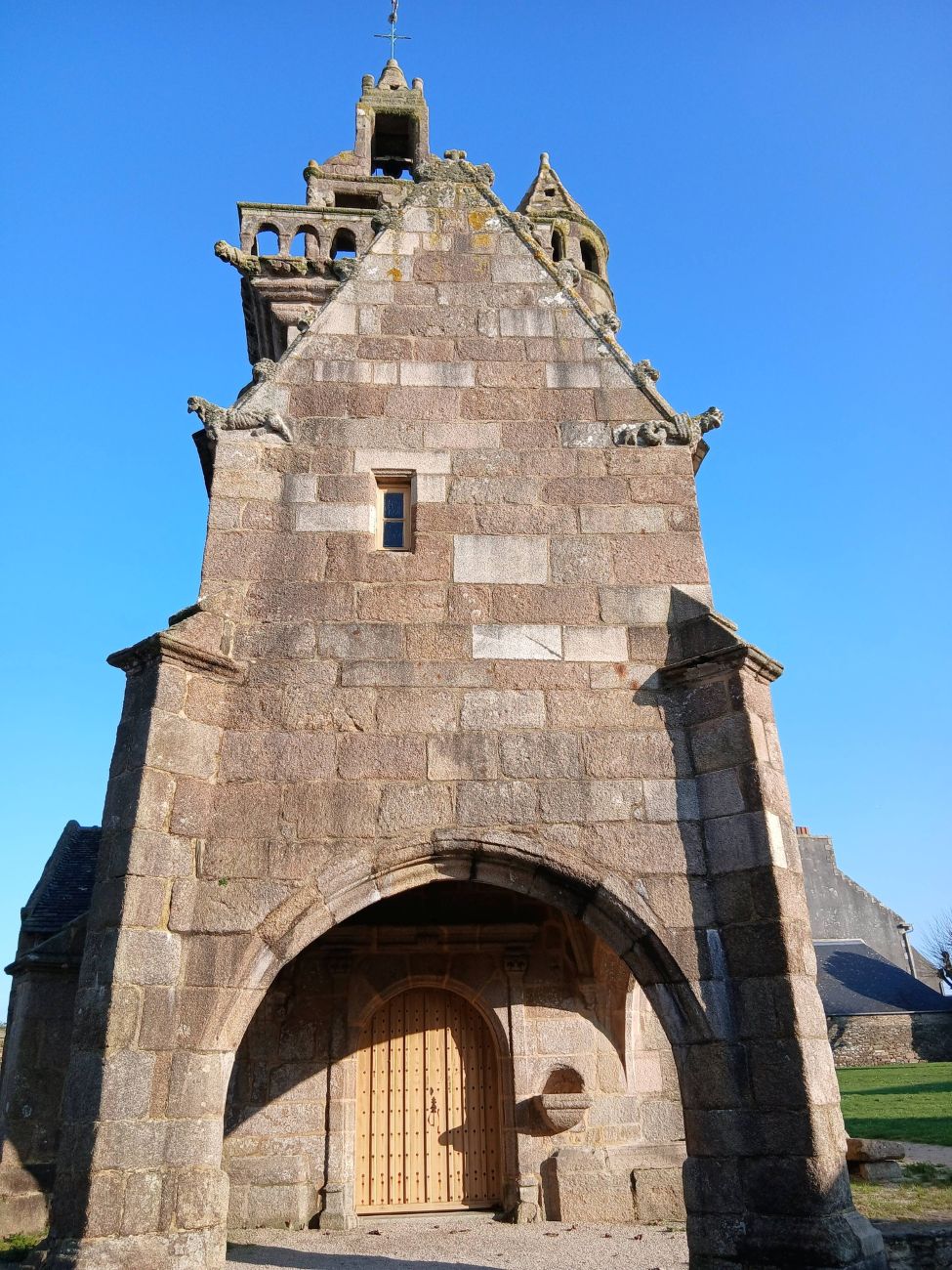
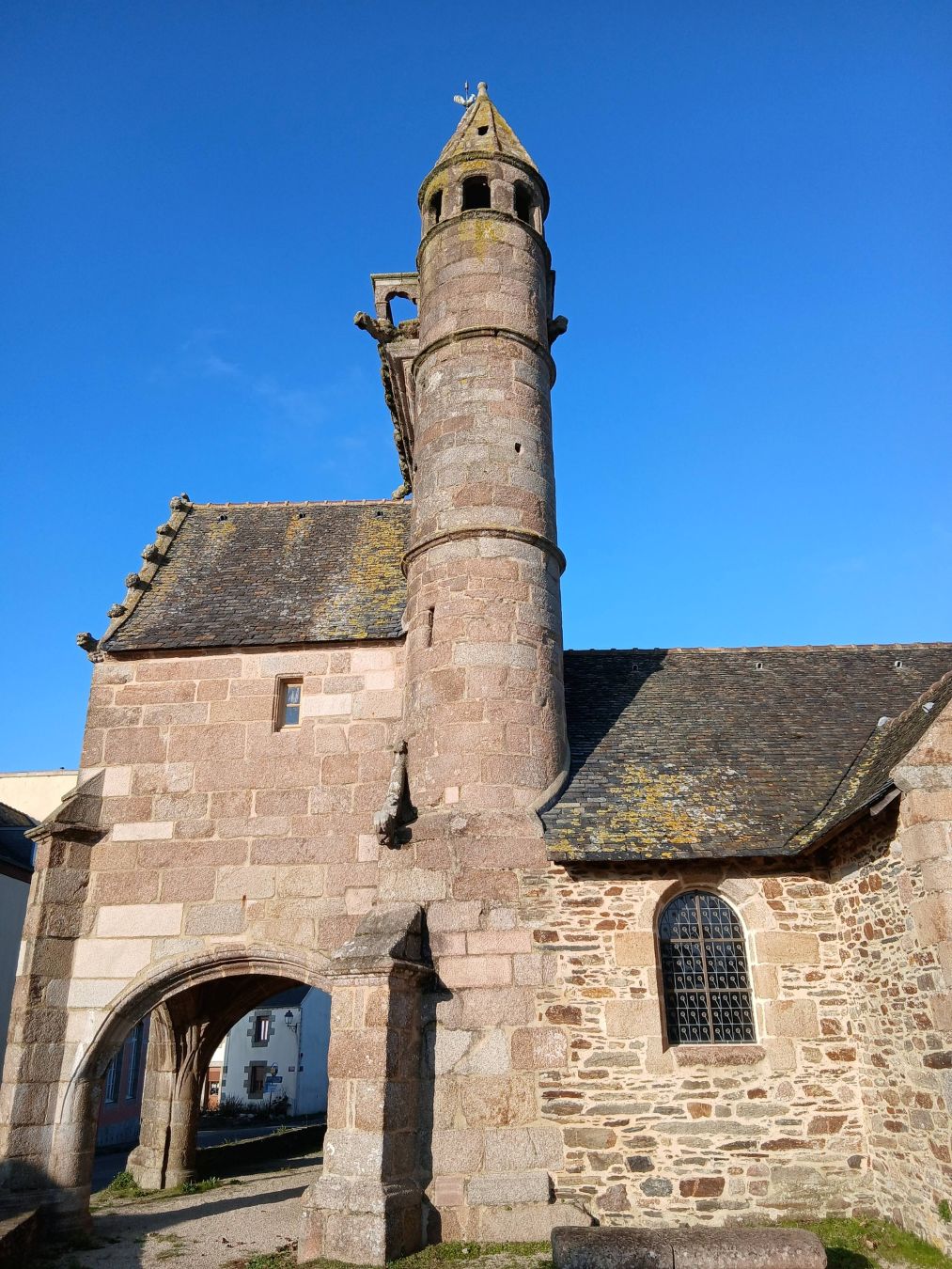
Other things to see here are the current Parish Church Saint-Maudez-et-Sainte-Juvette, inaugurated on November 23, 1902, and officially consecrated on May 18, 1904, has retained a number of decorative elements from the old church, which were reused there. Among them is the Gothic diptych in praise of Saint Maudez (6 panels) and Saint Juvette (4 panels), which recounts the principal events of their lives: Saint Maudez healing the infirm, receiving his father’s blessing, delivering a possessed man, and restoring sight to a blind man; and Saint Juvette resurrecting a lord, delivering the possessed, the “mad,” and the rabid, giving sight to the blind, hearing to the deaf, and speech to the mute, and protecting birds and animals. The high altar also comes from the old church, as well as the side altars, are dedicated to Saint Fabian and Saint Sebastian on one side, and Saint Catherine and Saint Barbara on the other. The church is also decorated with a large decorative triptych in memory of those who died in the Great War or WWI, inaugurated on October 4, 1927. The Sainte-Marguerite Chapel dates from the 15-16C and was restored in 1878. It houses a wooden statue of Saint Margaret slaying the dragon, and its Pardon, Our Lady of Hope, takes place every August 15th. Traditionally, the bodies of shipwrecked sailors found in the waters of the Penzé river or on the nearby shores were laid in this chapel. The Trogriffon manor, on the banks of the Penzé, nestled in a narrow valley, dates from the 17-18C and still boasts a 15C turret and a 16C dovecote, as well as a beautiful park with a pond containing both fresh and salt water. The Penzé viaduct is a railway viaduct that carries the Morlaix to Roscoff line across the Penzé river.
A bit of history I like tell us that Henvic was formerly known as Hen-Guic, meaning old town. In ancient Celtic, Scandinavian , and Saxon languages, “wic” means “bay, gulf, or estuary.” In Breton, “gwic” translates the Latin “vicus” and designates the central village of a parish. The 6C was marked by the arrival of monks from Ireland and Wales to preach Christianity (Saint Carantec, then Saint Maudez). The people of Henvic were very devoted to Saint Maudez. He traveled throughout Brittany to convert people; he built numerous chapels and monasteries: this is how the town of Henvic is said to have been founded at a place called Le Menec’h (plural of manac’h, “monk” in Breton). The Norman and Viking invasions during the 9C, and especially in 878, led to the construction of fortified manors built of stone instead of the wood previously used. In 1481, at the muster of the bishopric of Léon held in Lesneven, Henvic was represented by eleven nobles. The principal lordship was that of Lézireur, owned in 1421 by Yves Kerigou, steward to Duchess Jeanne of France, (Second daughter of Louis XI and Charlotte of Savoy), and which passed in 1460 into the hands of the Guicaznou family, whose coat of arms is engraved on a basin still visible in the castle farm. At the beginning of the 16C, the town of Henvic had several noble houses, inns, and hostelries, but in 1522, when Jean de Guizcanou had inherited the titles and positions of his father Mériadec, the castle of Lézireur and the town were destroyed and almost entirely burned during the attack on Morlaix by an English expedition. The castle of Lézireur was again partially burned in 1594 during the Wars of the League by the Leaguers. On April 20, 1792, 120 National Guardsmen, 120 volunteers, a gendarmerie brigade, and an artillery company with two cannons arrived in Henvic and Taulé to close the churches, take down the bells (destined to be melted down), and arrest the refractory priests, whom they did not, however, find.
The village of Henvic on its heritage : https://commune-de-henvic.neopse-site.com/fr/rb/2042263/patrimoine-140
The Finistére dept 29 tourist office on its heritage : https://www.toutcommenceenfinistere.com/patrimoine/
The Bretagne region tourist office on the pink granite coast trails : https://www.brittanytourism.com/destinations/the-10-destinations/pink-granite-coast-morlaix-bay/
There you go folks, a nice introduction to quantHenvic, a real find. One of the highlights of living in the peninsula of Brittany surrounded by water,and beautiful sights, Again, hope you enjoy the post onthis is Henvic !!!as I
And remember, happy travels, good health, and many cheers to all !!!

 Paris1972-Versailles2003