
One of the wonderful spots in the magnificent Jardin du Luxembourg in my eternal Paris. As said, do stop by it often before as my job made me stop here on bus 82 and sneak into the garden each trip, Do read my other posts on it, There are wonderful things to see and do here, and really needs a book, I have great memories of it with the family ,walking and playing with the boats when my boys were younger while living nearby in Versailles. I found me pictures in my cd rom vault and one older paper picture that should be in the blog for you and me, Therefore, let me tell you about the monument and fountain Eugéne Delacroix in the Jardin du Luxembourg !!! Hope you enjoy the post as I.
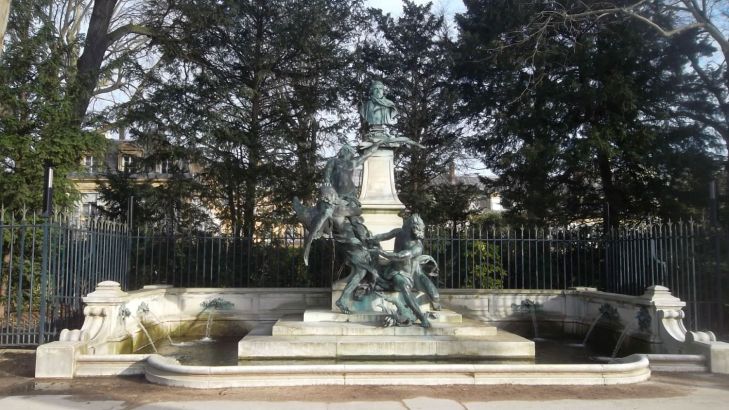
Passing by it and marvel of its beauty as even better understanding its meaning and the person exalted here is tops, me think, While in the Jardin du Luxembourg , this was my must stop of many afternoons with my family. And my favorite statue fountain there is of Eugéne Delacroix. One of my favorite personage in the history of France and a painter’s delight. In the Jardin du Luxembourg there is one monument dedicated to Eugéne Delacroix, the painter A complex monument comprising a fountain, a bust and decorative characters. This monument was inaugurated on October 5, 1890. The times raises glory to the left, so that she lays a crown and a palm in front of the bust, on the right, Apollo, genius of the Arts, applauds this late recognition. The sculptor Dalou used a photograph of the painter by Nadar to carved his features. On the pedestal you can read ” A /Eugéne Delacroix / 1798 – 1863 / Ses Admirateurs” or To / Eugéne Delacroix / 1798 – 1863 / His Admirers. It is located between the Luxembourg Palace and the Orangerie behind the Luxembourg Museum.(see posts).
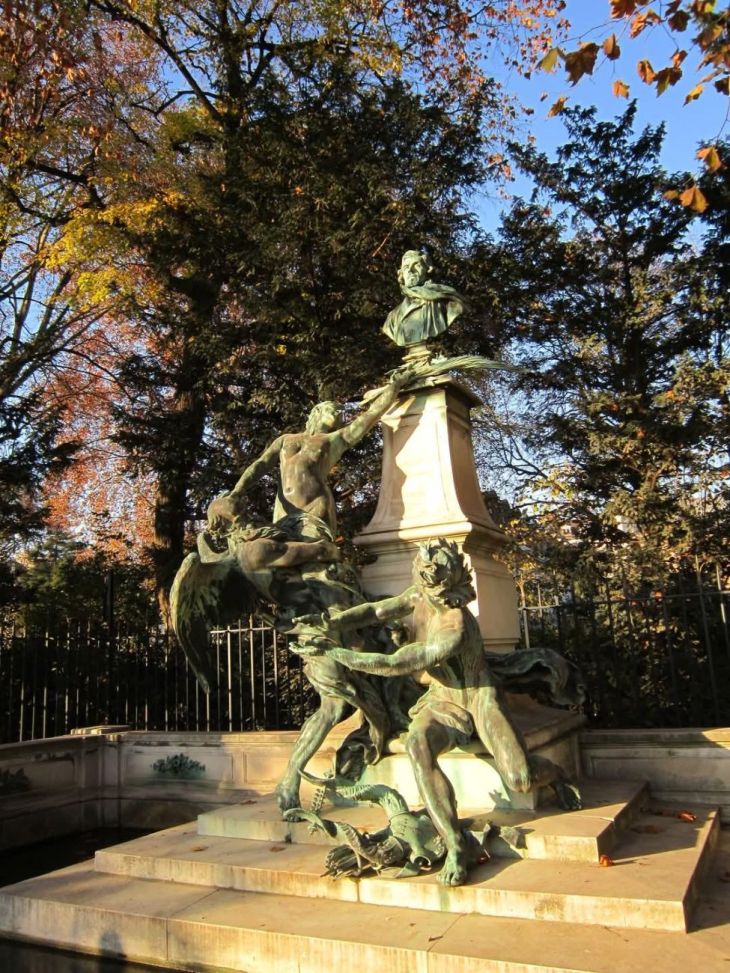
It consists of a rectangular basin in white marble into which six water jets are poured by masks fixed on the wall of the water buffet which decorate the background. The bronze and marble monument is 4.5 meters high and the bust of Delacroix is one meter high. On a base surmounted by three steps is placed a stele, on which is fixed the bronze bust of Eugène Delacroix who participated in the painted decoration of the Senate Palace and Saint-Sulpice Church, a particularly abundant work and whose merits are universally known. The artist is accompanied by allegories of bronze whose figures evoke Time, Glory and the Genius of the arts. Time is on the left side, it is obviously a somewhat shoddy, bearded and bald god; however, he carries in his arms a pleasant and sensual young woman, as the sculptor Jules Dalou loved them, raising him to the bust of Delacroix, to whom it offers a palm that honors and symbolizes the many merits of the painter. On the right side is the Genie of the Arts in the form of a crowned god who claps in his hands to applaud the triumph of Delacroix. At the foot of the monumental sculptures are quivers with their arrows, a Franc helmet, characters and bucranes.
Of course I need to tell you on this post a bit on the man Eugéne Delacroix, one of my favorite painters of France. Eugène Delacroix is a French painter born in 1798 in Charenton-Saint-Maurice and died in 1863 in Paris. When he was born, his father, Charles Delacroix, held important positions as Minister of Foreign Affairs, then as Ambassador to Holland. He was then appointed prefect in Marseille, then in Bordeaux, where he died when the young Eugène was six years old. His mother, Victoire Delacroix, was the daughter of one of the greatest cabinetmakers of his time, Jean-François Oeben, in the service of King Louis XV. Thanks to the support of his uncle, the painter Henri-François Riesener, Eugène Delacroix entered the studio of the painter Pierre-Narcisse Guérin in 1815. It was then one of the largest workshops in Paris, frequented by many artists.
And the rest is beautiful painting history such as at the Salon of 1822, he was only twenty-four years old, Delacroix presented at the Salon a first large canvas, inspired by literary history, Dante and Virgil in Hell (now at the Louvre museum). He presented at the Salon of 1824 a large painting, inspired by the events of the Greek War of Independence, Scene of the Massacres of Scio (now at the Louvre museum). In 1827, Delacroix exhibited, with several other paintings, a masterful Death of Sardanapalus (now at the Louvre museum). Linked to a play by the English poet Lord Byron, the work shows the oriental sovereign seated at the top of a pyre, surrounded by his horses, his riches, his wives, whom he wished had disappeared with him, condemned for treason. He presented at the Salon of 1831 his Freedom guiding the people, a masterful work linking ancient allegory and contemporary representation. The work is acquired by the State and exhibited now at the Luxembourg Museum. In 1826, he had already received an order from Christ in the Jardin des Oliviers for the Saint-Paul Saint-Louis Church in the Marais. In 1834, thanks to the support of Adolphe Thiers, Delacroix was commissioned to produce the sets for the Salon du Roi at the Palais Bourbon, in the Chamber of Deputies. In 1837, he received the order for the ceiling of the library of this same in the Chamber of Deputies, devoted to the arts and sciences. In the mid-1840s, he also painted the decor of the Luxembourg Palace library, the current Senate. In the early 1850s, Delacroix was honored with the commission for the central decor of the Galerie d’Apollon, designed in the 17C by the painter Charles Le Brun, and remained unfinished. It represents the god Apollo, winner of the serpent Python. It’s the victory of light over darkness, a victory of color.
Delacroix paints a very moving Pietà in the Saint-Denis-du-Saint-Sacrement Church, in what is now rue Turenne. In 1849, he received the order for the decorations of a chapel of the very large Saint-Sulpice Church, the Chapel of the Holy Angels. This masterful work occupied him until 1861. He produced two large facing murals, The Struggle of Jacob with the Angel and Heliodorus expelled from the temple, as well as the ceiling, Saint Michael defeating the demon. in January 1857, at the seventh attempt, the painter was finally accepted into the Academy of Fine Arts. The loyal Jenny Le Guillou, his housekeeper who joined him in 1835, was the only one to live by his side, sparing him the hassles of everyday life. Eugène Delacroix died on August 13, 1863 in his apartment on the rue de Fürstenberg ; his atelier and today museum in his honor at no. 6-8. Jenny Le Guillou takes his last breath, in the early hours of the morning.
When I came with the family couple times by train but more often by car always found me off street parking by Rue Guynemer on the other side., The monument fountain is by Porte Férus gate which is by Rue Vaugirard by the musée du Luxembourg and bus lines 58,84,89 are closer.
The Senate of France on the garden: https://jardin.senat.fr/en.html
The Paris tourist office on the Jardin du Luxembourg: https://parisjetaime.com/eng/culture/jardin-du-luxembourg-p1063
A wonderful and well merit monument to a great painter of our modern times, one we may never see the likes again. Again, hope you enjoy this post on the monument and fountain Eugéne Delacroix in the Jardin du Luxembourg !!! as I.
And remember, happy travels, good health, and many cheers to all !!!

 Paris1972-Versailles2003
One of my favourite Parisian gardens
LikeLiked by 2 people
Join the club, is very popular from the time my boys sail boats in the pond ! Thanks for stopping by Cheers
LikeLiked by 1 person