
I have written several posts on this area of my lovely Bretagne. In my latest visit this week I went to out into far corners past Brest for the memories of always, We came with the family here often and always a nice trip, On the way back home passed again, and had better picture this time, Therefore, let me put these wonderful monument as a short introduction on the pont Albert Louppe !!!, Hope you enjoy the post as I.
We were impressed by the bridge going to Brest over the rade on the N165, the pont Albert Louppe. Great masterpiece of architecture, and always wonderful to see it, The bridge spans the Elorn river between Le Relecq-Kerhuon and Plougastel-Daoulas (see posts).To contemplate this 888 meters long construction, you just have to go under it on a walking trail we did not did, after having parked your car in one of the car parks provided for this purpose. I am telling you now on this bridge, a small enclave in the Finistère department no, 29 , just east of Brest (see posts), and bordering the the town of Guipavas (see post) on the land side. Le Relecq-Kerhuon is one of the founding towns of the Brest urban community, created in 1974 and becoming Brest Métropole in 2015. The metropolitan area currently includes eight towns: Bohars, Brest, Gouesnou, Guilers, Guipavas, Le Relecq-Kerhuon, Plougastel-Daoulas, and Plouzané.
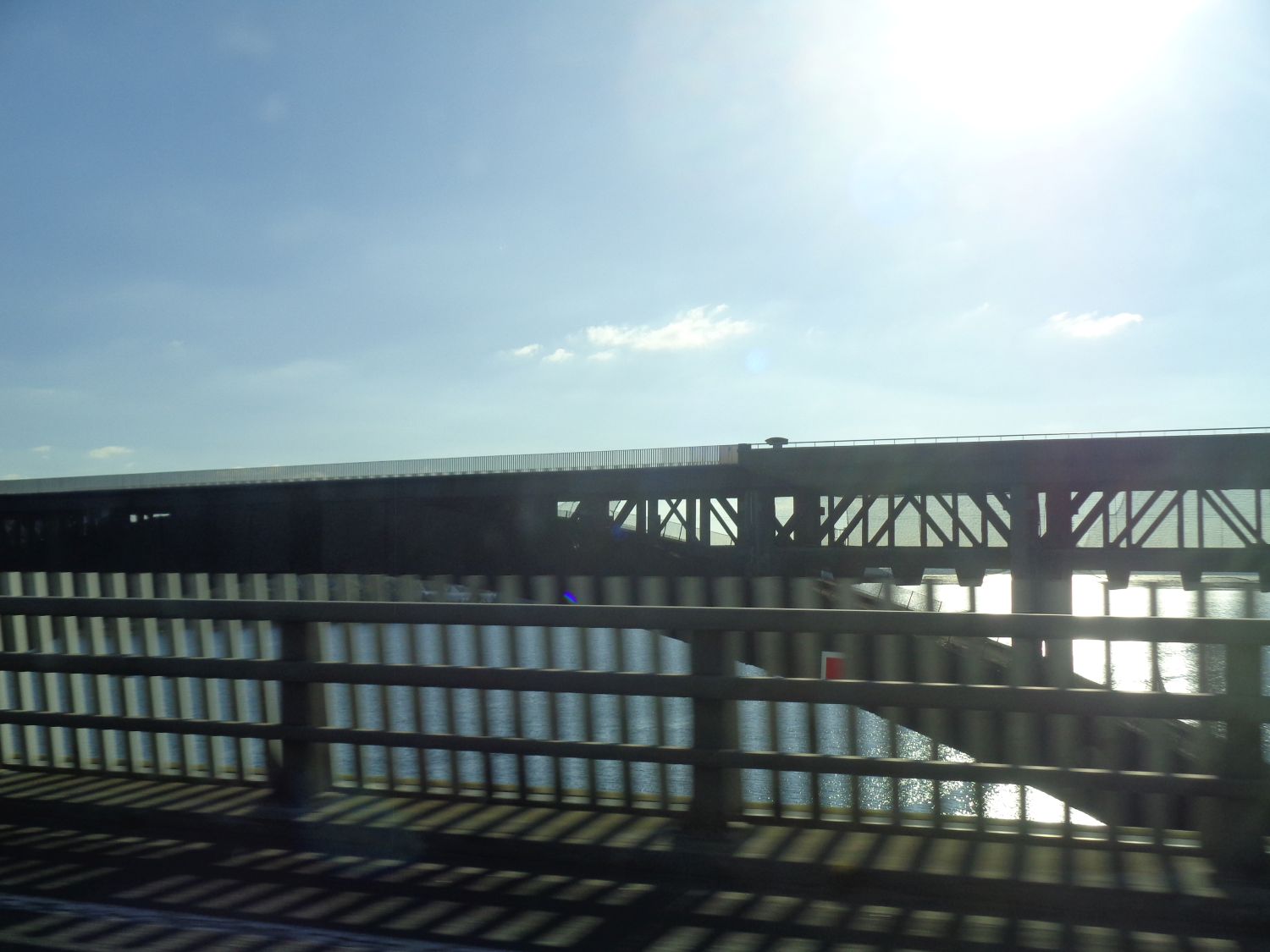
The Pont Albert-Louppe Bridge is a recessed arch bridge with a two-level deck. The upper level is for roads. The bridge’s arches held the world record span for concrete arch bridges at the time: 173 meters. The arches reach 27.5 meters above the water and more than 42 meters above the river bottom. The bridge is 888 meters long. The deck beam is 9 meters wide. At its ends stand four statues: “Léonard Peasant” and “Léonard Woman” (1930). At the other end of the bridge, two other statues representing Cornish people stand alongside them, all by sculptor René Quillivic,The Albert Louppe Bridge is now a promenade overlooking the Elorn river and Brest harbor.
In the 20C, Le Relecq-Kerhuon was crossed by major road transport routes since the construction of the Albert-Louppe bridge, crossed by the national road N165 ,the local Boulevard Léopold Maissin, then experienced many traffic jams; then the construction of the Brest-Quimper-Nantes N165 expressway, that of the Iroise bridge , and that of the Brest eastern ring road N265 ,put an end to traffic jams but compartmentalized the town into areas isolated from each other despite the few bridges, large roundabouts and interchanges allowing local service.
In the past, the crossing between the Léon and Cornouaille was made by steam ferry or by Landerneau. 1922: A project was born, the construction of a bridge. Construction began in 1926. The distance connecting the two banks was 700 meters. A gallery was built under the bridge to accommodate a railway line, which never saw the light of day. 1930 marked the completion of work on a reinforced concrete bridge measuring 888 meters long and 42.5 meters high. The Pont Albert-Louppe Bridge, first called the Plougastel Bridge and still called the first Plougastel Bridge, is a bridge crossing the mouth of the Élorn river in the harbor of Brest to connect the towns of Plougastel-Daoulas to Le Relecq-Kerhuon. Its construction, decided on September 22, 1922 and authorized by a law of July 2, 1924, took place between 1926 and 1930. In 1994, it was doubled, to ease traffic flow, by the Iroise Bridge (see post) which is almost parallel to it. The bridge takes its name from the former senator of Finistère and engineer Albert Louppe, as President of the Finistère General Council, who had secured the construction of this bridge a few years earlier.
A flagship of French technology, the bridge was inaugurated on October 9, 1930, by the President of the French Republic, Gaston Doumergue, and by the Mayor of Plougastel, Mathurin Thomas. Three days later, on the 12th, the bridge was blessed by the Bishop of Quimper, Adolphe Duparc, accompanied by 50,000 people. In 1944, during WWII, the nazis army destroyed the first arch of the bridge (on the Brest side), rendering it unusable by the Allies. In 1949, the bridge was reopened after widening and reconstruction. It was widened again in the 1960s. The Albert-Louppe Bridge was decommissioned for automobile traffic. It was reserved for two-wheelers, tractors and pedestrians. In 2019, due to the deterioration of the bridge, tractors, the last authorized motorized vehicles, were banned and sent to the Iroise bridge, while pedestrians no longer have the right to pass under the bridge, apart from the GR-34 on the Le Relecq-Kerhuon side.
A bit of history tell us that at the time of railway construction between 1862 and1865, the hamlet of Kerhuon and its manor were located on the eastern bank of the cove of the same name. The viaduct, as well as the station serving the hamlet of Kerhorre, to the west of the cove, then took this name. Following the commissioning of the station in 1865, the surrounding district was populated and took its name: Kerhuon. In the 16C, the hamlets of Le Relecq and Kerhorre belonged to the seneschalship of Brest and Saint-Renan. In 1896, the fishing and working villages of the essentially rural town of Guipavas separated from it. On March 30, 1896, Le Relecq-Kerhuon was established by law as a separate town. On April 8, 1896, the Official Journal published the great news. At the end of the 19C beginning of the 20C, the coastline of Le Relecq-Kerhuon, especially on the Landerneau river side, became a Riviera because it benefited from a microclimate and westerly winds by Pointe Sainte-Barbe, becoming a highly sought-after site for the aristocracy and bourgeoisie of the time.
In the company of a morganatic wife from Finistère, Rosalie Léon, she met a troupe of actors whose tour she followed to Paris where she became a cabaret singer before becoming a fashionable Parisian actress. The Russian prince Pierre de Sayn-Wittgenstein, son of Louis-Adolphe-Pierre zu Sayn-Wittgenstein, and himself a former lieutenant general and aide-de-camp to Tsar Alexander III, noticed her during a show and fell madly in love with her. She became his officially declared mistress, known as “Princess Léon” During the summer of 1862, the couple came to Guipavas and the prince bought a property at the place called “Beau-Repos” and another in the district of Camfrout in Kerhuon. Subsequently, the couple came to settle in the hamlet of Kerbar where he had the castle of Kerléon built between 1883 and 1886, surrounded by vast gardens and magnificent greenhouses, then the princely Russian cottage of Kerjulien nearby. the good Russian princess”, suffering from tuberculosis, died on August 28, 1886 in Ems, a spa resort where she had gone to “take the waters”; Her inconsolable husband died a few months later on August 19, 1887 in his castle of Kerléon in Le Relecq-Kerhuon but his coffin was transferred in 1892 to the family vault on May 26, 1892 in Schillingsfürst (Bavaria). Her twin sister, Marie of Sayn-Wittgenstein-Berleburg, Princess of Hohenhole, inherited the vast estates and, among others, the Kerléon estate. She was married to the Bavarian Prince Chlodowig-Alexis of Hohenhole-Schillingfürst, Duke of Ratibor and Corvey. But the Princess of Hohenhole, victim of the confiscation of foreign property by the Tsar in 1887, had to accept in 1889 the sale by liquidation of the Kerléon estate. But the princess, having reserved for herself during this sale a picturesque part of this vast estate, the castle of Kerjulien, continued to come there from time to time. The Chancellor of Germany stayed at Le Relecq-Kerhuon on several occasions, for example he came in May 1900.
Other aristocratic or bourgeois residences were built during the second half of the 19C or the beginning of the 20C, for example the Gué Fleuri manor, and Kerhuon castle. During the Great War or WWI, the population took part in the war effort and local industries linked to National Defense experienced very high activity. During WWII ,the town suffered some bombing. Other things to see here are the Lossulien Manor preserves vestiges dating from the 15C in a green setting. The Notre-Dame du Relecq Church, built from 1890. The Lossulien Chapel: it dates from the 16C and has a bas-relief representing Saint Suliau, hence its name.
The town of Le Kelecq-Kerhuon on its heritage : https://www.lerelecqkerhuon.bzh/environnement-et-cadre-de-vie/histoire-et-patrimoine/
The Brest Metropolie community on viewpoints see bridge: https://www.brest-metropole-tourisme.fr/explorer-brest-metropole/nos-tops/top-10-points-de-vue/
The Finistére dept 29 tourist office on exceptional views : https://www.toutcommenceenfinistere.com/en/exceptional-landscapes/
The Bretagne region tourist office on Brest (see bridges) : https://www.tourismebretagne.com/destinations/les-10-destinations/brest-terres-oceanes/brest/
There you go folks, now I feel better having this unique post in my blog, The town of Le Kelecq-Kerhuon needs more time indeed, worth the detour ,me think, Again, hope you enjoy the Pont Albert Louppe !!! as I.
And remember, happy travels, good health, and many cheers to all !!!

 Paris1972-Versailles2003