
And here I take you again,way north of me to the tip in the peninsula of my lovely Bretagne. One of the off the beaten path towns of the Finistére ,and seldom over look for its distance from the mainstream. However, it is worth a detour for its sea and Breton traditions. I took new pictures from my trip this week that should be in my blog for you and me, Therefore, let me tell you on this is Landéda-L’Aber Wrach !!! Hope you enjoy the post as I.
The town of Landéda is in the Finistère department no 29, of my lovely Bretagne region ,and in my belle France. A coastal town on the English Channel coast, in the heart of the Côte des Légendes, Landéda forms a peninsula between two abers, Aber-Wrac’h to the north and Aber-Benoît to the south, the very jagged end of which itself forms the Sainte-Marguerite peninsula. It has 15 km of coastline, The fastest way to get here is from the N12 highway east west or the N165 highway north south Also, the D13 road going from Brest – Gouesnou – Bourg-Blanc – Lannilis and the D128 road to Landéda, The town is 245 km from Rennes 29 km from Brest ,151 km from Saint Brieuc , 68 km from Morlaix, 320 km from Nantes ,and 183 km from my current home from where I came along the D16/D33 local roads to connect with the N165 highway dir Brest here get around bearing right on the beltway N265 road going under the N12 highway continue becoming the D267 road at rondpoint des lapins or roundabout of rabbits bear left onto the D67 road on next roundabout Charles de Gaulle bear right onto the D13 dir Lannilis before entering this town on the roundabout bear left onto the D28 or Rue de Verdun continue same road into the Rue de la Libération until roundabout Avenue du Général de Gaulle bear left onto the D113 road on next roundabout Rue du Cosquer bear right onto the D128 road or Rue de la Roche continue to next roundabout on left garage Renault bear right onto the D128A road or Bon Plaisir continue same road Rue de la Mairie to around the Church Saint Gongard at place d’Europe into Rue de l’Armorique find parking on your right hand side, You see the picturesque mairie or city hall below.

The town of Landéda has several islands in its municipal territory such as Île Guénioc Island, located 2 km from the coast, it is approximately 400 meters long and 160 meters wide at its widest point. Guénioc Island is of great interest due to the numerous archaeological remains preserved in a remarkable way. The presence of cairns containing dolmens, the construction of which is estimated at 4,600 years BC (Neolithic), makes this place among the oldest monuments in Europe Île Garo, Île Roch’Avel where the remains of a galgal, a megalithic tumulus, remain Île Tariec iit bears the name of Saint Tariec and was inhabited, having its chapel and cemetery. In 1842 the island was cut in two by erosion accelerated by sand extraction, hence the Grande Tariec and Petite Tariec, the two current islets; Île Cézon is accessible at low tide and is part of a group of well-known islets. The fortifications of Fort Cézon surrounding it were built by Vauban from 1694 and then transformed over the centuries until WWII, during which 17 blockhouses were erected., and Île Stagadon , located at the entrance to Aber-Wrac’h, is administratively part of the town of Plouguerneau. The islands opposite Aber Wrac’h, also called the Lilia Islands archipelago, Île Wrac’h and its lighthouse. Île Venan, Île Vierge . Île Terc’h or Erc’h (aka Île aux Americans).Île La Croix , Île La Malouine. Île Enez Vihan. Petites îles Vrac’h, Île Leac’h Venn ,and île Valan.
The artisanal expertise of bakers for 17 years, the Boulangerie Tour de Mains have shops in Lannilis and Landéda,open Tuesday to Sunday lunchtime. Discover their Breton specialties such as the Kouign-amann, which combines softness and crunchiness to conquer your palate. Also taste their house specialties such as the Iroise (with its delicious chocolate mousse and salted butter caramel),and the The Raspberry Diplomat (its generous Bavarian sponge cake and light raspberry and meringue pieces). We went for light lunch at their Landéda City center location at Boulangerie Tour de Mains 19 Place de l’Europe, It was wonderful as usual in our bakeries/pastry shops, good deal for the road warrior in us !

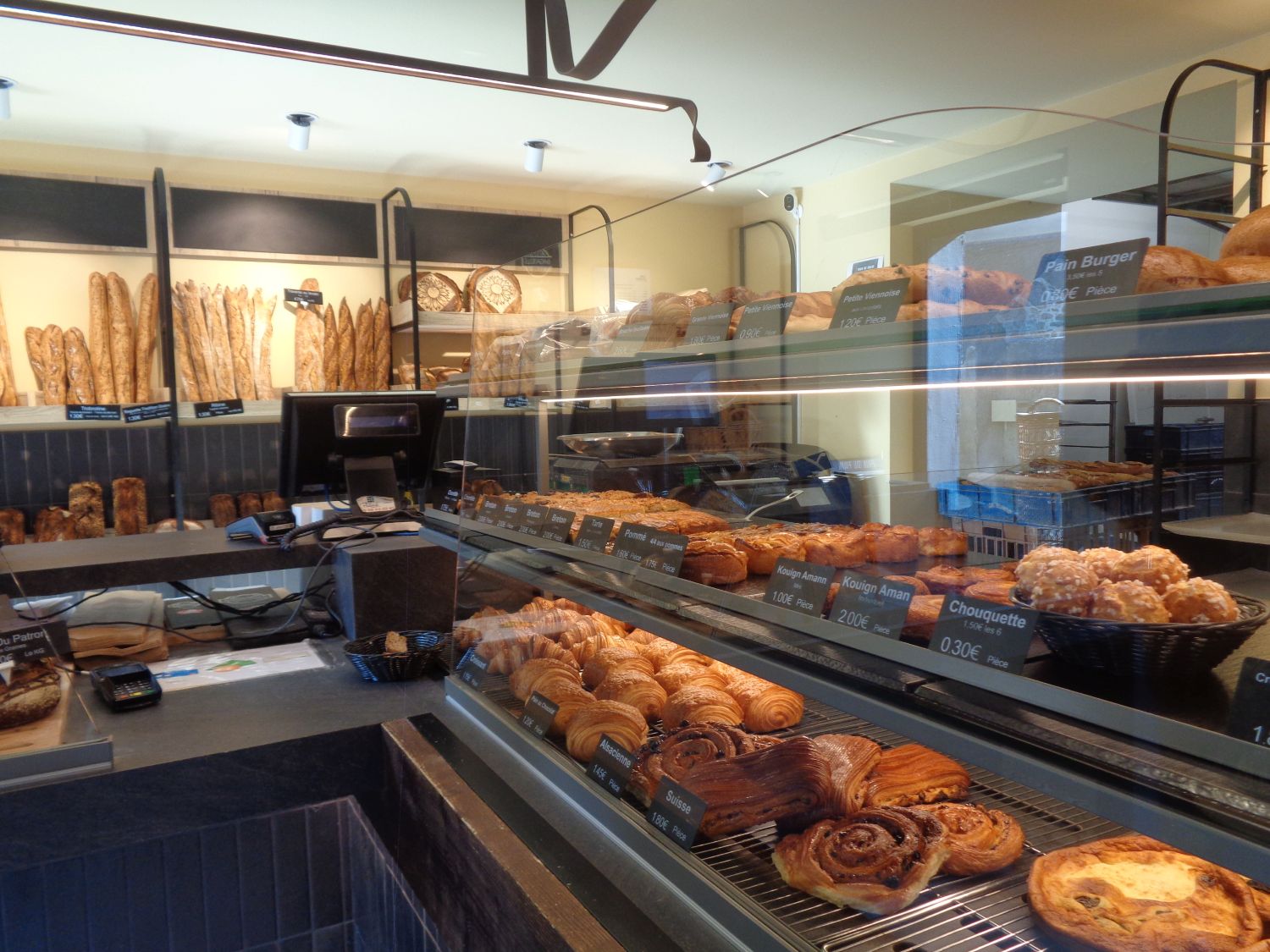
The official Boulangerie Tour de Mains of Landéda : https://www.boulangerietourdemains.fr/
A bit of history I like tell us the Aber-Wrac’h region, in Gallo-Roman times, was the end point of the Roman road coming from Carhaix and Vorganium. A port town of some importance, not located and not precisely identified, was therefore there in Gallo-Roman times, perhaps Gesocribate, a port in northwestern Gaul mentioned by the Peutinger Table which places Gesocribate at Aber-Wrac’h, but which many historians place rather at Le Conquet, or even Brest. The town of Landéda – L’Aber Wrac’h was built under the influence of the sea and the activities associated with it. Landéda formerly belonged to the parish of Ploudiner and gained its autonomy in the 14C, thus dividing the parish of Ploudiner around 1330 into three: Landéda, Lannilis and Broënnou, which the latter was then united with Landéda and annexed in 1829. During the interwar period, two American yachtsmen used to frequent the restaurant “La Baie des Anges” at Aber-Wrac’h to taste lobster mayonnaise. But one day they arrived unexpectedly without warning; The innkeeper then decided to pan-fry and flambé the lobsters and serve them with a garnish of vegetables. He told his customers that he was naming his new recipe “lobster à l’Américaine” in their honor. However, this story is highly contested; the most popular theory attributes the creation of lobster à l’Américaine to Pierre Fraysse, a cook born in Sète who, returning from the United States, opened a restaurant called Chez Peter’s in 1854. On June 19, 1940, the Nazis arrived in Landéda with a motorcycle, a small car, and a horse-drawn cannon. The next day, it was the turn of the motorized elements. 700 stayed in the town, with 200 horses. The boats and bicycles were requisitioned, and the school was occupied by a Nazi garrison. A resistance network (Jade-Fitzroy network) recovered English airmen at Aber-Wrac’h and helped them return to England from the Sainte-Marguerite peninsula. On February 6, 1944, Aber-Wrac’h was bombed. Since 1957, a Herlford-River-L’Aber-Wrac’h yacht race has been organized every year to commemorate the links then established between the two sides of the Channel.
The local Abers tourist office on the Aber Wrac’h : https://www.abers-tourisme.com/decouvrir-les-abers/aber_wrach/#section02
The Bretagne region tourist office on the Abers and lighthouses trails : https://www.brittanytourism.com/destinations/the-10-destinations/brest-terres-oceanes/the-abers-and-the-lighthouse-trail/
The Abers country site on the port of Aber Wrac’h : https://www.paysdesabers.bzh/services-et-demarches/peche-et-nautisme/port-de-laber-wrach/
The town of Landéda on its heritage : https://www.landeda.fr/decouvrir/
There you go folks, another dandy with very nice views of the channel and beautiful secluded creeks and beaches we like it. Looking forward to be back, eventually. Again, hope you enjoy this post on this is Landéda-L’Aber Wrac’h !!! as I.
And remember, happy travels , good health, and many cheers to all !!!

 Paris1972-Versailles2003