
I have to tell you again on my dear Versailles,always will be there for me, Many memorable times spent in my former city, If Paris is worth a Republic, Versailles is worth a Kingdom ! This is Versailles where we spent the first 9+ years of our lives in France, The city of Versailles is the capital of the department 78 of Yvelines sin the Île de France region of my belle France,I found me again older pictures in my cd rom vault that needs to be in my blog for you and me. The Orangerie is one that is very nice, part of the inside of the palace/museum of Versailles but actually a different history and even before there was a castle. I like to tell you a bit more of the Orangerie of Versailles !!! Hope you enjoy the post as I.

The Orangerie of the Château de Versailles was built by Jules Hardouin-Mansart between 1684 and 1686, it replaces the one built by the Le Vau in 1663 , therefore before the beginning of the works of the palace/museum! The Orangerie (see post) to the south of the Parterre d’Eau of Louis Le Vau was destroyed, in order to adapt the place for a new structure, designed by Hardouin-Mansart. In addition to the orangerie, the staircase of the hundred steps, which facilitates access to the gardens and the Piece d’Eau des Suisses,(see post), and the Parterre du Midi were designed and built at that time, giving to the southern gardens of the castle their current configuration and decoration. The orangery houses in winter more than 1,500 shrubs in boxes, mostly orange trees ,about 900, but also lemons, grenades of which some are centenaries, laurels, myrtles, also, roses all with great big windows laurels, In summer, from June 1 to October 10, orange trees and other boxes are exposed in the Parterre Bas. The orangery is made up of a central gallery 150 meters long, the facade of which is oriented south. This gallery is framed by two side galleries located under the escaliers des Cent Marches or staircases of the hundred steps. The whole, lit by large arched windows, enclose the Parterre Bas or Parterre de l’orangerie. The Parterre Bas is delimited on its fourth side, to the south, by a balustrade overlooking the road to Saint-Cyr-l’École (D10). This separates it from the pièce d’eau des Suisses. In its center is a large circular basin, surrounded by six pieces of lawn. The Orangerie houses the proserpine kidnapping statue by Pluto (1696) by François Girardon.
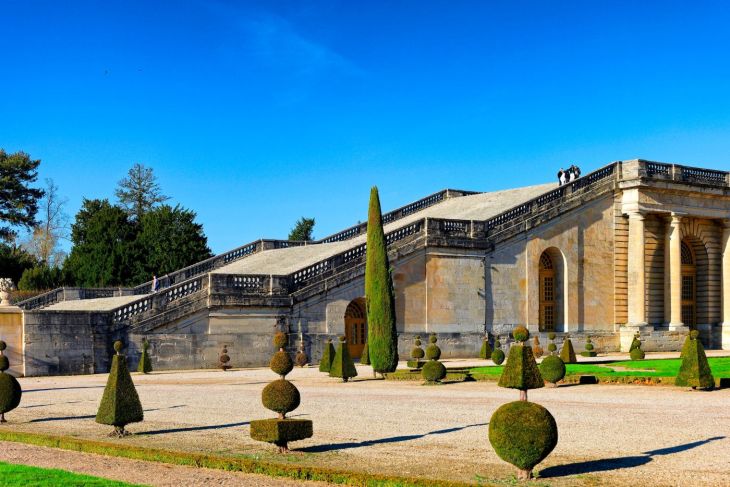
The escaliers des Cent Marches or Hundred Steps stair seen from the N10 road dir St Cyr l’école. The two Stairs of the Cent Marshes or hundred steps of the Domaine de Versailles frame the central gallery of the Orangerie. Two smaller side galleries are located under these stairs. The one hundred steps stair is in fact 103 and 105 steps whose proportions (13 cm x 39.5 cm or about 5,1 by 16.6 inches)) accommodate the steps wonderfully, to the point that it is as easy to climb as to descend. Two return galleries end under the monumental staircases of the hundred steps which act as buttresses to the whole. The walls, 4 to 5 meters thick (about 13 to 16.5 feet), the double glazing of the bays and the exposure to the South allow to maintain the winter a temperature which does not drop below 5 ° C or about 41F.
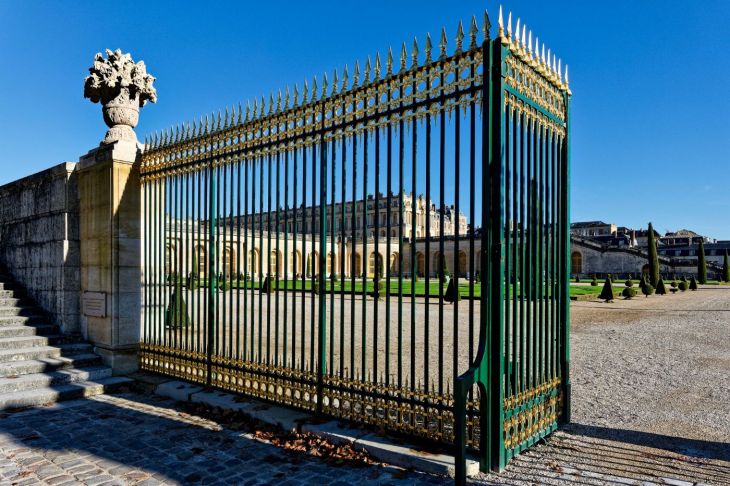
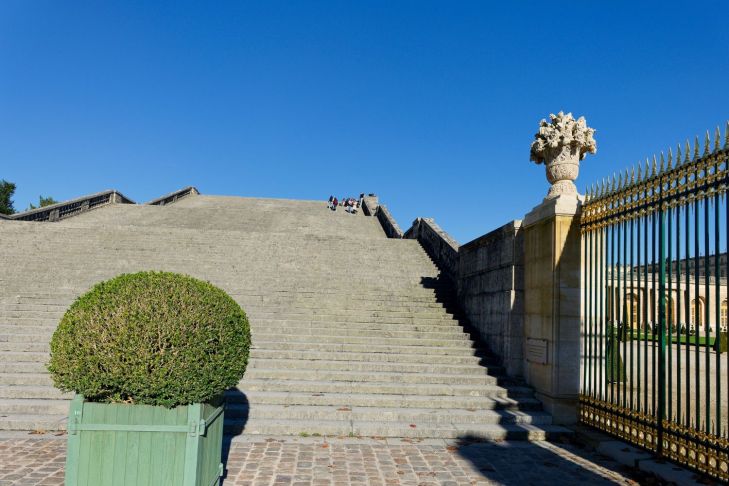
Inside the Orangerie you will find, the most extraordinary collection of plants of all time, more than 2000 pots of lemon, grenades, laurel roses, oranges coming from Portugal, Spain, Italy, and the Vatican. During the winters these treasures were preserved thanks to the thick walls of 5 meters and the double window panning, even able to keep the Connétable de Pampelune planted in 1421!!! You can see inside the baths or vasque octogonale done in 1674. done on a piece of marble de Rance, it is an octogonal of 3 meters wide and 1 meter deep. It is difficult to imagine taken a bath here as it would be impossible to heat in those years. The vase took several turns in different places until finally arriving at the Oragerie in 1934!
By retaining water and nutrients, and using pruning techniques, French gardeners were able to make citrus trees bloom throughout the year, to the delight of Louis XIV. Citrus-based motifs will become a theme in sculpture, mosaic, embroidery, weaving, paintings, poems or songs throughout history. Orange flowers remain popular as floral ornaments in weddings. Each year at the end of November, the Orangerie floor is empty. Oranges, lemons, palm trees, oleander, pomegranates in crates are mounted in the “berlinguettes” to join their winter refuge. Access by very small doors, “flaps”. They were pierced so as not to open the big doors and prevent the cold from getting into the building. The orangerie, oriented to the south, is buried underground so no air flow , and still has the double chassis of its period mirrors. Attributes that ensure a stable indoor temperature (between 5 and 8 ° Celsius or about 45F) in winter. Indoors, all this lush, almost tropical vegetation, with these hundreds of delicate trees from Italy, Spain, Portugal, disturbs the smell. Strange and delicious sensation that the cold on the face combined with these fragrances come from the warm, sunny countries. From October to May, oranges, lemons, pomegranates and palm trees winter in this cathedral of 13 meters high built partly underground. Inside, the scents are intense or delicate.
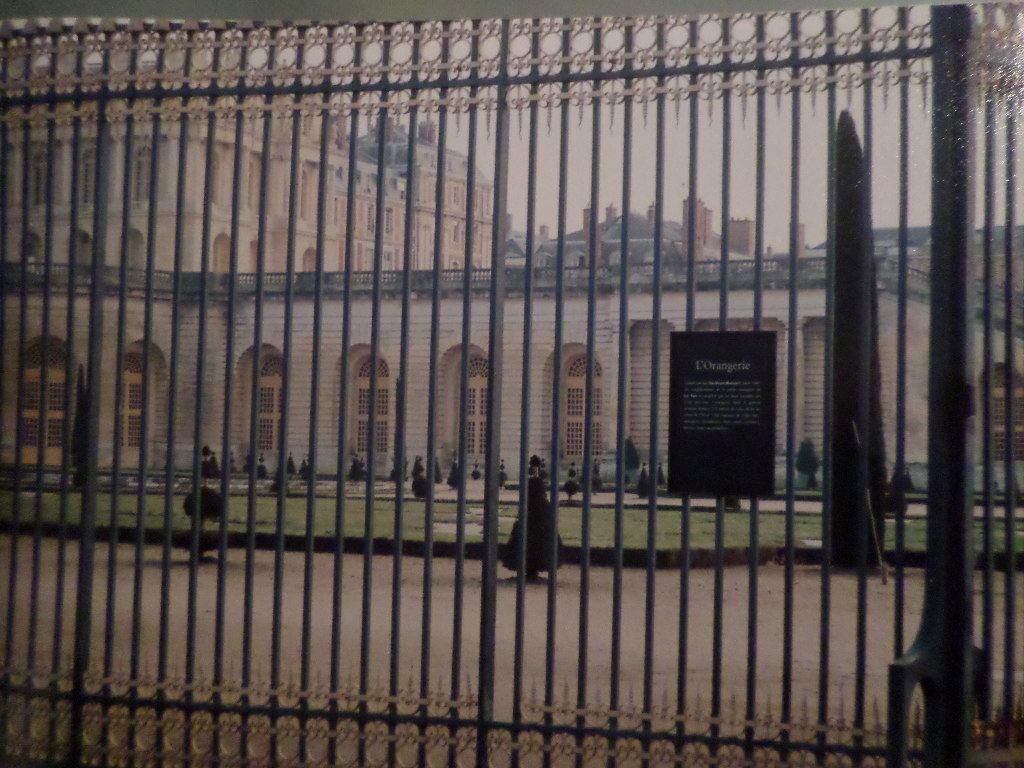
This building of the Orangerie is located under the Parterre du Midi , illuminated by impressive arched windows, consists of a central vaulted gallery, 150 meters long, flanked by two wings of 117 meters supporting the two staircases called the Hundred-Steps(cent marshes) . The walls, to keep the heat, are so thick, five meters, that they give the impression that we are cut off from the cold and the noises from the outside, disconnected from the universe Versailles. The ensemble, illuminated by large, curved windows, constricts the low floor or the flowerbed of the Orangerie. A beautiful place that I like a lot ,and I walked around a lot of times. This orientation, a thickness of walls more than 5 meters and precautions taken in winter-for example, under the old regime, gardeners came back by large chattier to avoid opening large windows doors whose joints were caulked with straw made that the
Orangerie has never experienced a freezing ,the low floor is bounded on its fourth side, to the south, by a balustrade overlooking the road to Saint Cyr l’école (D10). My route a lot of time to see my boys girlfriends lol! This one separates it from the pièce d’eau des Suisses . In its center is a large circular basin, surrounded by six pieces of grass. Under Louis XIV, it was adorned with some sculptures today all at the Louvre Museum (of course…). The great orangerie, by its dimensions, was transformed into a prison for the Communards in 1871, and became the obligatory step between the Satory garrison, where the military judgments were held.
The official Château de Versailles on the Orangerie: https://en.chateauversailles.fr/discover/estate/gardens/orangery#the-building
The official Château de Versailles on the park: https://en.chateauversailles.fr/discover/estate/park
The Versailles tourist office on the gardens : https://en.versailles-tourisme.com/the-versailles-gardens.html
There you go folks a must to see while in Versailles, it will take you more than a day to see it all , I would give it 3 and that is just the Domaine of Versailles. Need more to see the rest of the city wonders. The Orangerie is a natural history of Versailles, and France! Again, hope you enjoy this post onthe Orangerie of Versailles !!! as I
And remember, happy travels, good health, and many cheers to all !!!


