
There is so much architecture and history around here enough for a blog on its own! Let me go again into my road warrior mode and take you down to lovely Carnac. I have written on the megaliths stones before but not much on this one which deserves attention and it is very close to me. Therefore, let me tell you a bit on the Tumulus de Kercado of Carnac !!! Hope you enjoy it as I.
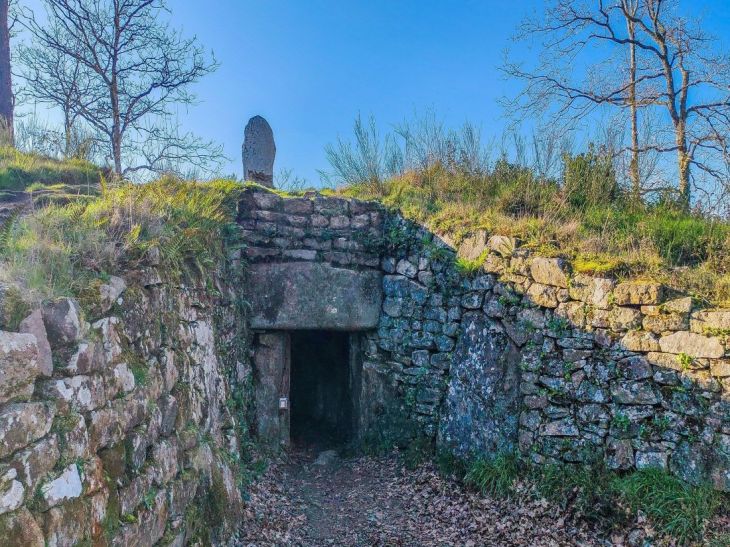
Its in the woods so need a bit of walk too but piece of cake, we take south the D768 towards Carnac by the la trinitaine store on the roundpoint of Kergroix take the D186 passing other alignments such as Kerlescan,turn right on the D196 and take the road of Kercado stop front of a private mansion and walk to the tumulus of Kercado, You see a panel guiding you « tumulus », It is 21 km from Vannes, and 24 km from my current home.
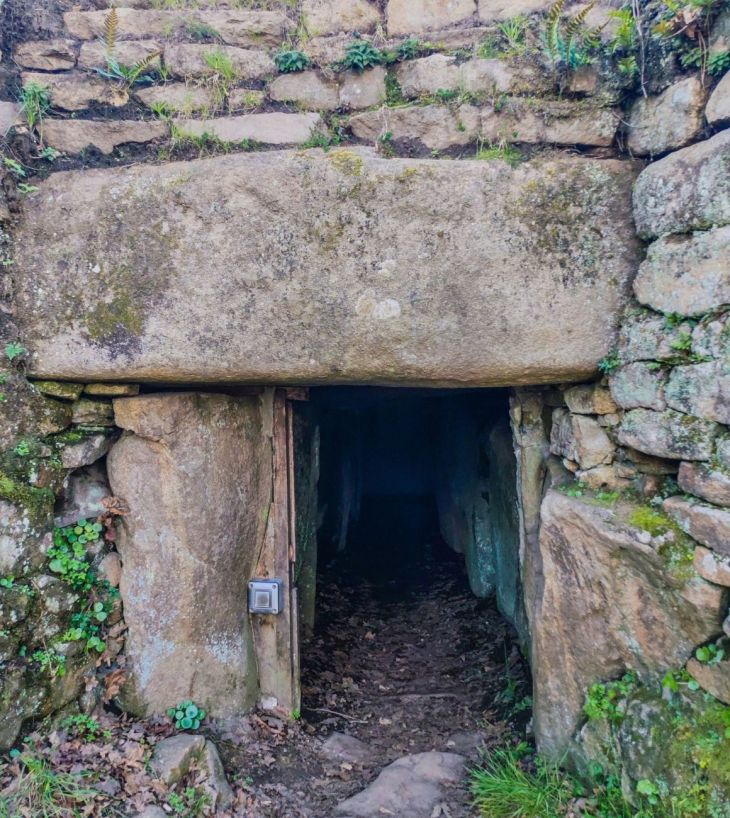
The Tumulus de Kercado is a megalithic site located near the village of Kercado ,part of the City of Carnac. It is one of the largest and most impressive burial mounds in the region. Carnac is famous for its standing stone alignments, but the tumulus is also a major part of the ancient history of the area. This burial mound dates back to the Middle and Late Neolithic periods, and was probably used as a burial site for important individuals. The mound consists of a large mound and contains burial chambers built with large stones. Archaeological excavations have uncovered many objects, such as pottery and tools, providing valuable insight into life at this time. Visitors to the tumulus can explore the mound and its burial chambers, providing insight into the social organization and burial practices of prehistoric peoples. This site bears witness to the technical skills and advanced social organization of the societies of the time. As the monument is located on a former lordship estate, it is likely that this situation helped prevent the cairn from being dismantled by local residents to recover the stones that constitute it. The site is said to have served as a hiding place for the Chouans in the war of the west vs the French revolution.
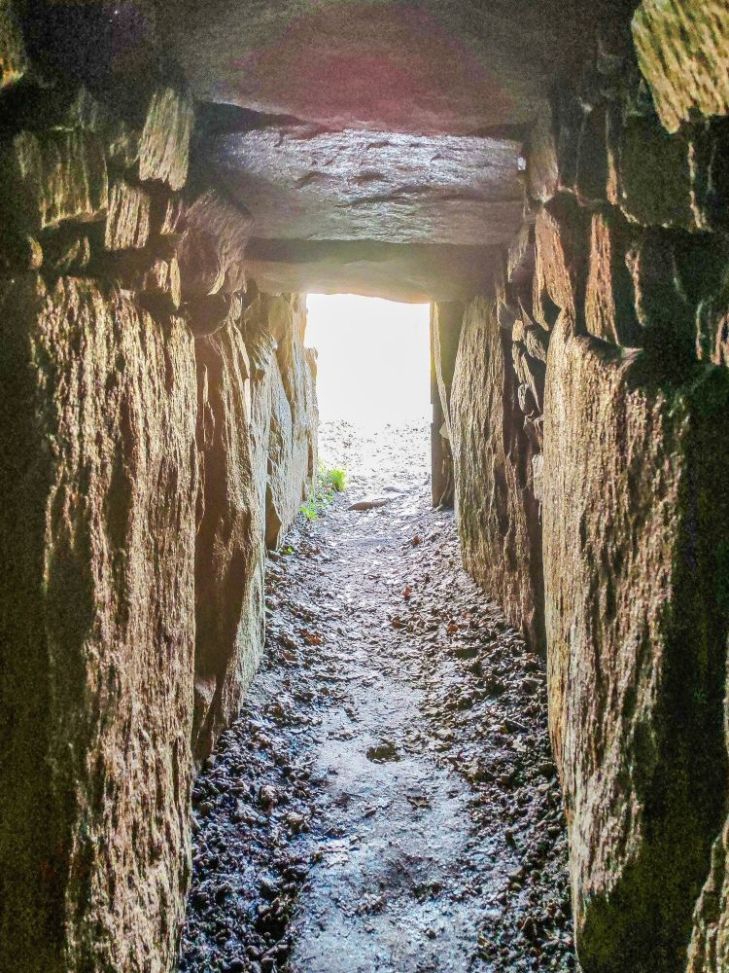
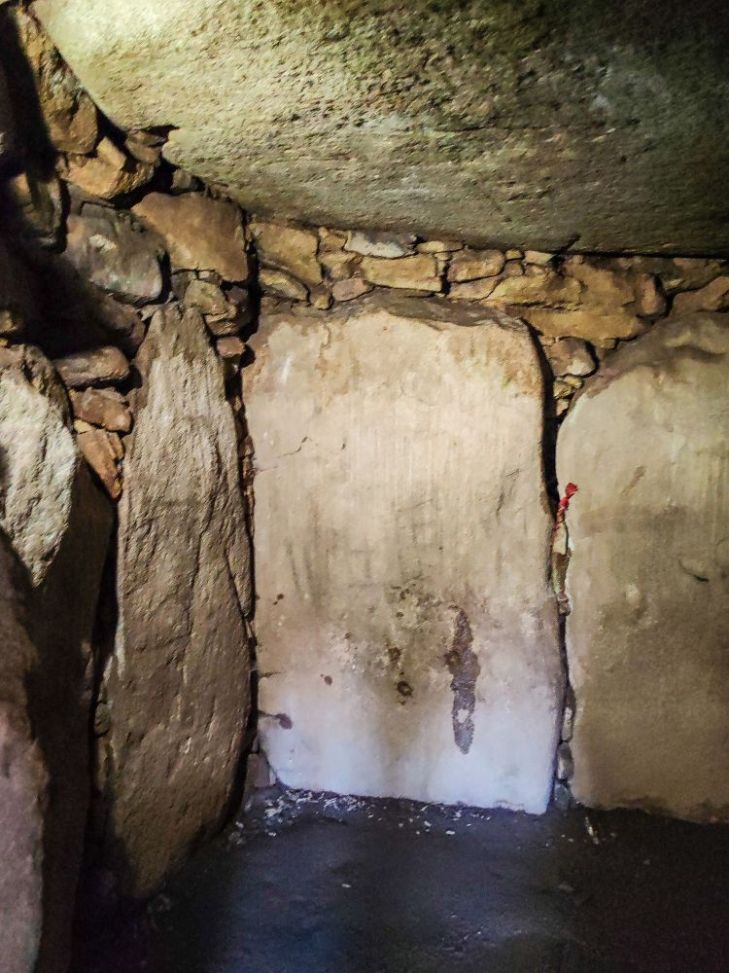
A bit of history I like tell us that in 1863, the cairn was excavated by René Galles, at the time, access to the inside of the cairn was via an opening made at the top in the north-east corner of the chamber, Better description from the official site tell us that the cairn is circular in shape. It measures 30 meters in diameter and is approximately 3.50 meters high. The cairn is made entirely of dry stones without any intervening layers of earth. The entire cairn is surrounded by a facing wall. The outer perimeter of the cairn has been paved fairly regularly with stones placed flat over a width of 3 meters on the east side, 4 to 6 meters on the west side and 4 meters on the south side. The cairn contains a corridor dolmen, opening to the south-southeast, comprising a single chamber. The corridor is delimited by nine orthostats (five on the north side, four on the south side), partly surmounted by dry stone walls. It measures 7.50 meters long and has a width ranging from 0.90 meter at the entrance to 1.20 meters near the chamber. The whole is covered with five roofing tables. The chamber is quadrangular in shape 2.90x 3 meters wide. It measures 2.30 meters high in the center, The chamber is delimited by eight orthostats surmounted by fairly crude walls, all covered by a single roofing slab. The floor of the corridor and the chamber were paved in the centre of the chamber a cavity, dug in the underlying rock (0.60 m x 0.40 m x 0.15 to 0.20 meters), Two slabs of the corridor as well as the southern support of the entrance to the chamber have an engraved decoration of the reticulated type, The northern support of the entrance to the chamber has the shape of an anthropomorphic silhouette. The cover slab of the chamber is engraved with an plow axe type motif, placed near the supports, which suggests a reuse, The study of human bones (adults and children) and animal bones (birds). Most of these bones showed traces of burning, The diversity of the furniture discovered corresponds to a long period of frequentation from the Middle Neolithic to the Late Neolithic;a carbon 14 dating on a charcoal indicates a period between between 5200 BC and 4360 BC, however, further study in 1979 gave a dating of 4670 BC.
The Carnac tourist office on the dolmen of Kercado: https://www.carnactourism.co.uk/fiche/dolmen-de-kercado-en
The town of Carnac on the megaliths heritage:https://www.carnac.fr/Territoire-d-exception/Capitale-des-Megalithes/Patrimoine-megalithique-unique
Theofficial Menhirs of Carnac on practical information: https://www.menhirs-carnac.fr/en/visit/practical-information#services-and-conditions-of-visit
There you go folks, another wonder of our world very easy accessable from the expressway N165 to the D768 direction Carnac and right in front of the bowling alley on your right coming from Auray are the dolmens! Again, hope you have enjoy this post on the Tumulus de Kercado of Carnac !!! as I.
And remember, happy travels, good heatlh, and many cheers to all !!!

 Paris1972-Versailles2003