
I am again to tell you about more streets of my eternal Paris. I have many many posts on Paris and several on the streets of the most beautiful city in the world. I have come up with pictures from cd rom vault that should be here for you and me. As always thank you for following my blog some since 2010. Therefore, here is my take on the streets of Paris, part XV !!! Hope you enjoy it as I.
The Rue du Chevalier-de-La-Barre is a street on the Butte Montmartre in the 18éme arrondissement of Paris. It begins at 9, rue Ramey and ends at 8, rue du Mont-Cenis. In its first part, it slopes down to rue Lamarck and is closed to vehicles. From rue Lamarck to the intersection with rue de la Bonne, stairs provide access to its highest point. It becomes a street authorized for vehicles again up to rue du Mont-Cenis. It was formed by the union of two roads, the rue de la Fontenelle, which went from rue Ramey to rue de la Bonne, and rue des Rosiers, which ended at rue du Mont-Cenis. Rue des Rosiers was merged with Rue de la Fontenelle by the prefectural decree of April 2, 1868: this put an end to an unfortunate homonymy (due to the annexation of the village of Montmartre to Paris in 1860) between this “rue des Rosiers” in Montmartre and the “rue des Rosiers” in the 4éme arrondissement of Paris. This rue de la Fontenelle was renamed rue de La Barre by the decree of November 10, 1885, name rectified to rue du Chevalier-de-La-Barre by the decree of June 24, 1907 ,Remarkable buildings here me think are at No. 34: Carmel of Montmartre , located at the foot of the bell tower of the Basilica of the Sacred Heart of Montmartre, this is a community of nuns of the Catholic Church living according to the spirituality of Carmel and the spirit of Saint Teresa of Avila, No. 40: City of the Sacred Heart. This is a path of stars is placed in the ground, reproducing the constellations. Made up of small lamps, it lights up at dusk. 85 meters long and 12 meters wide, it begins at 40, rue du Chevalier-de-la-Barre and ends in a dead end. Off of it at no. 3: the Saint-Benoît priory, founded in 1984, it houses the congregation of the Benedictines of the Sacred Heart of Montmartre. No. 61: in the 1965 film, Mata Hari, agent H 21, Claude Rich is arrested on a café terrace, today the Au Petit Creux, at 8 Rue du Mont-Cenis; Parc Marcel-Bleustein-Blanchet, formerly Parc de la Turlure.

The Paris tourist office on the 18éme arrondissement : https://parisjetaime.com/eng/article/explore-paris-s-18th-arrondissement-a832
The Rue Montorgueil is in the current 1er and 2éme arrondissements ,and in the Montorgueil quartier or neighborhood of Paris, its southern section in the 1er arrondissement, its northern section in the 2éme. It begins in the south, behind the Saint-Eustache Church, at 2 rue Montmartre and 124 rue Rambuteau, and ends 360 meters to the north at the intersection of 1 rue Léopold-Bellan and 59 rue Saint-Sauveur. To the north, Rue Montorgueil is extended by Rue des Petits-Carreaux (see post), The Rue Montorgueil is served by metro line 3 at Sentier station and line 4 at Les Halles and Étienne Marcel stations. The street has been called “Mont Orgueilleux” since the 13C because it led to a hill, or a small hill , whose summit is occupied by Rue Beauregard. According to Victor Hugo’s novel (Les Misérables), the street owes its name to the instrument used to carry heavy loads up a low hill, the jack, formerly called l’orgueil, literally the pride, The first mention of Rue Montorgueil, dates from December 17, 1498. From the opening of the Poissonnière Gate in the walls of Louis XIII in 1645, the street was also the arrival point for catches from the ports of northern France , particularly oysters, for which a market was located on the site of Rue Étienne-Marcel. It is mentioned under the name of “rue de Montorgueil” in a manuscript dated April 22, 1636, Some remarkable buildings on it me think are that at Nos. 38 and 40, rue Mauconseil: restaurant “L’Escargot Montorgueil”. Created in 1832 and specialized in Burgundian cuisine and snail-based recipes, its clients included Marcel Proust, Sarah Bernhardt, Sacha Guitry, Pablo Picasso and Charlie Chaplin. The interior is on the Second Empire style, At No. 51: 18C building housing, on the ground floor, the pâtisserie Stohrer or Stohrer pastry shop founded in 1720. The origin of the rum baba, this shop, famous at the end of the 19C, has decorative panels by Paul Baudry. Several painters have depicted it. No. 64: entrance to the inn “Le Compas d’Or”, established here since the 16C, whose building located at the corner of rue Marie-Stuart included nos. 64 to 74 located inside the courtyard then included a former and vast shed housing coaches leaving for Dreux, Creil and Gisors; its framework, resting on masonry pillars, reaches 15 meters in span and extends to about 20 meters in depth. In “The Belly of Paris”, Émile Zola mentions the establishment. Kléber Bénard and Jean-Marcel Poyer, members of Bonnot’s gang, shared a room there from January 2 to February 6, 1912; the latter was arrested there by the police. During the second half of the 19C, the building also housed the then-renamed “Philippe” restaurant. The complex was demolished in 1927 to make way for the current building. No. 67: On January 4, 1750, Jean Diot and Bruno Lenoir ,the former a 40-year-old servant; the latter a 21-year-old shoemaker were surprised by a watchman “in an indecent posture and in a reprehensible manner.” Arrested and then tried, they were sentenced to be burned alive in Place de Grève on the following July 6. As a gesture of clemency, they were secretly strangled before smelling the fire. These were the last people executed in France for homosexuality. Since October 18, 2014, a plaque placed on the road at the intersection of rue Bachaumont has paid tribute to the two men. Nos. 73 and 1, rue Léopold-Bellan: a corner building, in the Rococo style, built between 1743 and 1746 for the master mason Étienne Regnault, whose initials can be seen on the ironwork support bar at the windows of the first three floors; at the corner of these streets stands a History of Paris sign. Nos. 78 and 73-75, rue Greneta: restaurant “Le Rocher de Cancale” ,Pierre-Jean de Béranger a French songwriter, born in this street In the arts : Victor Hugo evokes rue Montorgueil in “Les Misérables” (1862) ,In “Le Ventre de Paris” (1873), Émile Zola cites the inn “Le Compas d’Or” located at no. 64 Rue Montorgueil is a painting painted in 1878 by Claude Monet. It represents the street filled with a multitude of French flags on June 30, 1878, the closing day of the Universal Exhibition and the celebration of the National Day.

The Paris tourist office on the Paris Centre arrondissements 1-4 : https://parisjetaime.com/eng/article/explore-the-centre-of-paris-a846
The Place de Catalogne is a circular square located in the 14éme arrondissement of Paris. It is located at the crossroads of Rue du Commandant Mouchotte, Rue du Château, Rue Vercingétorix, Rue Jean Zay and Rue des Cinq-martyrs-du-lycée-Buffon, near Gare Montparnasse. In a neoclassical style with columns and pediments, it includes two semicircular buildings. Its style is a contemporary reinterpretation of classical French architecture, built by the architect Ricardo Bofill from 1983 to 1986. It includes 574 social housing units. The square is surrounded by several contemporary buildings such as in Nos. 1 to 19: Échelles du Baroque, Ricardo Bofill (1985); Nos. 21 to 25: building, Maurice Novarina (1988); Hôtel Concorde Montparnasse; Nos. 2 to 18: Building, Ricardo Bofill (1985). This site is served by metro lines 13 from Gaité and Pernety. It takes its name from Catalonia, the autonomous Spanish community where Barcelona architect Ricardo Bofill, the designer of the architectural complex built around the square in the 1980s, hails. Architect Ricardo Bofill was therefore entrusted with the project of creating buildings reflecting this “new” neighborhood. A sensible and logical choice for this Spanish architect, who thus revives the long tradition that unites his compatriots and the Montparnasse neighborhood. In the 1940s, many artists in exile came to settle in the district, such as Eduardo Pisano, it took its name by municipal decree of September 3, 1985. During the winter of 2023-2024, 478 trees were planted in the center of the square, which was entirely planted with vegetation. Remarkable buildings here is at No. 10: headquarters of the French Economic Observatory (OFCE) since 2017. Also on a business lunch I stop by the Le Choubidou at 13 Place Catalogne (see pic). The RestaurantGuru reviews on Le Choubidou: https://restaurantguru.com/Choubidou-Paris
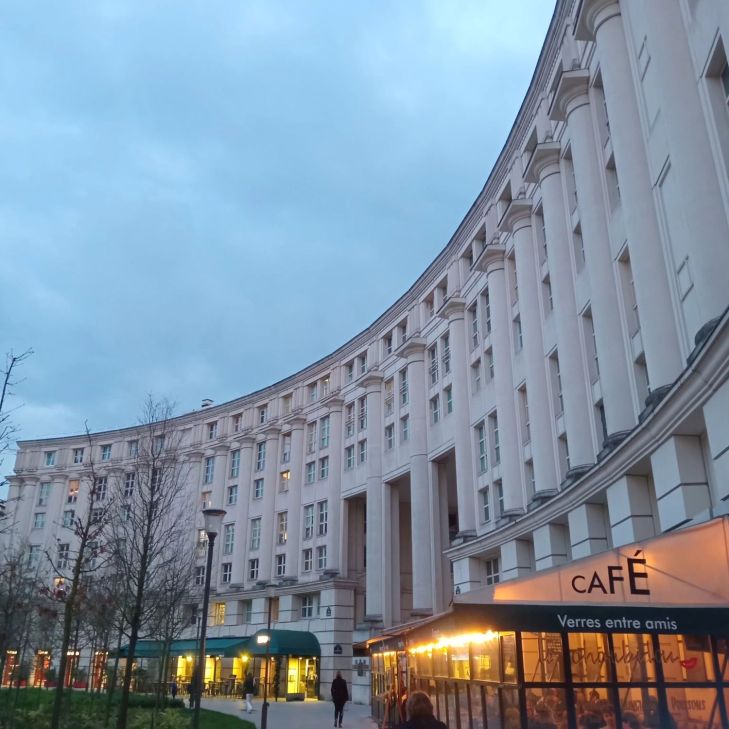
The Paris tourist office on the 14éme arrondissement : https://parisjetaime.com/eng/article/explore-paris-s-14th-arrondissement-a836
There you go folks, another dandy beautiful set of glorious streets of my eternal Paris. I have criss cross them many and have many in my blog already, Again, hope you enjoy this post on the streets of Paris, part XV !!! as I.
And remember happy travels, good health, and many cheers to all !!!

 Paris1972-Versailles2003
I like the new design of the Place de Catalogne. I worked nearby for a while when the first version was in place, when cars drove around it and there was a fountain in the centre. Cars now only drive on one side and trees have replaced the fountain. Strangely, the plaque describing the fountain is still fixed to a wall.
LikeLiked by 1 person
Times change of course. Thanks for stopping by. Cheers
LikeLiked by 1 person