
I am again to tell you about more streets of my eternal Paris. I have many many posts on Paris and several on the streets of the most beautiful city in the world. I have come up with pictures from cd rom vault that should be here for you and me. As always thank you for following my blog some since 2010. Therefore, here is my take on the streets of Paris, part XIV !!! Hope you enjoy it as I.
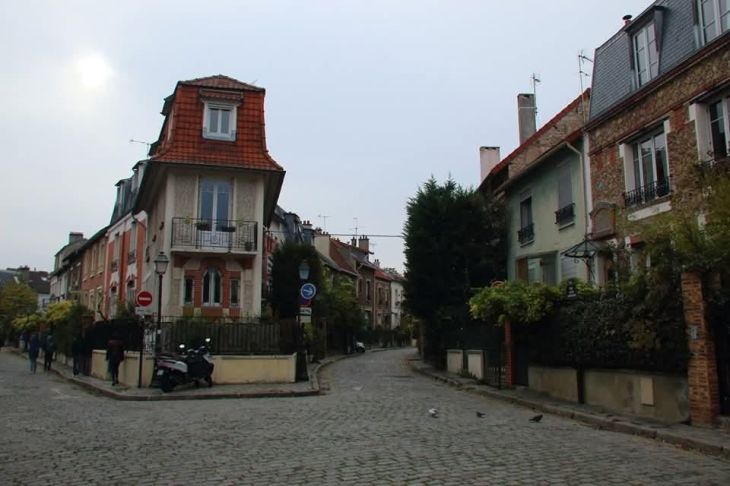
The Rue Irénée-Blanc is in the 20éme arrondissement of Paris. It begins on Rue Mondonville and ends on Rue Pierre-Mouillard. The street is part of the La Campagne à Paris housing estate; like the other streets in this estate, it is entirely lined with small townhouses. This site is served by line 3 at the Porte de Bagnolet metro station. It is named after Irénée Blanc, president of the real estate company La Campagne à Paris, who opened this street. This street was opened under its current name in 1911 in the La Campagne à Paris housing estate. This site was formerly occupied by a gypsum quarry belonging to Father Roussel. During the Haussmannian excavations carried out under the Second Empire (Napoléon III), the quarry was used as a rubble dump and eventually formed a mound. Between 1907 and 1928, a low-cost housing cooperative (HBM) had 92 houses built by different architects. The charm of the subdivision lies in the variety of materials used (brick, millstone, coated rubble), decorative elements and the omnipresence of flower gardens or small gardens. In addition, absolute calm reigns in this small hamlet away from car traffic. La Campagne à Paris is a small village, or almost. Indeed, it consists of two cobbled streets that form a sort of loop and in which a hundred small houses are built. It is accessed via Porte de Bagnolet on the right, Boulevard Mortier on the left, Rue Camille Bombois, climb the stairs to the district and Rue Irénée Blanc. The La Campagne à Paris is located near the porte de Bagnolet,between the boulevard Mortier,rue du Capitaine Ferber ,and the rue Géo-Chavez ,as well as occupying all or part of a zone define by the boulevard Mortier, rue Pierre Moullard, rue du Capitaine Ferber, place Octave Chanute, rue Géo Chavez, and the rue du Capitaine Tarron, This block is made up of internal streets such as the rue Paul-Strauss, rue Irénée-Blanc and rue Jules-Siegfried to which are added four streets each with a staircase and which only received a name in 1994: rue Mondonville, rue Georges-Perec, rue du Père-Prosper-Enfantin and rue Camille-Bombois.
The Paris tourist office on the 20éme arrondissement of Paris : https://parisjetaime.com/eng/article/explore-paris-s-20th-arrondissement-a834
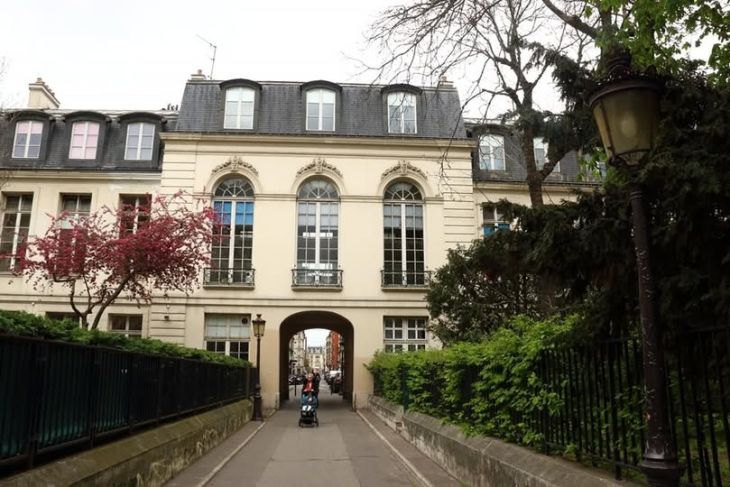
The Rue Bayen is a road in the 17éme arrondissement of Paris. It is named after the French chemist and pharmacist Pierre Bayen, The street is 760 meters long, it begins on Rue Poncelet, near Place des Ternes. It continues in a straight line, opens onto Boulevard Gouvion-Saint-Cyr, at the intersection with Rue Galvani. Its width varies between 3.50 meters and 12.40 meters. Nowadays, the street ends opposite the Champerret emergency center, Place Jules-Renard. As is traditional in Paris, odd numbers are then located on the left side of the street, even numbers on the right side. The end is near Ternes metro station on line 2. The other side is closer to the Pereire and Porte de Champerret metro stations on line 3. The Rue Bayen is located on the grounds of the former Château des Ternes, an estate situated before the end of the 18C in what is now the western part of the 17éme arrondissement of Paris. In 1778 and the following years, the architect Nicolas Lenoir sold the château’s furnishings, divided its grounds into subdivisions, and built the current Rue Bayen through the main building. In the 19C, the street, called Rue de l’Arcade, was part of the village of Neuilly, in the hamlet of Les Ternes. By decree of May 23, 1863, this street in the former village of Neuilly was classified as a Parisian street network and took its current name by decree of August 24, 1864. The notable buildings here are at no. 27 bis: the German painter Louise Catherine Breslau lived here at the beginning of her career. No. 28: the Château des Ternes. Rue Bayen (see photo) crosses the former main building of the château through an arcade. The building comprises a forward section, pierced by large, semicircular bay windows, and two recessed wings. The façade is classically inspired with ribbed corners, large semicircular bay windows, on two levels and a mansard roof. The central pavilion forming the avant-corps was gutted to make way for a path, then a street. The first known mention of this place dates back to the Middle Ages, in a title of the abbey of Saint-Denis dated 1320. In 1548, Pierre Habert, master writer, valet of the king’s chamber, advisor to the king and secretary of his Chamber, brother of the poet François Habert, bought the Esterne farm, which he converted into a larger residence, flanked by two turrets and a drawbridge, spanning the ditches. His grandson, Isaac Habert, became the owner and recognized lord when King Louis XIII established this land as a fief by royal decree of 1634. At the end of the 17C, the place had five houses, three of which formed the castle. In 1715, Pomponne de Mirey, secretary to the king, treasurer of the financial administration, receiver of consignments, lord of Blanc-Mesnil, bought and rebuilt the castle in the form of a manor house surrounded by a park which took on its current appearance, after the removal of the moats and the drawbridge. Pomponne de Mirey died on April 21, 1740 at the Château des Ternes. After several owners and parcels of land. In 1856, the Congregation of Sainte-Croix took over a small religious school which had been established there, and thus created its third college in France (after Le Mans and Saint-Brieuc). This college took the name of the College of Sainte-Marie at the Château des Ternes. Due to its success, the premises became too small and the college moved to Neuilly-sur-Seine in 1867, where it took the name of the College of Notre-Dame de Sainte-Croix de Neuilly; no. 41: the painter Geoffroy Dauvergne lived there from 1946 to around 1953; and no. 43: Marché des Ternes or market.
The Paris tourist office on the 17éme arrondissement : https://parisjetaime.com/eng/article/explore-paris-s-17th-arrondissement-a831
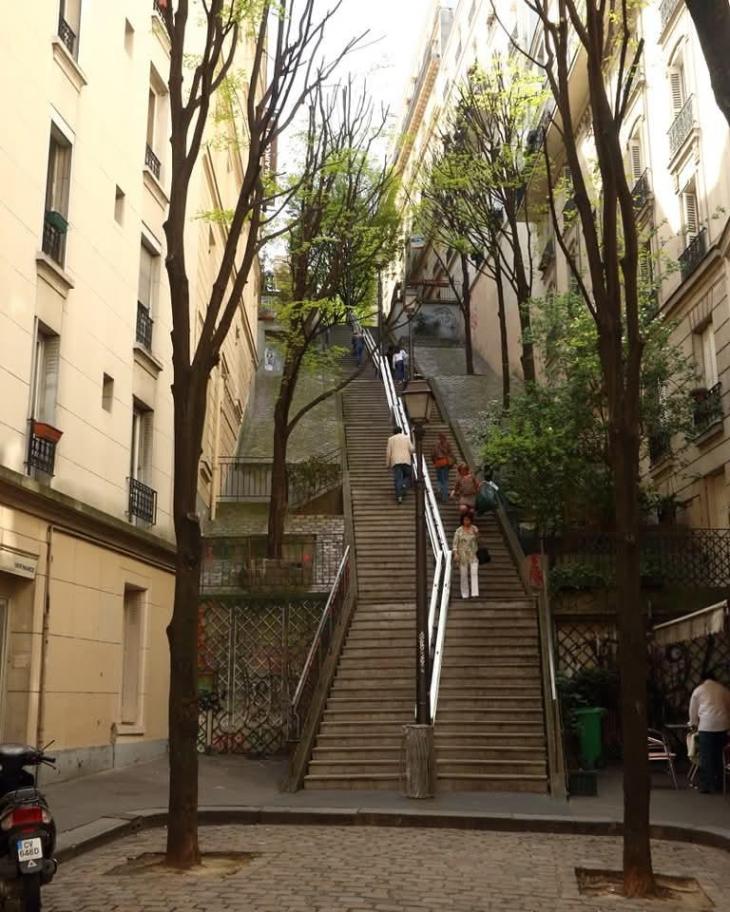
The square Caulaincourt is of the 18éme arrondissement of Paris. A steeply sloping road, largely consisting of a staircase of 122/23 steps, it begins at 63 Rue Caulaincourt and ends a few dozen meters lower, at 83 Rue Lamarck. It is named after Armand Augustin Louis de Caulaincourt, general and Duke of Vicenza, defender of the district in 1814. This street was opened in 1897 and was then classified as a Paris street by a decree of February 7, 1969. My surprise and challenge, not told before, was the stairs oh my God, these are steep and long, another wonderful off-the-beaten-path spot in my eternal Paris. There are 123 steps going up on the right, 122 going up on the left. To be precise, five floors with 19 steps and one floor with 17 steps, the equivalent of six floors. According to a study by APUR (Parisian Urban Planning Workshop) on Parisian street stairs, Paris has a total of 148 staircases, 38 of which are nestled in Montmartre. Among them, 32 are connections between roads at different levels, five are sidewalks and roadways at different levels, and one is a work of art. A nice spot for lodging me think is the Coulaincourt Hotel & Hostal at 2 Square Coulaincourt, The Metro station Lamarck – Caulaincourt is on line 12.
The Paris tourist office on the 18éme arrondissement : https://parisjetaime.com/eng/article/explore-paris-s-18th-arrondissement-a832
The Passage des Princes is a covered pedestrian walkway in the 2éme arrondissement of Paris. This passage connects 5 Boulevard des Italiens to 97 Rue de Richelieu. It was inaugurated in 1860 under the name “Passage Mirès”. It bears this name because it was opened on the site of a former furnished hotel operated by the Privat Père et Fils family, successively bearing the names Hôtel des Princes et de l’Europe (built in 1806-1926), Hôtel du Nord et de l’Europe (1827), Hôtel des Princes (1827-1842), Hôtel des Princes et de l’Europe (1842), or Hôtel de l’Europe (1842-1843). In this passage which is the last one to be built in Paris during the Haussmann era as opened in 1860. The passage was destroyed in 1985 for a real estate project but was rebuilt identically in 1995. The open angle that it originally formed was then straightened to form a right angle, which allowed for better use of the premises: shops on the ground floor, offices on the first to fourth floors, housing on the fifth and sixth. Various elements of the original decor were then reused, such as a beautiful 1930s cupola in colored glass decorated with roses, reinstalled on the section located near the Boulevard des Italiens or the access porch on the Rue de Richelieu side. Considered as the Mecca for games, this covered arcade houses numerous shops dedicated to toys, scale models, video games ,etc.

The Paris tourist office on the passage des Princes : https://parisjetaime.com/eng/culture/passage-des-princes-p1586
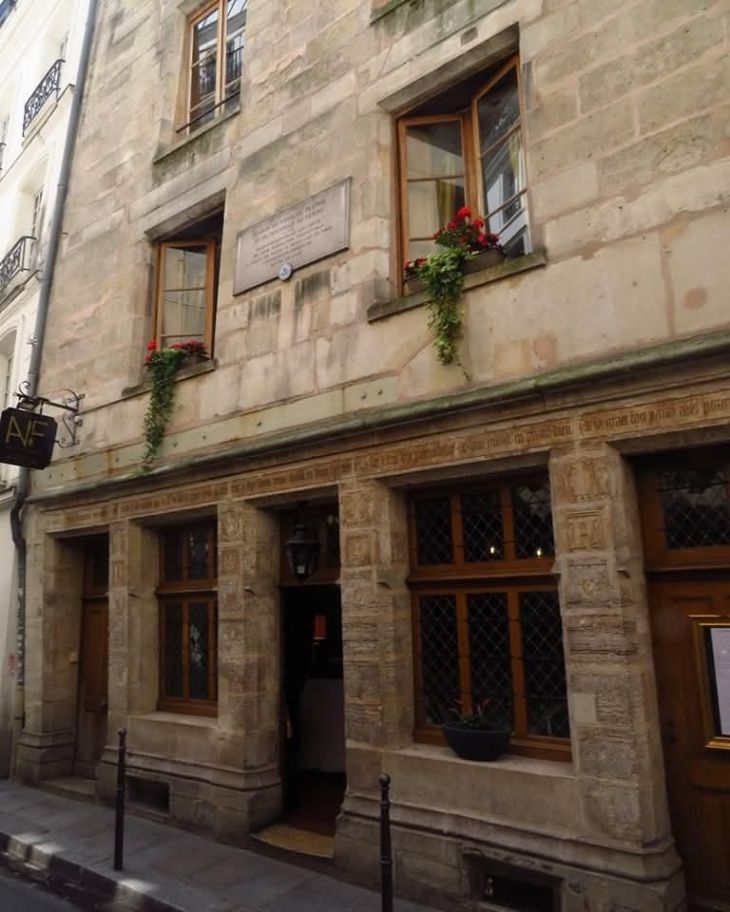
The Rue de Montmorency is in the 3éme arrondissement of Paris, in the quartier Marais . It begins on Rue du Temple and ends at 212 Rue Saint-Martin. The street is named after one of the most prominent Renaissance families of the Marais, the Montmorencys. This site is served by the Arts et Métiers and Rambuteau metro stations. Rue de Montmorency was opened in the 13C when the lands of the Saint-Martin-des-Champs priory (now the National Conservatory of Arts and Crafts-see post)) were subdivided, creating the Saint-Martin-des-Champs quartier or neighborhood. The section between Rue Saint-Martin and Rue Beaubourg was known as “Rue du Seigneur de Montmorency” as early as the 14C. The section between Rue Beaubourg and Rue du Temple was, in 1328, the ruelle au Villain. It was called rue Cour-au-Villain before taking its current name in 1768. Renamed during the French revolution, Rue de Montmorency became, until 1806, rue de la Réunion, The notable buildings here are at no, 5 stood a private mansion where Marie-Madeleine de Castille and Nicolas Fouquet lived from 1651 to 1658. This private mansion belonged to the Montmorency family until 1624. Théophile de Viau also stayed there. A neoclassical fountain is still visible in the garden of the current Hôtel Thiroux de Lailly, often called Hôtel de Montmorency. Moyse Blien stayed there in 1755. No. 6: Louis-Philippe porch. The singer Lio, Joseph Morder and Robi Morder lived there. From 2000 to 2006 the Iranian painter Zohreh Eskandari lived and worked there. No. 8: Madame de Sévigné lived there from 1676 to 1677. No. 40: The engraving workshop of Charles Brennus, engraver of the Brennus shield, the trophy of the French rugby union championship, was located there. No. 51: Maison Nicolas Flamel’s house (see photo) built by Nicolas Flamel to accommodate the poor, formerly known as “au grand pignon”. Built in 1407, it is said to be the oldest house in Paris. The first two floors remain and retain their original decoration: the Gothic inscription mentioned above, as well as the molded pillars of the base and the decorations of angels and small columns. On the second and fifth pillars are engraved the initials “NF” in homage to the founder of the place , Many old-style buildings and private mansions, Rue de Montmorency is now home to contemporary art galleries.
The Paris tourist office on the Paris Centre (grouping district 1-4) : https://parisjetaime.com/eng/article/explore-the-centre-of-paris-a846
There you go folks, another dandy beautiful set of glorious streets of my eternal Paris. I have criss cross them many and have many in my blog already, Again, hope you enjoy this post on the streets of Paris, part XIV !!! as I.
And remember happy travels, good health, and many cheers to all !!!

 Paris1972-Versailles2003
Great series! I’ve walked along many of the streets………but not all.
LikeLiked by 1 person
Oh they are so many but I have been to many and there is more to come eventually from my vault of memories! Thanks for stopping by Cheers
LikeLiked by 1 person