
I find it amazing the natural beauty and monumental architecture/history of my lovely Bretagne, and we have been to many and there are many more to be seen. However, the coastal region is sublime and always a welcome to visit any time. We love it, Let me tell you about the Chapelle Sainte Anne la Palud of Plonévez Porzay !!! Hope you enjoy it as I.
The town of Plonévez Porzay is located in the Finistère department no, 29 , in my lovely Bretagne of my belle France. A coastal town of the Atlantic Ocean, located on the edge of the Bay of Douarnenez and located in the Porzay basin bordered by Mountain Crêtes de Locronan and fôret du Duc, Bois de Saint-Gildas, and Ménez Hom ,exceeding in places 250 meters above sea level, The town is 10 km from Crozon, 5 km from Locronan, 11 km from Douarnenez, 21 km Quimper, 62 km from Brest, 140 km from Vannes and 115 km from my current town,. The departmental road D 107 at the Châteaulin-Douarnenez axis, and the departmental 63 on the axis Quimper-Plomodiern via Locronan and continuing towards the Crozon peninsula. Easy on the N165 past Quimper take the D100, D39 to Plogonnec then the D63 to the town.
The Chapelle Sainte-Anne-la-Palud is located near the dunes bordering the beach bordering the Atlantic Ocean, the chapel is in an old marsh dried over the centuries, the Sainte Anne venerated in Sainte-Anne-la- Palud is a more or less mythical Breton who is one of those Breton saints from Brittany in the High Middle Ages. She is often assimilated to Sainte Anne, the mother of the Virgin Mary ,and grandma of Jesus patron saint of Brittany. Her life is little known. The Chapelle de Sainte-Anne-la-Palud depended until the French revolution of the Abbey of Landévennec. It is claimed that the chapel dates back to the time of Saint Guénolé. A stone of the 17C chapel bell tower bore the date of 1419. The chapel was rebuilt several times in particular in the 17C.was built at the Romanesque time under the hill dominating the bay. Its 20.5 meter high arrow carried the dates 1230 and 1419. In the lintel of a side door one could read 1232. This chapel therefore had the honor of receiving the granite statue of 1548, crowned in 1913. In February 1796, the chapel was put to sale under national goods ,and most were burned, The new chapel date of 1864.
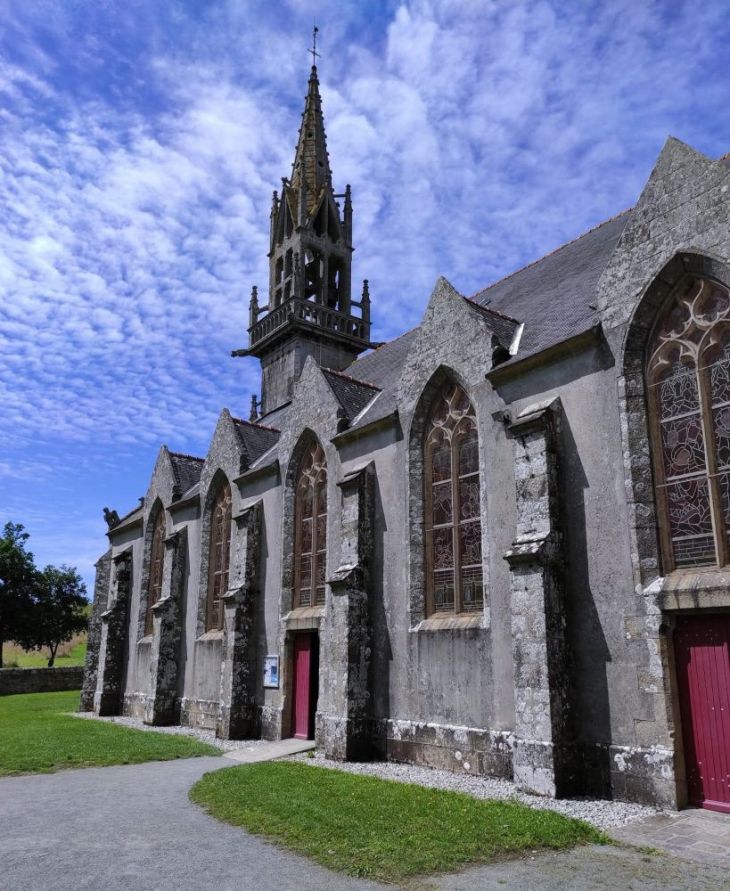
I give you a description from on site brochure, tourist office and wikipedia,I will be back for more, eventually. The Sainte Anne la Palud Chapel has a certain number of wooden statues, from the 16C, among which we can see, in the choir, Saint Anne and Saint Joachim; on the left and right, by the beginning of the transepts, Saint Corentin with butt and mire, and Saint Gwénolé in a black Benedictine dress. In the altarpieces of the lateral altars which come from the old church of Plonévez, we find the group of the Rosary on the left, and on the right the saints deacons Etienne and Laurent, accompanied by Saint Mélar, all secondary patrons of the parish. These groups are from 1625. Rosary altar in a curved tomb, smooth columns, Corinthian capitals and large pediment. The central picture of 1625, represents in high relief and polychrome the group of the Rosary: Saint Catherine of Siena, virgin to the child known as Rosary and Saint Dominique.
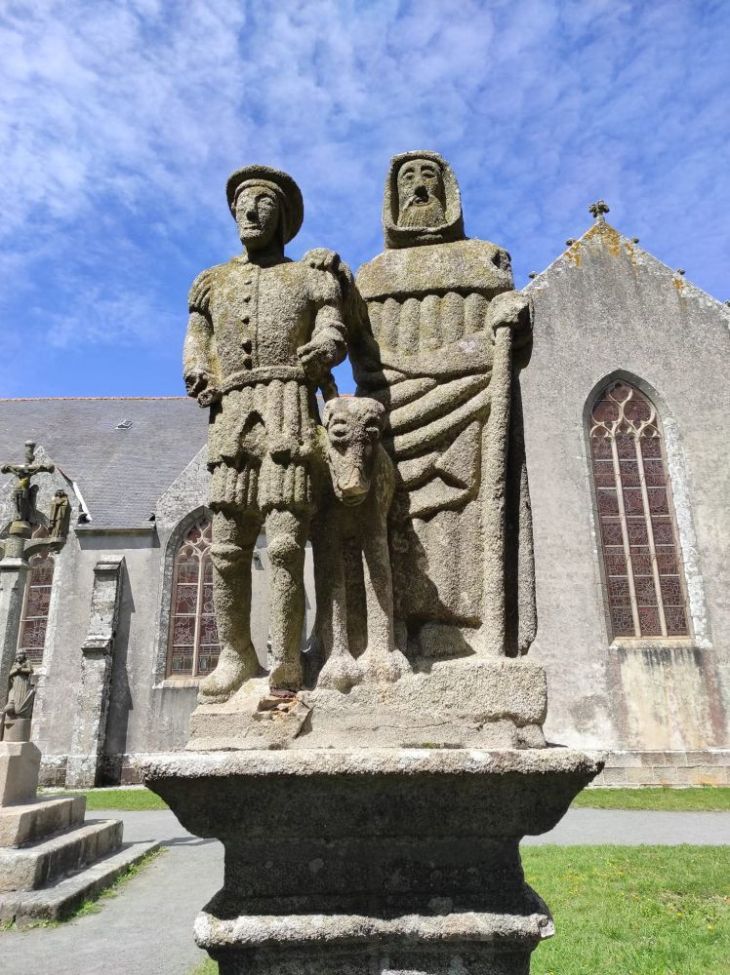
The altarpiece of Saint-Laurent in a curved tomb, smooth columns, Corinthian capitals and large pediment. The central table in high relief and polychrome of 1625, presents Saint Etienne, Saint Laurent and Saint Melar in apotheosis. They are the secondary patrons of the parish of Plonévez-Porzay with Saint Corentin and Saint Michel. Master altar: 18C in a curved tomb. The tabernacle is crowned by an elegant balldoquin. Central window of the Choir the Holy Family of Mary, supervised by her parents Anne and Joachim. The other two windows of the choir, 1936. Life of Saint Anne and Saint Joachim according to the apocryphal.statues ; Saint Joachim and, a group of Sainte Anne and Marie standing, who present the book of scriptures. Golden statue of Sainte Anne: this statue, gold and polychrome, raised by an elegant Baldoquin, of the 18C ; Saint Yves in terracotta of the Gruër monk of Solesmes (1955). Saint Yves, inventor of the justice of the peace, defender of the underprivileged, born in 1258, died in 1303, is patron of lawyers and secondary patron of Brittany. The Virgin and Child base is from the 17C, The statue of Saint Corentin, in polychrome wood, is from the 16C. Saint Corentin is the first bishop of Quimper and according to tradition, founder of the cult of Sainte Anne at La Palud, it is presented to us with miter, pastoral and evangeli butt; On his stole: Saint Nicolas, Saint Laurent, Saint Etienne and two holy anonymous bishops.
Saint Guénolé 16C, dressed in the austere Bénédictine bure, holds under his left arm a closed Bible, 1st abbot of Landévennec, and according to tradition, founder of the cult of Saint Anne at La Palud. Saint Melar 17C, Breton blood prince, bears the princely crown and priest’s stole. Son of Saint Milliau, king of Cornouaille, patron of the parish of Plonévez-Porzay the venerated statue of the oratory-that which is, for the country, Santez Anna Ar Palud-represents, Saint Anne serious and smiling at the same time. Before the Blessed Virgin Child, the mother holds the book of the law open: a symbol touching of maternal education. She carries, cut in the base, the date of 1548. It has therefore been 400 years since she received the tributes and prayers of the Breton faithful. The chapel of Sainte-Anne La Palud has two 19C bells: Marie-Anne and Marie-Sébastienne from 1841, Stained glass shows devotion to the old saints of Brittany, to represent some episode of the life of those of them who may have had some relation to the Chapel of Sainte-Anne la Palud.
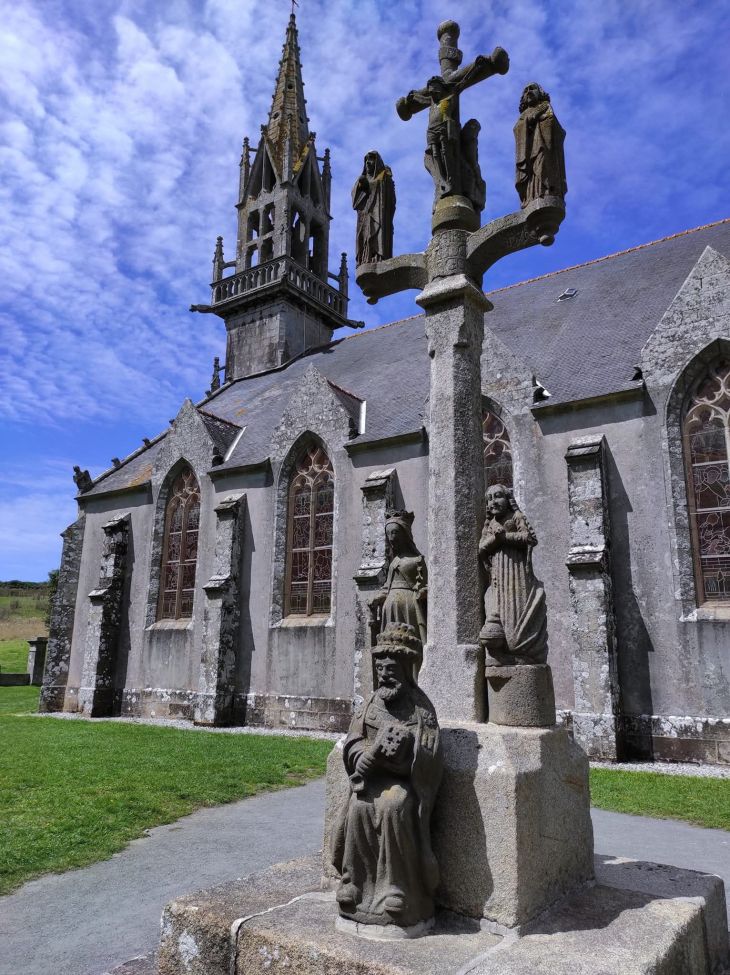
A cross stands in the enclosure, very close to the chapel. It is from 1653 , a complete calvary in the middle, Christ and the Pieta; right and left, four characters. At the foot, we see statues which were formerly in the chapel: Saint Peter, Sainte Marie-Madeleine and a blessing bishop. About a hundred meters south of the sanctuary is the fountain of Saint Anne. The current work replaced, in 1870, The fountain replaced by the edict of 1642. The niche contains two stone statues of Saint Anne and the Virgin. The niche was seriously damaged and the Virgin beheaded by occupants on January 23, 1944 , According to tradition, the pilgrimage of Sainte-Anne la Palud was established at the beginning of the 6C by Saint Corentin and Saint Gwénolé on a ground given to Saint Anne by King Gradlon after the submersion of the city of Is. The pilgrimage of Sainte-Anne took off in the second half of the 18C. The Petit Pardon or little forgiveness, takes place at the end of July each year. The chapel welcomes each year, for the last weekend in August, one of the most important pardons in historic Brittany. It is also called the Grand Pardon or great forgiveness. It spans four days. Among the most notable pardons, those who celebrated the arrival of the relics of Sainte Anne from Rome and Apt, in 1848 and in 1922.
Other things to see here with more time are The Manoir de Moëllien (17C), passed in the hands of several families in 1929, was transformed into a charming hotel-restaurant from the 1960s. The parish Church Saint-Milliau , the original parish church (1585) does not exist anymore. It was dedicated to Saint Etienne before being in Saint Milliau. The current parish church was built in 1867-1868 and its bell tower in 1873. The Chapel of Notre-Dame-de-la-Clarté in the 17C, the Pope Innocent XI and the German Roman Empire plan to stem the Ottoman expansionism in Europe. The Lord of Moëllien then joined the troops of the King of Poland John III Sobieski. Returned to be unable to have this war won against the Ottomans, the Lord of Moëllian had the Chapel of Notre Dame de la Clarté (clarity) built in honor of Virgin Mary in 1739.
A bit of history I like tell us that Plonévez-Porzay, during the Roman invasion, had due to his position withdrawn from remaining the last refuge of the Druids, fierce enemies of foreign domination. In their various revolts they concentrated their forces there and the story tells that the last rebels were crushed a short distance, in the mountains of Argol. Nevertheless the Gallo-Romans were established throughout the Bay of Douarnenez and, even today, we meet there, with each step, the traces of their passage, The “new parish” as its name suggests in Breton of Plonévez-Porzay was created from the High Middle Ages, During the wars of the League, in December 1593, after having ransacked the city of Faou, for fifteen days, the parish of Plounévez (Plonévez-Porzay), was somehow bleeding white by an unrestrain soldier, In 1685 a brotherhood of Saint-Rosaire was founded in the parish church of Plonévez-Porzay. Another brotherhood, that of Saint-Michel, also existed at that time, The law of August 12, 1792 bears the new parish of Plounévez [Plonévez-Porzay], whose limits are modified compared to the old,
In June 1911, Hippolyte Le Floch, mayor of Plonévez-Porzay, refused to install secular teachers appointed to replace the nuns of the Holy Spirit Girls under the Congregations Act. Protest of 12 mayors from the Châteaulin borough (including the mayor of Plonévez-Porzay) who declare to refuse to indicate on the certificates of residence of the priests if they use the Breton language during religious education (catechism, sermons) .This was due to law separating State and Church, In 1929, a fraction of the territory of the town was attached to Locronan and in 1932, Kerlaz, which hitherto depended on the town of Plonévez-Porzay, became an independent town, the limit between the two towns being made up of the stream of Douric-Ar-Briant.
On June 30, 1944, following acts of sabotage committed in the Crozon region, the Nazis blocked all the roads accessing Crozon and arrested all the people who arise, who were led to the city hall where their papers were controlled by a nazi officer. If a hundred people approximately were let go, 43 men are aligned on the church square (a man escapes discreetly while hiding in the church) and 42 men are led to Menez Gorre’s quarry, then conveyed to trucks at Quimper train station. A second roundup in Plonévez-Porzay where a burial and 10 additional hostages took place, These 52 men are conveyed in cattle wagons at the Royallieu Transit camp near Compiègne (Oise 60) ,then 50 of them reach the Neuengamme concentration camp, then scattered in various groups in northern Germany. 34 hostages out of the 50 in Neuengamme survived in early March 1945, but many died during the months of March and April 1945 victims of forced marches, hunger, typhus, bombings, etc., so that 18 hostages from the roundup of June 30, 1944 returned alive in France between the beginning of May and the end of June 1945.
The town of Plonévez Porzay on its heritage : https://www.plonevez-porzay.net/public/environnement-et-urbanisme/tourisme/
The local Menez Hom Atlantique tourist office on the chapel Sainte Anne la Palud :https://www.menezhom-atlantique.bzh/activite/chapelle-sainte-anne-la-palud/
The local Menez Hom Atlantique tourist office on the Grand Pardon of Sainte Anne la Palud : https://www.menezhom-atlantique.bzh/l-agenda/les-grands-evenements/grand-pardon-de-sainte-anne-la-palud/
There you go folks, another sublime spot to visit very nice natural coastline with great views of the Atlantic ocean and great chapel. Again, hope you enjoy this post on the Chapelle Sainte Anne la Palud of Plonévez Porzay !!! as I.
And remember, happy travels, good health, and many cheers to all !!!

 Paris1972-Versailles2003