
I am again to tell you about more streets of my eternal Paris. I have many many posts on Paris and several on the streets of the most beautiful city in the world. I have come up with pictures from cd rom vault that should be here for you and me. As always thank you for following my blog some since 2010. Therefore, here is my take on the streets of Paris, part XI !!! Hope you enjoy it as I.
The passage Vendôme is located in the 3éme arrondissement, between the Place de la République and rue Béranger , measures 57 meters long. This site is served by the métro République of lines 3, 5, 8, 9 and 11 , This passage leads to rue Béranger, formerly rue de Vendôme, open to the dependencies of the temple and thus appointed in honor of the Duke of Vendôme, Grand Prieur de France. Duke Philippe de Vendôme had the title of large prior of the temple hospital priory on the date on which rue de Vendôme was opened on land belonging to the order of Saint-Jean de Jerusalem successor to the Templars. The Passage Vendôme was built in 1827 on part of the land of the old Daughter-du-Sauveur convent at the location of the Charles V enclosure dismantled in 1670 where the boulevard du Temple was fitted out. It originally linked the boulevard du Temple to the Carreau de Temple to an ideal location between the animation of theaters of the boulevard and a lively market. In 1869, the development of the Place de la République shortened it four meters, having its facade replaced on the boulevard du Temple by a new one on the square as well as a part of its glass roof. The passage is thus found with two types of covers. In 2005, a vast partial renovation operation was carried out. Glass windows, cornices and paintings have been refreshed but there is nothing left of the large cleanings. The renovation of the soil that has never been completed, left high ungrateful raw concrete. Very degraded since, the Passage Vendôme does not seem to find its original chandelier, yet, It is worth the detour for the architecture of old and a wonderful area of Paris,
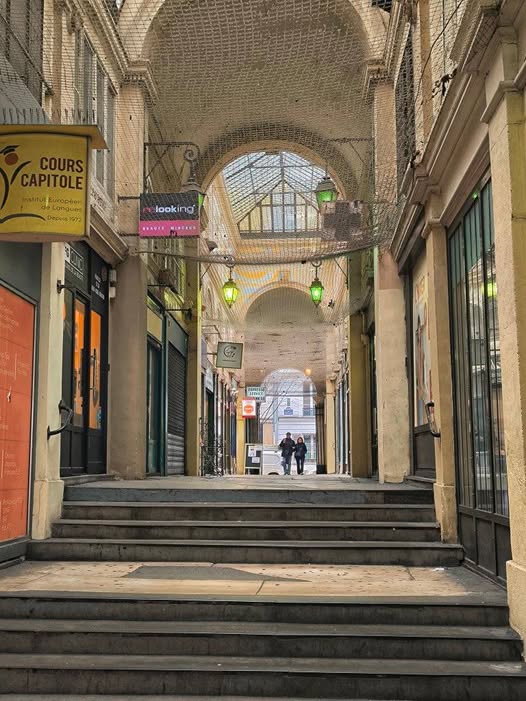
The association of passages and galleries of Paris on the passage Vendôme: https://passagesetgaleries.fr/passage-vendome/
The Rue Monsigny is located in the 2éme arrondissement of Paris. It bears the name of the French composer Pierre-Alexandre Monsigny, It goes from the rue Quatre Septembre next to the Metro Guimard style quatre septembre of Line 3 where the picture was taken;and the street continues to rue Dalayrac left or rue Marsollier right, It was located in the vicinity of the old salle Ventadour ,and opened in 1825 under the name of rue Neuve-Ventadour, it bears its current name since 1829. The part located between the rue Saint-Augustin and the Quatre Septembre was opened in 1868, at the same time as the rue du Quatre-September was perceived. A nice building here and worth the visit is the Théâtre des Bouffes Parisiens at 4 Rue Monsigny,
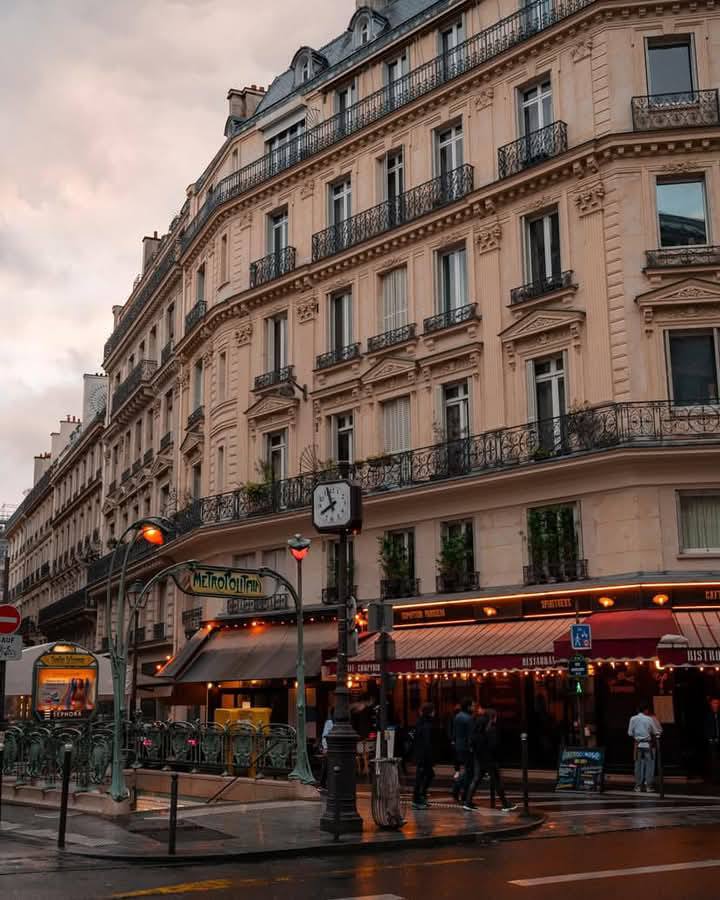
The Paris tourist office on the Paris centre area now includes the 2éme et 3éme arrondissements: https://parisjetaime.com/eng/article/explore-the-centre-of-paris-a846
The rue de l’Université is in the 7éme arrondissement. It is 2,785 meters long and variable width, between 10.50 meters and 15 meters, is flat and parallel to the Seine, of which it is only a few hundred meters away. It begins, at the height of the crossroads with the rue des Saints-Pères and crosses the boulevard Saint-Germain then resumes near the Palais Bourbon, crosses the Esplanade des Invalides, crosses the boulevard de la Tour-Maubourg then avenue Bosquet and Avenue Rapp; it then obliquely crosses the avenue de la Bourdonnais before ending up deadlocked on the allée Paul-Deschanel on the square of the Eiffel Tower (you see it?). In the 12C, the University of Paris acquired a territory along the Seine, west of the Abbey of Saint-Germain-des-Prés to which it previously belonged. This territory was called “Pre-aux-Clercs” (first mention in 960): either because students (formerly called “clerics”) came to relax during their rest periods , In 1639, the university sold the pre- Aux-Clercs and it was loti to become a new district of Paris whose main street took the name of rue de l’Université.
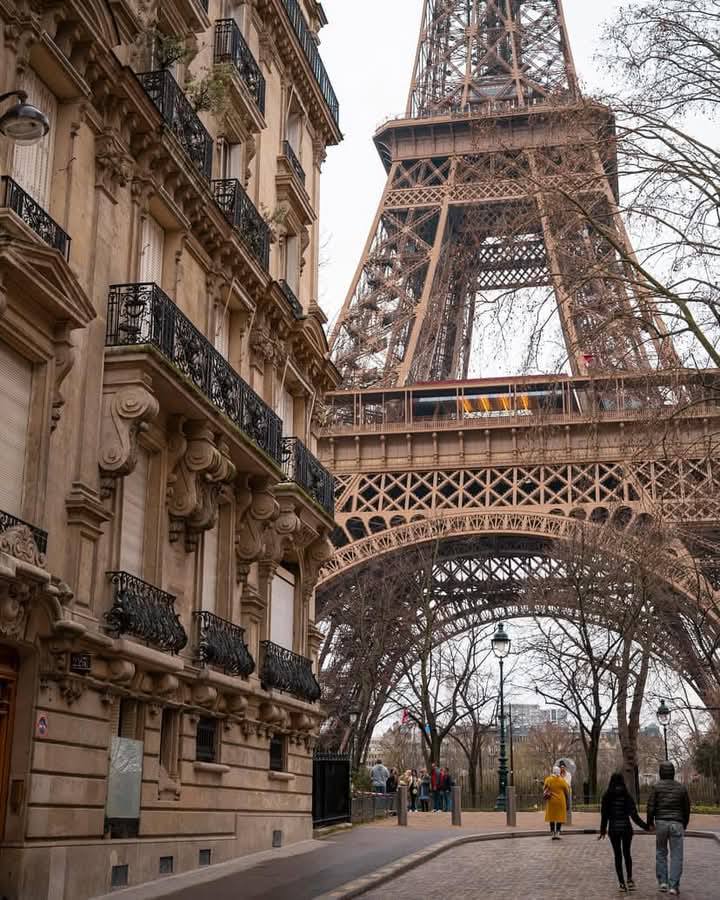
Remarkable buildings on rue de l’Université I like are the area quadrilateral between the rue Surcouf , rue de l’Université, rue Jean-Nicot and the Quai d’Orsay is in the old île des Cygnes. In this same quadrilateral was the Manufacture of the Gros-Caillou tobacco, built in 1827 and destroyed in 1909. At no 3: Boutique of the designer of jewelry Line Vautrin, between the early 1950s and 1962, no 6: facade, hotel of Montmorency in 1787, no 11: Interesting building on the street that belonged to the family of Albert de Luynes, built after the drilling of the rue du Pré-aux-Clercs and the destruction in 1844 of the Tambonneau hotel designed by Louis Le Vau. Headquarters since 1979 of the Hugot Foundation of the Collège de France, No. 17: Bochart de Saron hotel, built in 1639 and raised from one floor in 1650 Charles-Maurice de Talleyrand-Périgord lived there for the Estates General of Versailles in 1789 until 1792, the date of his departure for England, it belonged today to Gallimard editions. Nos 18-20: Buildings built around 1666 for the hospice of the incurable Claude François Chauveau-Lagarde, lawyer of Marie-Antoinette and Charlotte Corday lived at this address, before François-René de Chateaubriand settled there, At no 24 : Hôtel de Séneterre. hotel built in 1685. In October 2013, the Haute Couture branch of Maison Yves Saint-Laurent then directed by creator Hedi Slimane settled there after a complete renovation of two years , No 33: Hotel Le Vayer, building up after 1845 in the Louis XV style (successively called “Cosnac hotel”, 1730, “de Nesle”, 1745 and “de Montesquiou”). Served as a headquarters for the artistic recovery committee, in charge of operations to recover works of art, books and archives, left the national territory by the nazis during WWII. No 34 bis: Arsène Lupine lived under the name of Duc de Charmerace, no 36: The Revue Les Temps Modernes, founded in 1944 by Jean-Paul Sartre and Simone de Beauvoir, had its siege. No 82: Alphonse de Lamartine lived from 1837 to 1853. No 90: Albert I of Monaco was born there in 1848. no 101: Chaban-Delmas building, built in 1974, in order to house on seven floors, the personal offices of the deputies of the National Assembly and of their employees. Building renovated in 2008, it was connected to the Bourbon Palace by an underground passage. On 126-128: Palais Bourbon and Hôtel de Lassay, seat of the National Assembly. No 182: here, Auguste Rodin had a workshop of the Marbles. Nos 192-200: rear facade of the Alma Palace whose main entrance is on the Quai Branly. No 204: At this level, the rue de l’Université runs along the facade and the southern entrance to the Quai Branly museum.
The Paris tourist office on the 7éme arrondissement or district of Paris : https://parisjetaime.com/eng/article/explore-paris-s-7th-arrondissement-a825
There you go folks, another dandy beautiful set of glorious streets of my eternal Paris. I have criss cross them many and have many in my blog already, Again, hope you enjoy this post on the streets of Paris, part XI !!! as I.
And remember happy travels, good health, and many cheers to all !!!

 Paris1972-Versailles2003
I love Paris every moment / Every moment of the year…
🙂
LikeLiked by 1 person
Oh yes Paris is eternally beautiful. Thanks for stopping by grazie mille Cheers
LikeLiked by 1 person
J’ai passé des moments vraiment merveilleux à Paris, je ne les oublierai jamais.
Bonne soirée 🙂
LikeLiked by 1 person
J’imagine que je n’ai jamais rencontré personne qui m’ait dit le contraire. Merci encore d’être passé. Salut
LikeLiked by 1 person