
I have taken the metro in Paris several times even if prefer to walk or the bus, The metro is useful and fast, When I worked in Paris took it and then realise walking was better, thereafter only when absolutively necessary, Once again, found me older pictures in one cd rom that should be in my blog, These are mostly on the Guimard architecture style, very nice indeed. Therefore, here is my take on the Metro à la Guimard of Paris !!! Hope you enjoy the post as I.
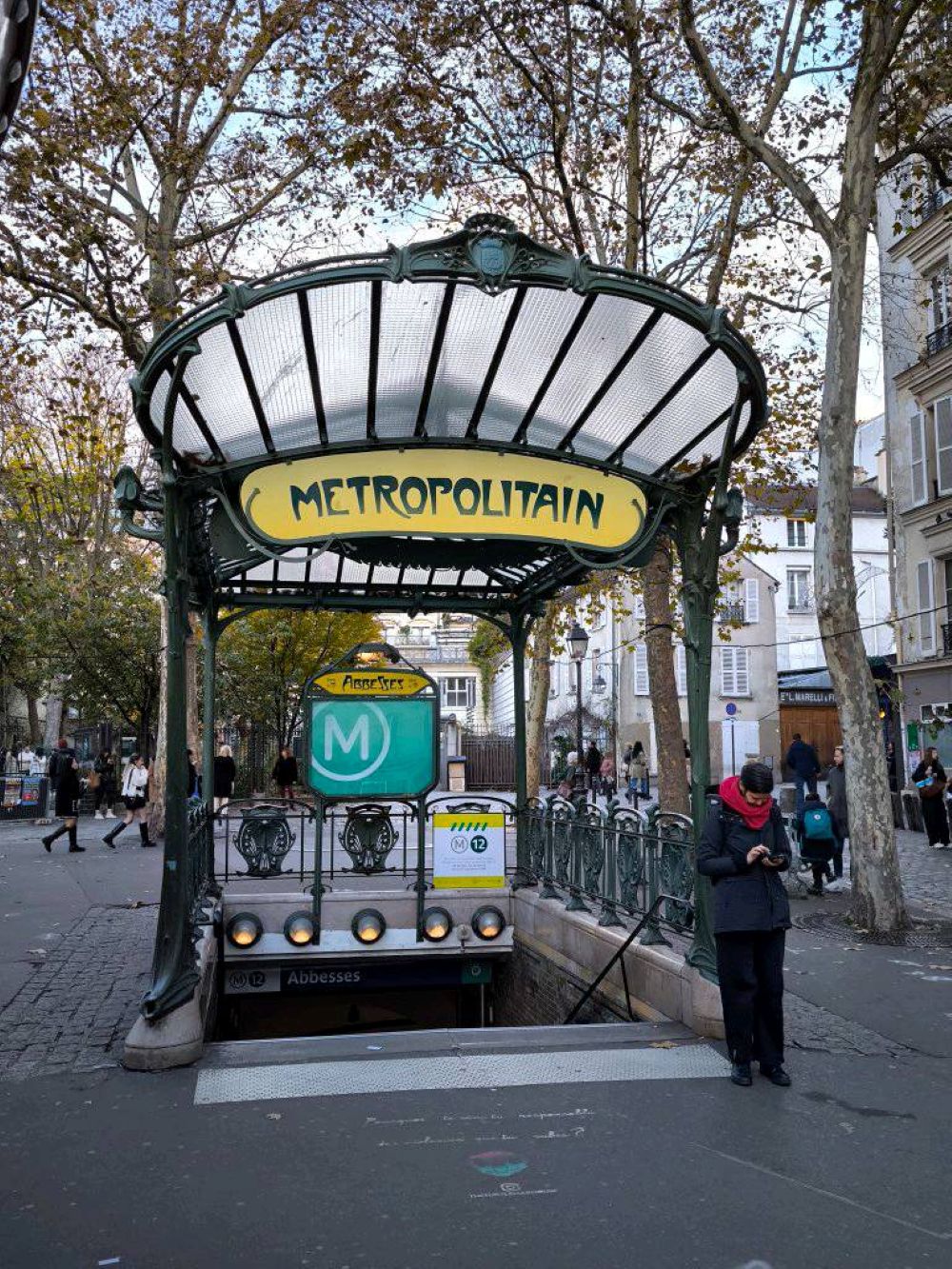
The metro Abbesses is a station on line 12 , located in the 18éme arrondissement of Paris.On this section, the tunnel develops under the buildings of the Butte Montmartre or mound with a strong ramp of 4%. Due to the elevation on the surface, the quays of the station are located 36 meters below the surface, which makes it the deepest station of the Paris metro, The station was opened on January 30, 1913, almost three months after the Inauguration of the second extension of line A of the Nord Sud railroad company, from the provisional terminus of Pigalle to Jules Joffrin. On the RATP level of line 12, the station carries as a subtitle Butte Montmartre by the name of the mound under which it is located. This subtitle is however absent from the quays of the station, inscriptions on “nord-sud” style earthenware lending themselves badly. ,On March 27, 1931, line A became the current metro line 12 following the absorption of the Société du Nord-Sud on January 1, 1930 by its competitor, the CMP , which manages the concession of most of the other lines of the network ,The station has a single access entitled “Place des Abbesses”, leading to the central media of the aforementioned square, to the right of the street 2 Rue La Vieuville, having kept its original decorations on the cheesy walls. Consisting of a fixed staircase, it is decorated with a Guimard edict wearing a glass roof nicknamed “dragonfly”; This edict was originally present at the Hôtel de Ville station (access no 6, located on rue de Lobau), and reassembled to its current location in 1974 due to the creation of an underground car park adjoining the city hall of Paris. It served as a set of filming for the films “The fabulous destiny of Amélie Poulain” by Jean-Pierre Jeunet and the “Le Locataire” or tenant of Roman Polanski.
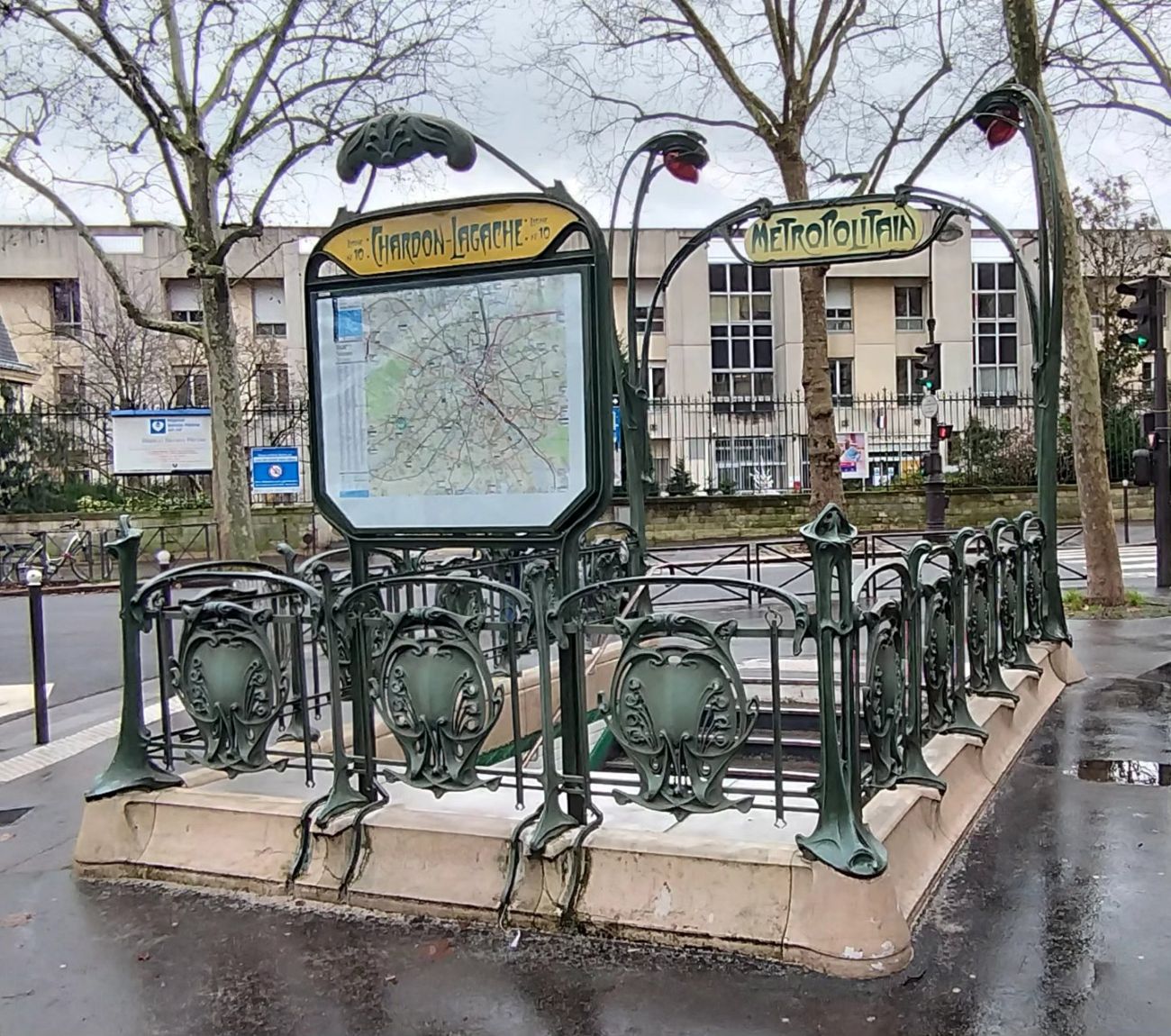
The metro Chardon-Lagache is on line 10, located in the 16éme arrondissement of Paris. The station is located at the intersection of the Chardon-Lagache, Molitor and Mirabeau streets. The station was opened on September 30, 1913 with the commissioning of the extension of line 8 from Beaugrenelle (today Charles Michels) to Porte d’Auteuil. Pierre Chardon was the “poor doctor” of Auteuil for fifty years. He was buried in the second cemetery of Auteuil in 1845. He associated with his name that of birth of his wife Amélie. The station is thus the third in a series of six to have awarded the name of a woman, On the night of July 26 to 27, 1937, the station was transferred to line 10 as part of the reshuffle of lines 8 , 10 and from the old line 14, when line 8 was redirected to its current Balard terminus. The service between Porte d’Auteuil and Jussieu was however provided until two days later, on July 29, initially limited to the Motte -Picquet – Grenelle, The Station has a single access entitled “Rue Chardon-Lagache-Sainte-Périne Hospital”, leading to the right of No 16 of this street at its intersection with rue Molitor. Consisting of a fixed staircase, it is decorated with a Guimard edict.
The metro Réaumur- Sébastopol is on lines 3 and 4, located on the edge of the 2éme and 3éme arrondissements of Paris. The station is located at the intersection of rue Réaumur and Boulevard de Sébastopol. It has 4 access: 1 boulevard de Sébastopol, fixed staircase, mast Dervaux , 2 rue Réaumur, rue de Palestro with 2 narrow fixed staircases, Guimard entourage and “metro” and non-metropolitan due to narrow access, 3 Rue Saint Denis 68, rue Réaumur, 2 secondary access Guimard with narrow fixed staircases, 4 square Emile Chautemps, Gaîté Lyrique, Square Émile-Chautemps, It opened under the name of rue Saint-Denis on November 19, 1904, a month after the commissioning of the first section of line 3 between the Villiers and Pérè Lachaise stations; It took its current name on October 15, 1907. On April 21, 1908, the line 4 was opened. René-Antoine Ferchault de Réaumur was a French chemist, physicist and naturalist. He is the inventor of the alcohol thermometer. Sébastopol is a city in the southwest of the Crimean Peninsula, which is the site of a Battle of the Crimean War in 1855, where it was won over by the French and the British ;after a year of headquarters from October 1854 to September 1855.

The metro Rue du Bac is on line 12 , located in the 7éme arrondissement of Paris. By the start of boulevard Raspail, at its intersection with boulevard Saint-Germain and rue du Bac. The station was opened on November 5, 1910 with the commissioning of the first section of line A of the Société Nord-Sud de Paris , between Porte de Versailles and the provisional terminus of Notre-Dame-de-Lorette. It owes its name to its proximity to the rue du Bac, which took its name from the fact that in 1564, its outlet against the Seine, a boat was necessary to cross the Seine river. On March 27, 1931, line A became the current metro line 12 following the absorption of the Société du Nord-Sud on January 1, 1930 by its competitor: the CMP , which manages the concession of most of the other network lines. The line has a main entrance and a secondary exit brought together under the title “Boulevard Raspail”, leading to the central background of the aforementioned boulevard, facing No. 2. The first metro mouth, made up of a fixed staircase, is decorated with a ceramic and wrought iron entourage in the characteristic style of the old Nord-Sud network, while the second, simply embellished with a pruning stone entourage, includes a rising mechanical staircase allowing only the exit from the platform towards the Hôtel de Ville of Issy. The decoration is of “Andreu-Motte” style with two orange brown light ramps and orange-colored “clod” seats, as well as flat brown tiles covering masonry benches , and the outlet of a secondary corridor outlet. Advertising frameworks are metallic and the station name is registered in Parisine character font on enameled plates. This is one of the few stations to still present the “Andreu-Motte” style in its entirety, if we except the eardrums as well as the outlets of the main access and outing corridors.

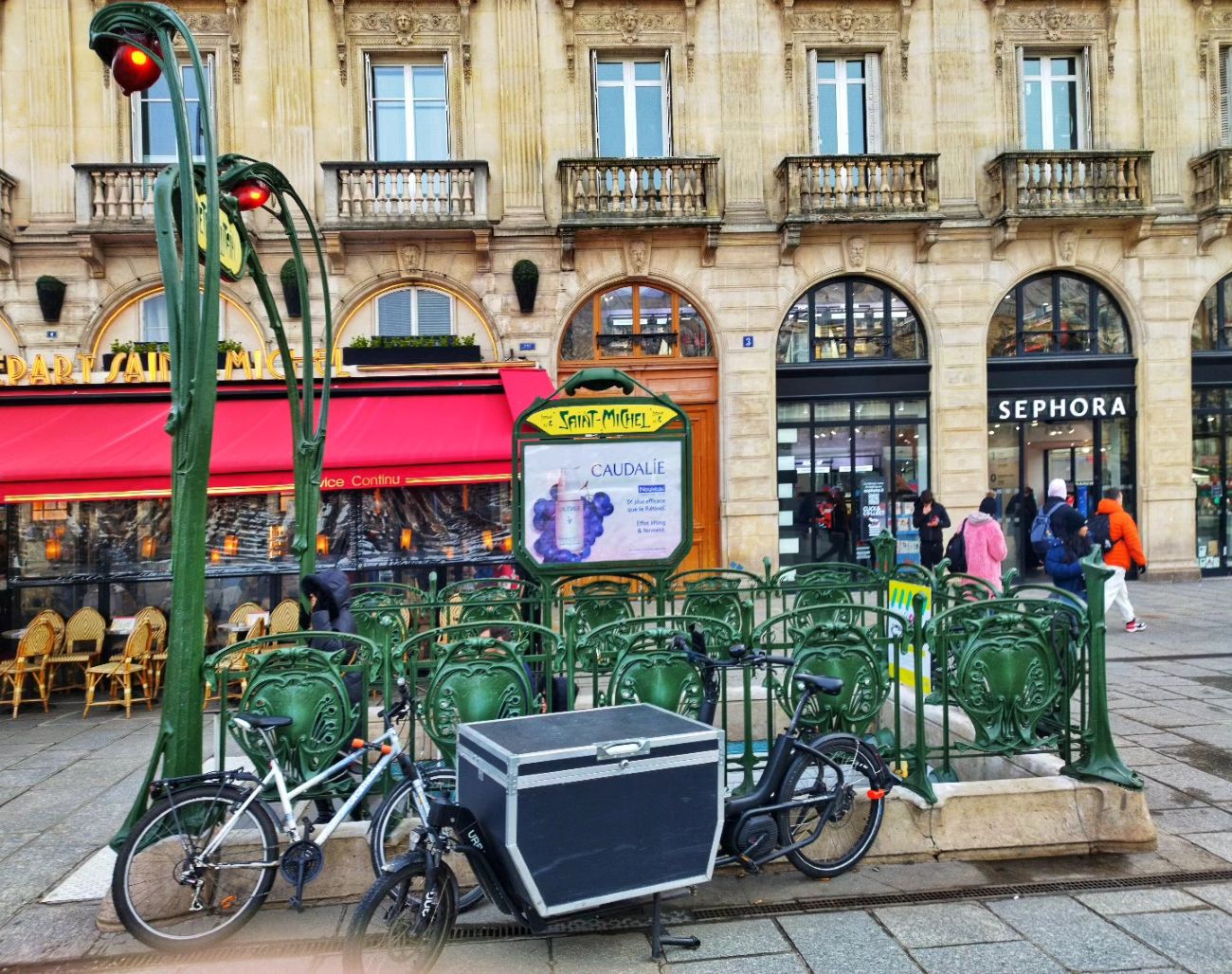
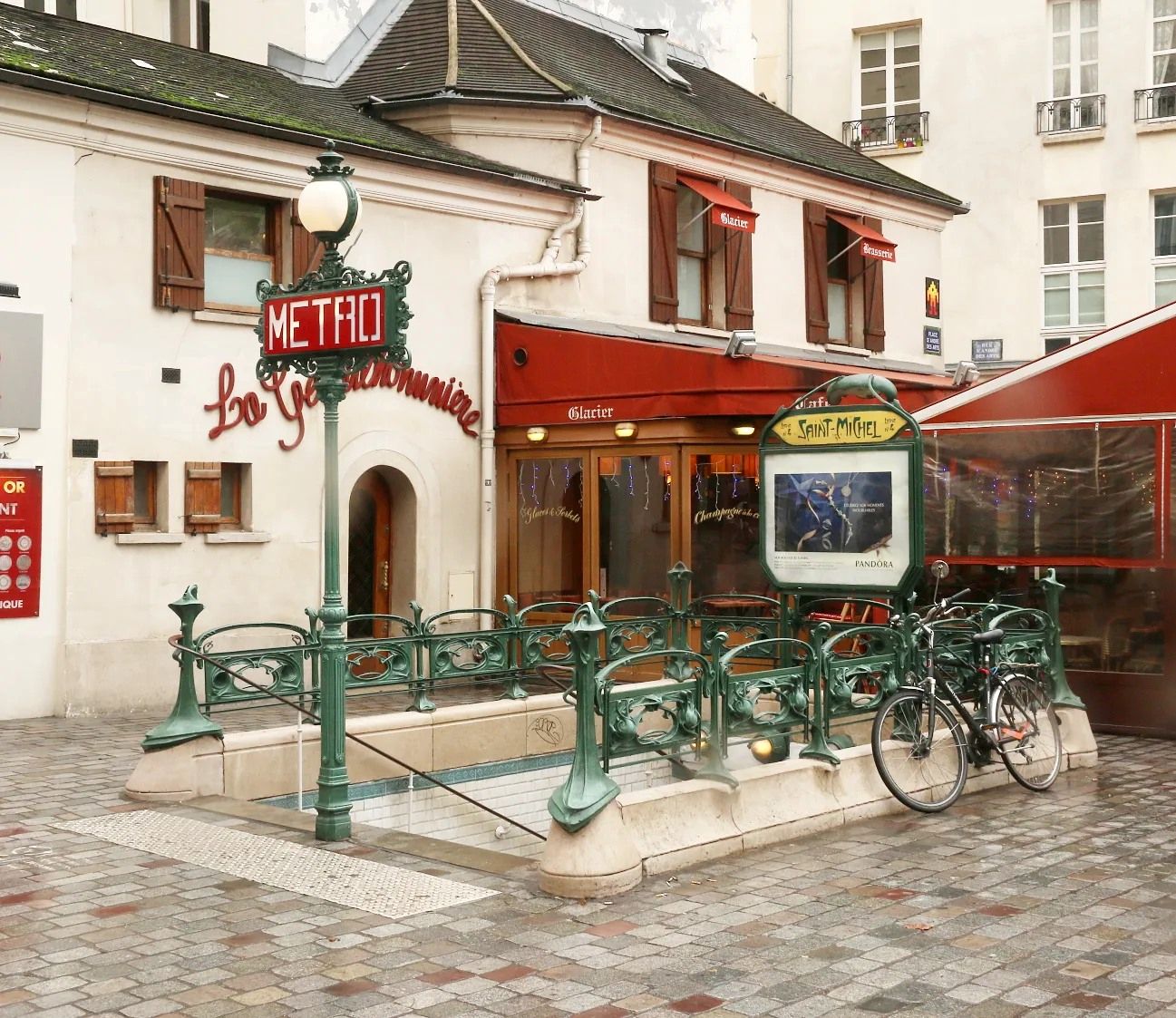
The metro Saint-Michel is on line 4, located at the limit of the 5éme and 6éme arrondissements of Paris. The station is located in a curve under Place Saint-Michel ( square), and extends from rue Danton to the Seine. It bears the name of Place Saint-Michel under which it is located, at the northern end of the homonymous boulevard. You reach it on 5 access: No. 1 Quai Saint-Michel (Notre-Dame); No. 2 Place Saint-Michel a Guimard station (see pic) ; No. 3 “Fontaine Saint-Michel”; No 4 Place Saint-André-des-Arts, (see pic); No. 5 Pont Saint-Michel, an entrance on the Quai des Grands-Augustins and two entrances to the Quai Saint-Michel. More, it has a link with line C of the RER at Saint-Michel- Notre-Dame. Via this correspondence, it is possible to reach the RER B at the same station, or line 10, at Cluny – La Sorbonne station. The station was opened in 1910 when opening the central section of line 4 previously split into two parts, stopping at Raspail, in the south, and in Châtelet, to the north. The delay is linked to the difficult underground crossing of the two arms of the Seine at the Île de la Cité. During the 1970s, the platforms were renovated in the “Andreu-Motte” style with two orange light ramps, benches treated with flat orange tiles and orange orange seats.
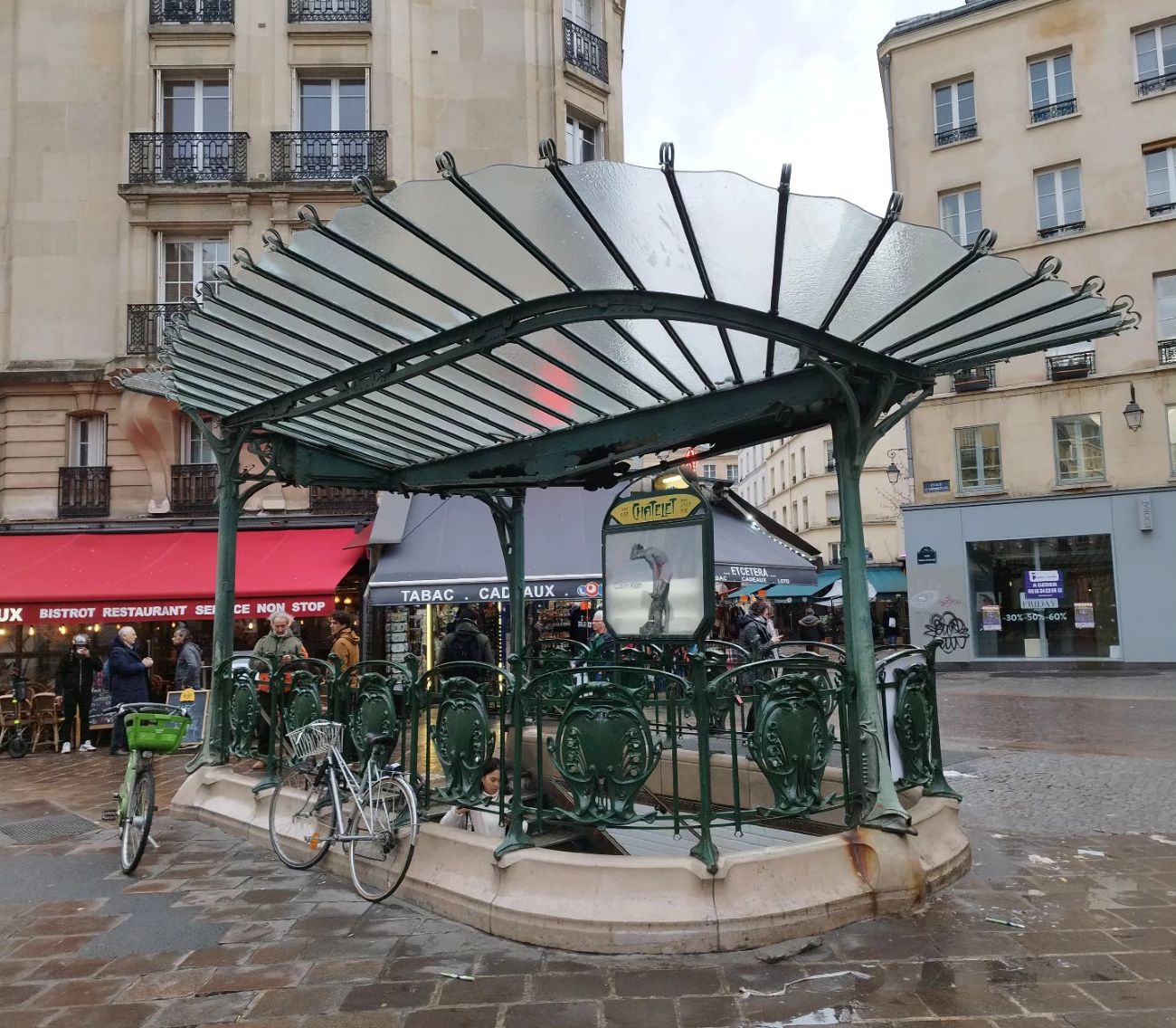
The metro Châtelet is on lines 1, 4, 7, 11 and 14, located straddling the 1ert and 4éme arrondissements of Paris. It is one of the two stations of the network to be served by five metro lines. It constitutes the nerve center of the Paris metro and is part of a more global exchange center incorporating the Châtelet – Les Halles RER station as well as the Les Halles metro station.It includes two parts linked together by a long corridor equipped with two treadmills. The latter serve under Place du Châtelet: line 7 under the Quai de Gesvres (between Pont-Neuf and Pont Marie); Line 11 under avenue Victoria ,further north, they serve: line 1 under rue de Rivoli (between Louvre – Rivoli and Hôtel de Ville) ; line 4 under rue des Halles (between the Halles and Cité); Line 14 diagonally between these two previous streets, in parallel to line 4 (between the Pyramid and Gare de Lyon stations). The station is connected, from the northern part, by another corridor comprising three rolling sidewalks, at the RER station of Châtelet – Les Halles ,which it serves lines A, B and D) and, through it, Les Halles Metro station 4. The strictly known Châtelet station is open on August 6, 1900, more than two weeks after the first section of line 1 between Porte de Vincennes and Porte Maillot. On April 21, 1908, the line 4 was open with the inauguration of its first section on the right bank of the Seine, of which it provisionally constituted the South terminus from Porte de Clignancourt until January 9, 1910, date of completion of the double under-flowial crossing, allowing the tracks to continue through the left bank of the river to Porte d’Orléans. On April 16, 1926, the Line 7 station was open with the commissioning of its extension from Palais Royal (now Palais Royal – Louvre Musée) to Pont Marie. On December 9, 1977, the station was corresponded to the new Châtelet- Les Halles on lines A and B of the RER (joints by line D on September 27, 1987), itself connected to the station Les Halles of Line 4 which, in parallel, is rebuilt in the east of its initial location (located under Rue Baltard) in order to allow rapid pedestrian relations with the RER quays. Finally, on October 15, 1998, the Line 14 station was opened in turn on the occasion of the inauguration of its first section between Madeleine and Bibliothéque François-Mitterrand (library). The station draws its main name from its proximity to the Place du Châtelet, which is set up on the site of the Grand Châtelet, a former fortress which served as prison and court under the old regime, before being demolished in 1802.
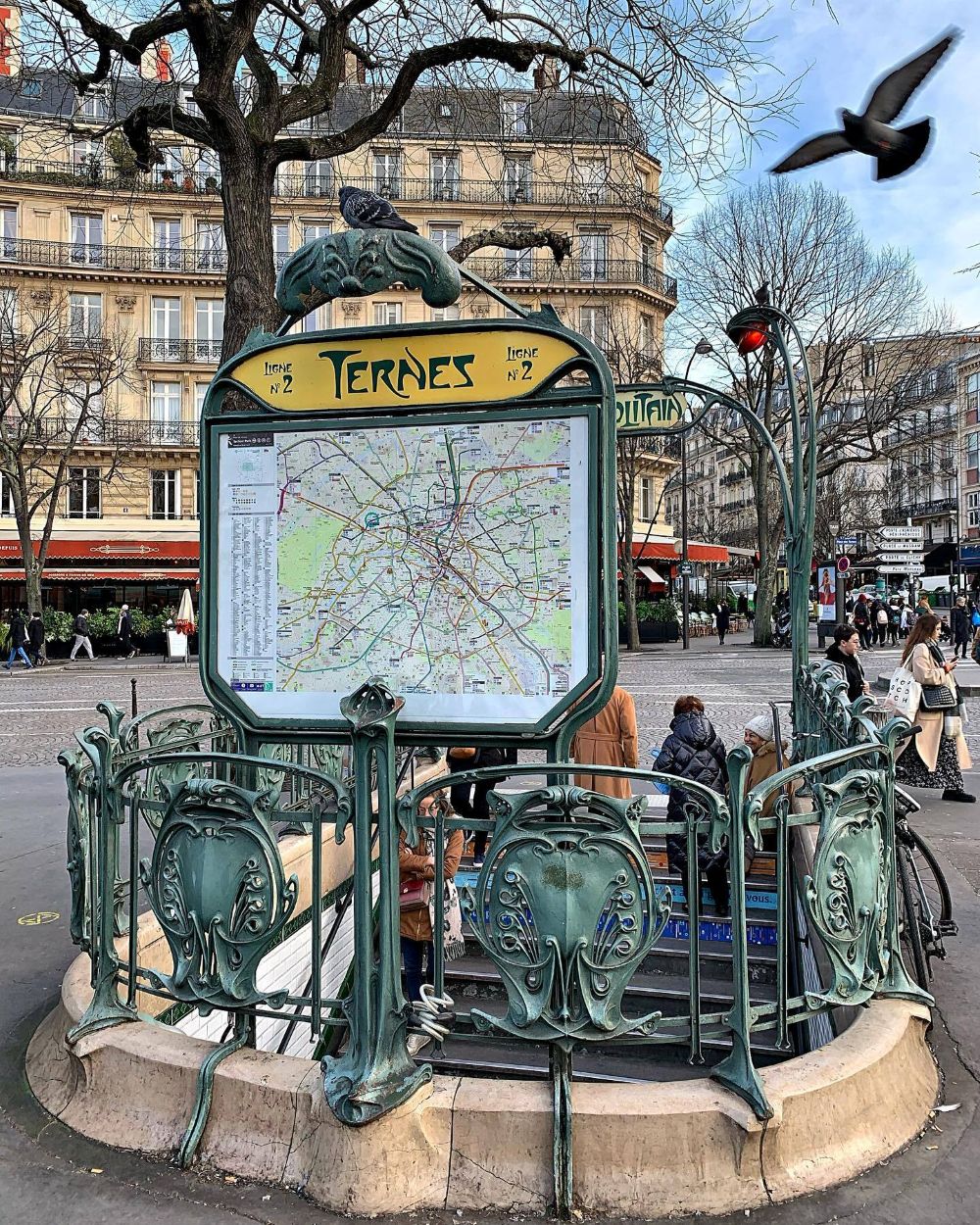
The Metro Ternes is on line 2, located at the limit of the 8éme and 17éme arrondissements of Paris. The station is established in curve under the Place des Ternes, between the southern section of the avenue de Wagram and the exit of the Boulevard de Courcelles. It is inserted between the Charles de Gaulle-Etoile and Courcelles stations. The station has three access: No 1 “Place des Ternes”, consisting of a fixed staircase decorated with a Guimard edict leading to the central media of Place des Ternes; No 2 “avenue des Ternes”, made up of a fixed staircase with a mast with a yellow “m” inscribed in a circle, being at the right of No. 3 in Place des Ternes; And no, 3 “boulevard de Courcelles”, consisting of a rising mechanical staircase allowing the exit from the quay in the direction of the Porte Dauphine , located opposite the No. 130 on the boulevard de Courcelles. The station was open to the public on October 7, 1902 with the commissioning of the section between Étoile (today Charles de Gaulle – Etoile) and Antwerp of line 2 North, which will more simply become line 2 on October 17, 1907 at the continuation of the absorption of line 2 south (corresponding to a large part of the current line 6) by line 5 on October 14 1906.
The Paris transport network RATP on the metro: https://www.ratp.fr/en/plan-metro
There you go folks, this is another memorable post on my eternal Paris! Yes, the metro is part of its landscape so get used to it too, And while at it marvel of its wonderful architecture and history as I Again, hope you enjoy the post on the Metro à la Guimard of Paris !!! as I
And remember, happy travels, good health, and many cheers to all !!!

 Paris1972-Versailles2003
I will generally walk everywhere but sometimes you’ve got to let the metro take the strain.
LikeLiked by 1 person
Yes of course with minimum use i prefer when tired the bus above ground see more but when needed. Thanks for stopping by Cheers
LikeLiked by 1 person
Always a pleasure
LikeLiked by 1 person
And the design of Guimard stations has been featured elsewhere. I remember Victoria station in Montreal.
LikeLiked by 1 person
Yes what is good carries on. Thanks for stopping by. Cheers
LikeLiked by 1 person
Love these, it feels like going back in time
LikeLiked by 1 person
Indeed they are nice and best kept nicely for all to see and enjoy it. Thanks for stopping by Cheers
LikeLike