
This is an important beautiful church of my eternal Paris yet finally glad to tell you was in it and got the pictures to show in my blog! This was a while back and found the pictures in my cd rom vault. As said, these are monument of architecture and history that tells the story better than anything ,and I love to visit them. And not enough, need to be back, eventually. Anyway, I will tell you more of this wonderful church in a nice area indeed, Therefore, here is my take on the Church Saint Sulpice of Paris !!! Hope you enjoy the post as I.
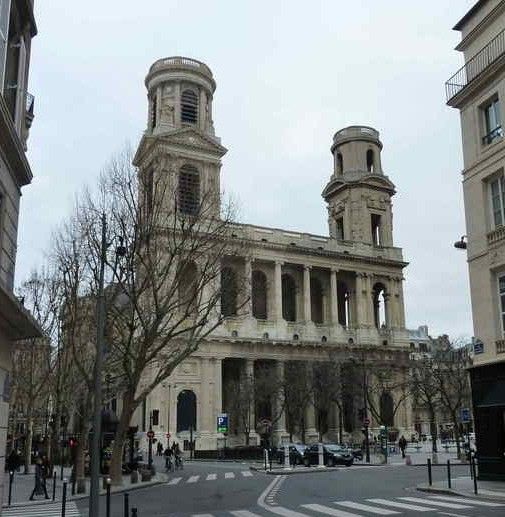
The Saint Sulpice Church is in the Odeon quartier/neighborhood of the 6éme district/arrondissement of Paris. It is located in place Saint-Sulpice with an official address of 2 rue Palatine. It is dedicated to Sulpice the pious, Archbishop of Bourges in the 7C. Saint-Sulpice is not a frequent dedication in the churches of France. Yet it is a French Saint born at the end of the 6C in the Diocese of Bourges and of Noble ancestry. He would have been raised at the Royal palace, which would have initiated him into business. Dubbed the good or the pious, known for his austerity, fasting, his affability, but also for his healing gifts on the sick, indulging in prayer and serving the poor, he was said to enjoy a gift of persuasion through his voice that led people to invite to conversion . The Bishop of Bourges would have conferred on him the orders to make his preaching official. In 624, he was appointed Bishop of Bourges. Pursuing his role as missionary, he focuses on the conversion of the Jews, many in his diocese, and participates in the training of the campaigns. After 17 years of Episcopate, he chose a coadjutor to devote himself entirely to the service of the poor. He died in Bourges in January 646 or 647. More than 340 churches are dedicated to him in France,
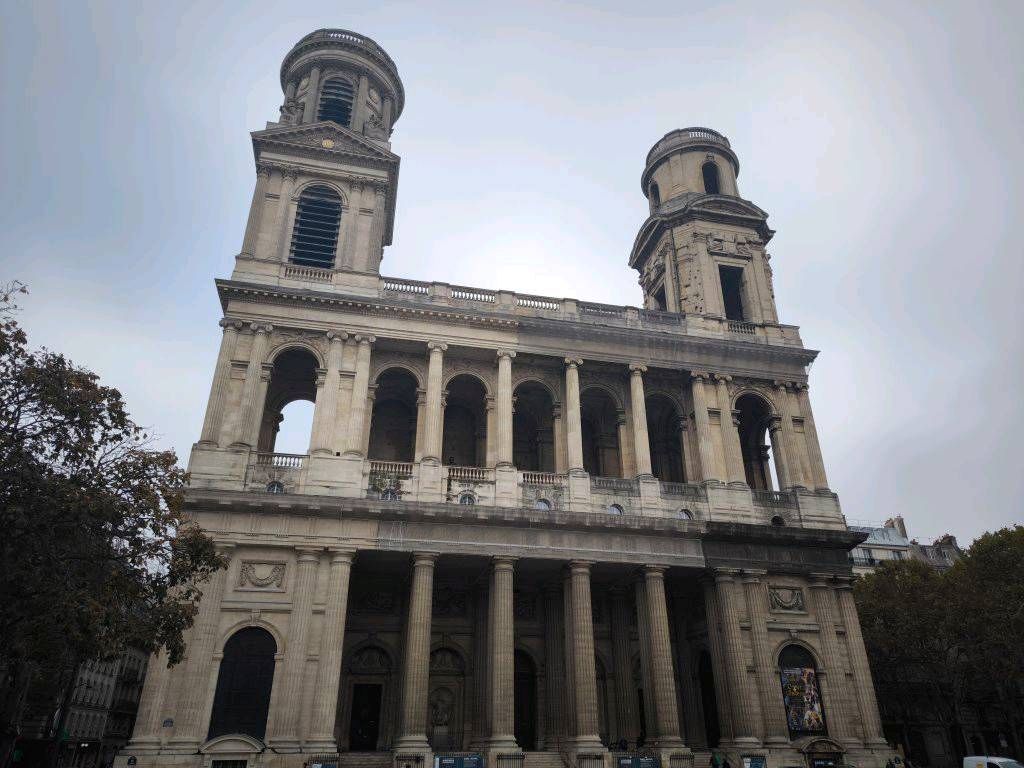
The present church took the place of a small sanctuary dedicated to Saint-Sulpice-des-Champs, which would go up in the 12C. Rebuilt, then enlarged in the 14C and 16C, it eventually proves to be insufficient for the population of the parish, The first stone was laid by the Regent Anne of Austria in February 1646. The plans were to build the largest church in Paris , indeed 119 meters long and 57 meters wide (it is actually the 2nd biggest). The two towers of the church are of different architecture as the North Tower was completed in 1788, while the French revolution prevented it from doing the same for the South Tower. It waited to be finished for more than 2 centuries! The old church will be totally encompassed , see it at the level of the present choir, the Cross of the transept and two bays of the nave. It is a must to visit me think; its architecture is the epitome of Classicism, the decorations, the murals and frescoes of the chapels deserve careful look. You see the giant clams and its Virgin and Children, reliefs and sumptuous mausoleum offer the Church artistic masterpieces in Paris. Forty years will pass. It is the energetic priest Jean-Baptiste Languet de Cergy who will restart the construction in 1719 thanks to a lottery.
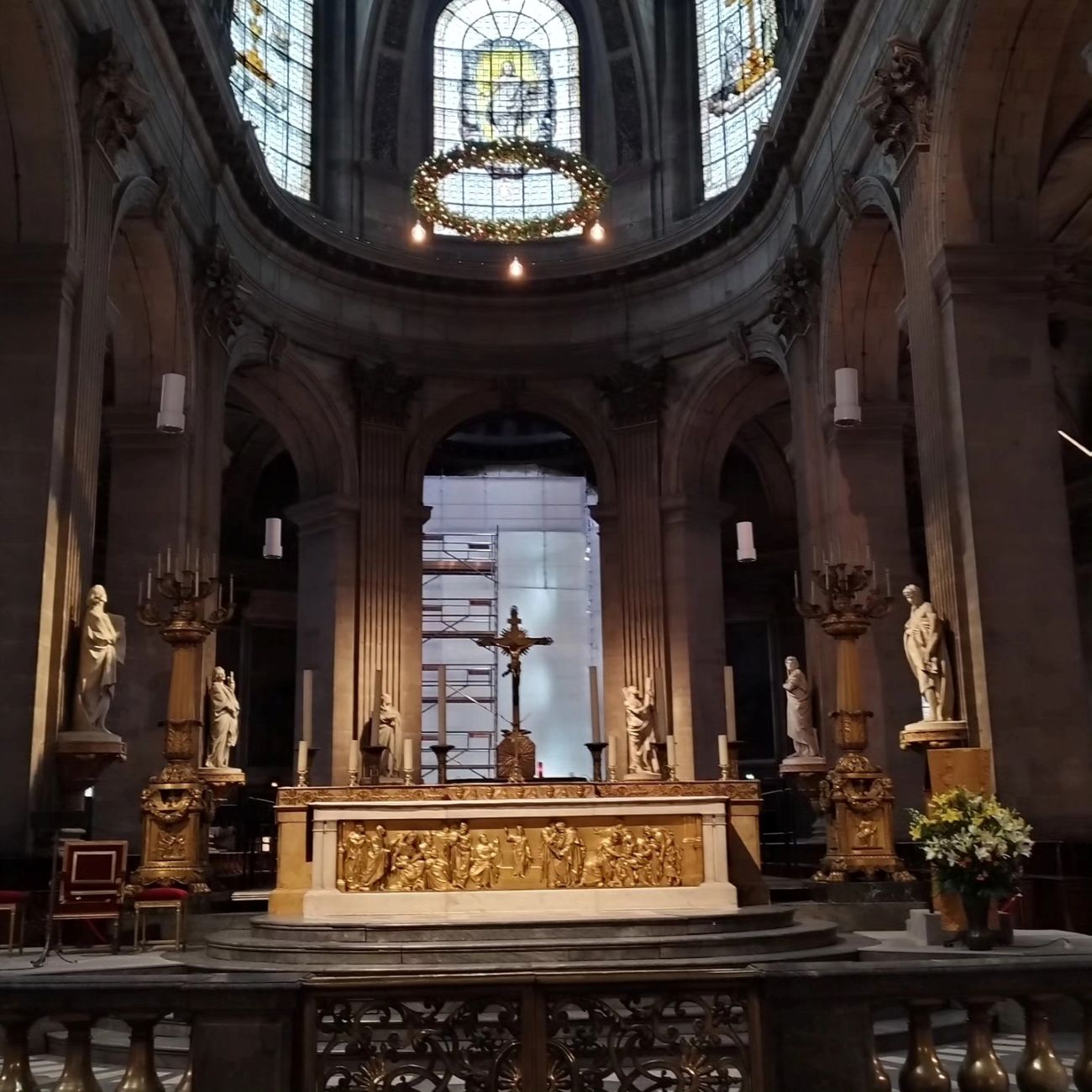
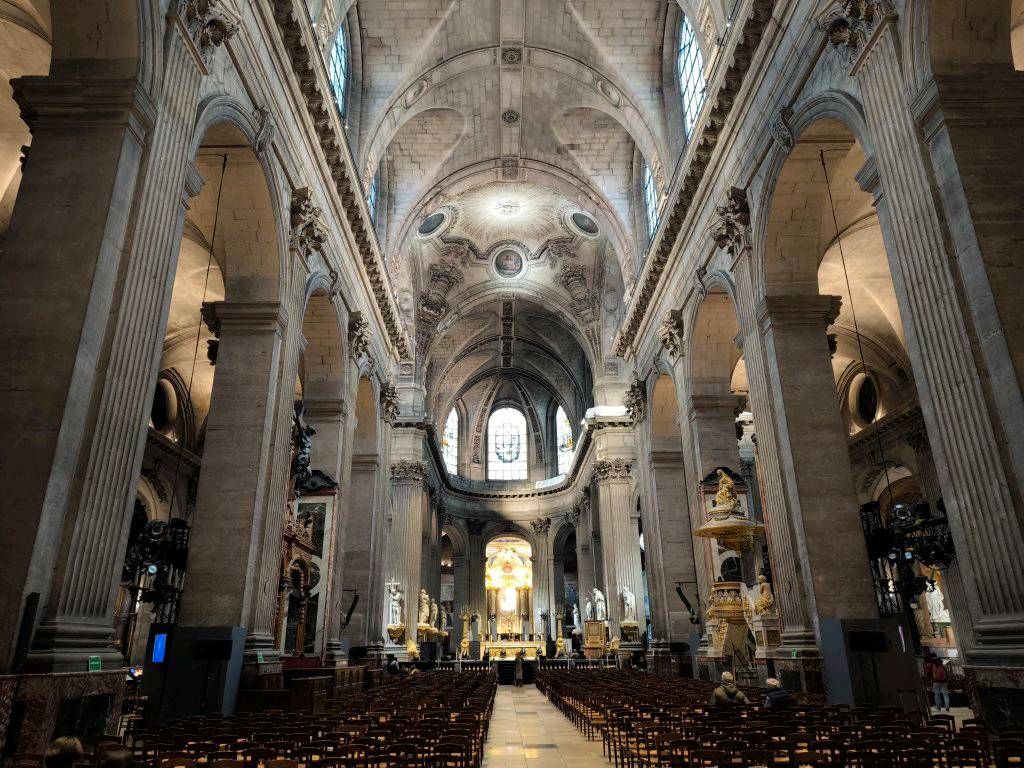
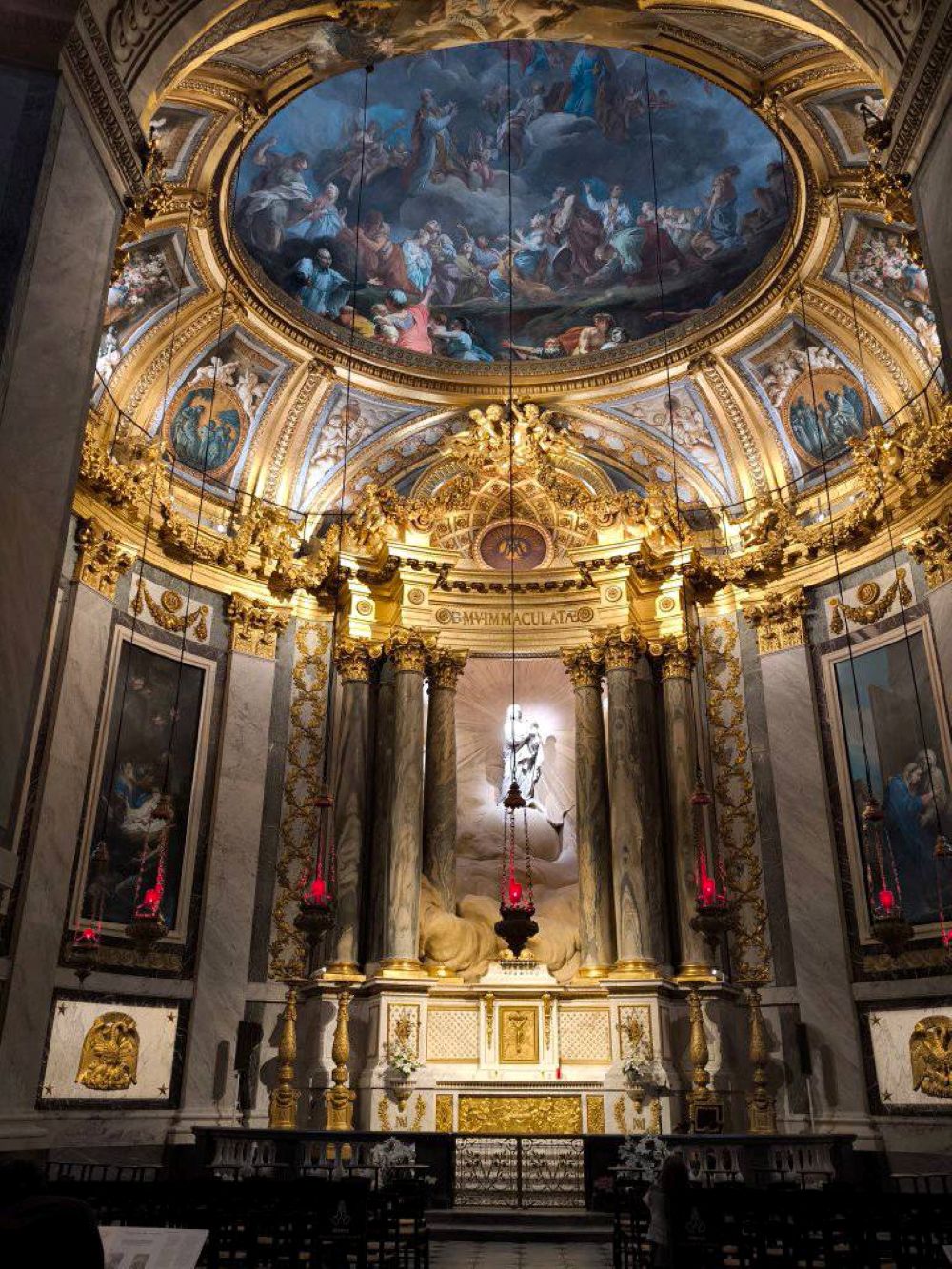
The Chapel of the Virgin,is the first element that was built, The Chapel of the Virgin is one of the oldest of the church. In 1774, enriched with an open dome, very original, responsible for plunging the assumption into a sort of celestial light. You can also see two paintings by Carl Van Loo , about the life of the Virgin, and the Angels of the Slodtz brothers adorned with garlands. Finally, the most majestic element is undoubtedly the white marble statue, the Madonna with the Child, by Jean-Baptiste Pigalle in a niche created by Louis-Philippe Mouchy, his nephew and pupil. In this chapel, the Classical and the Baroque come together in a happy way, but in general, the darkness prevents to admire it fully. The Chapel of the Virgin, future Axial Chapel, is the first element that will be built. The young king Louis XIV (he was seven years old), in the presence of the Regent Queen, signed letters Patent authorizing the mastery of work to receive legacies, foundations and donations. In 1660, after ten years of interruption, the work resumed. The choir and the nine chapels of the ambulatory are erected, then, in 1674, these are the four large piles of the Crusaders. In 1676, the north arm of the transept came out of the ground. The choir of the Old Church (which hinders the construction) is then destroyed. But in 1678, the funding dried up, the crates were empty. In addition, a huge passive is discovered. It is important to be clear: legacies, foundations and donations are not enough for such a large construction. The financial situation is even disastrous forty years will pass. Nothing is more built. The new church will use the nave of the ancient… with a difference of four meters (because the old church dates from the 12C and the natural level of the soil was ascended during the ages-in addition the plans of the new building envisaged a first raised level). The transept is not finished, the South arm does not exist. The aspect of the neighborhood is the one given by a interrupted construction site, with the inevitable nuisances for the residents and a deformed cult house, prey to the bad weather.
The Chapel of the Holy Angels. This side chapel (the first on the right when entering the church) is one of the most interesting by Eugène Delacroix. The artist took six years, from 1855 to 1861 (and with the help of an assistant), to create the two large oil and wax paints, as well as the vault that is a strengthened canvas. .Eugène Delacroix in Saint-Sulpice ,at the time he painted the
Chapel of the Holy Angels, the priest of the church had forbidden the artist to work on Sundays. Delacroix was very upset because the music of the offices threw him in such a state of exaltation that he worked twice as many times on Sundays of sung masses. With his assistant, he decided to play a trick on the guard responsible for monitoring the application of the instructions. The chapel, during the works, was closed by a palisade and a door. On a Saturday night, the two compadres set up a mannequin, dressed like the painter, sitting on a chair. On Sunday morning, the caretaker went to check that no one was working. Applying his eye to the keyhole, he saw the dummy, took it for Delacroix and knocked on the door to expel this disrespectful. No answer, he thrust the door. Delacroix and his accomplice come out of their hiding place and surprised our man… in flagrante of breaking and entering. And Delacroix was finally able to work on Sundays !!! After the Concordat of 1802, the church was in a bad state. Work was done to put it back afloat, especially in the re furnitures. Paintings and various objects which were purchased , and even the woodwork of the Chapel of the Sacred Heart. But it was only from the restoration, and especially from 1824, with the rise on the throne of king Charles X and the arrival of the ultras, that the Church could hope to regain its former splendor. The
Church of Saint-Sulpice is rich in multiple murals and frescoes. One owes the initiative of these artistic creations to the
city of Paris. Between 1820 and 1875, the latter commissioned renowned painters to decorate all the lateral and radiant chapels, not forgetting four large canvases in the transept. Some great names were sought, such as Eugène Delacroix for the
Chapel of the Saints-Anges and whose paintings obviously aroused controversy. In 1824, Jean-Dominique Ingres was asked to take over the Chapel of the Souls of Purgatory (at that time, dedicated to Ste. Anne and located next door), but he declined the offer. Refusal that deprived the posterity of a promising artistic comparison.
Having been restored, the Chapel Saint-Jean-Baptiste-de-la-Salle is one of the most beautiful in the church. The fresco paintings trace two episodes of the Life of Saint Roch, as well as an allegory of his apotheosis on the vault. There are many chapels dedicated to Jean-Baptiste de la Salle in the churches of France. This presence is justified because this Saint, a contemporary of king Louis XIV, devoted his life to the education and training of the young children of the popular classes, an activity which the Jesuits ensured for the affluent classes. At Saint-Sulpice, he was all the more entitled to his chapel that he was trained in the priesthood at the Sorbonne and at the Séminary de Saint-Sulpice. Here in the Chapel Saint-Jean-Baptiste-de-la-Salle , in illustrations of the Life of Saint Roch. The same was done in the Chapel of Saint-Maurice and in the Chapel of Saint-Vincent-de-Paul. Finally, see the two masterful frescoes in the Chapelle Saint-Martin. The fresco of Saint Martin sharing his coat is very nice. The Chapelle Saint-Jean-Baptiste does not shine by the beauty of its paintings, but by its two magnificent works of art in marble: a Saint Jean-Baptiste preaching and the funeral monument of the parish priest of Cergy.
The funeral monument of the parish priest of Cergy represents the struggle of immortality against death. An angel raises the funeral veil which covered the prelate. Immediately, to the right, death flees, frightened by the hope of eternal life and resurrection, which humbly awaits the prelate, both hands strained. A work with a very strong symbol, made from 1756 to 1758. In 1777, Chalgrin receives the charge of finishing the façade, in particular-and according to his own plan-the towers. Once the North tower was completed in 1780, The sculpted decoration of the baptismal font chapel under the Tower. Small reliefs, statues and great bas-relief of the Baptism of Jesus Christ are still in place, but in plaster. The pulpit to preach of Saint-Sulpice, made in 1788, is an architectural piece as original as it is magnificent. It gives the impression of being suspended in the air. The project, in a very classical style, was innovative for the time with a great sense of balance in both shapes and colors. The allegories of the theological virtues (Faith and Hope), frozen on the pedestals, seem to weigh with all their weight to stabilize this elegant construction that its apparent lightness seems to threaten to collapse. On the lampshade, Charity was carved into the wood.
The marble statue of Saint Vincent de Paul holding small children was very successful during its creation. It was exposed to the Salon of 1857 and received a medal. The Choir of Saint-Sulpice. for the reception of the seminarians, it was decided to expand the sanctuary of the Church by advancing the altar to the nave, and to enrich the choir with a decoration worthy of the greatest Parisian cult places after the Cathedral. In 1825, thanks to a sumptuous tabernacle adorned with four palms created for Saint-Sulpice, the order of the altar pads for the coronation of king Charles X. The Golden bronze bedrock of the high altar Jesus in the midst of the Doctors of the Church is of the same maker of the choir. The stained glass windows of Saint-Sulpice. At the end of the 17C, the Church still had only the sanctuary, the Chapels of the ambulatory and the south transept before the work was interrupted for forty years. But this did not prevent the filling the apse and the radiant chapels in stained glass. It is a time when we demand light, and it will be even more true in the 18C. In the 16C, the Council of Trent opposed the historiated.
The restoration of the ancient stained glass of Saint-Sulpice began in the 19C. Unfortunately, the explosion of the Luxembourg magazine in 1871 destroyed or damaged many of the stained-glass windows in place. The general restoration of the canopy was done from 1872. The face of Christ in the resurrection has been redone. Perhaps also the face of the Virgin in the Annunciation, although the sources consulted do not mention it. The stained glass window showing Saint Sulpice in adoration before the Sacred Heart is a creation of 1885 to replace the original stained glass window destroyed during the War of 1870. Nevertheless, it is at the Church of Saint-Sulpice that one can admire the most important collection of stained glass windows made during the reign of king Louis XIV. More precisely, their creation is part of the decade 1670. During the visit of the church, you must not miss to have an eye on the floral decorations of the borders.
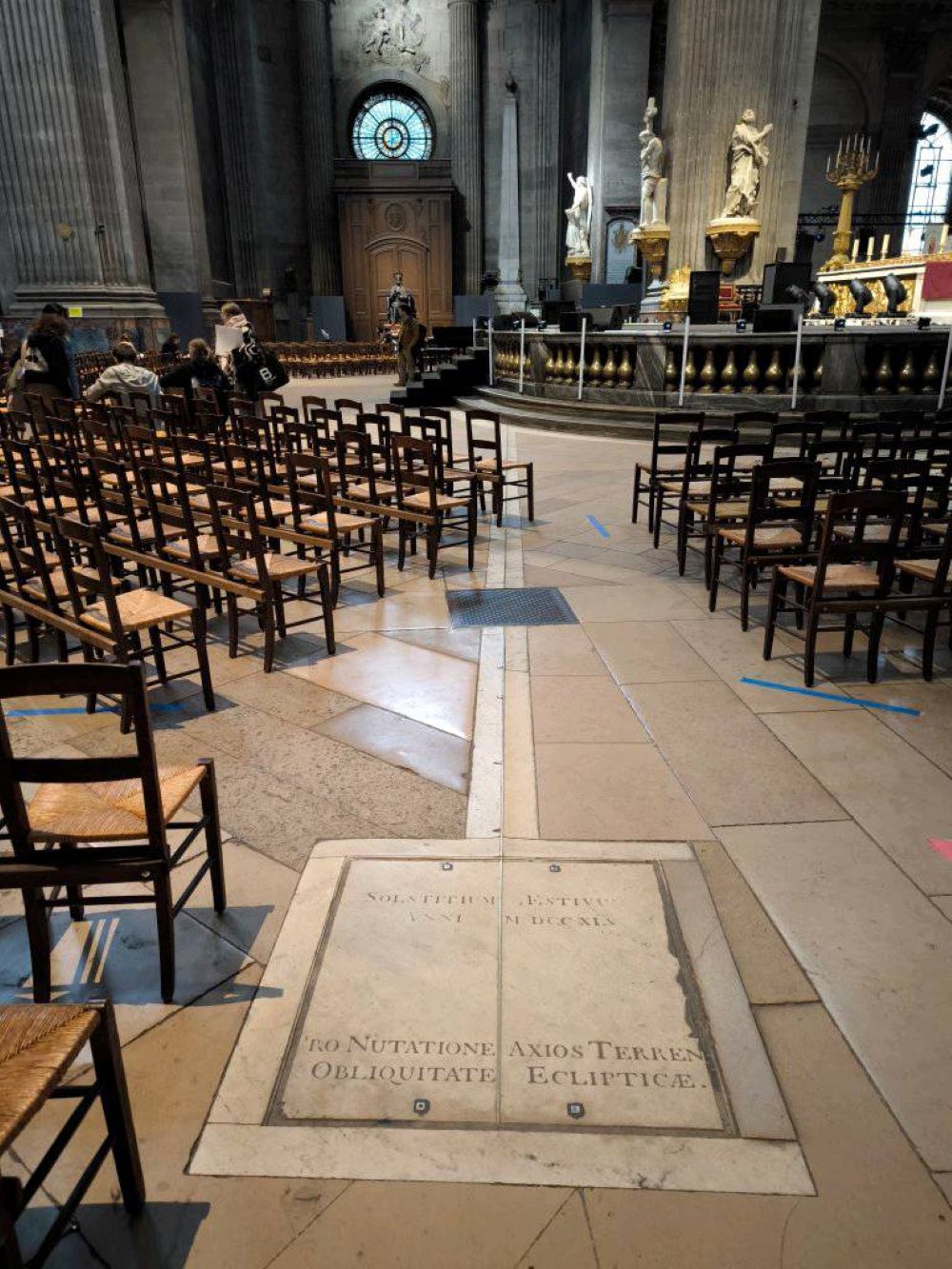
There is a wonderful Meridian in this church for all a must to see, The meridian of the Church Saint-Sulpice is an astronomical measurement apparatus. This meridian, traditionally called “gnomon”, is a device designed here to project the image of the sun on the ground, in order to determine fundamental elements of its annual movement in the sky. The meridian is built around a line strictly oriented along the North-South axis, represented by a brass rule inserted in a strip of white marble embedded in the ground of the church.
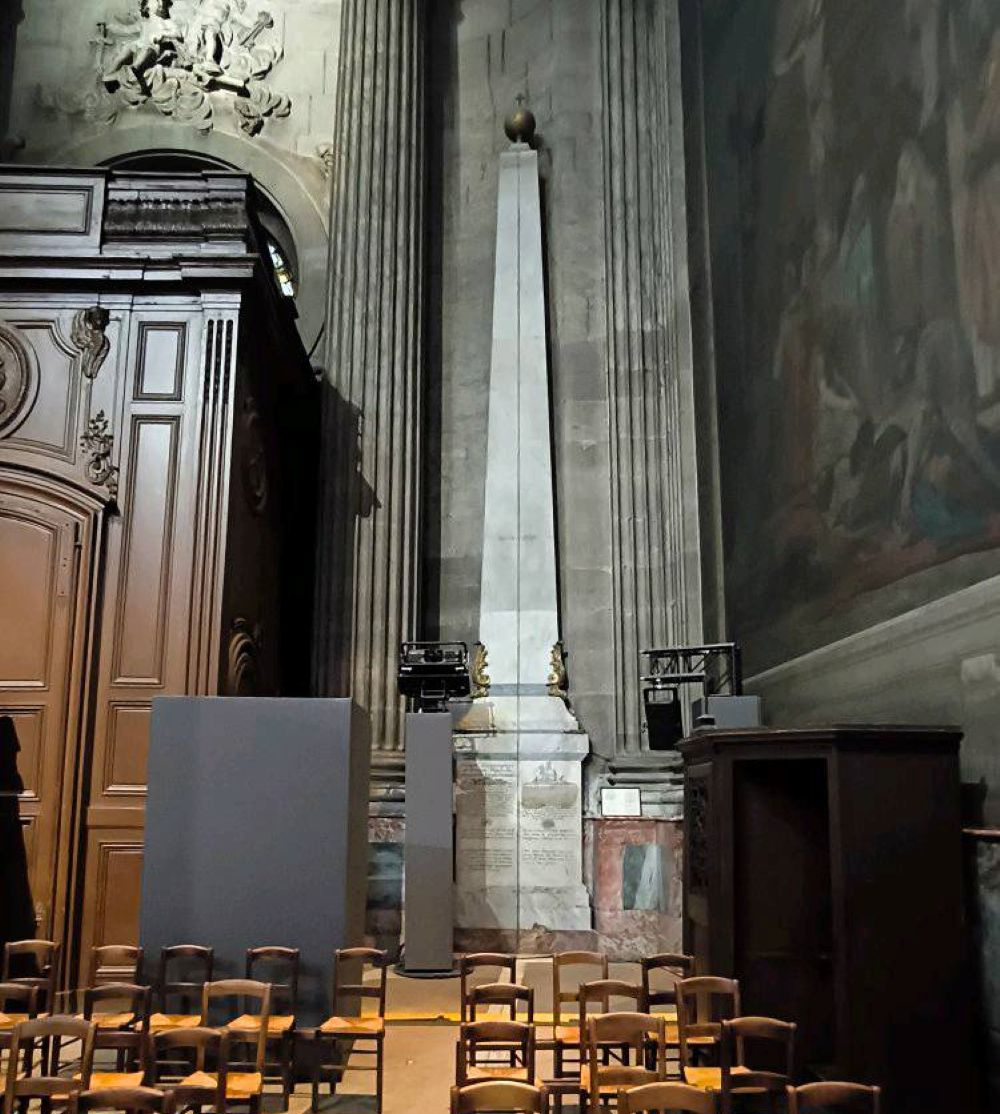
The sunlight passes through a small opening of a circular section arranged in the southern stained glass window, at a height of 25 meters, forming on the ground a small stain of elliptical light which crosses the meridian line each time the sun culminates True noon. The sun crosses different parts of the meridian depending on the time of the year, depending on its height in the sky at noon. On the meridian line is a “gold” disc which locates the position of the sun with equinoxes. It is located just in front of the altar. At the southern end of the meridian line is a square marble plate, which corresponds to the position of the sun at the highest at noon (64 ° 35 ′ on the site of Saint-Sulpice), the day of the solstice of summer, around June 21. At the other end of the meridian line is an obelisk, which is lit near its summit when the sun is at the lowest at noon (17 ° 42 ′ on the site of Saint-Sulpice), the day of the solstice of ‘winter. If the obelisk did not exist, the solar image would strike the horizontal soil in an area located about 20 meters beyond the wall of the church. The meridian was built on the initiative of Jean-Baptiste Langue de Gergy, parish priest of Saint-Sulpice from 1714 to 1748.
The organ of Saint-Sulpice has an international reputation. Built by Cliquot in 1781 (with 5 keyboards and 64 games), it was already looked at at the time as one of the best in the kingdom. Aristide Cavaillon-Coll rebuilt it from 1857 to 1861. He reused many of the elements created by Cliquot to link classical tradition with romance. The 20C has respected this illustrious instrument; it has retained all its original characteristics. And many wonderful concerts are played here indeed today.

The official Church of Saint Sulpice: https://www.paroissesaintsulpice.paris/visiter-et-decouvrir/
The Paris tourist office on the Church Saint Sulpice: https://parisjetaime.com/eng/culture/eglise-saint-sulpice-p1572
The Association friends of Aristide Cavaillon Coll on organs: http://www.cavaille-coll.fr/
There you go folks, an wonderful monument of eternal Paris, the most beautiful city in the world and monuments like this definitively makes it so. Again, hope you enjoy this post on the Church Saint Sulpice of Paris !!! as I.
And remember, happy travels, good health, and many cheers to all !!!


