
I came to my nice Rennes. This city of many nice monuments, and of course the City is in Îlle et Vilaine dept 35,of my lovely Bretagne, I came back after a long hiatus and it was great ! Bear with me as the next posts will be on this beautiful city . Let me tell you a bit more on the streets of Rennes, part II !!! Hope you enjoy it as I.
The main street ending here is the Rue Saint-Michel, better known as “rue de la soif” (street of thirst). The Rue Saint-Michel connects with the Place Sainte-Anne to the Rue Rallier du Baty via the Place Saint Michel. It has many half-timbered houses dating from the 16C and 17C lining the street, built on narrow plots they have a side corridor and a staircase on the back facade. They have decors carved with human profiles, heads of chimeras and foliage, dolphins and griffons. The house at number 13 dates from 1580, the oldest in Rennes. Very popular with the student and some not student lol! With lots of bars and beer flowing into the wee hours.
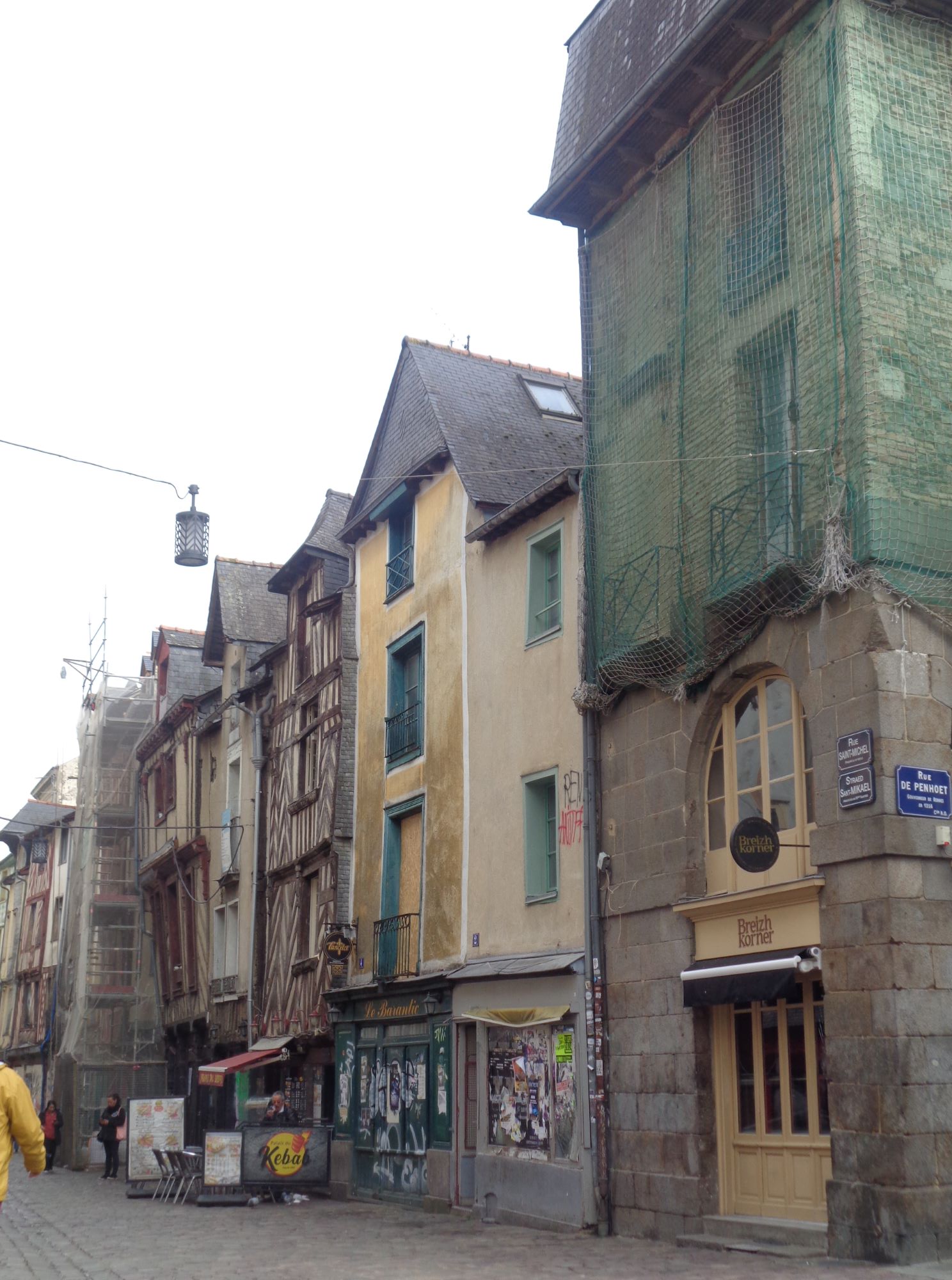
The Place Sainte-Anne is bordered by the Basilica of Notre Dame de Bonne Nouvelle (see post) . It is the absolute center of the city from which the kilometric distances are calculated! Moreover, near the rue Saint-Michel, with its many bars, it is often animated at night. In the streets that lead to the square as well such as the rue Saint-Louis, the famous rue Saint-Michel, rue de Penhoët, rue de Saint-Malo , rue de Saint-Michel and Rue de Saint Melaine. Most of the houses are half-timbered such as the Hotel de Bretagne at No. 94, the houses at number 105; 176; 187; and no. 198, where Jean Leperdit mansion, and where he died in 1823 . The new church Saint-Aubin, Notre-Dame-de-Bonne-Nouvelle basilica (see post), built in the early 20C, and the convent of the Jacobins, current Congress Center of Rennes.
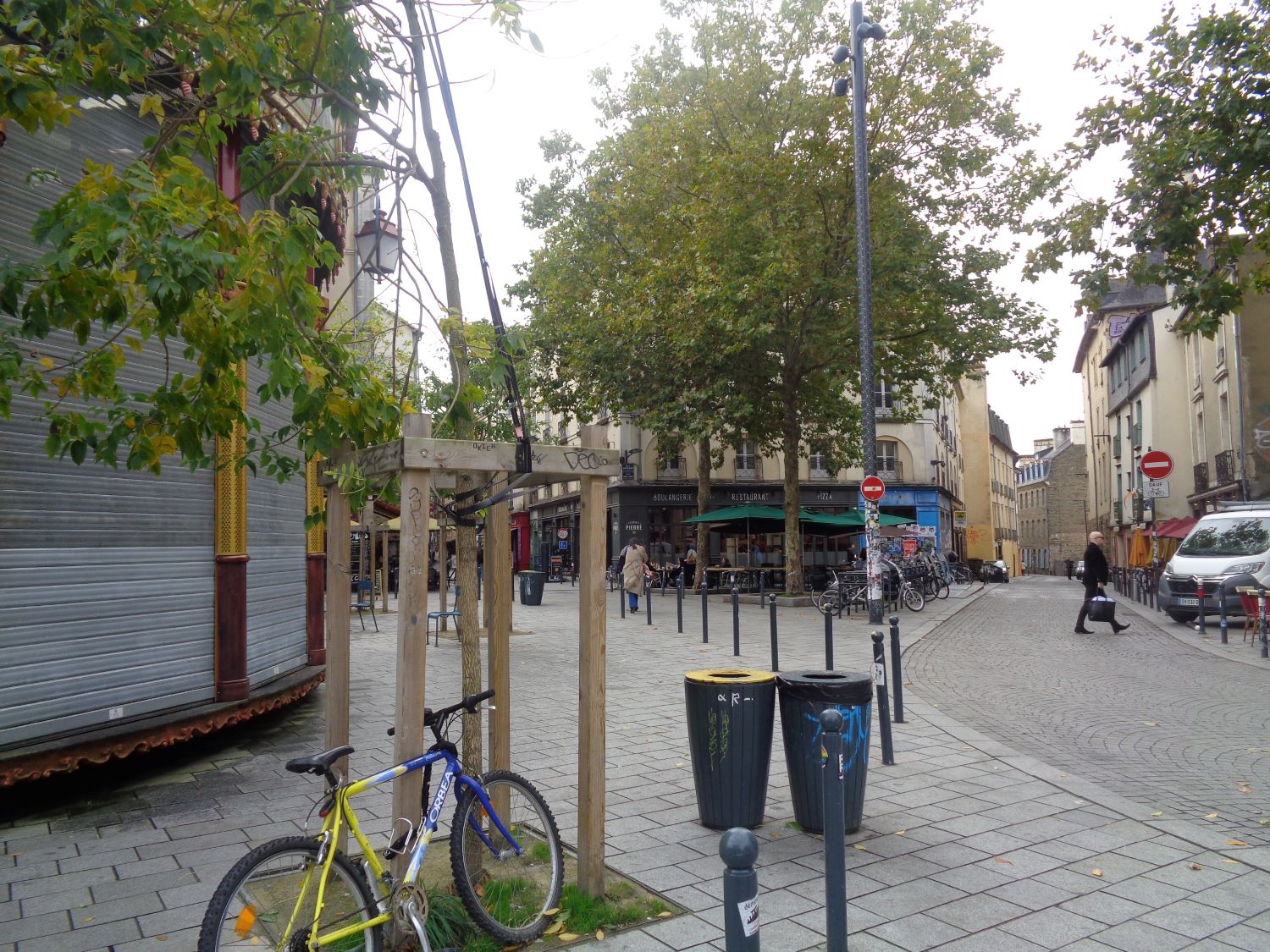
The Place Hoche, connects rue Hoche to rue de Robien in the North and rue de la Borderie pierced in 1909 to the northeast. The La Visitation shopping center has access to the square. Its northwest angle is located on the site of part of the buildings of the old Carmelite convent. Houses that bordered rue Saint-Melaine that are found on both sides of the place several buildings are remarkable. At the corner of the square and rue Saint-Melaine, (n ° 1) an Art Nouveau style building, the great seminary built from 1857 current Faculty of Sciences Economic and previously Faculty of Letters and Human Sciences – transferred to Villejean in 1967. By a transfer having taken place on days from December 7 to 9, 1940, this building hosted the offices of the Feldkommandantur which will sit there during the WWII, The Hotel Galicier is also with its turret, built in 1894 at the corner of the square (n ° 6) and the new rue de Robien ,the N ° 5 hosted a temporary hospital (also called a complementary hospital) during the Great War or WWI. This square refers to Louis Lazare Hoche, French general of the revolution on October 17, 1796, when he left the theater in Rennes to join his hotel, he underwent an attempted assassination perpetrated by an arsenal worker in the Rue de Fougères. It is therefore no coincidence that care to join the general’s name to this square located near the rue de Fougères. The excavation practiced in 1994, necessary for the construction of an underground car park of four levels, led to archaeological excavations which updated vestiges of the Gallo-Roman era: circular well, a bucket of wood in iron handle, blacksmith workshops, a small altar kept in the commercial hall of the Visitation mall.
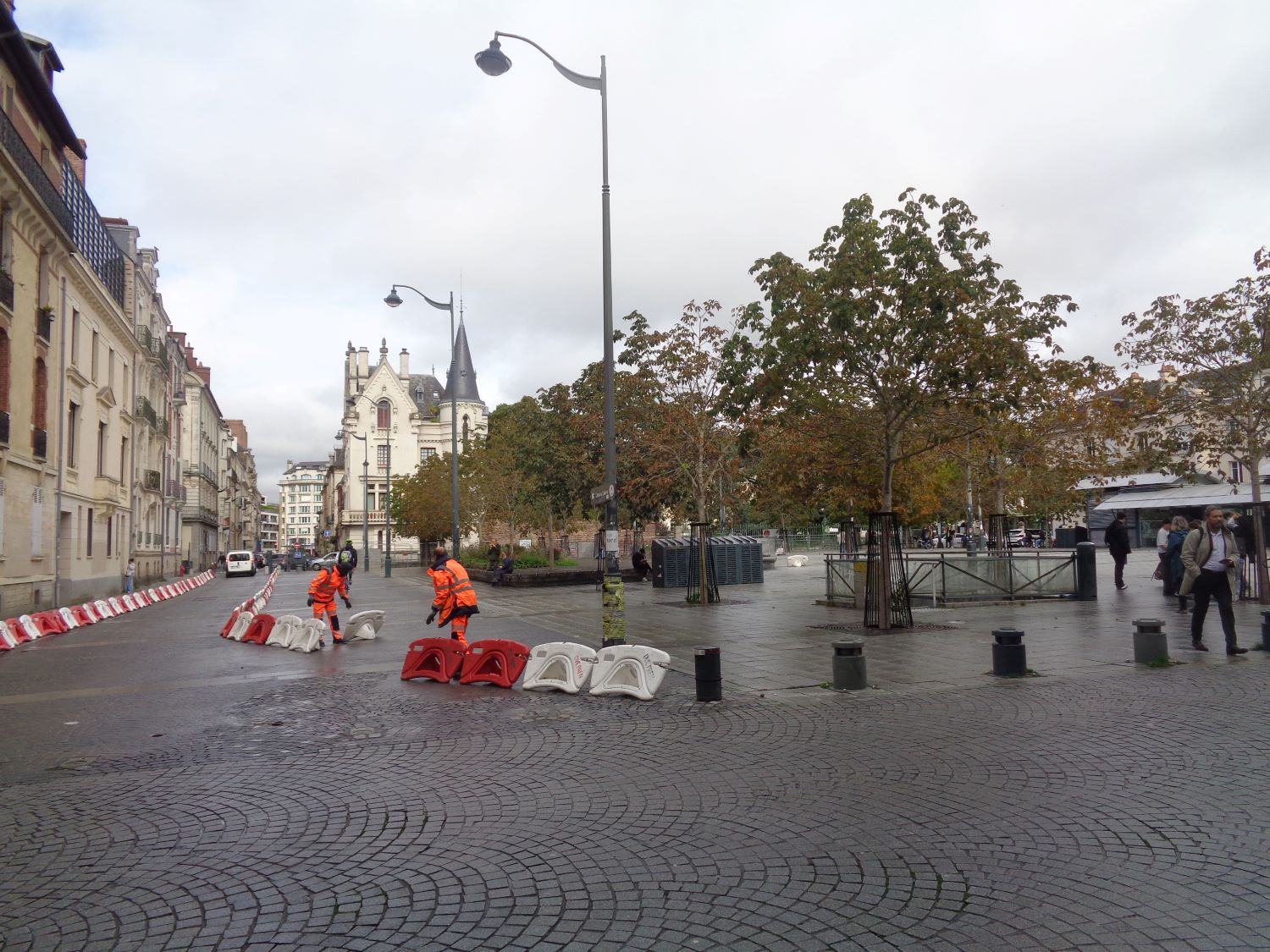
The rue d’Antrain is one of the main shopping streets in downtown Rennes. It is located north of the place d’hôtel de ville. It is an extension of rue Le Bastard towards rue Lesage and rue de l’Hôtel-Dieu. It connects rue de la Visitation to Boulevard Volney and rue de la Motte Brus. It is extended by avenue General George S. Patton. The metro stations serving the street are Sainte-Anne, Jules Ferry and Gros Chêne. The rue d’Antrain was mentioned in 1403 and was then called rue de la Reverdiais, until 1792, when it was still located in the suburbs of the city. The Faubourg was also appointed Faubourg Saint-Laurent or Pavé Saint-Laurent, because it led to this parish. This name of Reverdiais comes from a pleasure house surrounded by gardens and groves that was there. The remarkable buildings are at No. 2, at the corner, a remarkable house with a wooden pan, dated from the 17C, called the Cross-Verte and built by the Visitandines, and whose facade is made up of typical burgundy colors. It was completely restored in 2013, At No 9, the remarkable Art Nouveau style building from the old Valton store with an apparent iron structure on the front and decorated inside by the famous Mosaiste Isidore Odorico in 1897. , See a 16C wooden house, the second of this type that can be found in this street, at no 29, the Cinema Le Club, built in 1949, was taken up in 1983 under the name of the Arvor, art and test room known to broadcast author films. At No. 31, a former Capuchin convent sheltered the current Lycée Saint-Martin private high school and its chapel ; at n ° 58, the Maison de La Houblonnière, Hôtel de la Moussaye, known as the Indien. Ordered built for King Louis XIV, the southern part of Santo Domingo. In no 61, within the collège de l’Adoration, the old education house for poor girls of the Breton nobility, called Hôtel des Demoiselles.
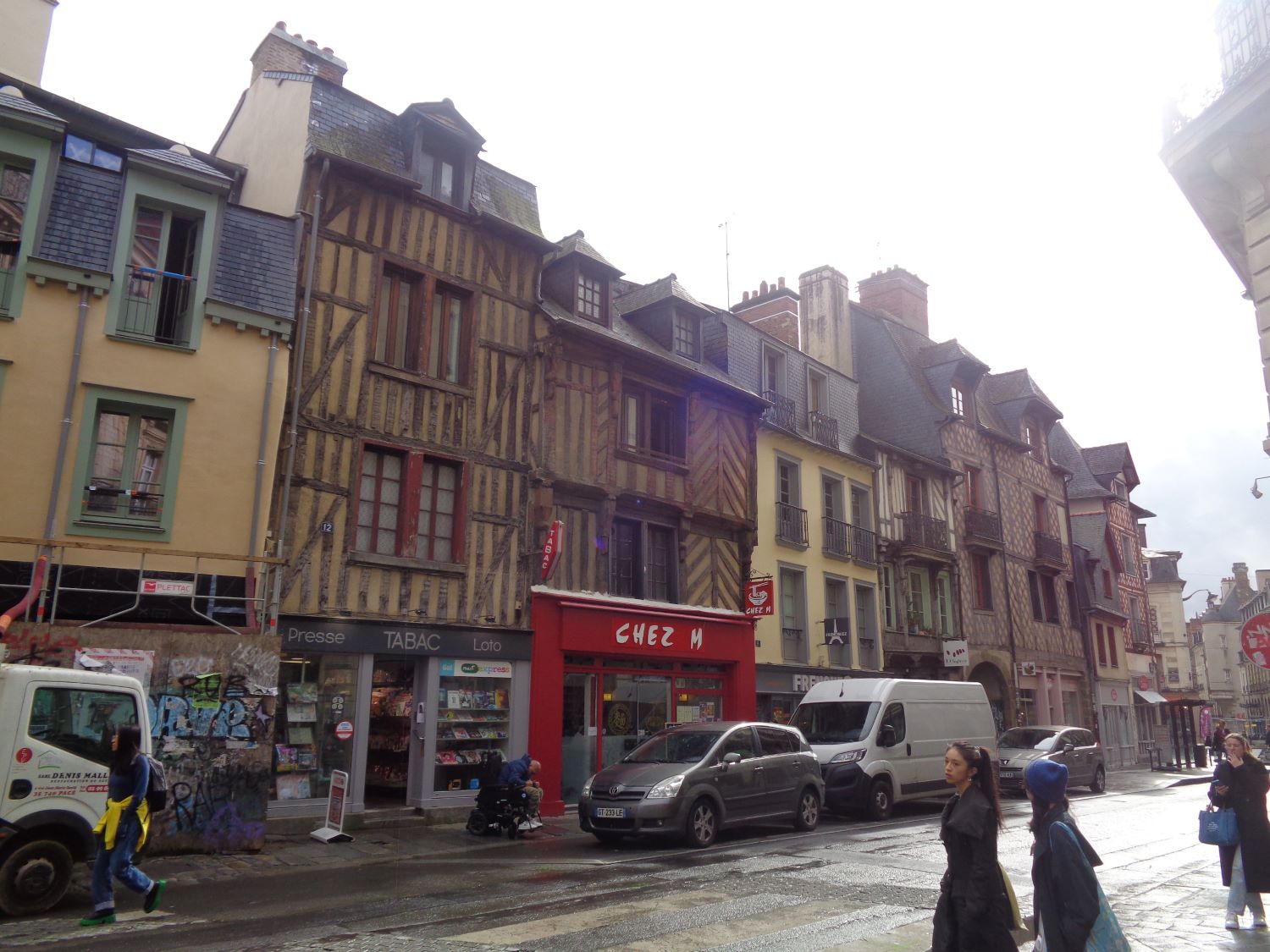
The rue du Champ Jacquet is located between the rue de Bertrand and rue Château-Renault. The name would be that of a gardener owner of the land, but would more likely have the distortion of Campus Sancti Jacobi, name cited in 1312 (see scallops). In the corridor of a street building there are bits ( parapets at the top of the ramparts). In 1728, the street was appointed rue de Léon in honor of the prince who had presided several times the order of nobility in the States, name distorted by the locals in the rue de Lyon. The statue of the mayor Jean Leperdit had replaced, in 1892, a heavy and massive fountain to which a false air of mausoleum had given the name of “tomb of genius”. A statue of Leperdit was able to be replaced in 1994, the original having been intended for the cast iron during the 1939-45 WWII. At n ° 5 rises the Hôtel de Bégasson, named after its owner built around 1640 on the ground floor in white stone with bays decorated with doric pilasters it has two stages with wooden sides, the cover adorned with tiny pediment in pediment. It is served by a circular staircase with double-volley with wrought iron ramp. We admire the row of buildings with wooden sides, on the north side. On the site of the current wooden sides, built in the 17C, stood the rampart of the 15C. There are always, the houses relied on it during their construction as it was customary, but it is only visible from a private passage which serves the apartments if these traditional timber wooden houses are still standing is because the fire of 1720 partially spared the square

The Rennes tourist office on its heritage: https://www.tourisme-rennes.com/decouvrir-rennes/
The city of Rennes on public transports: https://metropole.rennes.fr/thematique/transports-circulation
There you go folks ,another jewel in my wonderful capital city ofRennes. The walks are worth it with plenty of lovely areas, Again, hope you enjoy the post the streets of Rennes, part II !!! as I.
And remember, happy travels, good health, and many cheers to all !!!

 Paris1972-Versailles2003