
And moving right alone on my road warrior forays in my beautiful Morbihan in my lovely Bretagne, and in my belle France, let me show you a gem off the beaten path to many. I have come here and visited the market, this weekend I visit a bit more …. I like to update this old post with new text and links for you and me, Let me tell you a bit on the fine arts museum in town;and do read my other posts on the town of Le Faouët in my blog Therefore, let me tell you about the Fine Arts museum of Le Faouët !! Hope you enjoy the post as I.
The town of Le Faouët is part of the Cornouaille Morbihannaise. Its territory is bounded on the west by the course of the brook Mill du Duc bordering Le Saint, on the south-west by that of the Inam river bordering Guiscriff and Lanvénége; and to the east by that of the Ellé river bordering the towns of Priziac and Meslan. The town is located on a hill that rises to 152 meters above sea level. The departmental road D769, a fast track connecting Lorient to Roscoff, bypasses the east by a large curve-beltway. I went inland thru the D102 past Languidic and Plouay into the D769 to Le Faouët.

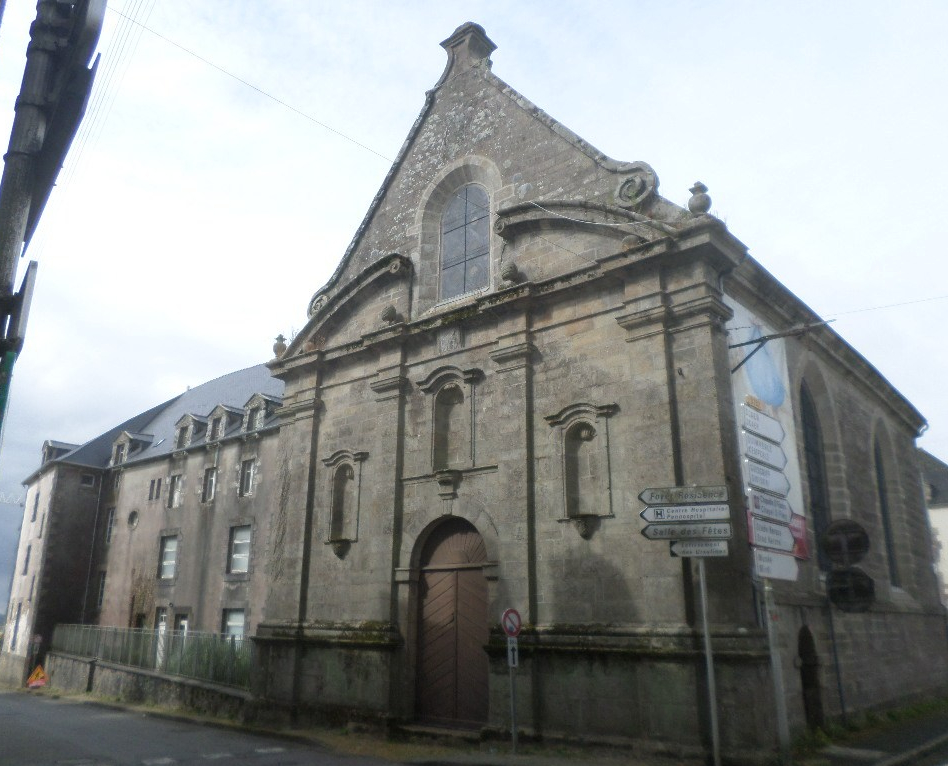
The Fine Arts museum of Faouët, or Musée des Beaux Arts de Le Faouët is a museum of paintings inaugurated in 1987 in a former convent of the Ursulines of the 17C, at No. 1 rue de Quimper. The museum presents a collection of drawings, paintings, engravings and sculptures, testifying to the daily life in Le Faouët from 1845 to 1945. From the middle of the 19C, the rich heritage and traditions of Le Faouët attracted many French artists and foreigners to inland Brittany. The first core of the municipal collection was formed on the eve of WWI at the initiative of Victor Robic, mayor of the time. An artist at his leisure, he maintains friendly relations with the artists frequenting the locality and at the same time encourages them to donate one or more of their works to the town of Le Faouët. A first museum was inaugurated in 1914, in the City/Town Hall. In 1987, the town acquires the former Ursuline Convent, which was then put on sale. This allows the development of a municipal collection threatened by oblivion. This also favors the organization of exhibitions devoted to artists who often frequented the small city, or to broader themes, generally related to the history of arts in Brittany. The museum presents the works of artists such as François Hippolyte Lalaisse Emmanuel Lansyer, Jules Trayer, Henri Guinier, Elizabeth Sonrel, Guy Wilthew, Germain David-Nillet, Arthur Midy, Henry of Estienne, Adolphe Beaufrere, Ernest Guerin, Emile Compard, Mathurin Méheut, Henri Alphonse Barnoin, Charles Riviere, Marius Borgeaud, Auguste Leroux, Fernand Daucho, Chauvaux Oscar, Lucien-Victor Delpy, Lucien Demouge, etc.

A bit of history I like tell us that Le Faouët was the seat of a lordship, the town probably having its existence to a castle destroyed during the War of Succession of Britain in the 14C. The lordship was erected in barony in 1495 by the Duchess Anne of Brittany. This town is cited for having participated in the revolt of the Bonnets rouges (red hats) or Revolt of the stamped paper (money) which occurred in 1675 .This small town becomes famous by the activities of Marion du Faouët, leader of a gang of thieves.. The town quickly acquired revolutionary ideas while the surrounding countryside became hostile. The town is attacked three times by the Chouans (rebels vs the French revolution) during this troubled period.
From 1860 to 1920, Le Faouët became one of the main artistic centers of inland Brittany, attracting many French and foreign painters and photographers. Their arrival was facilitated by the arrival of the railway at Quimperlé in 1865, a town 26 km away, then at Faouët even in 1906. The artists are housed mainly in the two hotels, the Lion d’Or and La Croix d ‘ Or, overlooking the Place des Halles, which equips artists’ studios and black rooms for photographers. Their favorite subjects are the scenes of markets and daily life, giving the image of an immutable Brittany rooted in the past, as well as the monuments, mainly the 16C market halls and the chapels of Faouët and the region, as well as as the surrounding landscapes. Among these painters, were the English Guy Wilthew, who lives at the Hôtel de la Croix d’Or, marries one of the daughters of the painter Louis-Marie Le Leuxhe and regularly stays at Faouet until his death. Also, Alphonse Le Leuxhe, began a career as an artist-painter, prematurely interrupted by his death during WWI. Many others who frequented Le Faouët were the Welsh gentleman Sydney Curnow Vosper the Belgian Oscar Chauvaux, naturalized French, also stayed several times at Faouët at the beginning of the 20C before becoming in 1934 curator of the Locronan Museum. Three painters set up a permanent workshop here: the Frenchmen Germain David-Nillet, who came to Faouët for the first time in 1902, and Arthur Midy, as well as the Swiss Marius Borgeaud, who spent only a few years in Faouët between 1920 and 1922 , staying mainly in Rochefort-en-Terre. Many other painters came more briefly like Fernand Legout-Gerard, Emile Compard, Auguste Leroux, Henri Barnoin, Charles River, Emile Schmidt-Vehrlin Robert Yan, Étienne Buffet, Jean-Bertrand Pégot-Ogier, Henry Déziré, Alfred Swieykowski, etc. or Jeanne-Marie Barbey, also a photographer. Elisabeth Sonrel also stays, realizing several works at Le Faouët, painting including Woman and children on the place des Halles du Faouët circa 1910, now in the fine arts museum.
The official Fine Arts Museum of Le Faouët : https://www.museedufaouet.fr/
The Museums of Brittany on Le Faouët : https://bretagnemusees.bzh/musee/musee-du-faouet/
The town of Le Faouët on the museum : https://www.lefaouet.fr/tourisme-culture-patrimoine/musee-du-faouet/le-musee-vous-accueille/
The local pays roi morvan tourist office on the museum of Le Faouët : https://www.tourismepaysroimorvan.com/en/preparing-your-stay/to-see-and-do/art-history-and-culture/musee-du-faouet-989038
There you go folks, another dandy, a wonderful place of great artisitc value in Brittany and France, one of the off the beaten path sites you must come. Again, hope you enjoy this post on the Fine Arts Museum of Le Faouët as I
And remember, happy travels, good health, and many cheers to all !!!

 Paris1972-Versailles2003