
I continue updating and revising old posts with new text, sometimes photos when not repeated to bring these marvels to life.These monuments needed a post of their own in nice Vitré, in the Haute Bretagne or upper Brittany on the outskirts of the territory or marshes of medieval times that were the frontier of the dukedom, I will tell you about the curiosities of Vitré, part I !!! Hope you enjoy the post as I
Vitré is gorgeous and has more porch houses than any other in France! The town is one of the Arts and History designation, 3 flower’s town , and best detour de France désignations, It is located 43 km from Rennes in departément 35 Ille et Vilaine. It is ,also, 164 km from my house.
You can see along rue Pasteur at no 15 the Monastery Saint Nicolaswith many more items than on the castle and the old chapelle Saint-Nicolas, at 500 meters from the castle was the chapel of the hospitals Saint-Nicolas and Saint-Yves established in the suburbs since the Middle Ages. The Saint-Nicolas monastery was a conventual establishment in the 17C. It is in fact a much older monumental set since it became during its history, the main body of the pre-existing Saint-Nicolas and Saint-Yves hospitals, which were built in 1222. This building with the chapel of the same name attached to it, the last material trace of one of the oldest French Hotels-Dieu (old hospitals).

However, there are nevertheless few elements before the 15C, a period when the Saint-Nicolas chapel was built, whose ornamental wealth reflects the local economic boom Arriving in Vitré on August 3, 1655 five Breton and Norman nuns of the mercy of the Order of Saint Augustine as part of the meeting of the States of Brittany in the city. On September 10 of the same year they were officially admitted to hospitals and obtained the right to use the hospices chapel, allowing them not to have to build one themselves, Their importance was such for the community that they were not hunted during the French revolution, crossed the times of terror and chouannerie, therefore, the monastery and the Saint-Nicolas and Saint-Yves hospitals lasted into the 19C. In 1986, the hospices were definitively transferred to the outskirts of the city to a new hospital center. The Saint-Nicolas chapel built in the 15-16C in a flamboyant Gothic style,is one of the symbols of the rise of the city of Vitré, rich under the old regime of a powerful bourgeoisie structured by the brotherhood of active overseas merchants within the French Oriental Seas company. The stained glass window opening onto the choir and the rosette face all those who penetrate the city from the north, making this chapel a monumental element of the glass architectural landscape and one of the symbols of the heritage of Vitré.

Since April 9, 2022 as part of a transitional town planning. 4 project leaders animate the monasteru and chapel ; these are Tinctoria, Cavrac, La Canopée, and the Tous au Verger, The Tinctoria offers a space devoted to plant dyes as well as textile fiber, hemp and Lin, which marked the history of Vitré from the 14C to the 18C. Tinctorial plants, hemp and flax are cultivated in the convent garden for an educational purpose and to serve for confections of articles or workshops on site. A restaurateur cooking in the old kitchen also gives certain peelings for this purpose. Cavrac is a loose cellar where you can consume on site. La Canopée is a theater company that will offer performances in the garden. Tous au Verger offers a conservative garden and fight against food waste by referencing fruit trees in the city.
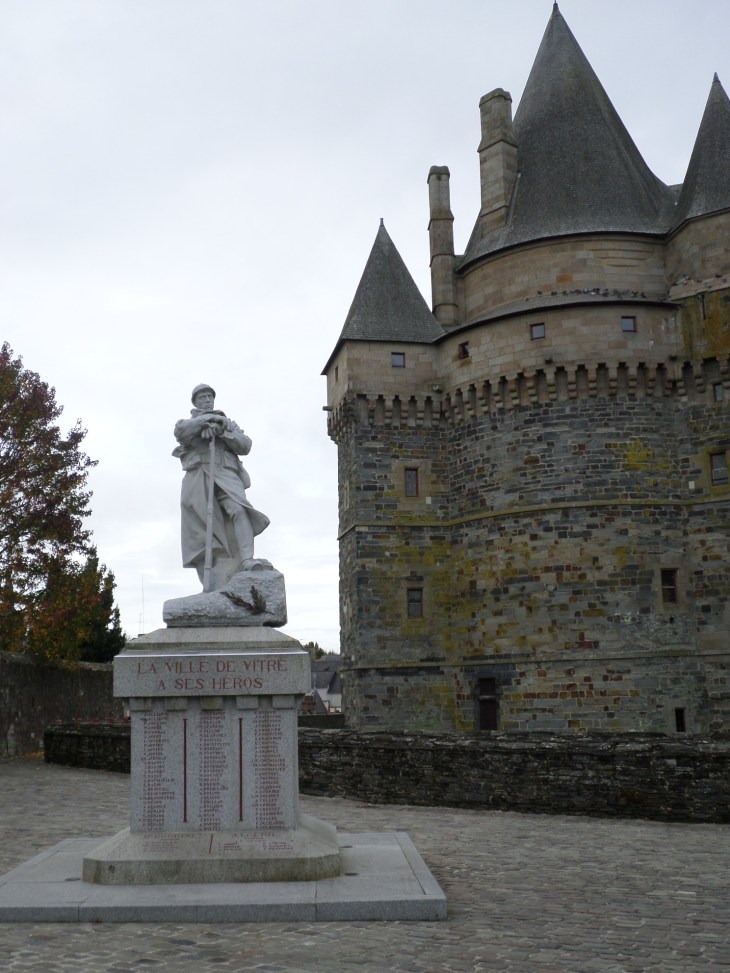
The Monument aux Morts or monument to the dead of Vitré is by the castle at Place du Château. It bears the names of 315 soldiers who died for France during WWI. Also, bears the names of 47 people who died for France during WWII,Jean Boucher , Breton statutory recognized for his art, was retained unanimously by the municipal council of Vitré, during its session of June 14, 1919, to make the war memorial which will be inaugurated the May 22, 1921. A statue of 2.50 meters high by 2.60 meters to 2.80 meters wide, wingspan of, on a granite base with inscription of the names of the heroes dead for the fatherland, In his long march to Paris, for the Liberation in 1944, General de Gaulle had stopped by Vitré to greet the locals in the first lights of the morning, the inhabitants crowd towards Saint-Yves and on the Place de la Gare. He was then taken to the Hôtel du Chêne Vert (above the current restaurant L’Odorico -see post)), to appear in front of the inhabitants and residents !
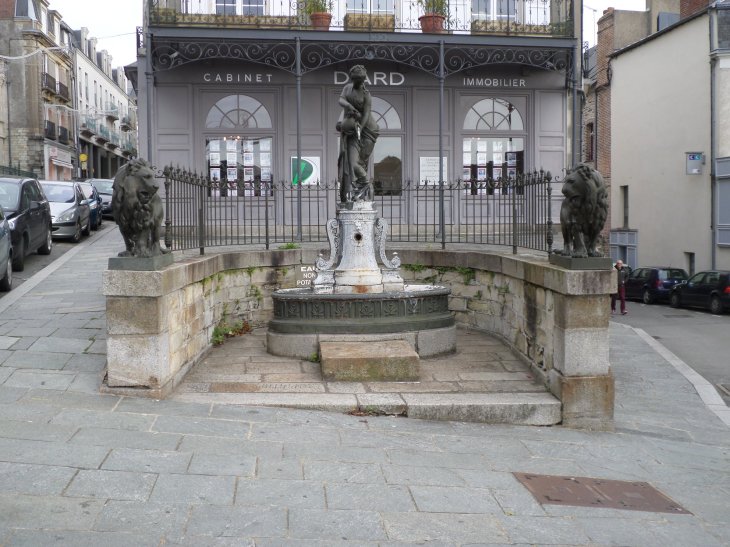
The Fontaine Aux Lions opposite the train station , done in iron steel of 1874. It is at the intersection rue Neuve and rue de la Liberté, Fountain with water carrier in the middle of a pool framed by two cast iron the city of Vitré taking up the motto of the city “Gules to the silver lion” where the omnipresence of lions, The building in the back was the home of the Hay of Netumières family ,built at the beginning of the 18C on the site of that of Mme de Sévigné Hôtel de la Tour de Sévigné !
Other things to see in Vitré with more time are : The Church of St. Croix: built in 1672 on the hillside. It was renovated in 1827. The priory of the Benedictines or priory of Notre-Dame: This building adjoins the Church of the same name. The Priory hosted the sub-prefecture until 1926. The District court occupied the West Wing until 2010. The north wing has since 2004 an antenna of the house of Cultures of the world, which became in 2011 the French Centre of intangible cultural heritage. The Château Marie is a 17C building, where the Councelor also stayed. It has a ceiling with exposed painted beams, The Chapel of Trois-Maries: It is located at the top of the Rue du Rachapt. The name originates from the cult of the three Mary developed in Brittany in the Middle Ages by Pierre de Nantes, who was Bishop of Rennes, and derived from beliefs drawn from the Golden legend. Vitré, also houses a rich heritage of private mansions, mainly built between the 15C and 19C. We note the Manoir de la Meriais, the Hôtel du Bât, the Hôtel Ringues de la Troussanais, the hotel de la Botte Dorée, and the Hotel de Sévigné. The streets of the Baudrairie, Poterie, Embas, etc. and the squares of the Marchi, station, Castle, and Notre-Dame show a medieval and Haussmann architecture. Out of the 53 houses with porches in Brittany, the rue de Poterie counts 9 and has the most important concentration of houses in porch of the area. Moreover, this street was once called “Rue des Grands Porches” or the street of the big porches,
Nearby, you can see with more time the Château des Roches-Sévigné, former Breton residence of Madame de Sévigné, is a gothic manor of the 15C located 7 km from Vitré towards Argentré-du-Plessis. Where she wrote several letters to her daughter . It has a garden French style. The museum or Musée des Rochers-Sévigné, is inside showing objects such as the Marquise de Sévigné letters , where she wrote several letters to her daughter . It has a garden French style. Le Jardin des Rochers , a private property but open to the public and managed by the city . It’s a park of 30 ha alongside the Château des Rochers-Sévigné, where lived Madame de Sévigné.
The Vitré metropole tourist office on its heritage : https://www.bretagne-vitre.com/en/essential-window/the-historic-center-step-by-step/
The City of Vitré on its heritage : https://www.mairie-vitre.com/Joyau-d-architecture-medievale.html
There you go folks, another nice road warrior trip of my lovely Bretagne. Vitré is one city to visit me think, worth the detour for its marvels. Again, hope you have enjoy this post on the curiosities of Vitré, part I !!! as I
And remember, happy travels, good health, and many cheers to all !!!

 Paris1972-Versailles2003