
I bring you back to my lovely Bretagne. This time in the dept 35 of Ille et Vilaine and the historical city of Rennes!! I have several posts on this pretty city ,but need to tell you that is wonderful sublime to walk on it, so therefore, taking bits and pics from other posts I have decided to split and give them a post of their own, well deserve me think, Therefore, here is my take on the rue du Châpitre of Rennes, Hope you enjoy it as I.
Strolling in the rue du Châpitre is always a moment out of time, far from the animation of the other streets and squares of the historic center. We come to do window shopping looking in front of original stalls, and enjoy a galette or crêpe while taking the time to raise our eyes to admire the sculpted and colorful details of the facades , The rue du Châpitre is the emblematic street of the historic center. Its history is also read in its arrangement and tells the mutations of the city, from its ancient origins, including the medieval foundations, the architecture of the Renaissance to the mansions built after the fire of 1720.
From the Middle Ages concentrated the elites around the Bishop. It is also from the ecclesiastical power and the presence of his canons that its takes the name, It was formerly called the rue du Four au Châpitre. The four or oven, was located at no.16, belonged to the Bishopric. By looking carefully at the facade we can see some details there, like ears of wheat and stylized Saint-Pierre keys, which recall his presence. And it is all the architectural interest of the street that includes houses with a wide variety of styles and eras. The oldest house in wooden structure is at no. 18 (see pic). You will easily recognize it with its cantilever and the chapter inn, a definitively closed medieval restaurant. Its very narrow facade is typical of the 15C. The neighboring houses that make the corner with the rue de la Psalette, at numbers 20 and 22,(see pic) are later ; they date from the 16C. Their carved sets are remarkable and testify to the style of the Renaissance. At the other end of the street, you can admire another house dating from the Middle Ages. It houses a charming guest house in which you can see a magnificent Gothic fireplace. This former mansion dates from the 14C-18C, and belonged to the Talhouët family in the 18C.
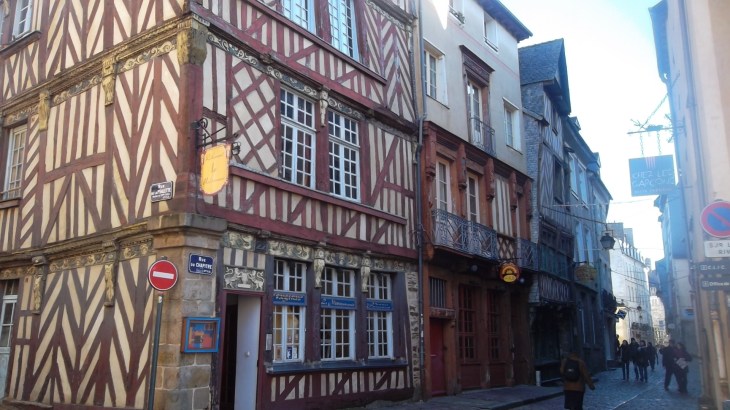
It is impossible to miss the no 5 house with its wooden facade in polychromy. It is the former Hôtel de l’Escu de Runfao built in the 17C with three half-timbered levels. On the southern side of the street of other wooden houses dating from the 17C have kept arcades which were used to cover the coaches. Today transformed into beautiful shops and restaurants whose terraces are particularly pleasant in fine weather. After the fire (1720), the manufacturers therefore favored the stone The best example is the splendid Hôtel de Blossac, located at no 6. If it now houses the Regional Directorate of Cultural Affairs (DRAC), this mansion and its vast garden was built for the Blossac family between 1728 and 1732 at the site of the stables of the Hôtel de Brie Voisin, which the Blossac family acquired at the same time, it stretches on a very large plot in a district where the space was rare and therefore expensive. Staying at the heart of the city was undoubtedly a way to establish your power. Finally, Blossac’s family lived there very little time, and in the 19C, it was a famous writer who marked his imprint there. Paul Féval, son of a magistrate from the Court of Appeal, indeed stayed on site between medieval houses and mansions of wood or stone, the rue du Châpitre therefore reserves a lot of beautiful surprises. This is probably why restaurants and original shops have settled there.
An anecdote, wooden houses or half timbered,you know the difference ? In Rennes, it is fairer to talk about wooden houses. Two peculiarities distinguish the wooden from the half-timbered: first a larger elevation of houses-some are real buildings of 3 or 4 floors. Then, the second characteristic of the wooden section, the presence of a cantilevement, the fact that the upper floors are wider than the ground floor. This is one of the originalities of the landscape in wooden houses in Brittany, and in particular in Rennes ; the more they rise, the more the facades overflow and tend to meet above the cobbled alleys. Voilà !
The Rennes tourist office on the wooden houses: https://www.tourisme-rennes.com/decouvrir-rennes/histoire/maisons-pans-de-bois/
The city of Rennes on its heritage : https://metropole.rennes.fr/le-patrimoine-et-le-matrimoine
There you go folks, another beautiful city only 1h30 from my house ! Rennes will amaze you with its beauty, architecture,and history. A marvelous medieval field of sublime buildings and great ambiance on the bars, restos, brasseries, and else. Again, hope you enjoy this post on the rue du Châpitre of Rennes as I
And remember, happy travels, good health, and many cheers to all !!!

 Paris1972-Versailles2003
Beautiful timbered property
LikeLiked by 2 people
That’s true! Thanks for stopping by Cheers
LikeLiked by 1 person
Wonderful timbered house
LikeLiked by 2 people
Indeed, thanks for stopping by Cheers
LikeLiked by 1 person
Always a pleasure
LikeLiked by 1 person