
Let me tell you again towns in the confines of my lovely Bretagne, and the Finistére dept 29 ,we got into another ocean beauty , lovely by the coast, and nice monuments. Again, found me older pictures not yet in my blog that should be in, Therefore, let me tell you about the curiosities of Plobannalec-Lesconil !!! Hope you enjoy the post as I.
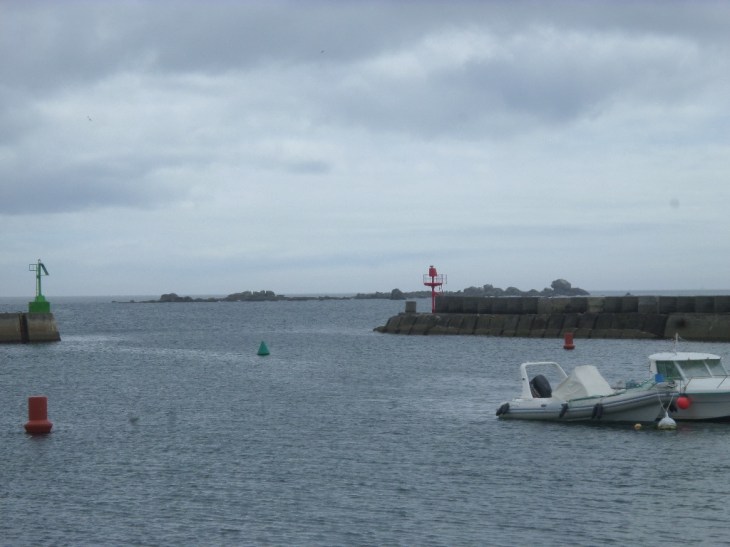
The town is made up of two agglomerations: the initial borough of Plobannalec, inland, rural and laidback, and the fishing port of Lesconil, further south, maritime tradition and quant, which began to develop in the mid-19C, which declined from the 1970s, and whose trawl fishing activity disappears in the early years of the 21C. Mostly in Lesconil you have a fisherman’s harbor paradise. Here you have all the action around the harbor with lots of fisherman’s boat even if the trade has almost disappear, you can still see plenty of boats and the off island of Men ar Groas visible from the harbor deck. The current port is created on the other side of the overland, in a rocky cove called Pors Carn, for the time being open to the sea. The kick-off of its foundation was, in August 1878, the decision of the SCSN (today the SNSM, me follow as donor since 2008) to build a lifeboat station In 1879 , the shelter and the hold, 90 meters long; are finished. They can accommodate the Foubert de Bizy lifeboat (named after the donor), a 10.10-meter straight canoe.
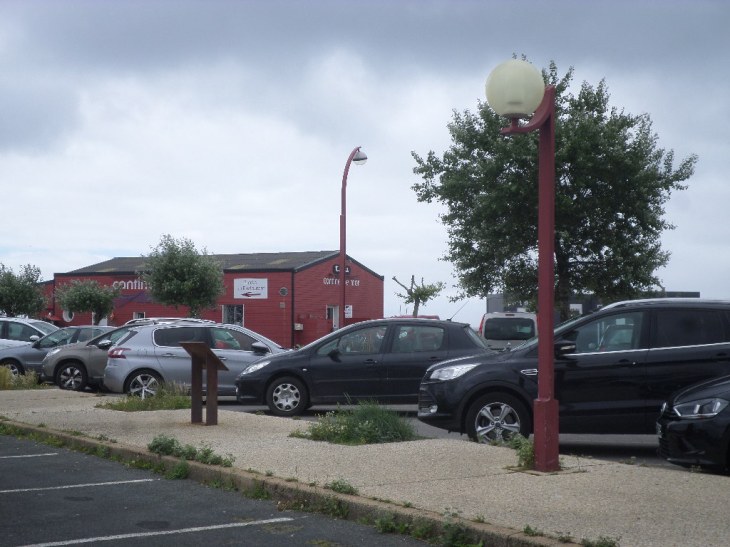
Right by the port de Lesconil we had our apéro drink as we were on the road warrior mode and did not ate inside, However, this is a nice place well recommended on reviews and worth to be back for it eventually, This is the Tara Cantine de Mer Quai de Langoguen, on Lesconil side, RestaurantGuru reviews on the resto : https://restaurantguru.com/Tara-Cantine-de-Mer-Plobannalec-Lesconil
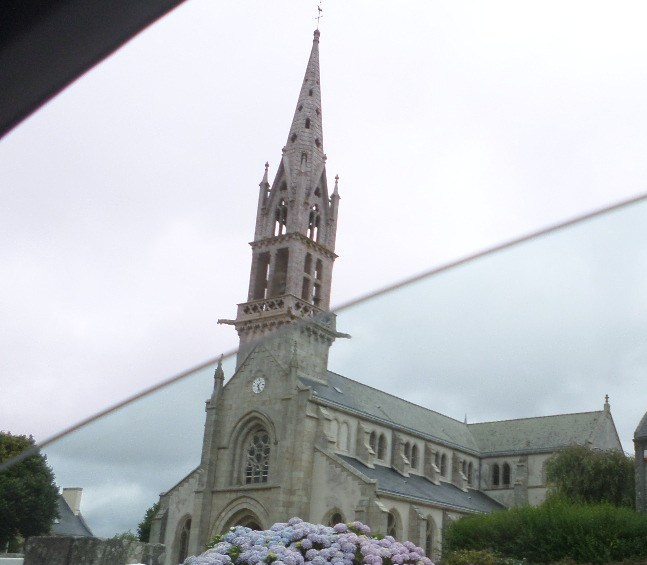
The Church of Saint-Alour built from 1875 to 1879 of the parish of Plobannalec. The church was consecrated on 11 June 1879. Saint Alour is the third Bishop of Cornouaille who lived in the 5C. This church replaced a 16C church, some parts of which were even back in the 13C. The modern stained glass contains Saint Alour, Saint Guénolé (Saint Guénolé sends Saint Tudy and Saint Alour to preach religion in the Bigouden country), Saint Alain, Saint Louis and San Sebastian. The Church contains a painting of the Assumption (copy of Spanish painter Murillo ! ), a painting of the marriage of Saint Catherine (copy of the Italian painter Correggio ! ), a reliquary of the 15C pediculate with inscription of “Saint Quido “, and a reliquary of the 16C in vermeil supported by four balusters with statues of the Savior, the Blessed Virgin, St. Sebastian and St. Louis. The closing of the baptismal font dates from the 18C. The Church houses the statues of Saint Alour 18C, San Sebastian 17C, Saint Peter, Saint Herbot, the Blessed Virgin 18C, and a Pietà 15C. Picture upon arriving see other post for more.
I will tell you here from memorial war sites something I left out from the first post on this church, It is long but feel is necessary for the history buff lover in me.
More than 100 years ago, it was the end of the Great War or WWI, The memorial to the fallen of Plobannalec was inaugurated in 1923 , The bottom of the stained glass window represents the dead soldier in a horizon blue uniform lying between his parents dressed in bigouden costume (Breton) of the era. Look at the height of the headdress after the war. Another personalization of the decor: the presence of a nun from the Congregation of the Daughters of the Holy Spirit whose first community settled in the town in 1862. Second key character in the stained glass window, standing this time, Marianne, symbolizing the French Republic . Her large braids fall above a loose dress in the national colors and she holds the French flag in one hand. Various leaders of the national community gather around her, starting with a priest in a chasuble and biretta (Abbot Jézégou ) as well as a politician with a bald head, easily recognizable, Clémenceau, Father Victory. On the other side, we recognize an officer in uniform, bearer of the Legion of Honor medal. At the back, in a strongly green-tinged setting, the walls of Reims Cathedral stand out amid the flames. The fire which ravaged the cathedral was caused by German shell fire on September 14, 1914. Reims became the symbol of the martyr city and German barbarism. Above, large clouds symbolize the passage between battered France and the celestial world. Here stands in majesty the Sacred Heart of Jesus, whose devotion only redoubled during the war, culminating in 1917. On each side, those who participated in the Christianization or defense of France, starting with Saint Joan of Arc, recognizable by her haircut and wearing clothing in royal colors. after recognizing Prince Charles, she was given a white banner with fleur-de-lis on which she had the inscription Jesus Maria. This is what the stained glass window shows. Joan of Arc is therefore presented here as the leader who helped drive the enemy from the territory, a barely disguised way of suggesting the visitor draw a parallel with the current situation. The same remark applies to Saint Geneviève, just above Joan of Arc. She also, through her energy and tenacity, helped save Paris from the invasion of the Huns. We think of Reims again when we discover Saint Rémy, his hands clasped and wearing his bishop’s mitre. It was he who baptized Clovis and 3000 soldiers at Christmas 496 , a highlight of national history and the Christianization of Gaul. On the other side of Christ in majesty is Louis IX, Saint Louis, with his crowned head and his white and blue mantle, royal colors, on which stands out the fleur-de-lys, emblem of the Capetian monarchy. Near him stands out, in profile, the face of the priest of Ars, Jean-Marie Vianney, declared since 1905 patron of all priests in France. Finally, it is the representation of the Archangel Saint Michael with outstretched wings and equipped like a medieval knight. He is usually depicted slaying the dragon, an attitude reminiscent of that of the nearby war memorial where we see the French soldier crushing the German imperial eagle, symbol of the Reich, with his foot. its crowning glory in the upper rose-shaped network. Here are suggested the different armed forces which contributed to the final victory: the lit grenade for the infantry, the cannonballs for the artillery, the anchor for the navy, the breastplate for the cavalry and finally the wings for aviation. In the center stands out the dove of peace holding an olive branch in its beak. So, we realize that it is the whole post-war atmosphere that shines through: the human losses, the problem of war damage, the question of mentalities, particularly that of veterans or even the religious devotions activated by the recent canonizations of 1920: Saint Joan of Arc and Saint Marguerite-Marie Alacoque who declares to have had a miraculous apparition of the Sacred Heart of Jesus. Thus all the bays of the church were occupied by stained glass windows entirely paid for by the parishioners.
The local Pays Bigouden tourist office on the Saint Alour Church : https://www.destination-paysbigouden.com/a-voir-a-faire/visites-patrimoine/eglise-saint-alour-253904
The local Pays Bigouden tourist office on Plobannaiec-Lesconil pleasure marina : https://www.destination-paysbigouden.com/a-voir-a-faire/en-plein-air/port-de-plaisance-de-lesconil-1505990
The city of Plobannalec Lesconil on its heritage : https://www.plobannalec-lesconil.bzh/decouvrir/la-commune/histoire-et-patrimoine/
There you go folks,a wonderful area plenty more to see I was touching the bases this is a gorgeous area that need to be visited more, a lot more. Plobannalec-Lesconil or for me rather Lesconil is pretty, and I will be back ,eventually. Again , hope you enjoy the curiosities of Plobannalec-Lesconil as I.
And remember, happy travels, good health, and many cheers to all !!!

 Paris1972-Versailles2003