
We have come quite often to Nantes, a City that needs to be visited more by all. A wonderful historical city with many monuments to see, many wonderful properties. I was again on my local road warrior mode and as bit not back, decided to give it a refresher to this must to visit City of Nantes, Loire-Atlantique dept 44 of the Pays de la Loire region,in my belle France ; even if old Bretagne! Do read my previous posts on the city as well, For now let me tell you about the Lieu Unique (LU) of Nantes !! Hope you enjoy the post as I.
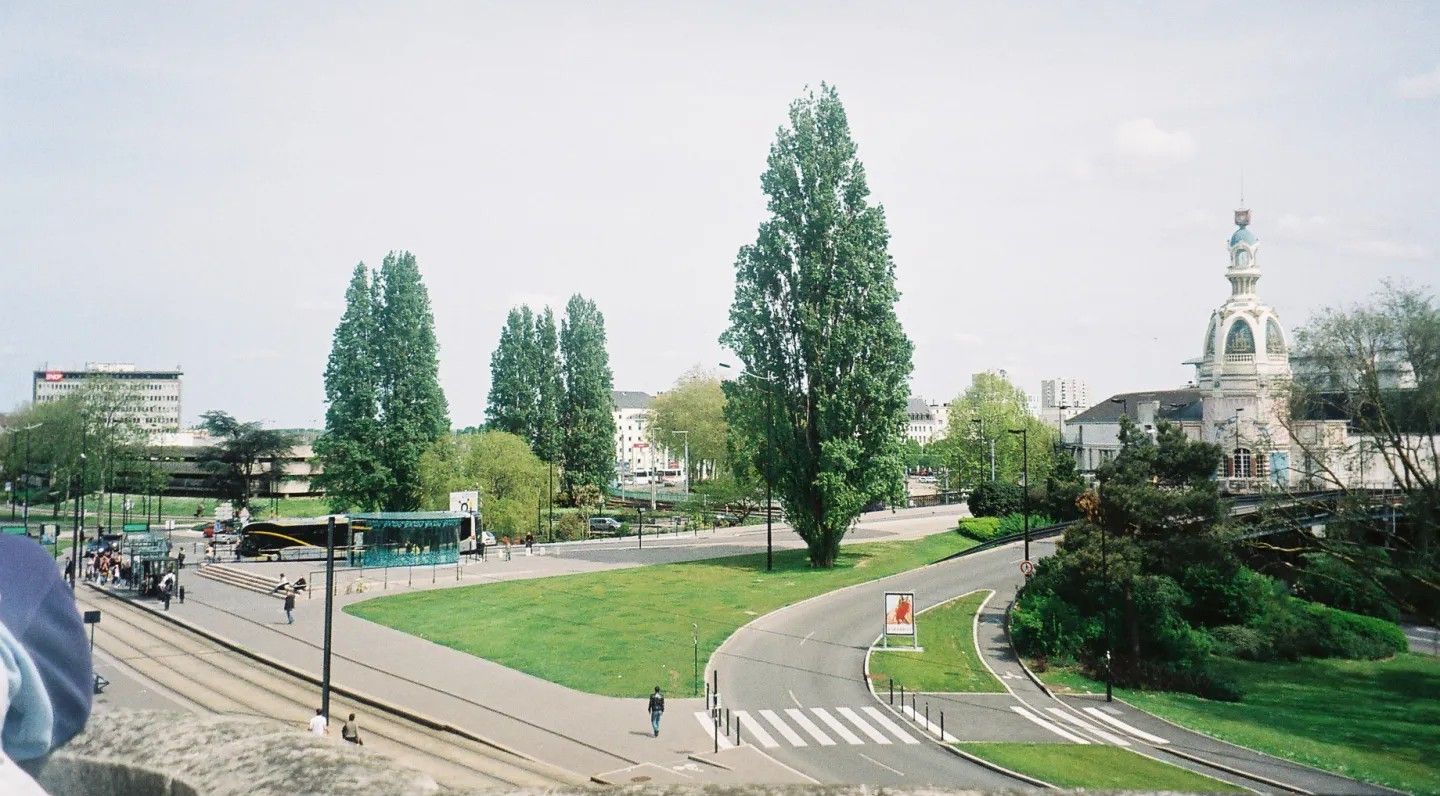
There is the Le Lieu Unique a contemporary culture center created on January 1, 2000 and installed in the former premises of the LU biscuit factory, whose initials are also those of the cultural center. It is located in the Champ-de-Mars district, on the banks of the Saint-Félix Canal, at the eastern end of what was once Gloriette Island. The LU tower that was kept is 38 meter high, and surmounted at the top by a lantern identical to that presented by the LU pavilion at the 1900 Universal Exhibition and is topped with a metal spire. The dome is made up of six oval-shaped windows topped with carved eagles. The body is decorated with a fame, angel wielding a trumpet and surrounded by six of the signs of the zodiac. At the top of a 130-step staircase, the tower offers a breathtaking view of Nantes. It finally becomes the Le Lieu Unique in 2000. The unique place is today internationally recognized for its spirit of curiosity in the various fields of art: plastic arts, theater, dance, circus, music, but also literature, philosophy, architecture and digital cultures. There is ,also, a very nice restaurant with gorgeous views over Nantes.

The two towers, built in a style close to Art Nouveau, aim to assert the power of the company by creating a perspective in the extension of the Saint-Pierre and Saint-André courtyards and by responding to the towers of the castle of the Dukes of Brittany. In 1943, the bombings of WWII which ravaged Nantes also affected the towers but did not destroy them completely. These will be beheaded during major works in 1972. Only the one located to the west was completely razed during the 1980s to make way for a hotel. The rest of the plant continued to operate until production and the 450 employees who worked there were transferred in 1986 to the new site at La Haie-Fouassière. The city of Nantes bought the Ferdinand-Favre annex in 1995 The remaining northern part between avenue Carnot, quai Ferdinand-Favre and rue de la Biscuiterie, where cultural activities take place today.
The bar restaurant Le Lieu Unique is a nice and original place to come to have a quiet coffee or glass in the afternoon, in this beautiful post-industrial decor. In fine days, the length chairs on the shaded terrace are particularly pleasant. In the evening, the place comes alive and can sometimes take on the appearance of a nightclub. Free entry.
A bit of history I like tell us that the history of the LU factory began with the arrival of Jean-Romain Lefèvre, a pastry chef from Varennes-en-Argonne, in Nantes, in 1846. Jean-Romain is employed in a pastry shop on rue Boileau. In 1850 he married Pauline-Isabelle Utile, and the couple decided to buy the pastry shop to turn it into a “Factory of Reims biscuits and dry sweets.” Success was quickly achieved and the couple opened a second store in 1854, under the company name “Lefèvre-Utile” (LU). At the end of the 19C, biscuits were sold in bulk. Louis opts for a more modern packaging, in metal boxes, called “tin boxes”
The brand’s identity was already created in the 1860s by chosing the allegory of Fame to affirm the quality of their products and a certain conquering desire. At the end of the 19C, packaging became an advertising medium. Subsequently, in 1892, the company developed a line of lithographed boxes. The illustrations are mainly inspired by Brittany with, for example, the Retour de la Pêche cookie box dating from 1892, the Régates de la Loire in 1894 or the Breton Banquet dating from 1902. They bought an old spinning factory in 1885. on the grounds of the Île de la Madeleine, opposite the Château of the Dukes of Brittany (see posts) ,and close to the train station. On February 1, 1887, Louis Lefèvre-Utile joined forces with his brother-in-law Ernest Lefièvre and together they officially founded the Lefèvre-Utile company. In 1897, Louis sent his son’s sketches to Firmin Bouisset who made him the Little Schoolboy (pétit écolier biscuits fame). And in 1905, at the time of the company’s golden age, Lefèvre-Utile released the Paille d’Or. The biscuit alone represents a graphic medium; in 1903, painted a portrait of Sarah Bernhardt for the advertisement of LU. The company’s advertising boards are true works of art. Inspired by Art Deco, they are available in posters, mural advertisements painted on the gables of buildings, on billboards attached to trams or exhibited at major events such as world exhibitions. The company participated in the Universal Exhibition in Paris in 1900, for which it was asked of Auguste Bluysen to build a tower 36 meters high. Inspired by lighthouses, this tower became an emblematic element of the brand since two towers were subsequently built in Nantes. The idea of these achievements is to show that the company is a beacon for the city. Inside the pavilion, earthenware by Eugène Martial Simas adorns the walls in a resolutely Art Deco style.
At the beginning of WWI, the three main biscuit factories of Nantes, LU, the Biscuiterie Nantaise (BN) and the Biscuiterie de l’Union, were requisitioned for the production of war bread. WWII allowed the factory to restart production of war bread and cookies. In the early sixties, faced with the invasion of American products on the market was the main reason that in 1969, LU merged with Brun to become LU-Brun. This restructuring heralds the end of the family business. A few years later, in 1975, LU-Brun associés was bought out to form the Céraliment LU-Brun group. The name changed again in 1978 to Générale Biscuit and in 1987 a new factory was built in La Haye-Fouassière, near Nantes.
The official Le Lieu Unique cultural center: https://www.lelieuunique.com/en/
The Nantes tourist office on the Le Lieu Unique: https://www.levoyageanantes.fr/en/places/the-lieu-unique/
The official nice restaurant inside le lieu unique : https://www.restaurantlieuunique.fr/
There you go folks, do visit Nantes,and its wonderful monuments. A must to visit while in the city ,worth it for its history and good taste! Again, hope you enjoy this post on the Lieu Unique (LU) of Nantes !! as I.
And remember, happy travels, good health, and many cheers to all !!!

 Paris1972-Versailles2003
💙
LikeLiked by 1 person