
The town of Plouhinec is in the Finistère department 29 in my lovely Bretagne and in my belle France, not to be confuse with the same name town in nearby Morbihan 56, It is also part of the Cap Sizun – Pointe du Raz community of towns. It is located at the southern entrance to Cap Sizun, near the Pays Bigouden; the town is bathed by the Atlantic Ocean (Bay of Audierne) and limited to the west by the Goyen ria which separates it from the town of Audierne(see post), I found me some pictures not yet in my blog and they should and took me to write this post primarily on the Church Saint Winoc of Plouhinec 29 !!! Hope you enjoy the post as I.
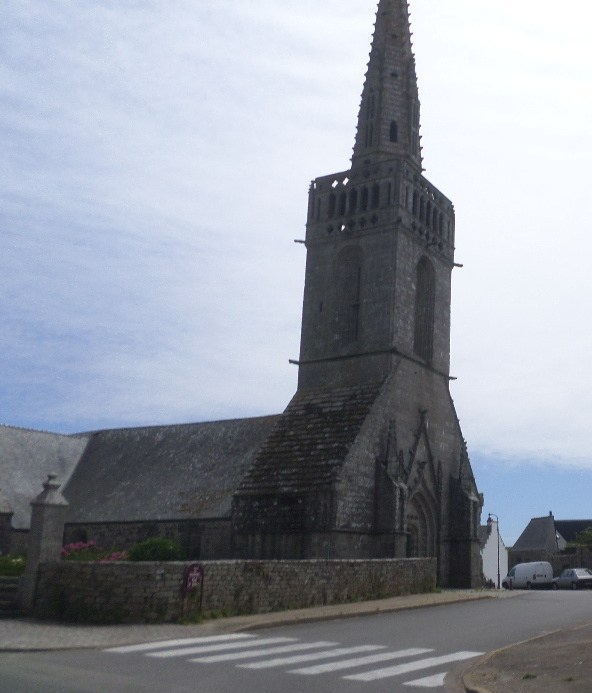
The Church of Saint-Winoc of Plouhinec dates from the 16-18C, revamped during the 18C, the Church seems to be built on the site of an older church. It is shaped like a Latin cross and dominated by a gallery tower that overlooks an arrow. The church consists of a nave, five bays with aisle and a paneled frame, then two bays with lateral chapels, a transept and a choir. Flanked by aisles, the Church is bounded by seven arched arches, resting on octagonal pillars without capitals. A Rosary brotherhood existed in the Saint-Winoc Church in the 17C.
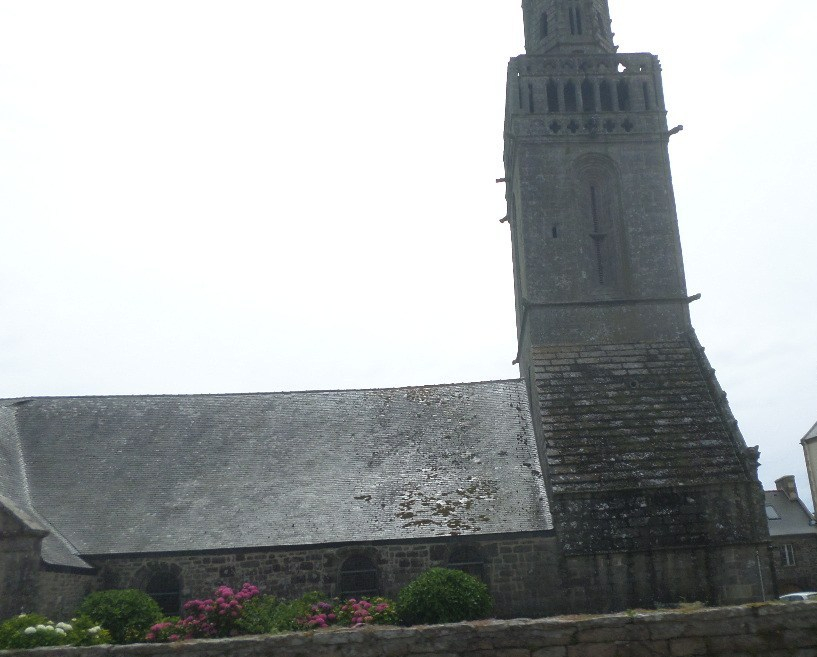
The Saint-Winoc Church stands in a long enclosure at the end of which sits the high calvary known as “Croaz Veret Coz”. In the shape of a Latin cross, the church, made of both cut stone and granite rubble, has a central nave of five bays with aisles preceded by a massive tower which supports the bell tower. The latter is pierced by a portal surmounted by a bas-relief representing a caravel led by three sailors. The south side of the transept is decorated with a few niches with saint carefully molded, two pinnacles missing. The devotional fountain linked to the church is located, and this is a rather rare case, about two km to the south. It is a singular aedicula in cut stone whose saint’s niche is located above the opening, in the gable wall. The transept is remarkable for its scale and the elegance of the southern transept, lit by a flamboyant window. The tower, bears, at the support of the upper balustrade, the date of 1582, but it must have been started around 1530-1540, a date which must be assigned to the facade on which it rests. , as well as the transept. It is entirely in the Gothic tradition. Inside the transept there are fragments of old sand pits. The rest of the church was rebuilt in the 18-19C. The stained glass windows of the transept and the collateral were laid in 1993-1994.
The high Altar dates from the 18C, it has an altarpiece with four torsos, superimposed on three floors, the Tabernacle is in dais and the altar is framed by two adorers angels, surmounted by four cherubs. At the top of the Altarpiece there is a statue of the Sacred Heart of the 19C. In the niches of the Altar you see Christ, surrounded by St. Peter and St. Paul; to the left of the Altarpiece is the statue of Saint Winoc; to the right of the Altarpiece, you see Notre-Dame de Lorette. In the north transept, there is an Altar from the 18C and several statues frame the altar with the Angel Gabriel, the Virgin of the Annunciation, the Group of Saint Joseph and Jesus Child, the Group of Saint Anne and Mary Child. There is also an 18C Pièta and the reliquary of Saint Winoc. The Altar of the south transept is also from the 18C, and it is topped by a table dated 1652, representing the pain of the Father, with Madeleine. Several statues frame the Altar are St. Roch, St. Blaise, St. Nicholas, St. Sebastian, Christ with links 15C. The pulpit to preach is from the 18C. The organ, which dates from 1935, has eight games. The baptismal font dates from the 16C. The Altar with torsos column altarpiece is from the 18C. At the south altarpiece is a canvas titled “God of Mercy” which dates from 1652. The Church houses the statues of Saint Winoc 17C, the Virgin Mother 17C, Saint Anne, St. Roch, St. Sebastian, St. Augustine, St. Nicholas, Saint Blaise, Saint John the Baptist , a man of Sorrow , an unidentified Saint and a Pietà.
Winoc, of royal stock, was born in Armorican Brittany. Wishing to devote himself to God, he left the court, with three companions, and arrived after a long journey, in the bishopric of Thérouanne (current department of Pas-de-Calais 62) at the monastery of Sithiu governed by Saint Bertin. Soon, by the order of this holy abbot, they founded an establishment on a height called Grunabergue, which has since been called Bergues-Saint-Winoc. Some time later, Bertin sent them to found another monastery at Wormhoudt and he put Winoc at the head of this community. He was recalled to God on November 6, 716 or 717, and buried in his monastery. At the time of the Norman invasions, his relics were transported to the Church of Saint-Omer, in Sithiu. From there, in the year 900, they moved to the Church of Saint-Martin, in Bergues. At the beginning of the 13C, three festivals were celebrated in Bergues in honor of the holy abbot. The first, on the anniversary of his death, November 6. The second was that of the elevation of his body, called the Exaltation of Saint Winoc; the third, that of the translation of the body of the saint to the abbey of Bergues, on September 18. The first of these festivals was the most solemn. The Roman martyrology mentions Saint Winoc on November 6.
An interesting history worth telling you here on Plouhinec , The Spanish Civil War causes the exile of very many Spaniards in two waves. The first begins shortly after the bombing of the town of Guernica (April 26, 1937); it will bring between 120,000 and 140,000 refugees in France in 6 months. The second wave, which occurred in February 1939, is known in Spanish history as the Retirada (Retreat). Between 450,000 and 500,000 Spaniards enter France in a fortnight. Although geographically far from Spain, Finistère will be a land of asylum or exile for many of these Spanish refugees. In 1937, around 2,200 civilians and 500 combatants arrived. In 1939, 3,700 refugees, overwhelmingly civilians, arrived in a week, between February 1 and 8. In this exile from Finistère, Plouhinec played an exceptional role by being the Finistère center with the highest number of refugees. In all, there are estimates of 3,5 million Spanish descend persons in France nowdays!
A bit of history tell us that the archaeological site of Menez Dregan, the megalithic necropolis of Pointe du Souc’h and the covered alley of Menez Korriged show the antiquity of the settlement on the territory of the current town of Plouhinec. A castellany of the viscounts of Léon landlocked in the county of Cornouaille in the 12C.In the 13C, it only consisted of a dozen parishes including Plouhinec. The famous preacher Julien Maunoir preached a mission in Plouhinec in 1644.
The town of Plouhinec on its heritage: https://www.plouhinec.bzh/decouvrir-commune/tourisme
The local Cap Sizun tourist office on information desk Plouhinec : https://www.capsizuntourisme.fr/sejourner/office-de-tourisme/plouhinec
More on the story of Spanish immigrants to Plouhinec from the town’s : https://www.plouhinec.bzh/decouvrir-commune/histoire-0
There you go folks, another road warrior trip up north of my lovely Brittany. For now just a small showcase of the wonders found in my neighbor Finistére . Again, hope you enjoy the post on the Church Saint Winoc of Plouhinec 29 !!! as I.
And remember, happy travels , good health, and many cheers to all !!!

 Paris1972-Versailles2003