
I am lucky to be surrounded by beautiful architecture and intriguing history all around me ,and in mostly off the beaten paths areas of my beautiful Morbihan, lovely Bretagne, and belle France. This was the case again ,when I took my usual local road warrior trip to Languidicabout 14 km from my house, .It is located 35 km from Vannes, department prefecture (capital city), 30 km from Pontivy and 18.5 km from Lorient, sub-prefectures , as well of 10 km from Hennebont, the capital of the canton. I like to tell you more on the wonderful Church Saint Pierre of Languidic,part II !!! Hope you enjoy it as I.

The Church Saint Pierre or St. Peter’s was built between 1876 and 1879 and replaces two older churches. The first was erected around 1329, in roughly the same location. The second was built in the 15C, perhaps in 1453 or 1433. This date is inscribed, in Gothic letters, on one of the beams and outside of the building The church was built at different times, that is why we found inside Romanesque capitals when the whole was in ogival style. Today, the church shelters one of the rare bells of the region prior to the French revolution. “Kolas” or Nicolas dates from 1783 and was not melted because it was used for civil sounding of the bell. The silver chalice and the tin ciborium, respectively from the 17C and 18C. In 1933, a martyrdom was built on Place Général-de-Gaulle.
The Church Saint Pierre is in neo-Gothic style and shaped like a Latin cross. We can see the multi-story tower and its spire which rises to 55 meters from a distance. The church is imposing with its long nave with low sides and has two rows of windows which light the interior particularly well, especially as the transept has two large bays. The interior is spacious and bright, with white walls, and encourages meditation.
Most of the stained glass windows, of good quality, depict the life of Saint Peter, the patron saint of the church. Note that those in the transept were changed in 1982, they represent Genesis and the Apocalypse. Also worth seeing, when looking up, is a marine ex-voto representing a three-masted square warship, the Reine des Cieux or Queen of Heaven.; the ex-voto, made of wood painted white and black, is armed with sixty cannons, all of which are distributed in two rows on each side as well as at the stern . The date of construction dates back to the second half of the 19C.


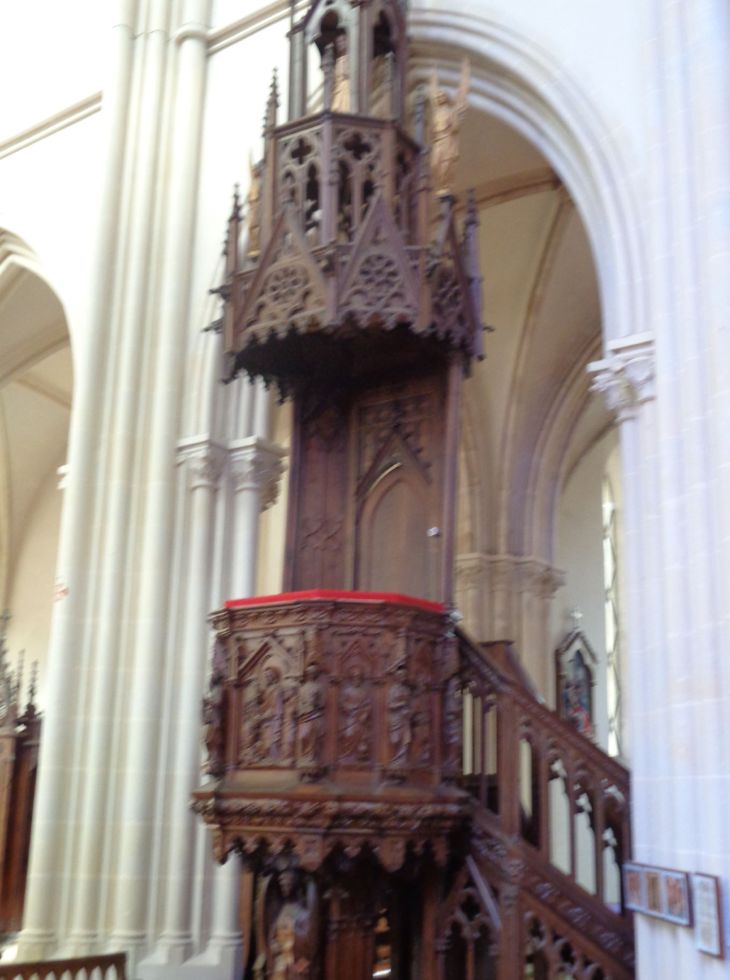
The side altars are dedicated to the Sacred Heart and Saint Joseph, the Blessed Virgin and Saint Anne. Saint Peter is of course represented several times, notably in the group of statues of beautiful proportions which decorate the church. It should be noted that all the furniture is uniformly made of beautifully crafted, perfectly maintained wood. Finally, it should be noted that a silver chalice from the 17C and a pewter ciborium from the 18C are classified as objects in the inventory of historic monuments of France.

A bit of history I like , briefly is on the War of Brittany’s Succession. The town was first supporters of Jeanne de Penthièvre, Henry de Spinefort, captain of the city of Rennes, and his brother Olivier, captain of the city of Hennebont, soon joined Jean de Montfort (to take duchy against king of France). They notably defend the city of Hennebont during the siege of Charles de Blois (for the king of France); the Languidian campaigns are then plundered by the Breton and French soldiers. Languidic’s first city council, made up of the mayor and eight municipal officers, met in 1790 in the church sacristy. However, revolutionary fever does not take. In 1791, the members of the assembly gave up their function, no longer recognizing themselves in the ideas of the new regime. As in the rest of France, the priests are hunted down. From 1794, the presence of troops was essential to protect the Republicans (revolutionaries) entrenched in the town; the Chouans (rebels against the revolution) are becoming more and more daring; in late 1794, they venture into the town and cut down the tree of Liberty, and in the night of March 4 to 5, 1795, they kill the mayor. When the Quiberon Breton immigrants (from England) landed in 1795, hundreds of Languidicians went into battle; 87 are taken prisoner and released after paying a ransom. In Languidic, in 1799, the Chouans found themselves facing a republican troop. The fight was over, the former dispersed the latter. Royalists take over the territory: a cache of weapons and clothing is set up in the Kérallan wood. Fierce opposing the French revolution in this area of my Bretagne. At the fall of the First Empire,(Napoléon I) the municipal council affirmed its attachment to the Royalist regime: in 1820, Languidic participated in the national subscription of the Château de Chambord; in 1822, it voted subsidies for the erection of a war memorial for the Quiberon expedition and a monument to Georges Cadoudal (General hero of the Chouans native of Auray) During his official trip to Bretagne in 1960, the President of the French Republic Charles de Gaulle stopped in the town to greet the people gathered on the Place de l’Église. Upon his death, it is decided that this square will bear his name; Place Général de Gaulle.
The town of Languidic on its heritage/history: https://www.languidic.fr/decouvrir/histoire/?L=1
The Local Lorient South Brittany tourist office on Languidic : https://www.lorientbretagnesudtourisme.fr/fr/immanquables/languidic/
There you go folks, another nice gem of my beautiful Morbihan that does not stop to amaze me for its beauty whether by the coast or inland. Languidic is very near me and worth the detour. Again, hope you enjoy this post on the nice Church Saint Pierre, part II as I.
And remember, happy travels, good health, and many cheers to all !!!

 Paris1972-Versailles2003