
I was back in my road warrior mode going up to the northern parts of my lovely Bretagne to see new towns! The search is never ending with the abundance of beauties around here. I came upon this town and it was nice again! Therefore, let me tell you an introductory post on this is Quintin, Hope you enjoy the post as I.
The town of Quintin is located in the Côtes-d’Armor department 22, in my lovely Bretagne region, only 16 km from Saint-Brieuc, and less than an hour from my house. It is watered by the Gouët, a small coastal river which flows into the Channel. Strategically, the town is at the crossroads of the routes which go from Saint Brieuc to Quimper via Rostrenen on the one hand and from Guingamp / Châtelaudren to Lorient via Loudéac on the other hand. I went there on my way back on the D7 then D700 and finally the D768 roads, easy rides !
Some of the things to see here which did not saw this time were the former Convent of the Ursulines, rue Saint-Yves. Built in 1711 and closed in 1904, it became a national property in 1905. The church of the Holy Spirit, today named the Ursulines Chapel, was put up for auction and sold to a private owner in 2011, the writer Camille Aubaude. It welcomed the Ursulines religious community to Quintin. Thereafter ,this chapel has been linked to the foundation of Camille Aubaude’s Maison des Pages, and therefore to the National Federation of Writers’ Houses and Literary Heritage.
The ruins of the Saint-Thuriau church, dedicated to Saint Thuriau, Remains of an old parish church dating from the 15C, with the exception of the tower rebuilt in 1754 and 1755. After two appraisals, in 1763 then in 1767, the Council of the King of France decided in 1773 to demolish the church, which had become dangerous. The tower, which alone remained, collapsed in 1833. Worship was transferred in 1773 to the Carmelite chapel then, in 1790, to the Notre-Dame collegiate church, today Basilica Notre Dame de Délivrance
In Quintin, there also remain many opulent residences built by wealthy weavers and merchants in the 17-18C such as the Hôtel Digaultray des Landes It was built by François Digaultray des Landes, a linen merchant, in 1722. Located at 3-7 Saint-Thurian, The house at 8 place 1830 ( see pic) ) on the corner of place 1830 and rue Émile-Nau from the 16C, The house was built in 1564 with an approximately square plan. The first floor has wooden vertical mullioned windows, and an attic-type second floor also opens with vertical mullioned windows. Half-timbered walls and laths covered with slates. Gable with granite chaining, The old door on the right has served as a window since the 17C. Attached to the house is a “stone of the Banished”, which was formerly used for public announcements made by the herald. The house,at 37 Grande-Rue, a house with molded wooden fore-floor beams, on both floors. At the height of the first floor, small head sculpted in relief, The house at 8, rue au Lait corner with Place 1830 (see pic), with two-stories, with corbels, presenting beams and molded supports. On the first floor, the corner is accentuated by a column resting on the molded base. The rue au Lait facade has a door with a pediment and pilasters. The house,at 3 rue des Degrés, has an 18C facade, Symmetrical assembly whose axis is motivated by a slightly detached forebody. The door is surmounted by a window, under a triangular pediment dated 1759, lit by an oculus, The Grand Maison or large house at Place du Martray is a granite house with central overmantel and two doors. The large bays of the ground floor as well as the doors are paired, a circular shape connecting the right legs. The first floor still has the small wooden openings. The third floor has pedimented dormer windows, the middle one of which dates from 1728. There are two houses,at 5-7 rue Notre-Dame, Both houses have Renaissance facades with doors flanked by columns or pilasters and large typically Breton cornices. The semicircular arch of the first has its key molded between two forms of banners. The cornice is a succession of corbels or mutules, all treated like machicolations. The next house also has a band at the top of the spandrels, without sculpture. The door, also semi-circular, has jambs decorated with pilasters with some geometric motifs. A cornice supports a high triangular pediment.
The private mansion, built in 1740, was purchased by the town in 1816, and now the City/Town Hall. The previous city/town hall, built in the 16C, had been destroyed in 1751 and until 1777 the meetings of the town of Quintin took place in one rooms of the castle.
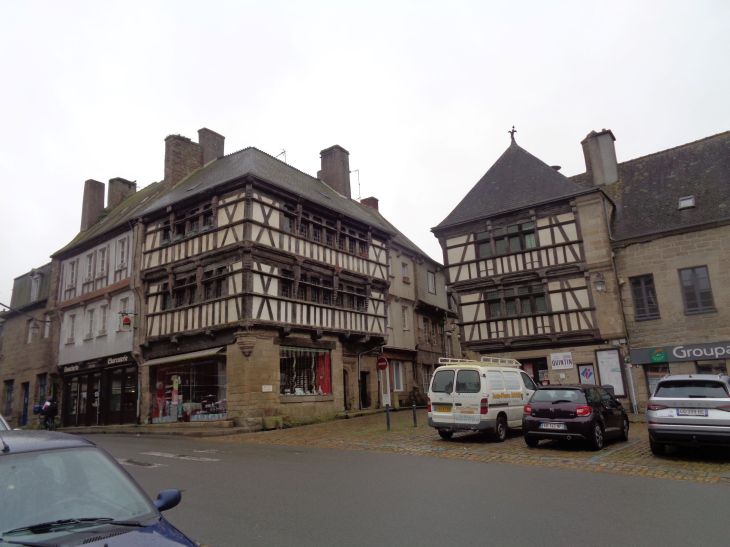
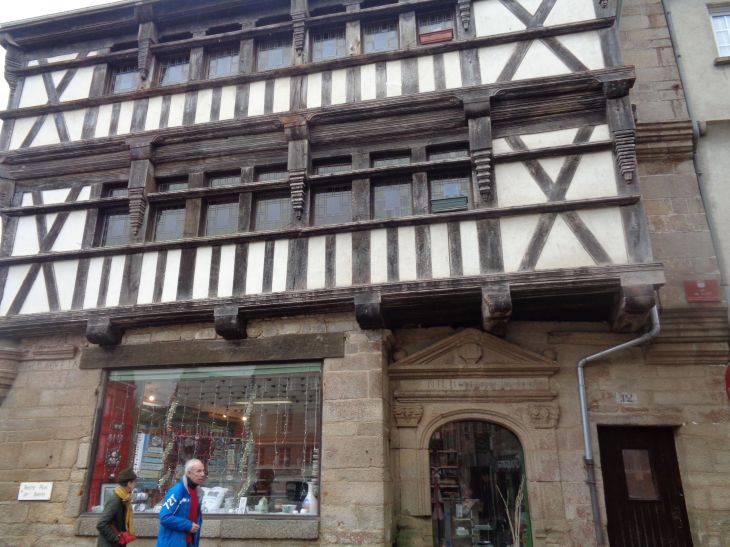
I did saw the Basilica of Notre-Dame de Délivrance, fontaine Notre Dame d’entre de la porte, Chapelle et Fontaine des Carmes, and the Château de Quintin. See forthcoming posts on them.
A bit of history I like !
The lordship of Quintin dates back at least to the 12C, the first lord of Quintin whose name we know is Geoffroy I Botherel, son of Alain de Goëlo, count of Penthièvre and Goëlo, who shared the lordship of Quintin and the passed on to his posterity. Geoffroy Botherel is said to have brought back from the Seventh Crusade a relic reputed to be a piece of one of the belts of the Virgin Mary In 1347, during the War of Succession of Brittany, the Lord of Quintin, who supported Charles de Blois, was killed at the Battle of La Roche-Derrien. In 1592, during the Wars of the League, the city, which had become Protestant, was taken by the Duke of Mercœur. But the inhabitants, who were attached to their lord, who was then Guy XX de Laval, Count of Laval, facilitated the recovery of the city by Captain La Giffardière; Quintin returned to the camp of Henry IV.
Quintin essentially developed, in the 17-18C, through weaving and trade in linen fabrics, enriching merchant families. The canvases were used to make hats and collars: in the 17-18C, this industry extended to so-called “Brittany” canvases in the Saint-Brieuc – Corlay – Pontivy – Moncontour quadrilateral and were exported to Spain and the Spanish colonies mainly via Cadiz. A new Spanish customs system and the maritime wars between the English and French caused a decline in exports in the years before the French revolution, this increasing during the wars of the revolution and the empire. The “Brittany” fabric factories completely disappeared between 1825 and 1840 because cotton gradually replaced linen and the factories remained in an artisanal mode of production using traditional techniques in the face of the rise of mechanical looms and were supplanted by foreign competition, notably Irish and Silesian, The decline of the textile activity caused poverty and emigration.
The town of Quintin: https://www.quintin.fr/#
The St Brieuc Bay tourist office on Quintin : https://www.baiedesaintbrieuc.com/en/quintin/
The Côtes d’Armor dept 22 tourist office on Quintin : https://www.cotesdarmor.com/a-voir-a-faire/patrimoine/villes-et-villages-classes/quintin/
There you go folks, a wonderful town in my lovely Bretagne, this is Quintin, Full of beautiful architecture and history all around you, my kind of town indeed, We will be back just under an hour from home awesome, Again, hope you enjoy this introductory post on this is Quintin as I
And remember, happy travels, good health and many cheers to all !!!

 Paris1972-Versailles2003