
I went back up to the north of me at the Côtes d’Armor dept 22 of my lovely Bretagne, We went to Tréguier ! Always by the coast and again a new town visited, amazing of the many wonderful spots that we still need to visit, easy does it, I will be telling you about this town in my next post as well from our visit this week in my road warrior mode ! Therefore, let me tell you about the Cathedral Saint Tugdual of Tréguier, exteriors !!!, and hope you enjoy the post as I.
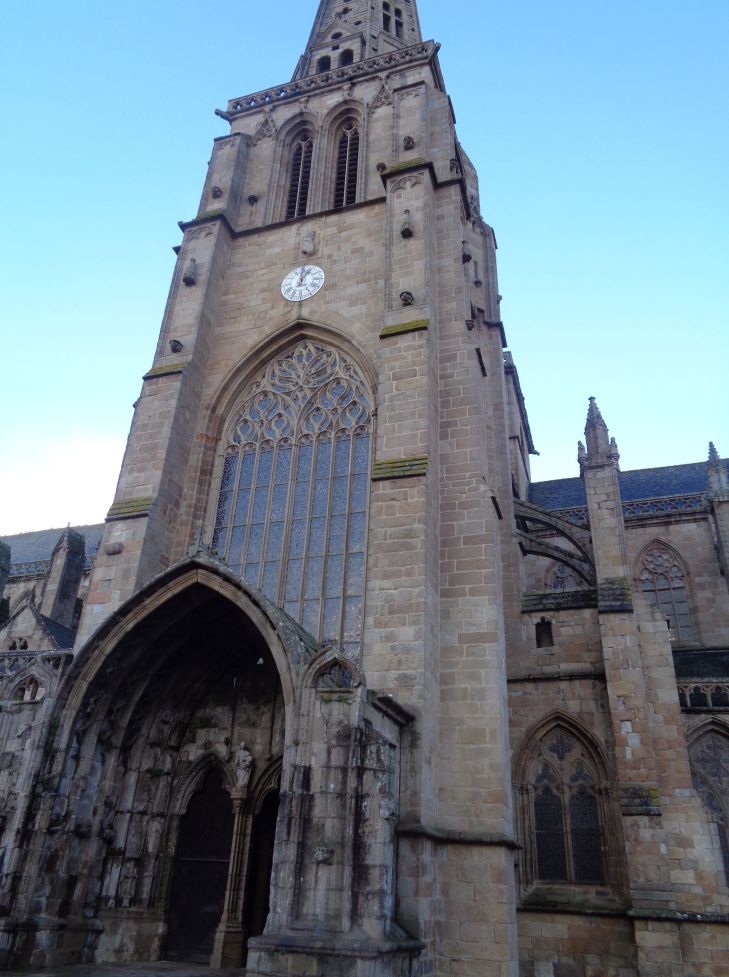
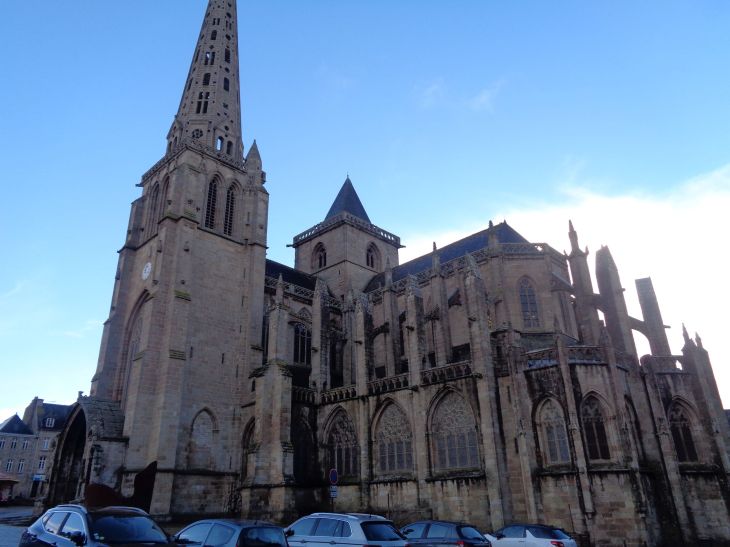
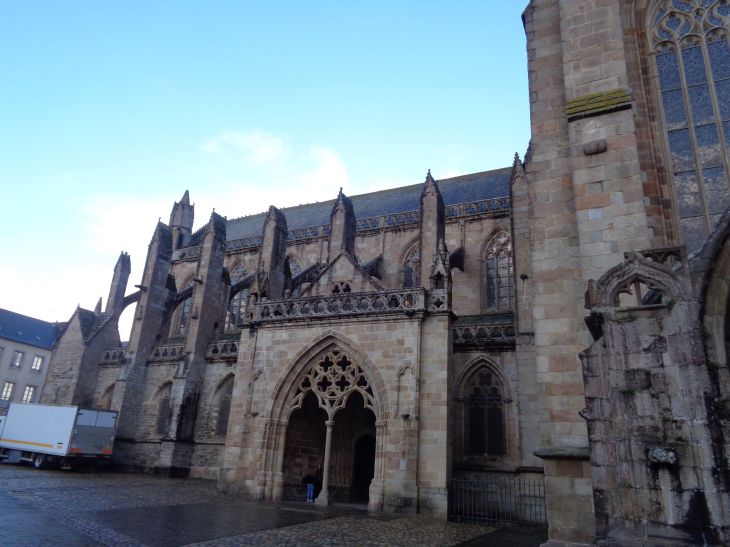
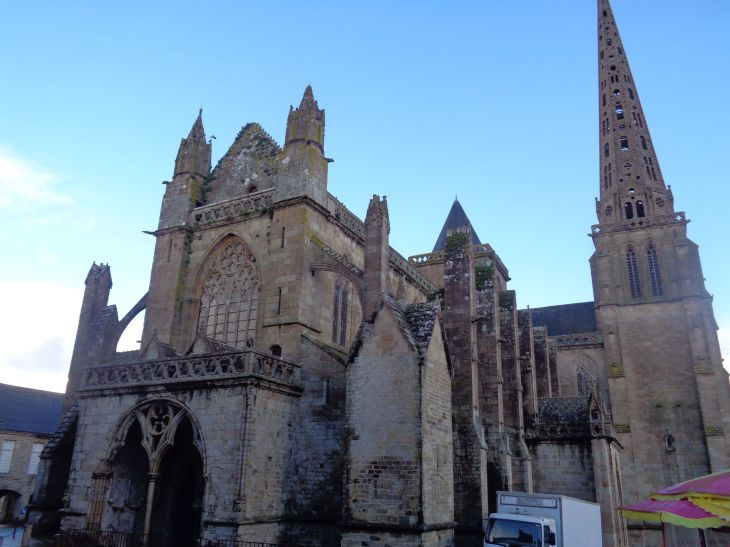
The magnificent Cathédrale Saint-Tugdual Cathedral,located at Place du Martray, It dates from the 14C and 15C (actually built between 1339 and 1435), it has three towers which dominate the transept. The southern one rises to 63 meters and dates from 1785. At its base you can see the porche des cloches or porch of bells which dates from 1438 and is topped by a flamboyant window. The tower of the Sanctuary, in Gothic style, occupies the crossing and remains unfinished. Built in Gothic style from the 13C to the 15C, the cathedral does however include a Romanesque part, the Hastings Tower, preserved from the earlier Romanesque cathedral. The granite nave is supported by Gothic arcades. The vaults, lit by high windows, are in the Tudor style.
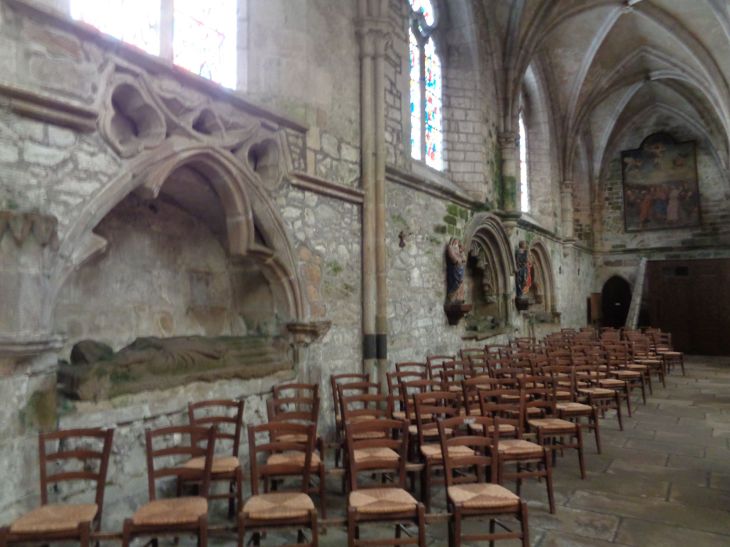
The cloister, forms a gallery covered with a wooden cradle. It has two entrances: Hastings Tower, on the cathedral side, and another independent entrance on the eastern side. In fact, it only serves the canonical space as the chapter house and was therefore probably not for the sole use of the canons. In the cathedral there are numerous tombs and funerary steles of important people from the region, coming from the cathedral. or surrounding places. Most are preserved in the cloister , Among the tombs for which we know the name of the deceased, the oldest is the recumbent figure of Alain de Vitré, known as Alain de Dinan, co-founder of Beaulieu Abbey (see post) and died in 1197. The cathedral also houses the tombs of several abbots of Beaulieu Abbey, from this abbey, from the first half of the 14C to the end of the 15C. This of course, the interior but it takes you to the cloister at the end.
Every year, on the occasion of the Feast of Saint-Yves, around May 19, the cathedral is the starting point for the pardon of Saint-Yves: at the end of the mass, celebrated in the cathedral by an important prelate, a procession takes place which goes to the church of Minihy-Tréguier, in memory of the archdeacon of the diocese venerated as a saint. The event can bring together up to several thousand faithful, notably lawyers of whom Saint Yves is the patron saint and sailors of whom he is one of the protectors. The cathedral also hosts, at the end of October, a small pardon of Saint Yves, of a smaller scale than that of May. A third pardon, at the beginning of December, celebrates the holy founder, Saint Tugdual.
A bit of history tell us that Tugdual was consecrated bishop of Landreger around 542. He was the first bishop of a particularly important episcopal see in Brittany until its suppression during the French revolution. We actually know very little about the existence of Tugdual, not even the precise date of his death which would have occurred on November 30 in 553, 559 or 564. He would be the son of Alma Pompa (Saint Pompey) and of Hoël I, 8th king of Armorica. Originally from Great Britain, Tugdual is said to have emigrated to Armorica accompanied by his mother. It seems that a large town quickly grew up around his monastery. This is how Tréguier was and remains an obligatory stopover on the Tro Breiz, a pilgrimage to the seven saintly Breton founders. In 848, Nominoë, king of Brittany, made this bishopric-abbey a secular bishopric and Tréguier remained the seat of a bishopric until 1790.
It has three towers which dominate the transept. The southern one rises to 63 meters and dates from 1785. At its base you can see the porche des cloches or porch of bells which dates from 1438 and is topped by a flamboyant window. The tower of the Sanctuary, in Gothic style, occupies the crossing and remains unfinished. Built in Gothic style from the 13C to the 15C, the cathedral does however include a Romanesque part, the Hastings Tower, preserved from the earlier Romanesque cathedral. The granite nave is supported by Gothic arcades. The vaults, lit by high windows, are in the Tudor style.
Around 1505, Duchess Anne of Brittany, Queen of France, made a pilgrimage to the tomb of Saint Yves. Between 1589 and 1592, the town was ravaged several times by the Leaguers. This period in the history of Brittany is synonymous with religious war between radical Catholics (supported by the Spanish) and Protestants (supported by the king of France and England). In 1789, Tréguier was mostly favorable to the new revolutionary ideas, During the winter of 1794, the battalion of volunteers from Étampes sacked all the religious monuments of the city: thus almost all the furniture, statuary, goldwork, stained glass windows disappeared… The cathedral served as a stable and was so ransacked that it could not be used for the imposed worship of the Supreme Being. This cult was opposed to the cult of Reason established by Chaumette in 1793. The Restoration (1814-1815) restored a certain religious importance to Tréguier.
The Côtes d’Armor dept 22 tourist office on the Saint Tugdual Cathedral : https://www.cotesdarmor.com/fr/fiche/patrimoine-culturel/cathedrale-saint-tugdual-treguier_TFOPCUBRE0220HA6396/
The town of Tréguier and its heritage : https://ville-treguier.fr/decouvrir-treguier/visiter-la-ville.html
The local pink granite coast tourist office on Tréguier : https://www.brittany-pinkgranitcoast.co.uk/cities-of-the-pink-granite-coast/treguier/
There you go folks, again another lovely town and beautiful monuments of Tréguier. This was worth the trip and nice, another spot in my world map, Again, hope you enjoy this post on the Cathedral Saint Tugdual of Tréguier, exteriors as I.
And remember, happy travels, good health, and many cheers to all !!!

 Paris1972-Versailles2003