
This is part of my new road warrior trips in my lovely Bretagne , where else !!!.. I have written another post on a nostalgic business trip and later family, however, several years not back and in my new life decided to take my boys and dog for a ride ; magical !! This time saw a bit more as always there is a next time lol ! Therefore let me tell you about the Church St Peter and St Paul of Plémet !! Hope you enjoy the post as I
Plémet is located in the department 22 of Côtes-d’Armor in my lovely region ofBretagne, and in my belle France. It was born on January 1, 2016 from the merger of the two towns of Plémet and La Ferrière. The return to the name of Plémet takes place on December 25, 2017. It takes its name from Saint Démet, of Welsh origin and having lived in the Brest region. The name of the town is Pllémé in Gallo, Plezeved in Breton local languages.
The Saint Pierre and Saint Paul Church, located at Place du Général Leclerc, On October 18, 1393, the pope gave a bull of indulgences in favor of the chapel of Saints Catherine and Marguerite in the church of Plémet. Falling into ruins, the church began to rebuild in 1787; but the work, interrupted for 10 years, was not completed until 1807. The original church dates from 1805. Its bell tower was completed in 1808 , From 1811 this church was in danger of ruin and was restored in 1841 then demolished in 1894.

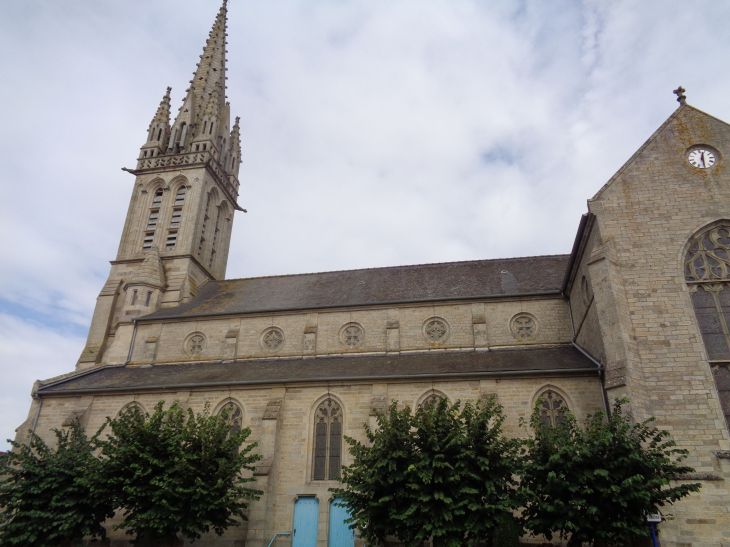
The blessing of the first stone of the new Church Saint Pierre and Saint Paul took place on April 15, 1894 and that of the church completed on April 12, 1896. In flamboyant Gothic style, in the shape of a Latin cross, it includes a nave with low sides of five bays plus that of the semi-recessed bell tower, a transept and a choir with a straight apse of two bays flanked by two chapels also opening onto the wings. . The spire and the belfry date from 1897. The church houses the statues of Saint Peter, Saint Paul and Saint Lubin;
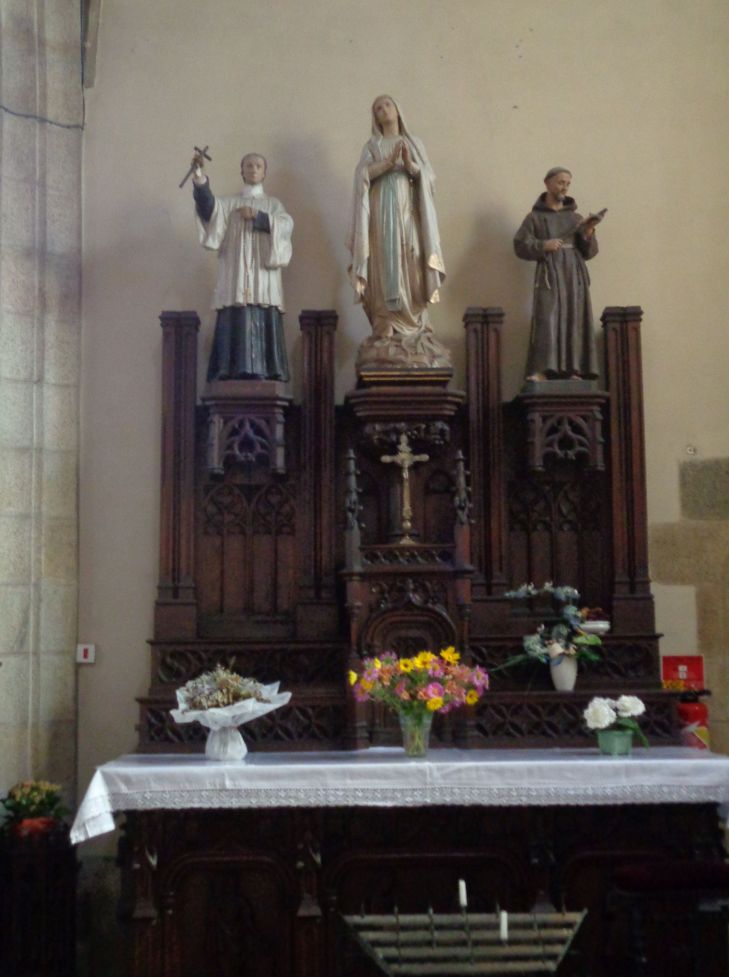
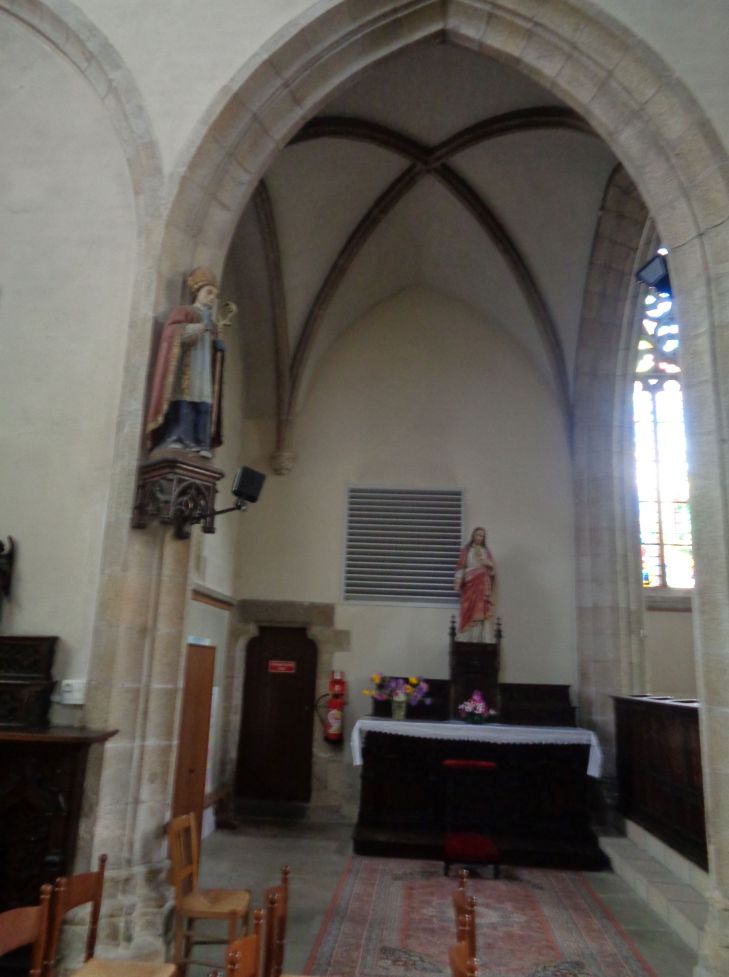
Inside, there is a reliquary of Saint-Pierre or the wooden Angel, which was the first work done in Plémet by Roland Guillaumel ( sculptor Grand Prix de Rome 1950) and, that it was walked during the processions.


A bit of history on the town of Plémet I like :
The Forges du Vaublanc were created by François de Farcy in 1671. They developed thanks to the proximity of iron mines, forest estates and the energy of Lié. In 1770, the forges produced 500 tons of cast iron and 800 tons of iron. Kaolin has been exploited in Plémet since 1891, the first operator being Henri Morane. In 1910, the “Société des kaolins de Bretagne” became the owner of the extraction and production sites. Around 1960 the company was the leading European producer of ceramic fiber. The Notre-Dame de Lanthénac Abbey, founded in the 12C, was located in the current town of La Ferrière. The abbey was sold on March 24, 1791 and was transformed into a farm. It was pillaged by the Chouans of Dujardin. The church was destroyed around 1810 and the stones were used to build a house in Loudéac.
Other monuments to see in Plémet me think are : Out in the woods there are castles such as the château aux Landelles, château de Bodiffé, château de Launay Guen, and the château du Vau blanc. The Saint-Lubin Chapel, whose foundation dates back to the 16C, was remodeled in 1741. The sacristy dates from 1823. The chapel was partly rebuilt in 1828 on the plan of the old chapel. It is named after Saint Lubin (born in 557), Bishop of Chartres who is said to have performed numerous miracles. At the beginning of the 21C, the chapel sometimes serves as an exhibition space.
The town of Plémet on its history (French in pdf files): https://plemet.fr/fr/rb/495692/histoire-de-plemet-par-andre-grall
There you go folks, more wonderful memories into my blog to relish for life and hopefully my sons will continue. This is a memorable town and glad to have it in my blog, Again, hope you enjoy this post on the St Peter and St Paul Church of Plémet as I.
And remember, happy travels, good health, and many cheers to all !!!

 Paris1972-Versailles2003