
I dare took the plunge to really visit Lisieux instead of just passing by. As said, my belle France has an endless repertoire of monuments that a life time will not be enough. The town is in the dept 14 of Calvados, region of Normandie, in my belle France. Therefore, let me tell you more on the Cathédrale Saint Pierre of Lisieux, part I !!! Hope you enjoy the post as I.
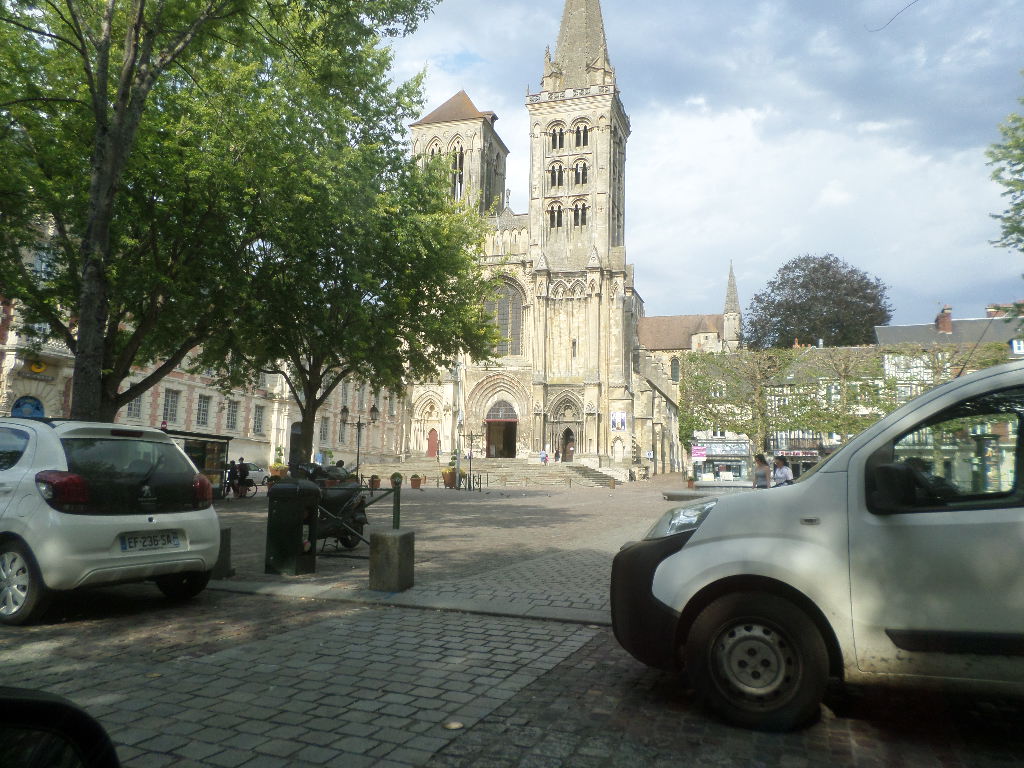
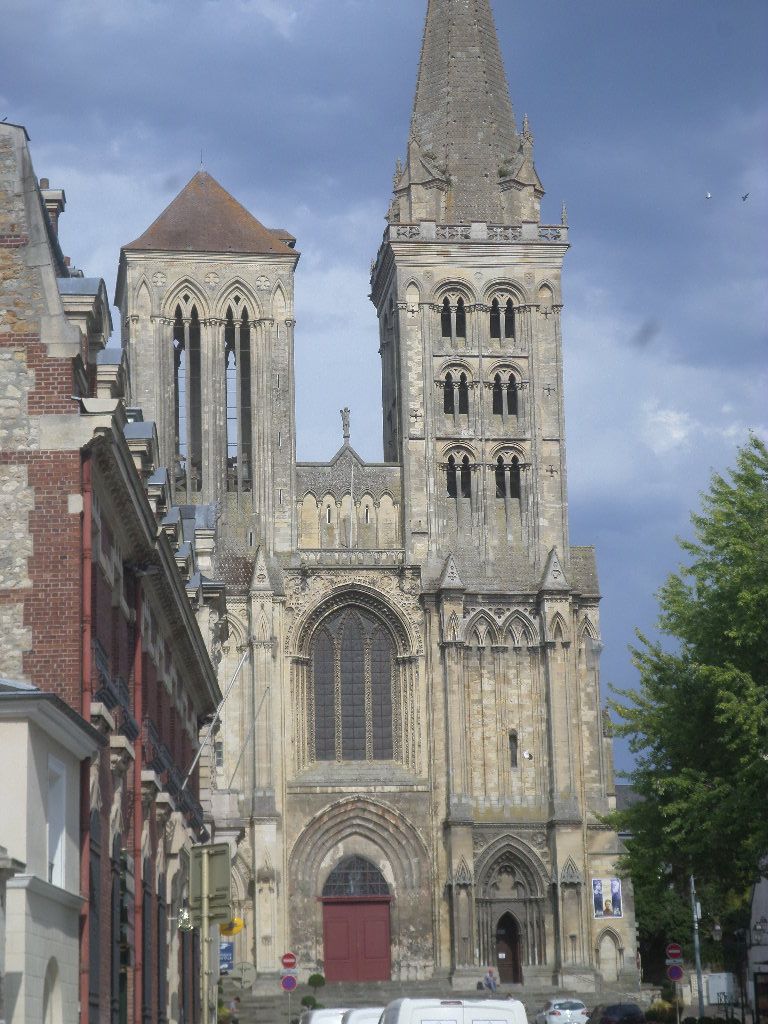
Three towers dominate the building: the lantern tower, frequent in large Norman churches, and two facade towers. The slender northern one dates back to the 13C. Its neighbor was rebuilt between 1579 and 1600 after collapse. Ended by an arrow, it rises to 72 meters. Its style is difficult to define: Flamboyant Gothic with some Renaissance characters such as full-arched arches, fairly small openings, marked horizontality. Like many Norman churches, the external decoration of the cathedral of Lisieux is sober. For example, there are no carved statues on the facades of the portals. Only geometric patterns, foliage, small columns or arches animate the stone. Small sculpted faces are the only whimsical elements on the exterior.
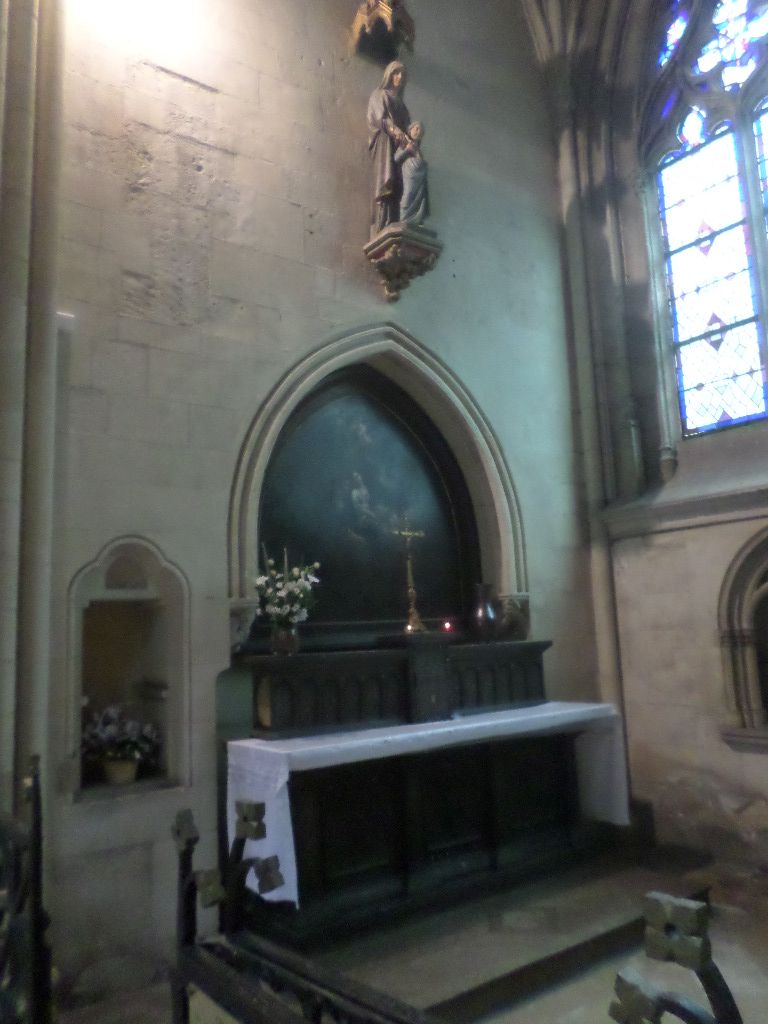
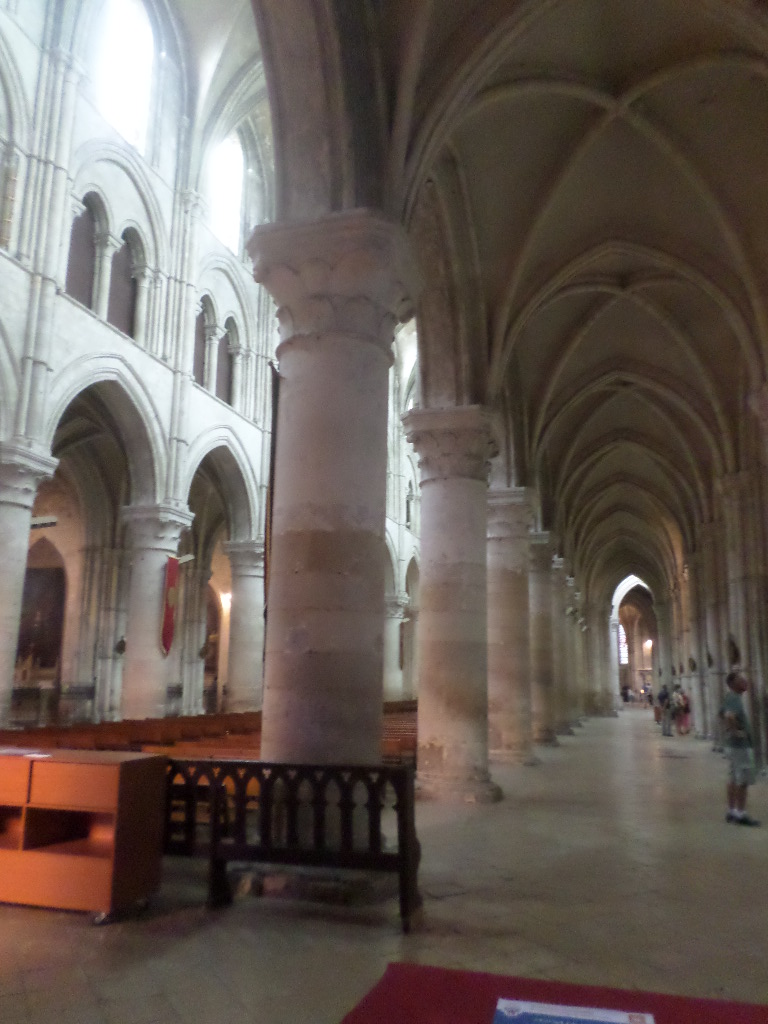
Chapels on the south aisle starting from the narthex are: the Baptismal font. It contains the marble baptismal font, a 19C Christ on the cross as well as The Preaching of Saint-Pierre, oil on canvas painted in 1770 by Larrieu; Chapel Saint-Paul. It houses an oil on canvas of Saint-Paul in front of the Areopagus, painted in 1770 by Jean-Jacques Lagrenée; Chapel Saint-Joseph . It has a statue of the saint made in 1884, as well as two oil paintings on canvas: Ecstasy of Saint-Jérôme, given in 1749 by a Lexovian canon and Death of Saint-Joseph from the 19C; Chapel of Remembrance. It hosts an engraving of the “True Effigy” of the Holy Face, given by Mr. Guérin, uncle of Sainte-Thérèse, and two oils on canvas: The Last Supper painted in 1785 by Descours fils and Sainte-Cécile by Philippe Guérin in 1804; Chapel Sainte-Anne. It houses a 19C statue of Saint Anne and the Virgin and two oils on canvas: Délivrance de Saint-Pierre, painted in 1770 by Jean-Joseph Taillasson and The Education of the Virgin from the 18C;
Chapel of Notre-Dame du Perpétuel Secours. It contains two oils on canvas: Resurrection of Tabithe, painted in 1770 by Anicet Lemonnier and Apotheosis of Saint François de Sales from the 18C; Chapel Saint-Benoît. Sculpted columns from the pulpit of
St Pierre Cathedral support the altar at the end of the 16C. It welcomes The Guardian Angel, an oil on canvas painted in 1875 by Édouard Krug; Chapel Notre-Dame du Carmel , former chapter room. It houses The Apotheosis of Saint Charles Borromeo, an oil on canvas from the 18C.
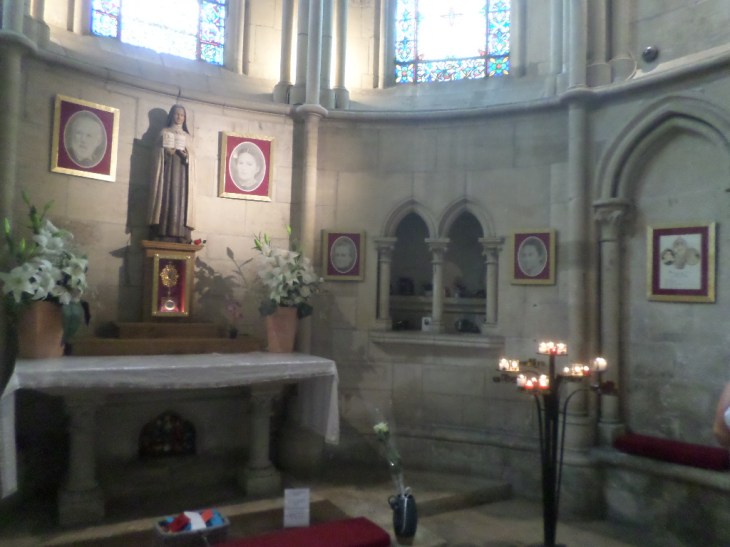
The Cathédrale Saint-Pierre is in the Norman Gothic style. For a while it was the mother church of the diocese of Lisieux before its integration into the diocese of Bayeux and Lisieux. Sainte Thérèse was very familiar with the St Peter Cathedral. It was there that she attended Sunday mass with her father, sisters and housekeeper. A statue and an inscription in a chapel in the Choir recall the exact place where the family was placed during religious services. It was here that the future Saint had the revelation of her mission: to save the souls of sinners. Thérèse’s father, Louis Martin, offered the high altar for the choir. Since the 20C, Sainte Thérèse has been the cathedral’s third patron saint, after Peter and Paul. As such, it appears on one of the stained-glass windows at the back of the choir.
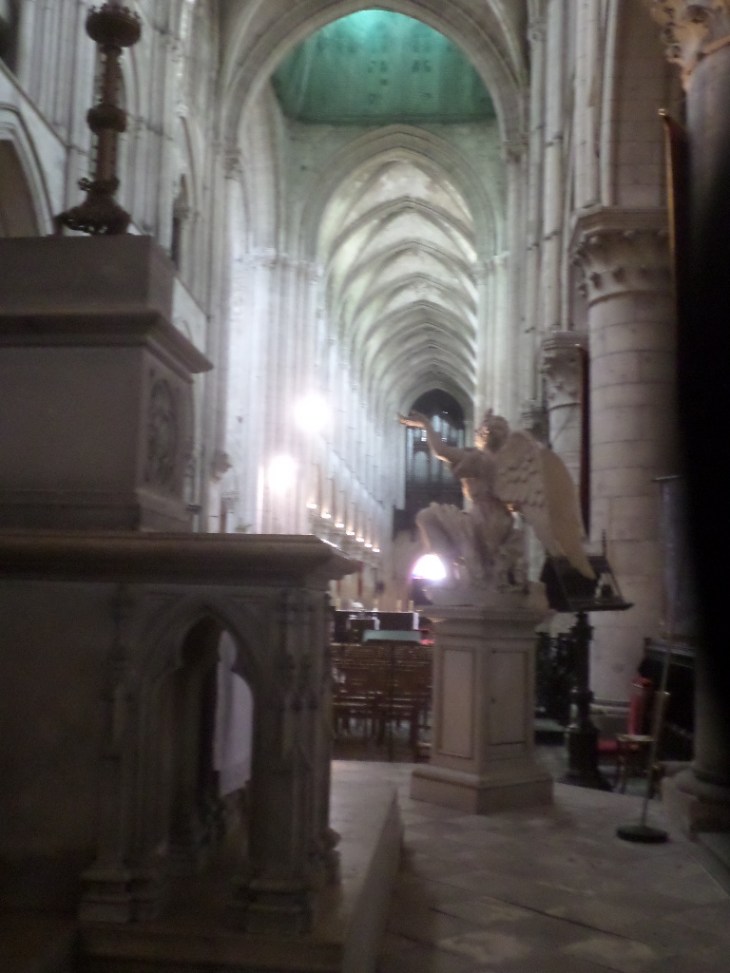
In the back of the Choir, the second level corresponds to a triforium. It is not openwork since there are no windows on the outside. The presence of this triforium confirms that the chevet belongs to the radiant Gothic style. The chevet participates in the Norman Gothic style. Very few stained-glass windows date back to the Middle Ages.
In the middle of the 11C, the Romanesque cathedral was in poor condition. It was decided to rebuilt one on the foundations of the old one. The site was launched in 1150 by the bishop of Lisieux called Arnoult. Close to the kings of France and England, this prelate involved builders familiar with the new techniques of Île-de-France region. The master mason, ancestor of the architect, introduced flying buttresses to support the vaults for the first time in Normandy. The facade of Saint-Pierre Cathedral is the most recent part of the building. Completed in 1250, it is a so-called harmonic facade: the three portals let us guess the interior division of the church with its central nave and its aisles.
The Bishop Pierre Cauchon, known for having been the inquisitor of Joan of Arc’s trial and having condemned her to the stake in 1431, became bishop of Lisieux from 1432 to 1442. During this period, he had the axial chapel of the cathedral to place his tomb there. The tomb is now gone but his body still lies under the paving. This Chapel of the Virgin is a very fine example of flamboyant Gothic architecture. The arms of the chapter and of Pierre Cauchon appear on the keystones.
The city of Lisieux on its heritage:https://www.ville-lisieux.fr/fr/x79-Lieux-emblematiques.html
The official Sanctuary of Lisieux : https://www.therese-de-lisieux.catholique.fr/en/decouvrir-le-sanctuaire/la-basilique/
The friends of the Cathedral of St Peter of Lisieux :https://www.amis-cathedrale-lisieux.fr/FR/
There you go folks, another masterpiece of architecture and history in nice Lisieux. You should not missed this Cathedral, and you will be glad. Again, hope you enjoy the post on the Cathédrale Saint Pierre of Lisieux, part I !!! as I.
And remember, happy travels, good health, and many cheers to all !!!


