
And I come back to the Finistére in my lovely Bretagne to tell you about another gem often misplaced in bigger previous post but that deserve mention on its own. I like to tell you about the Church Notre Dame de l’Assomption or St Michel of Quimperlé, part II !! Its once again in my road warrior mode in my lovely Bretagne that I came back to this wonderful fortified city. I have written before on the church but this is new text and pictures of today.
It takes a little courage to climb into the upper city, but the ascent is worth it. You can indeed gather in the Church Notre Dame de l’Assomption or St Michel , of Gothic origin 13C. The touching statue of Our Lady of Kergornet, who breastfeed the child Jesus, welcomes the Pilgrim.
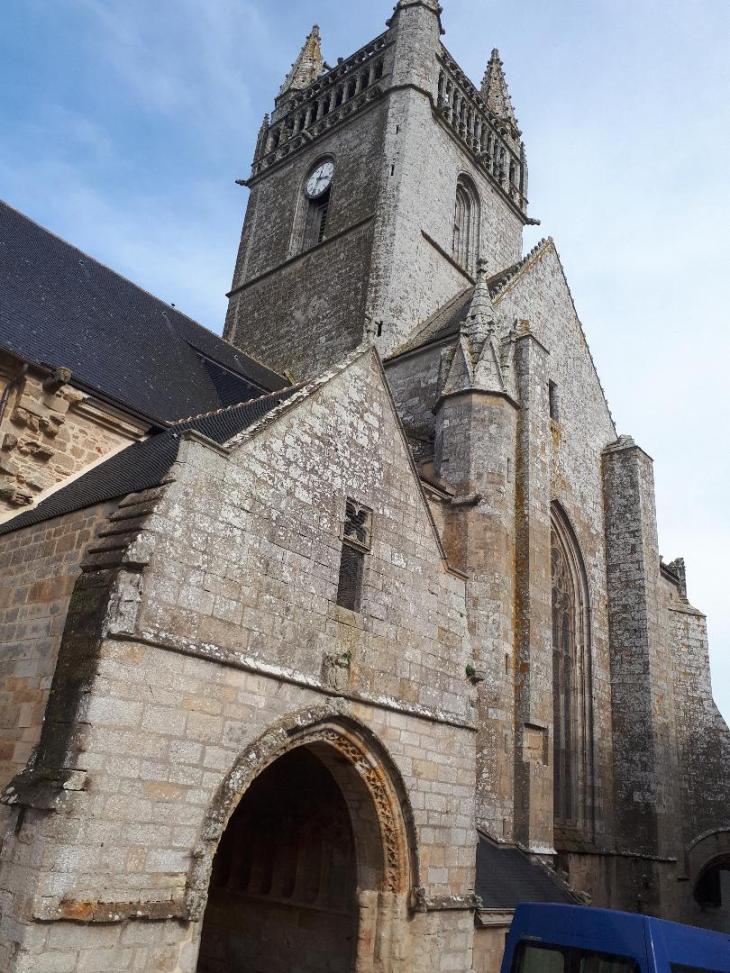
The church is dedicated to Notre-Dame, this former chapel of the city’s bourgeois community will also take the name of Saint-Michel in memory of the old neighboring parish church ruined in 1765. Of a first building built around 1280 only the walls of the nave pierced with bays and large doors to the north and south and undoubtedly the traces of a west porch, the other parts having been ruined during the Wars of Succession which affected the city in the middle of the 14C.
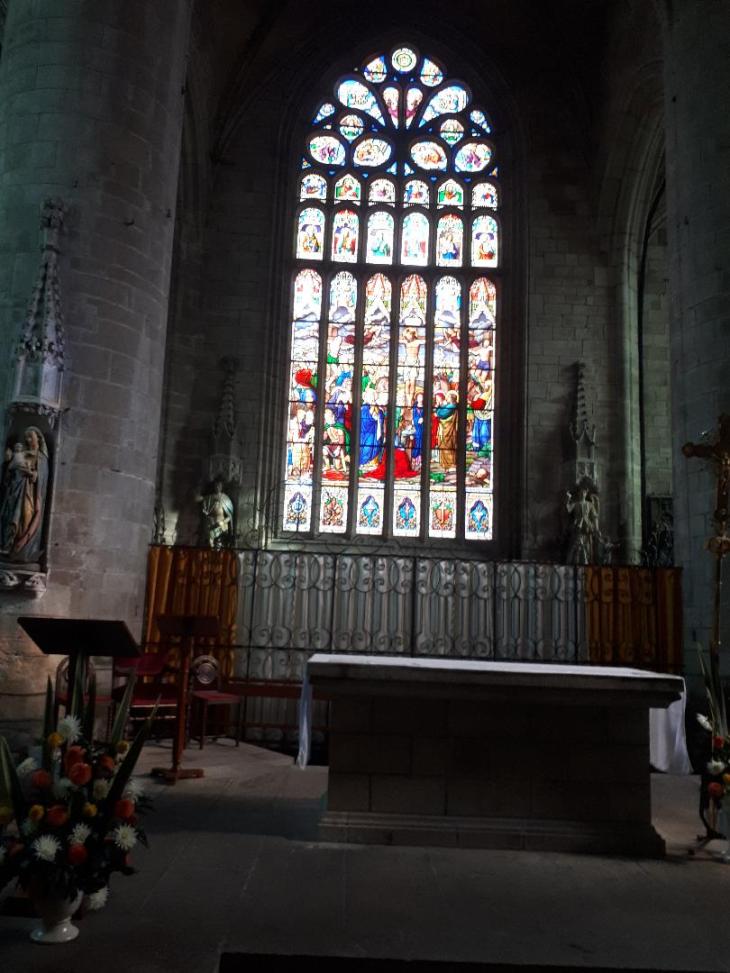
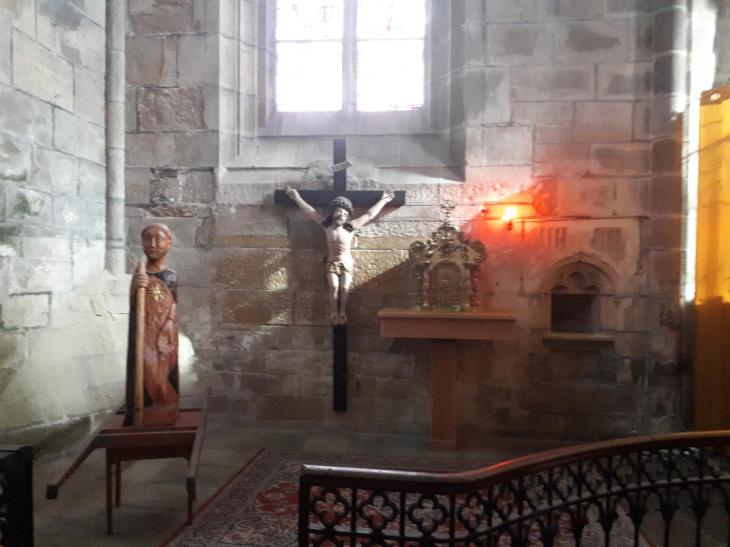
The construction of the eastern part of the church began in 1416 or 1418 and ended in the middle of the 16C. Thanks to the liberalities of Duke Jean V, Henry de Lespervez, the Abbot of Sainte-Croix de Quimperlé and bourgeois and aristocratic families of the City ,which of course, had their coats of arms appear both outside and inside, the work includes the installation of the north porch ,completed in 1425, the framework of the nave ,dated 1430, the eastern part of the crossing of the transept , the solid mass of the tower and choir in which Henry de Lespervez was buried in 1434. The construction of a rood screen placed between the nave and the crossing of the transept, accessible from a spiral staircase housed in the turret also serving the upper parts of the tower, remains , in the absence of traces of fixation, uncertain. It was only between 1520 and 1550 that the transept serving as the front choir, the non-projecting transept and the choir with a flat apse flanked by side chapels were covered with ribbed vaults. Since the 16C, the tower housed, as a belfry, the city clock which was equipped with a mechanism setting in motion a statue of Saint Michael; destroyed in 1590, it was restored in 1620. Built as an extension of the chevet, the sacristy, dates from the end of the 18C, as does the house which leans to it.
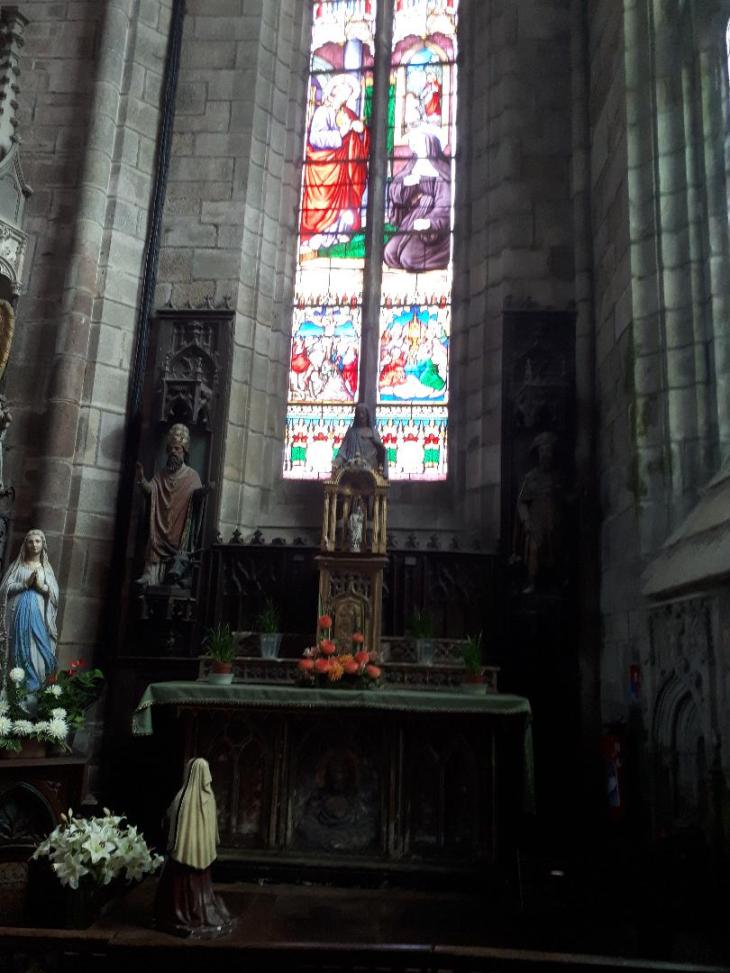
A framed bell tower covered with a pavilion roof surrounded by a platform flanked by four pinnacles. The room located above the north porch, a bay of which opens directly onto the north side chapel, is accessible by a spiral staircase. To the south, another spiral staircase gives access to a straight staircase which joins another spiral which, placed in the south-west corner of the tower, successively serves the space located above the vaults of the crossing of the transept, bell chamber and tower platform, Wonderful architecture !
The city of Quimperlé on its identity/presentation: https://www.quimperle.bzh/decouvrir-la-ville/quimperle/carte-didentite/
The local Quimperlé les rias on Quimperlé: https://www.quimperle-lesrias.bzh/la-ville-de-quimperle/
The parish of Quimperlé on its churches including this one: https://www.paroissesquimperle.fr/%C3%A9glises-chapelles/quimperl%C3%A9/
There you go folks, a lovely Church Notre Dame de l’Assomption, part II or also call of St Michel by the locals. It is worth the detour to pretty Quimperlé , check my other posts on the city worth the visit in my lovely Bretagne. Again, hope you enjoy the post as I.
And remember, happy travels , good health, and many cheers to all !!!

 Paris1972-Versailles2003