
I found some old pictures not included in my blog, and they should been one of my fav areas of my eternal Paris. Therefore will write a follow up post on the Opéra Garnier of Paris as i like to call it.I was by here for several years, and up and down and around it as worked across the street ! This is one of the most emblematic icons of Paris! It stuck on you, like anything in Paris does. Therefore, here is my take on the Opéra Garnier of Paris !!! Hope you enjoy it as I
The Opéra Garnier or Palais Garnier, is a national theater which aims to be an academy of music, choreography and lyric poetry; it is a major element of the heritage of quartier or neightborhood Opéra in the 9éme arrondissement or district of Paris. It is located at Place de l’Opéra, at the north end of Avenue de l’Opéra (see posts) and at the crossroads of numerous streets. It is accessible by metro Opéra station, lines 3, 7 and 8, and by RER line A, Auber station and by bus lines 22, 52, 53, 66, and Roissybus (aiport CDG). Parking Q-Park Edouard VII and Rue Bruno Coquatrix facing 23 Rue de Caumartin. Parking Q-Park Edouard VII and Rue Bruno Coquatrix facing 23 Rue de Caumartin.

Going around the Opéra or Palais Garnier a bit. The exterior of the opera house is surrounded by sixty different lights. The set includes: lampposts, caryatids (day and night, depending on their position on the east and west side façades, candelabras, pyramidal columns in peach blossom marble, rostral columns and imperial marble columns turquin blue Some luminaires could not have been made in bronze, as Charles Garnier wished, so it is simply coppered cast iron which constitutes the material.
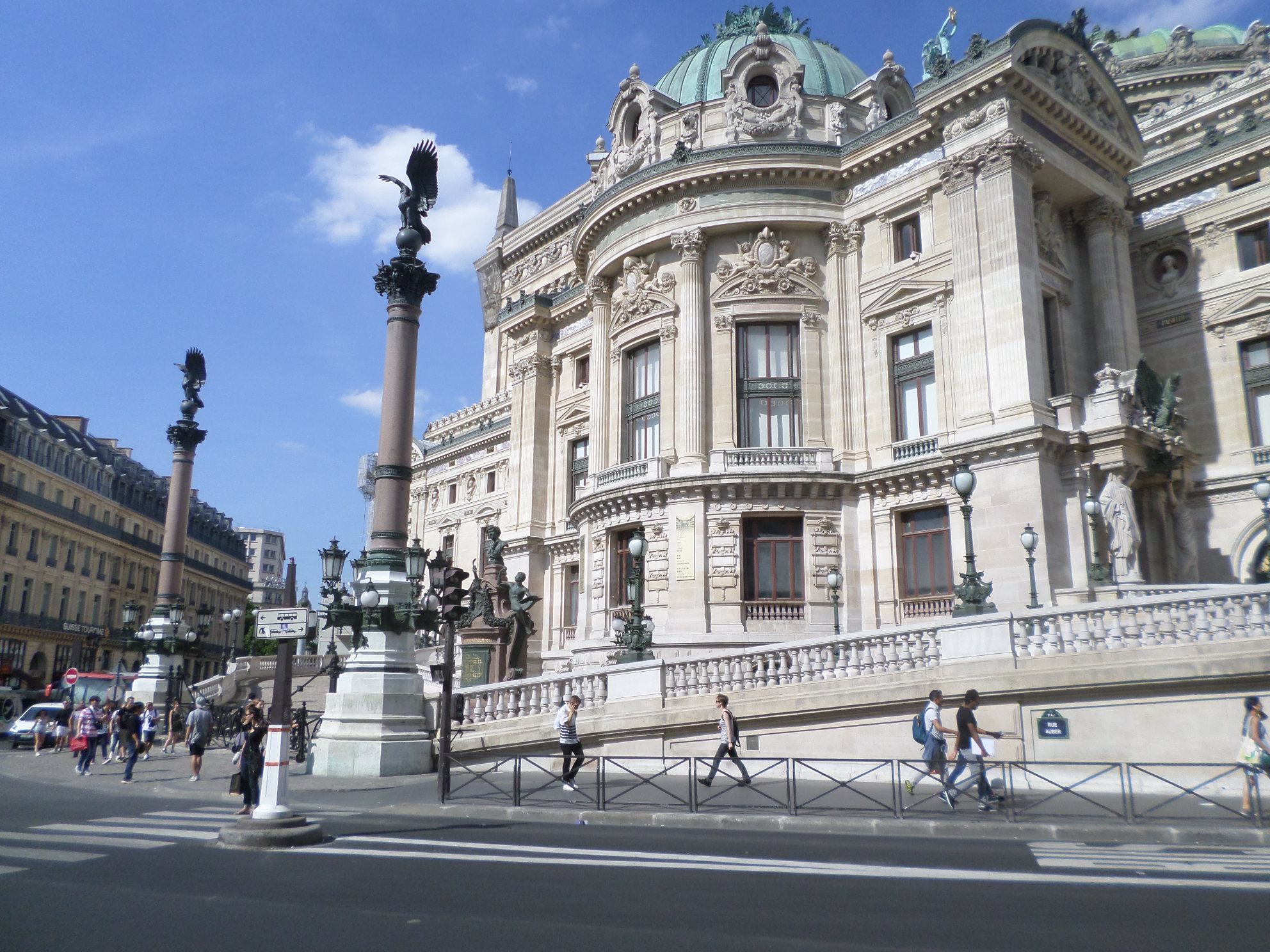
The West side facade or garden side shows an elevation visible from rue Auber and rue Scribe as well as from Place Charles-Garnier. The entrance is indicated by a series of green marble columns, two of which are surmounted by a large imperial eagle in bronze, a symbol miraculously preserved after the Second Empire. The entrance was intended only for Napoleon III and his relatives. The Emperor’s pavilion communicates directly with a front stage lodge on the garden side. It is ultimately the Presidents of the Republic who use this ingenious distribution ensuring security and discretion. This element of the composition is also known as the “Head of State Pavilion”. These salons, having therefore not had time to serve the monarch, were subsequently chosen to host the Opera Library-Museum (BMO) which today houses many works and objects.
The Opéra Garnier has two semi circular buildings on each end. It was done to host emperor Napoléon III in the
pavillon de l’Empereur giving to the street rue auber and the place Charles Garnier. Decorated with eagles in bronze preceeded by two ramps to load furniture’s ,etc ; this pavilion d’honneur is today the Museum Library of the Opéra. It has a great hall à l’Italienne, with red and gold tones and five levels of windows that makes it at level with the street rue Lepeletier de Debret raised in 1821, beforehand the salon of the street rue de Richelieu from the 18C. You see the sun and the symbol of Louis XIV on top of the scene recalling the foundation of the Académie Royale de musique in 1669. A composition painted of Chagall replaces since 1964 the ceilings painted by Lenepveu.
The East side facade or courtyard side shows an elevation visible from rue du Halévy and rue Gluck as well as from Place Jacques Rouché. The entrance is preceded, like that located to the west, by a series of columns of green marble. Only several female figures at the bottom, bronze torchiere holders, mark the difference with the opposite access. The rear facade is a paved courtyard, surrounded by a circular wall, incorporates a monumental portal with a sculpted tympanum, as well as two other gates and two secondary doors made of ironwork. The service entrances are at the rear of the building The large central dome is covered with copper which, once oxidized, takes on a green color. Formerly, the domes of the two pavilions were also covered in the same way, today they are made of zinc, like the other roofs of the building. Certain decorations of the domes covering the two side pavilions are made of lead. The lantern of the large dome is in repoussé, gilded copper.

The wonderful grand salon or grand foyer was inspired by the Palace of the Doges in Venice on the ceiling evoking the music, mythology and Christianism. The influence of the Galeria Farnèse des Carrache, on the ceiling by the galerie des glaces of Versailles, and the Bibliothéque or library of the Palais-Bourbon of Delacroix can be noted. The paintings of Delaunay (Apolo receiving the lyre, Orpheus , and Eurydice…), of Barrias ,and Clairin, completes the ensemble. The abundant golden decoration contribute to the lighting on the columns, chimneys and caryatids.
The Foyer de la Danse is a workspace for artists of the corps de ballet; its ornamentation, almost as refined as that of the spaces reserved for the public, makes it a sanctuary of dance. The rehearsal rooms for the choreography, there are a dozen rooms in addition to the dance hall . The artists’ lodges, there are about 80 individual lodges and collective lodges of all sizes, which can accommodate up to five hundred artists .The school Dance at the Opera, has moved and the old premises of the dance classes have been refurbished and modernized for rehearsals and daily lessons for the artists of the corps de ballet. The storage of set workshops are located outside the building itself, but designed by the same Charles Garnier assisted by engineer Gustave Eiffel, the set-up workshops, stores and reserves are located on Boulevard Berthier, in the 17éme arrondissement of Paris, they are named Ateliers Berthier.
Do not leave without trying the CoCo restaurant (for Coco Channel) , you go in by the place Jacques Rouché to the right facing the façade of the opera. The official BeauCoco restaurant: https://restaurant-beaucoco.com/fr/
The Paris Opera has had several names including “Royal Academy of Music and Dance” at its birth, then “Imperial Academy” and its activities took place in at least fifteen different rooms , After the fire at the Palais Royal theater in 1763, the Opera stayed in a large number of halls in Paris, including the Salle Montansier, located at the current location of Square Louvois. The Opera took up residence in the Salle Favart, abandoned by the Opéra-Comique. It moved again pending the completion of the Palais Garnier in 1874, which was part of Haussmann’s urban plan. The history of its construction, which spanned fourteen years, from 1861 to 1875, is closely intertwined with that of the Second Empire and the beginnings of the Third Republic. The facade alone inaugurated in 1867 , for the Universal Exhibition of 1867. The rest of the construction was delayed due to the war of 1870. The inauguration of the opera was finally made in 1875, after the abdication of Napoleon III in 1870. Napoleon III, at the origin of its construction, will never see its completion , and the unfinished Fumoir gallery will never be finished, The Grand hotel (Le Grand Hotel Intercontinental-fyi my old job) , at the corner of Boulevard des Capucines, was built in 1867 for the Exposition Universal, at the same time as the facade of the Opera.
During the excavations, intended for the construction of the foundation blocks, the work must be abruptly interrupted because the level of the water table has been reached. Steam pumps operating day and night are installed to pour a large concrete casing, temporarily filled with water to allow the construction of the infrastructure above. It also allows the distribution of loads on poor quality ground and the stabilization of the building. Today it still serves as a water reserve used by the Paris firefighters.
The inauguration took place on January 5, 1875 in the presence of the President of the Republic Mac Mahon, the Lord Mayor of London, the Mayor of Amsterdam, the Royal Family of Spain and nearly two thousand guests from all over Europe. The program included works by Auber, Havely, Rossini (Guillaume Tell) Myerbeer and the ballet La Source by Léo Delibes , On February 7 , 1875, the famous masked and transvestite ball of the Opera was organized, created in 1715. Principal chic annual event of the Carnival of Paris, it took place in the hall of the Nouvel-Opéra. It gathered eight thousand participants and was perpetuated until 1903. Since, the Palais Garnier and the Opéra Bastille form the Opéra de Paris which in 1994 becomes the Opéra national de Paris.

The Paris tourist office on the Opéra Garnier :https://en.parisinfo.com/what-to-do-in-paris/info/guides/a-visit-to-the-palais-garnier
The Paris tourist office on the Opéra Garnier :https://en.parisinfo.com/what-to-do-in-paris/info/guides/a-visit-to-the-palais-garnier
For programming ,hours, prices etc, see the official Opéra Garnier : https://www.operadeparis.fr/en/programme/season-26-27
There you go folks, as in Paris, all is sublime, the Opéra Garnier is a masterpiece of France, and the world. To think I worked across it for two years in my eternal Paris !! Again, hope you enjoy the post on the Opéra Garnier of Paris !!! as I.
And remember, happy travels, good health, and many cheers to all !!!


Such a grand building.
LikeLiked by 1 person
Indeed it is; thanks for stopping by Cheers
LikeLiked by 1 person