And I am coming back to my eternal
Paris, never too far away mentally and physically. And of course, to tell you a bit more anecdotes of the wonderful
Jardin des Tuileries!!! It has many memorable moments in my life visiting it and working across from it and visiting again. Let me tell you more of this sublime spot and sentimental area of my eternal Paris! Therefore, here is my take on
the Jardin des Tuileries of Paris, part III !!! Hope you enjoy this post as I.
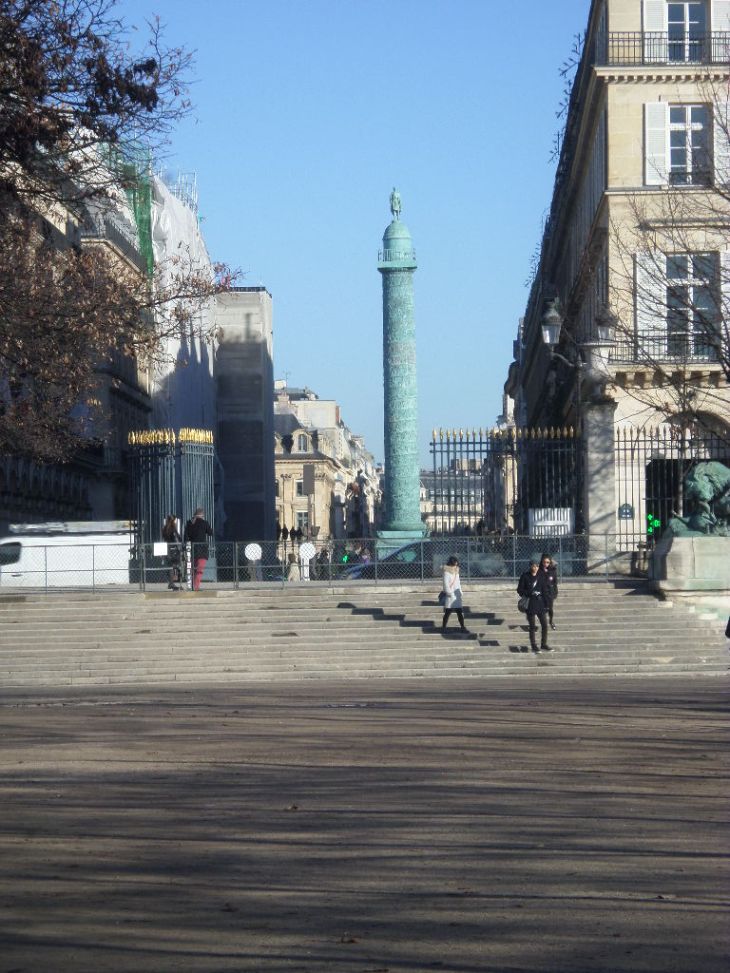
The Jardin des Tuileries is located in the 1éme arrondissement of Paris, and was created in the 16C. It is the oldest and largest garden in Paris with 28 hectares, It is, in fact, at the crossroads of the Louvre Palace/Museum, the Place de la Concorde, the Seine river, and the rue de Rivoli. Right along the Terrasse des Feuillants exit onto rue de Rivoli and into the rue de Castiglione you have a nice carrousel , nearby a Children’s playground and before your eyes lit up seeing the wonderful Obelisk of the Place Vendôme, Just magical!!! The jardin des Tuileries memories forever and glad to have worked next to it for about 2 yrs and visited zillions of times, my by far favorite garden/park in Paris, Other than walking into it you can reach it by taking the Métro on line 1 Tuileries station, or lines 1 ,8, and 12 Concorde, Also, most convenient bus lines 42, 69,and 72. The above was the entrance to the garden I took to go in just to relax at lunch, walk, sights and sound awesome!
 In the 13C, this area of the city included fields of squash, or cucurbits according to their scientific name, as well as tile factories. Queen Catherine de Medici was behind the construction of the Palais des Tuileries (Tuileries Palace) (see post) in 1564. Many rulers lived there. This palace no longer exists today. It was destroyed during the Paris Commune 1871. However, the garden still exist !!! In this garden, there is also a fountain, a menagerie, as well as a cave dating from the Middle Ages and decorated by Bernard Palissy, a famous ceramist. About fifty years later, the orangery and silkworm farm, a building in which silkworms are raised, will emerge. The orangery houses citrus fruits in winter, which cannot stand frost. However, the garden was rehabilitated during the reign of King Louis XIV. The latter, as well as his Prime Minister, Jean-Baptiste Colbert, ordered that it be completely redesigned by André Le Nôtre, the famous gardener of the king who was at the origin of the development of the gardens of Versailles and Vaux-Le- Vicomte palaces(see posts). By entering this garden, you are a historical witness of the redevelopment carried out by André Le Nôtre, who made it into a French garden. Le Nôtre carefully studied painting and optical effects to redesign the Grand Carré, which is remarkable for its play on perspective. He corrected the distortion due to the distance by shifting towards the East the small round basins of the reserved gardens, located to the left and to the right of the round basin (on the Place du Carrousel side), which seems much larger than the Octagonal Basin while it is twice as small! The Tuileries Garden has a multitude of entrances. Entering from the Place de la Concorde side, you can see on your left the Terrasse des Feuillants, the Jeu de Paume museum, built in the 19C, On your right, La Terrasse du Bord de l’Eau, symmetrically, is located the Musée de l’Orangerie. Today, it no longer hosts citrus fruits, but the famous Water Lilies by Claude Monet !
From the rehab of the 1990’s about 125,000 plants are placed each year by the estate’s gardeners, the irrigation water being channeled from the Ourcq canal (whose river has its source in the Aisne, 80 km from Paris), thanks to a high pressure pump and computerized management. Yes techno keeps the beautiful old running smoothly for all of us, I thanks the gardeners of Paris !!! In the center of the Jardin des Tuileries, stands the octagonal Basin, near which chairs have been placed so that you can rest, read, chat, and even sunbathe! You can also daydream and stroll on the Terrasse du Bord de l’Eau or Waterfront Terrace which overlooks the elegant Orangerie building and borders the Seine river ! The central alley, as well as the narrower paths perpendicular to it, are lined with elm trees and lime trees. Many sculptures are scattered around the park. At the entrance near Place de la Concorde, you can admire statues from Greek mythology. This garden also hosts statues of Rodin, the most famous of which is the thinker, statutes of Giacometti, known for his characters with slender limbs, but also works by Jean Dubuffet, Henri Moore, Max Ernst ,etc etc.
In the 13C, this area of the city included fields of squash, or cucurbits according to their scientific name, as well as tile factories. Queen Catherine de Medici was behind the construction of the Palais des Tuileries (Tuileries Palace) (see post) in 1564. Many rulers lived there. This palace no longer exists today. It was destroyed during the Paris Commune 1871. However, the garden still exist !!! In this garden, there is also a fountain, a menagerie, as well as a cave dating from the Middle Ages and decorated by Bernard Palissy, a famous ceramist. About fifty years later, the orangery and silkworm farm, a building in which silkworms are raised, will emerge. The orangery houses citrus fruits in winter, which cannot stand frost. However, the garden was rehabilitated during the reign of King Louis XIV. The latter, as well as his Prime Minister, Jean-Baptiste Colbert, ordered that it be completely redesigned by André Le Nôtre, the famous gardener of the king who was at the origin of the development of the gardens of Versailles and Vaux-Le- Vicomte palaces(see posts). By entering this garden, you are a historical witness of the redevelopment carried out by André Le Nôtre, who made it into a French garden. Le Nôtre carefully studied painting and optical effects to redesign the Grand Carré, which is remarkable for its play on perspective. He corrected the distortion due to the distance by shifting towards the East the small round basins of the reserved gardens, located to the left and to the right of the round basin (on the Place du Carrousel side), which seems much larger than the Octagonal Basin while it is twice as small! The Tuileries Garden has a multitude of entrances. Entering from the Place de la Concorde side, you can see on your left the Terrasse des Feuillants, the Jeu de Paume museum, built in the 19C, On your right, La Terrasse du Bord de l’Eau, symmetrically, is located the Musée de l’Orangerie. Today, it no longer hosts citrus fruits, but the famous Water Lilies by Claude Monet !
From the rehab of the 1990’s about 125,000 plants are placed each year by the estate’s gardeners, the irrigation water being channeled from the Ourcq canal (whose river has its source in the Aisne, 80 km from Paris), thanks to a high pressure pump and computerized management. Yes techno keeps the beautiful old running smoothly for all of us, I thanks the gardeners of Paris !!! In the center of the Jardin des Tuileries, stands the octagonal Basin, near which chairs have been placed so that you can rest, read, chat, and even sunbathe! You can also daydream and stroll on the Terrasse du Bord de l’Eau or Waterfront Terrace which overlooks the elegant Orangerie building and borders the Seine river ! The central alley, as well as the narrower paths perpendicular to it, are lined with elm trees and lime trees. Many sculptures are scattered around the park. At the entrance near Place de la Concorde, you can admire statues from Greek mythology. This garden also hosts statues of Rodin, the most famous of which is the thinker, statutes of Giacometti, known for his characters with slender limbs, but also works by Jean Dubuffet, Henri Moore, Max Ernst ,etc etc.
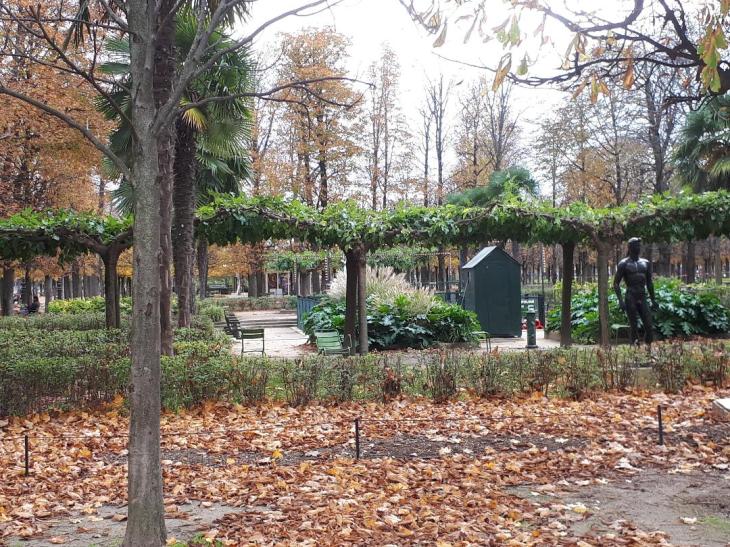 Of the many beautiful ones, I like to single out my all time favorites in sublime gorgeous Jardin des Tuileries of my eternal Paris. The ones I comtemplated the most while using my time from work or family visits. These are :
The statue “La Fame mounted on Pegasus“, the work of Antoine Coysevox , is located at the entrance to the Jardin des Tuileries, on the Place de la Concorde side, to the right as you enter, where it dominates the main gate.
Statue of Diane a la Biche.
Of the many beautiful ones, I like to single out my all time favorites in sublime gorgeous Jardin des Tuileries of my eternal Paris. The ones I comtemplated the most while using my time from work or family visits. These are :
The statue “La Fame mounted on Pegasus“, the work of Antoine Coysevox , is located at the entrance to the Jardin des Tuileries, on the Place de la Concorde side, to the right as you enter, where it dominates the main gate.
Statue of Diane a la Biche. It can be found in allée de Diane near the entrance on
rue de Rivoli. It is the work of Guillaume 1er Coustou.
Statue of Apollo. This bronze statue is the work of
Paul Belmondo. The father of Jean-Paul Belmondo cinema actor recently passed away,RIP
Statue
“Cassandre putting into the protection of Pallas”. This statue, located around the small basin, near the Carrousel garden, is the work of Aimé Millet, and dates from 1875. It was exhibited at the Salon of 1877, at the Universal Exhibition of 1878 and at the Luxembourg Museum, before being installed in the Tuileries garden.
Statue “The Centaure Nessus removing Dejanire”. This statue, located around the small basin, is in marble and was sculpted in 1892 and placed in the Tuileries in 1894.
The
Sphinge des Tuileries. A sphinx has the body of a lion and the bust of a woman. A very fine copy is on a pillar of a small entrance to the Jardin des Tuileries overlooking avenue du Général Lemonnier, at the corner of the Quai des Tuileries.
Statue of
« EVE », The statue of Eve was made in 1881 by
Auguste Rodin.
The statue
« Le Baiser » or the Kiss by
Auguste Rodin is on the right side of the Tuileries garden, opposite the Orangerie. Before creating the marble version, Rodin produced several smaller sculptures in plaster, terracotta and bronze.
Statue “RETURN FROM HUNTING” . The statue is located in the Tuileries garden near rue de Rivoli and avenue Lemonnier.
As part of the statues representing rivers, the Concorde entrance to the Jardin des Tuileries allows you to admire four sets dedicated to the Nile and the Tiber and for the French rivers to the Seine and the Marne on the one hand and to the Loire and Loiret on the other hand.
The
Paris tourist office on the Jardin des Tuileries:
https://parisjetaime.com/eng/culture/jardin-des-tuileries-p3545
The
city of Paris on the Jardin des Tuileries:
https://www.paris.fr/equipements/jardin-des-tuileries-1795
There you go folks another dandy post by yours truly on the most beautiful garden in
Paris, me think. The
Jardin des Tuileries showing history, architecture and gardening desings beauties all in one and central to the best of my
Paris. This sitting right in the middle of a sublime area of the most beautiful city in the world. Again, hope you enjoy this post on
the Jardin des Tuileries of Paris , part III as I.
And remember, happy travels, good health, and many cheers to all !!!
Published by pedmar10
I am a lover of travels to Europe , Americas , Africa and Asia as well ,who like to share my experiences of the last 53 years with the world, visiting so far 81 countries; living in 6, working in 5, and Citizen of 4, speaking fluently 4 languages. I can deal with sports especially football/soccer and love music, arts, wine collector/drinker, and go out to restaurants, and just visit the world.
My background comes all the way from Candelaria and Pajara in Tenerife, Spain where my grandparents came from ;not knowing each other then, to Punta Brava, west of Havana, Cuba. There , my parents born in Cuba met and later on I was born there too. 100% guanche (annexed Tenerife to Spain on April 10 ,1496). I left Cuba as many have to Madrid, Spain where I lived for 4 years. Then, move to Perth Amboy ,New Jersey USA (living there 13 yrs) ; where I completed high school, became a US Citizen, learned to drive a car, and learned English. Afterward, went to the university in Florida, ERAU, and upon graduation decided to moved there to Ormond by the Sea, near Daytona Beach, finally moving North Miami, then Hialeah, then another moved to Silver Lakes division in Miramar, Broward county, Florida; in Florida I lived a total of 18 years. Finally , moved to France in 2003 ,Versailles call me for its royalty, and working in Paris was great. It was time to seek frontiers again and moved to Brech near Auray, Morbihan in Brittany , and later move to not too far Pluvigner. Total so far in France has been 20 years, and counting.
Moving average a home every 5.5 years hopefully this will be my last. Cheers
All rights reserved. No part of this blog may be reproduced or transmitted in any form or by any means or stored in a retrieval system of any nature, without the written permission of the copyright holder, me. No part of this work may be modified, without the written permission of the holder, me.No part of this work may be exposed to public view in any form or by any means, without identifying the holder as the author, and with the before mentioned permission.
View all posts by pedmar10


 Paris1972-Versailles2003