
This was a nice trip trying to see something different from our lovely Bretagne , we went out to our neighbor Normandie to see Granville! It was a nice trip that I like to update here for you and me with text and links; hope you enjoy it as I. This was sort of an introductory post on the city and plenty more of it in my blog. Therefore, here is my take on curiosities of Granville !!! Hope you enjoy it as I
While thinking of my trips and those remarkable ones in my belle France (hard decisions) , we came to this part of Normandy which have bypassed in the past (as so much to see lol!) ,and decided to stop for a closer look. We as always were glad we did and found another jewel of our France. So, therefore, i come back to you for Granville off the Mont Saint Michel bay….and concentrate this time on the sea, that wonderful ocean now north of me. You need to concentrate in one area and then move on by car to the next one low town or high town (basse ville ou haut ville). The city has a wonderful high town area with gorgeous views over the city and the sea. The pointe du Roc is magnificent and plenty of old bunkers from WWII on the Atlantic wall construction by the Nazis. The walkpaths are wonderful and you need to be in good shape to walk all these. Passing by the fishing harbor and then the pleasure marina with all those restaurants/bars along the way is gorgeous.
Granville is a town in the department 50 of the Manche in the region of Normandie. The roads of D971 from Carentan, D924 to Villedieu-les-Poêles and D973 from Avranches. All leads you here. Granville is located 25 km from the expressway A84 (E401). It is also crossed from north to south by the D911, the coastal road to Avranches. The Paris-Granville line, departing from Gare de Paris-Montparnasse, has its terminus at Granville train station. Granville is located 17 km of its insular district of Chausey, 288 km from Paris-Notre-Dame, point Zero of the roads of France, 49 km fromSaint-Lô, 24 km of Avranches, 27 km of Coutances, 91 km of Cherbourg-en-Cotentin, 23 km from Mont-Saint-Michel, 26 km from Cancale, and 99 km from Caen.
It is a seaside resort and climatic station of the Bay of Mont Saint-Michel at the end of the coast of the Havres, an ancient port of mussels and the first port of hard shell seafoods of France. It is sometimes dubbed the “Monaco of the North” because of its location on a rocky headland, the presence of a casino and several large luxury hotels. On a land occupied by the Vikings, the town founded by a vassal of William the Conqueror in the 11C, former city of Corsairs,and the fortress of the defence of Mont Saint-Michel, became as early as the 19C a seaside resort frequented by many artists, equipped with a golf course and a racetrack. Homeland of the Dior industrial family (Christian Dior is buried at the local Church).
On 9 March 1945, when France was liberated and the Allied troops, eight hundred kms away, had begun to cross the Rhine, Nazi troops based in the isle of Jersey still occupied launched a daring commando raid against Granville. Although spotted by the Coutainville radar, the Nazis aboard light boats managed to land at night in the port of Granville. They dynamited the port facilities and sank four cargo ships. Fifteen American soldiers, eight British and six Frenchmen were killed, seventy Nazi prisoners were released and five Americans and four British were captured before the nazi commando fled, and the city finally could say it was liberated.

For the historical war lovers as I am, read more here in English: 3945km historical site on Granville
The port of Granville dates from the 16C. It is managed by the central and South-channel CCI and includes recreational activities, fishing, shopping and passenger traffic. From a mussels and oysters port in the 19C, it became a port of passenger transport with the stars Sweet France, Jolie France II and Joly France I destined for the Chausey and Channel Islands. A trading port with the capacity to accommodate ships of 18 meters wide, 125 meters long and five to six thousand tons of capacity. The first fishing port of Normandy with shells (clams, whelks, almonds, scallops, crustaceans (lobsters, cakes, crabs, spiders) and fish (sea bream, rays, bats, soles, yellow places, bars, mullets, pout, cuttlefish, squid) for the Local consumption with a Selling hall market, a refrigerating terminal and a computerized products sale capacity. A marina from 1975 of thousand rings in the basin of Hérel. It accommodates three thousand five hundred passages a year, with an average of three boaters per ship. Located a few minutes ‘ walk from the city center. Hérel’s Marina is one of the local economic lungs.


On the Pointe du Roc dominating the city, the barracks Bazeilles built in 1758, the barracks Genoa-Champagne built in 1788 and the battery built in 1942 by the Nazi occupant can still be seen. Curiosity of the port, the form of refit is a port equipment located wharf of the Pan-coupe. Completing the development of the harbour, this basin was built in 1887 for the maintenance of the land-fishery. Built in Chausey granite blocks, it is oval and 85-meters long. Restored in 1975, the form was abandoned by fishermen three years later following the installation of a boat elevator/lift.
Two lighthouses of the town: The Lighthouse of Cape Lihou and the lighthouse of Chausey. Located on the tip of the Roc (pointe du roc) at 34 meters above the highest seas, the Cape Lihou Lighthouse was built in 1828 according to a study by Augustin Fresnel. The lighthouse of Chausey, completed in 1847 and up to 19 meters, was designed on the model of the Carteret lighthouse of the same designer. It features a square tower overlooking a rectangular building. Finally, the lighthouse of the Sénéquet is located on the rock of Sénéquet, two miles off the harbour. The Cap Lihou cape forms with the Pointe du Roc, the western end of
Granville. Since 1826, the lighthouse built here has undergone very few modifications since its construction. The nazis, during WWII, camouflaged it with green paint. They had also built some fortifications, remnants of the “Atlantic Wall”, still visible today. A path runs the whole of the cape from the port to the old town. Some things to see here are the Lighthouse of Cape Lihou (see post) located on the Pointe du Roc at 34 meters above the highest seas, and the Notre-Dame Church of Cape Lihou (see post), according to legend, sailors found in 1113 a statue of the Virgin in their nets. It was then decided to name Our Lady of Cape Lihou. This makes it the oldest place of worship in Normandie!. The famous fashion designer Christian Dior was baptised in this Church in 1908.

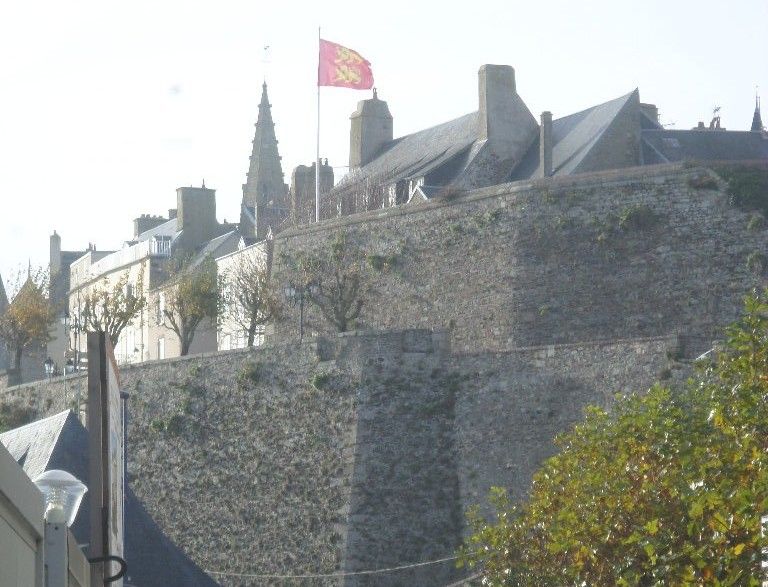
The Rue du Cap-Lihou is the extension of rue du Port. The intersection with Boulevard des Terre-Neuviers marks the transition from one street to another. This is the access road to the Haute Ville or Upper Town when coming from the port area. It goes around Pointe du Roc and ends at the Rond-Point des Français-Libres, opposite the lighthouse. The Promenade Marc-Châtaigner, and the rue du Cap-Lihou intersect, the latter is also the starting point of the Promenade du Roc. About 450 meters long and a hundred meters wide, extend the ramparts of the Haute Ville or Upper Town of Granville. The Haute Ville is the historic site of Granville: it was the English who were behind its creation in the 15C. The construction and reconstruction of the fortifications will extend over several centuries, while urban development will take place towards the East: modest residences, private mansions, whose owners equip the boats for the Great Fishing in Newfoundland or for the racing wars, and which will notably make the prosperity of the city from the 16C to the 19C.
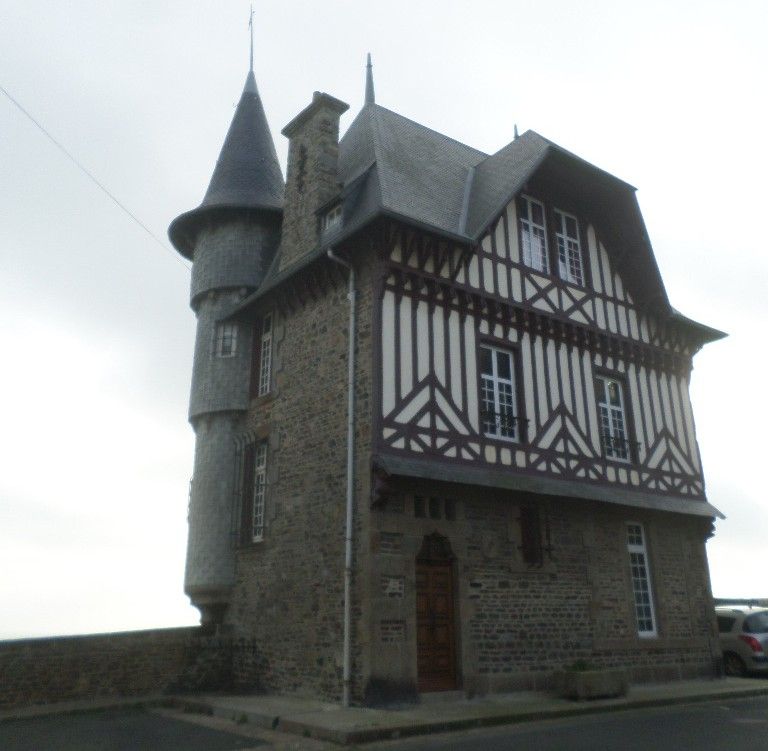
Here you see the Maison du Guet or Watch House. This charming building is an integral part of the silhouette of the fortified city. It raises many questions with its medieval look and its turrets reminiscent of Hogwarts. It is in fact a private house of seaside architecture dating from the beginning of the 20C.
At Place de l’Isthme square. It is divided into two parts separated by a ditch dating from the 19C. The Musée d’art moderne Richard Anacréon or Museum of Modern Art Richard Anacreon, once a convent then a school, is located on the western part of the square. The famous Tranchée aux Anglais, meanwhile, is visible from the eastern part, when you come to tickle the arrows of the Casino,
The city of Granville on its heritage: https://www.ville-granville.fr/cadre-de-vie-autour-de-moi/chausey/decouvrir/
The City of Granville on the Upper Town or Haute Ville : https://www.ville-granville.fr/a-voir-a-faire-a-granville/patrimoine/haute-ville/
The Granville tourist office on the walks in the Upper Town of Haute Ville : https://www.tourisme-granville-terre-mer.com/decouvrir/nos-incontournables/la-haute-ville-balade-autour-des-remparts-de-granville
The Manche dept 50 tourist office on Granville: https://www.manche-tourism.com/granville-normandy
The Normandie tourist office on Granville: https://en.normandie-tourisme.fr/unmissable-sites/granville-chausey/
There you go folks, another dandy city in my belle France.This one off the invasion beaches anothe sight to see different nice , Granville is wonderful and on clear weather nice views of Mont Saint Michel can be seen, gorgeous!! Again, hope you enjoy this post on curiosities of Granville !!! as I.
And remember, happy travels, good health, and many cheers to all !!!


Visited Granville during the Tour
LikeLiked by 1 person
Good for you! Nice town to ride lol
LikeLiked by 1 person
Indeed
LikeLiked by 1 person