
So will update for you and me this older post of a nice town that was near me for a period of my life. It is a royal town of France but seldom mentioned or seen, sort of like an off the beaten path town. I have a few posts on it in my blog and would like to expand a bit here. Hope you enjoy my take on the Château of Maisons-Laffitte, part I !!! as I.
And why not a castle very close to Paris and seldom visited but is a must for the architecture and the history of it as well as the horse races. Well, it was not far from me while in the area so used to go there a lot ,even to shop in the wonderful gourmet store of Longueil. I am talking about Maisons-Laffitte of course. It is a town in the département 78 Yvelines in the region of Île-de-France, about 10 km from Saint-Germain-en-Laye, and 18 km from Paris. It is at the banks of the Seine river on the left bank and on the west it has the forest of Saint-Germain-en-Laye. The metro area also includes a part of the isles of the Seine and de la Commune. The road D308 runs from Paris to Poissy passing by Maisons-Laffitte as principal road. The train station connects to Gare Saint Lazare in Paris and also has the regional express train RER A line L from many points in Paris. The night bus N152 Gare de Cergy-le-Haut Paris St-Lazare, passes by Maisons-Laffitte as well.
A bit of history I like tell us that the first mention of the village dates from about 820, in the writing of Bishop Minot, the name was Mansionis Villa. The first squire was certainly Nivard of Septeuil. His son Geoffroy I granted the Abbey of Saint-Wandrille de Fontelle the free passage in front of the port of Maisons towards 1060-1066. He also gave towards 1087 the Church of Maisons at the Abbey of Our Lady of Coulombs (near Nogent-le-Roi), with land, vines, tithes and a share of the toll. The family of Avesne kept its land, which quickly passed to the family of Marseille. The family ceded their property from 1460 to Jean IV de Longueil, judge in the Parliament of Paris. The Lordship’s town will be found in 1602, when John VIII of Longueil buys the share of Marseille.
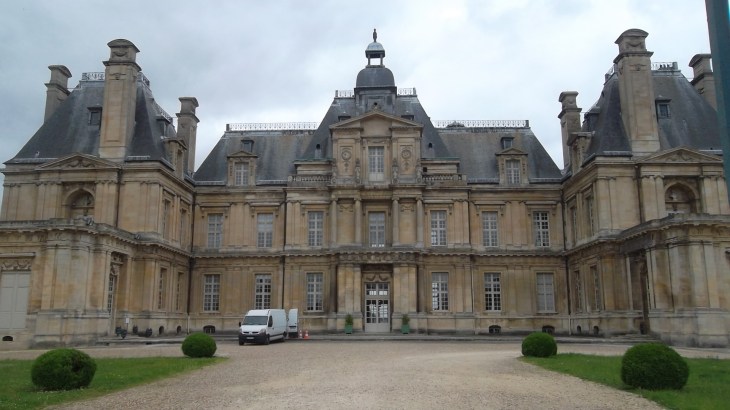
The castle was built by François Mansart, uncle of Jules Hardouin-Mansart who will build Versailles a few years later… This new building takes the place of the previous buildings built by the two lineages of house Lords. The castle will be great, to receive the king during the hunts in the forest of Saint-Germain. It is for this reason that the entrance to the monument is back to the Seine, preceded by a wide avenue coming from the forest. Construction started around 1642, ending at 1650. king Louis XIV lodged there in 1671 on the day of the death of Philippe François de France, duke d’Anjou.
The first alleys of the park, the Avenues Albine and Aegle, are contemporary of the castle. The other aisles will be created during the 18C. A map of 1740 shows it as we know it today. A majority of families live in the vineyard, which occupies 40% of the cultivated land. Among the descendants of René de Longueil, figure Jean-René who received scholars and writers at the château, among which Voltaire. The latter tells in his correspondence the fire which damaged the building in 1724, when he left after being treated with smallpox.
Starting with the king, to please Madame de Pompadour in 1747, then to Madame du Barry in 1770 to sell the castle. But king Louis XV did not let himself be engaged in these operations and end up selling Maisons in 1777 to the Count of Artois, brother of king Louis XVI and future king Charles X, who complemented the embellishments. The French revolution has finally put an end to this procrastination. The Count of Artois fled to England, and the estate was put under receivership in 1792. Put on sale in 1797 as national property, the ensemble is awarded to Jean Lanchère , supplier to armies interested in the profits he can make of the buildings, Lanchère destroys some pavilions, sells sculptures… to finally resell the Castle in 1804 to Marshal Lannes after his death in 1809 at the Battle of Essling, his wife, the Duchess of Montebello, sometimes received the emperor in visits. The latter, in 1810, ordered the construction of the first bridge between Sartrouville and Maisons.

In 1813, the Duchess of Montebello received the Empress Marie-Louise, of whom she had been a lady of honour for three years. In 1818, she sells the estate of Maisons in favour of Jacques Laffitte. Opponent of king Charles X (the former owner of the castle, between 1777 and 1789, while he was Count of Artois), Jacques Laffitte welcomed many members of the political opposition to Maisons. It is therefore logical that he exerts decisive influence during the other French revolution of 1830.

Jacques Laffitte is appointed President of the Council and Minister of Finance of the king. Overwhelmed by political agitation, he left the post in 1831, and came out pretty much ruined from the adventure. As a result of these events, he decided to divide the estate of Maisons to carry out a fruitful real estate operation. In 1833, the stables and other dependencies were destroyed in order to provide building materials for the purchasers of the park lots. In 1834 is deposited before notary the specifications of this subdivision, a copy of which is, even today, given to each purchaser in the park. The idea of this specification is to lay the principles of construction of this “city in the countryside”. To ensure the service of the properties, Jacques Laffitte is led to open new avenues in the park. Starting from the already existing backbone (avenues Aegle, Albine…), he traces geometric figures. He also draws a cross of the Legion of Honour around the place Napoleon and the Circle of fame, from which avenues will bear the names of the battles of the emperor. Jacques Laffitte died on May 26, 1844, carried by a pulmonary disease. The estate passes to the hands of his daughter Albine, who proceeds from 1846 to an auction of the remaining lots and who will eventually sell the estate in 1850, including the 33 hectares including the Castle. Charles Laffitte, a large horse-sport enthusiast, is a founding member of the Jockey Club in Paris, where the Encouragement society will be established. He owned the “Le Val-Fleuri” property in the park where the Malesherbes room is currently located, although the property was much larger.
The remains of the water machine of Maisons-Laffitte on the small arm of the Seine. It was probably built by François Mansart at the request of René de Longueil to fuel his future Castle of Maisons in 1634. Destroyed in 1885, it remains today that the three masonry abutments on which the machine rested. The wonderful Château de Maisons-Laffitte (b. 1643). is considered a masterpiece of 17C civil architecture. Constituting a reference in the history of French architecture, it marks the transition between the end of late Renaissance architecture and that of Classicism.
The official château of Maisons-Laffitte: http://www.chateau-maisons.fr/en/
The Friends of the Château of Maisons-Laffitte: http://amisduchateau.fr/sacm/la-sacm/
The City of Maisons Laffitte on the castle : https://www.maisonslaffitte.fr/Histoireetpatrimoine/10038/22
The Maisons-Laffitte tourist office on the castle: https://www.tourisme-maisonslaffitte.fr/adresse/chateau-de-maisons/
There you go folks ,you are all set for a wonderful experience in Maisons-Laffitte, believe me. Again, hope you enjoy this post on the Château Maisons Laffitte, part I !!! as I.
And remember , happy travels, good health ,and many cheers to all !!!

 Paris1972-Versailles2003