
So I continue on my efforts to show you something different of my belle France other than that other country Paris. Oh yes city you know what I mean…. Come on over to the mouvable feast that is France provinces or regions and see the gorgeous architecture and history that it embodies. I like to tell you more on this is Maisons Laffitte !!! Hope you enjoy the post as I.
The town of Maisons Laffitte we used to come often while living in nearby Versailles. Oh yes it is in the Yvelines dept 78 of the Ïle de France region. Now it has been a bit long in between, last was 2017. It is a wonderful town ,first, because it has a wonderful castle, then the hippodrome, and finally the nice shops along main street avenue de Longueil , especially the epicérie de Longueil. You best get here by car, from Paris take the A13 direction Rouen, enter at exit/sortie 7 direction Poissy go thru Poissy centre ville around roundabout facing Peugeot factory /office take second street alongside the offices on road D308 direction Maisons Laffitte, and will hit dead center of it. Or take the A15 out from Paris on porte st Ouen, direction Gennevilliers, stay on the same road as N315 (A15) direction Rouen to exit 7 Conflans Sainte Honorine take here the N184 direction Saint Germain en Laye to rue de poissy or the D308 see signs on your left for Maisons Laffitte. About 10 km from Saint Germain en Laye and 18 km from Paris. Of course on public transports too on the RER A trains from different locations in Paris.
How to get around and public transports with a map from the tourist office of Maisons Laffitte here: Maisons Laffitte tourist office on getting around
And if architecture is not for you, then Maisons Laffite has plenty of cultural activities and a wonderful cultural complex. The Festival has been postponned this year due to the virus covid 19 but schedule for May 2021 , more info will be shown here: Festival de Maisons Laffitte
At 39, avenue Longueil, you have a wonderful cultural center, library, tourist office etc. The setting of course is wonderful. Hours, contact tel and email can be had here for future events: City of Maisons Laffitte on cultural events
And of course, the wonderful pretty Bibliothéque or municipal library of Maisons Laffitte has it all for your leisure time after sightseeing the town. Created in 1965, the Maisons-Laffitte municipal library is located close to shops and public transport. Covering an area of approximately 600m², it has an adult and youth space, each with armchairs and work spaces. You can find there: books, magazines, audio books, comics, attend conferences, meet authors, surf the internet, etc . Also, find out about all the cultureal activities of the city. It is centrally located at 39, avenue Longueil, right next to the tourist office and across the street from the Hôtel de Ville or city hall and diagonally across from the RER A train station. You entered the library by place du Maréchal Juin behind the building.
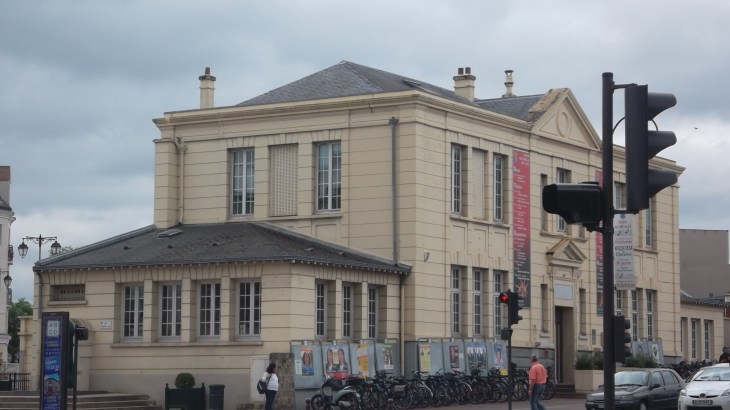
More on the municipal library in French here: Municipal library of Maisons Laffitte
And do walk and see the famous thinkers of our times that have come or stayed in Maisons Laffitte a wonderul town by the Seine river too. Some of these were Guy de Maupassant ;Henri Marie Baur ; Idel Ianchelevici ; Jean Cocteau ; Joseph Czapski ;Luigi Castiglioni ;Pierre Larquey ; and Roger Martin du Gard. But here is the Maisons Laffitte tourist office with more info on each of them in English: Maisons Laffitte on the land of artists
Other things to see in Maisons-Laffitte!
Inaugurated in 1878, the Hippodrome de Maisons-Laffitte (horse racecourse) is part of the series of racing fields built during the second half of the 19C in the region of ïle de France in addition to the Grands racecourses of Paris (Auteuil, Longchamp, Saint-Cloud and Vincennes) and alongside those of the Marche in Marnes-La-Coquette (1851), Enghien (1879), Saint-Ouen (1881) and Colombes (1883). A runway of 4 680 meters in grass, located on the edge of the Seine. The straight line of more than 2 000 meters is the longest in Europe with the Rowley Mile Course in Newmarket (Suffolk, England). The Hippodrome de Maisons-Laffitte has the peculiarity of being the only course of flat runs in Île-de-France where horses can run rope left and rope right in the same meeting of races. Different track configurations are possible, with a total of 35 different departures: A right-hand rope track (1 600 meters to 3 200 meters), a left-hand rope track (1 400 meters to 2 400 meters), and a straight line (2 000 meters).
Contemporaries of the château, several pavilions also of François Mansart: Two at the entrance of the Parc de Maisons-Laffitte, framing the two gates of Maisons-Laffitte, once closed by a grid. Two others a little further, very revamped, in the extension of Avenue Albine. A fifth in the northern cellars, Eglé Avenue, at another end of the park. An old church of the 11C and 16C, disaffected in 1896, today Exhibition Center. The Fountain of Maisons-Laffitte, in the village, next door, dating from the 18C. A Benedictine priory that the tradition brought back to the 15C, which survives the exterior structure with two pepper towers at the end of the street of the same name, very reshuffle before and after long served as a school of the village. You have the nice Church of Saint Nicolas, (see post) at 13 rue de la muette. The Church is built between 1867-1872 in a neo Roman style on the land of an old cemetery given by the city.
Several mansions such as the one at 30 avenue Pascal. The Doulton Pavilion made by the British pottery company Royal Doulton for the Universal Exhibition of 1878. After the exhibition, the façade was reassembled in the Parc de Maisons-Laffitte and a house was built in the back. At 35 Avenue Belleforière, Villa sur jardin of 1923 , it is now divided into apartments and the garden Loti is occupied by several buildings. At 2 Avenue du General-Leclerc, call the Florentine Villa built in 1905 . Also, several other building of great architecture interest such as the Juillard Property, Guard Pavilion, 72 rue de Paris , mansion at 2 rue de la mute, mansion at 24 Avenue Eglé, mansion at 21bis Avenue Eglé , mansion at 39 Avenue Albine, the Hotel Royal of Maisons-Laffitte, a building at 36bis rue de la mute.
I like to add some fabolous streets that sadly hardly any pictures taken while there but they remain precious to us for the memories forever.
Avenue Lavoisier: no. 18 at the corner with Avenue La Bruyère is the birthplace of Jacques Fath, French fashion designer considered one of the dominant influences in high fashion postwar, with Balenciaga, Christian Dior and Pierre Balmain.
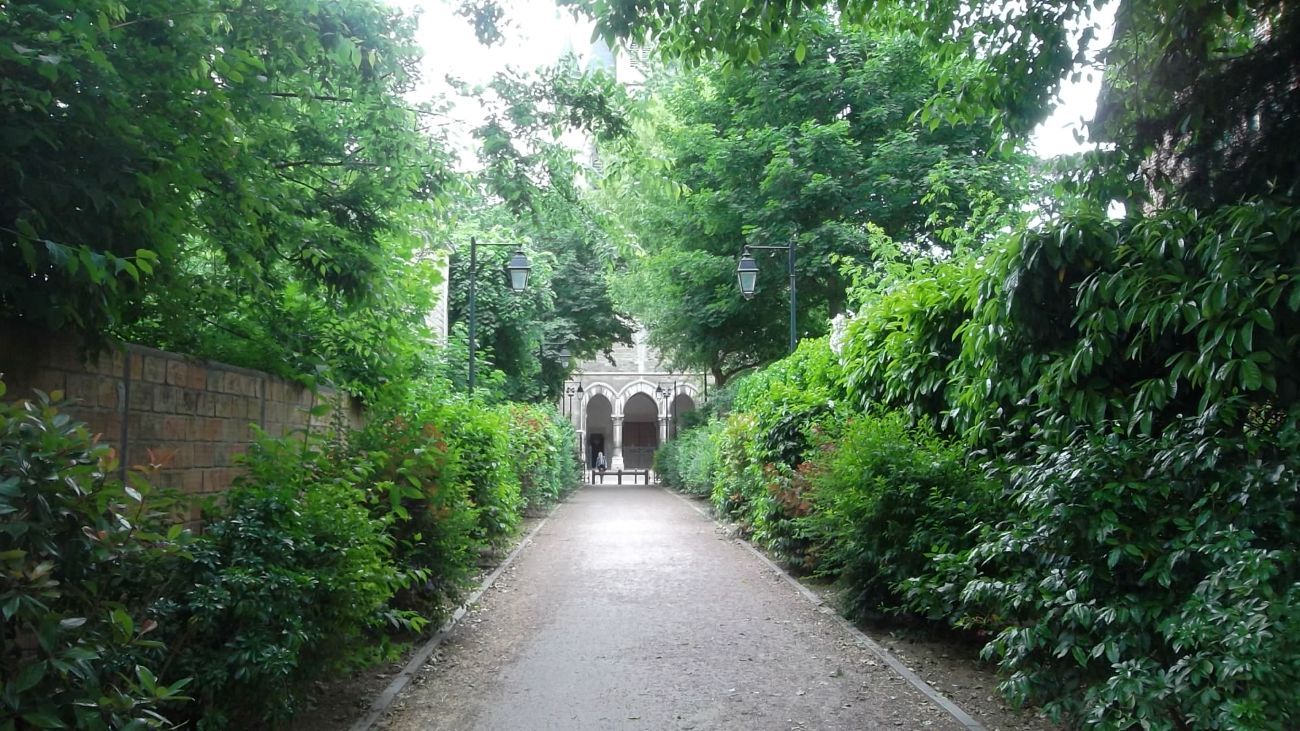
Place Marine . This beautiful square in the Great Park was named after the wife of Jacques Laffitte. It is crossed by Avenue Albine; and north seven avenues fan out. At no 5 picturesque house built in 1835 with an octagonal gazebo, to Etiennette Moussy, Parisian rented by architect Théodore Charpentier. Going towards the no 8 made a small passage by the No. 26 of the Avenue Albine where is the holiday home of Roger Martin du Gard . His parents rented it each year, in summer, To escape the heat of Paris. By no. 8: Charmettes former hotel restaurant where the writer Jacques de Lacretelle stayed in 1921. He has written several letters to his friend Marcel Proust. It was built in 1846, the first period of the “Colony Laffitte.” At no. 6 back on the parcel a Villa bought in 1901 by Leonie Rosalie Balmain and sisters who owned a couture house in Paris. To the left on the avenue Desaix extended the former estate of the Aga Khan. In 1940, the villa was confiscated by the Nazi army and later housed the headquarters of Rommel. The area is now subdivided.
At no 6 Avenue Duguesclin; Maison les Turrets-facade combining three architectural styles: renaissance pillars of the porch, Baroque pediment, balusters and putti 18C.
At Avenue de Wagram No. 8 Maison Juillard, 1837. Its architect Charles Duval, pierced windows behind some sculptures for more light in the stairwell. These windows are hidden for the sake of symmetry of the facade. They are called “Suffering of Days.”
Place Sully at no. 4 birthplace of Jean Cocteau. The artist retained happy memories of his childhood in this house that belonged to his grandfather. He called it the park of “green paradise”. The grandfather, Eugene Lecomte, has also offered a nice amount of money to the city in 1881 to develop fountains.
Avenue Corneille no 1 The Polish Literary Institute and the Kultura publishing house settled in 1951, in the villa the Belvedere. Organizers lived there as a community, a phalanx. The authors banned in Poland were honored.
Avenue Gretry No. 8 This house dating from 1837 housed since 1926 the famous restaurant La Vieille Fontaine. Jean Cocteau often had lunch there. All Paris had dinner there, and the presidential entourage.
Place Wagram no 5: Major Cotton House 19C, former senior officer of the guards of the Tower of London, which sold it to Emilienne d’Alencon. She had been the mistress of the Duke of Uzes, Leopold II of Belgium and wife of Percy Woodland. She lived here with her second husband, the jockey Alec Carter. At No. 2: Villa Victory or the Nursery: Its construction in 1838, this house was considered “American” because of its covered gallery. In 1930, the villa became a nursery for children of German communists persecuted or in special assignment. The writer Arthur Koestler of Hungarian origin is called to write promotional text for funds. Instead of staying two days he was held for 2 months with children from two to sixteen in 1934.
Place du Château. At the Malesherbes room location was the home of Charles Laffitte, Le Val Fleuri. Nephew of banker Jacques he was one of the founding members of the Jockey Club. Later, Max Lebaudy said the Little Sugar, lived there: he was the son of a wealthy family of sugar barons, known as spendthrift and very eccentric.
Avenue du General Leclerc No. 2a: the Cave, The last vestige of the castle stables. Pierre Giffard, editor at Le Figaro, had built his house around this cave. It is the origin of the first Paris-Brest bicycle race in 1891 which gave its name to a famous cake in the shape of a bicycle wheel, created by pastry Durand ; installed at Avenue Longueil . In 1926 Mr. and Mrs. lived here. Darmel, singing at the Paris Opera who created the Maisons-Laffitte Conservatory. At No. 2: the Florentine, Beautiful Italian villa dating from 1905. Look at the frieze of graffito.
And, Rue du Mesnil / Rue du Prieuré at No. 11 rue du Mesnil: the maison or house known as The prayer. René de Longueil gave the land and did move the priory in 1644 next to the old church. The current building is a mix of styles and periods. At no. 1 Rue du Prieuré the school / college “The Priory”, opened in 1905.
A bit of history I like tell us that the Poissys remained lords of Maisons until the 15C. Two sisters shared the lordship. It was rebuilt in 1602 by the successive purchases of a family of Parisian parliamentarians, the Longueil, whose arms became those of the town. The great man of the family was René de Longueil, superintendent of finance in 1650. The fortune of his wife, heir to several great Parisian financiers, enabled him to address the famous François Mansart to give himself a castle commensurate with his ambitions. From 1634 to 1646, Mansart built one of the masterpieces of 17C French architecture: the Château de Maisons. René de Longueil endowed it with a park of about 400 hectares, which king Louis XIV authorized the closure in 1658. The layout of the alleys continued little by little until 1740. It was even later that it was completed forestation of plots. In 1777, the Marquis de Soyécourt, heir to the Longueil family, sold Maisons to a brother of king Louis XVI, the Comte d’Artois (later king Charles X). The latter installed there, but only from November to March, for food and training, his English stable, about thirty animals, which he dispersed in 1784. The French revolution confiscated Maisons. This national asset was bought first by Lanchère, supplier of the armies, then by Marshal Lannes and finally, in 1818, by the banker Jacques Laffitte. He was the real initiator of the equestrian vocation of Maisons. He dreamed of making it a training center comparable to Newmarket. He organized the first races on the meadows on the banks of the Seine river which became today’s racetrack. In 1833, Laffitte decided to sell the Grand Parc du Château. He subdivided it to make it a colony, a city made up of country houses. The main buyers were wealthy Parisians, from business or entertainment. There were, of course, more modest buyers. The operation made such an impression that, in less than ten years, people got into the habit of saying Maisons-Laffitte instead of Maisons-sur-Seine, a custom formalized in 1882. The inauguration of the racetrack in 1878 stimulated horse racing activities, many trainers settled in town and in the park from the end of the 19C. In the 20C, urbanization continued west and south, gradually covering the old agricultural land of which nothing remains. Then the population grew thanks to the fragmentation of private estates and the construction of numerous collective buildings from 1950 to 1970. Both the Great Park entrance pavilions, each with their monumental gate, are the work of Mansart . Between these doors, a gap protected the entrance of the park without limit in sight. This group formed a side entrance of the castle park.
Jacques Laffitte comes from modest background , carpenter, but quickly rises up. Governor of the Bank of France in 1814, opposing Charles X, he welcomes to the castle many adversaries and has great influence on the Revolution of 1830 (that ended monarchy in France with Charles X) The same year he is named President of the Chamber of Deputies and once in throne king Louis Philippe I king of the French (but notice not of France) he is named President of the Council and minister of finances for the king. He goes thru a period of real estate development to create a new town, selling lots and building houses. Jacques Laffitte died on May 26 1844 not before building a town that now bears his name. The domain past to his daughter Albine that continues the sale of lots and finally sells the domain including the castle in 1850.
There you go folks, a very classy, quant town on the borders of the Seine river , close to Paris in another world of countryside and cachet! Again, hope you enjoy the post on this is Maisons Laffitte !!! as I.
And remember, happy travels, good health, and many cheers to all !!!


