
I arrived in Rome with the family, finally. It was a very nice family trip and we packed a lot of sights into it. However, one of the best if not the best was the visit to Villa Borgnese , I found me pictures spread in other posts that should have a post of its own on this beautiful spot, so here is my take again on the Villa Borghese of Rome, part II !!! Hope you enjoy it as I.
One of the most pleasant trips was to the Villa Borghese park a wonderful ,and a must visit while in Rome for all, The Villa Borghèse is a municipal park of 80 hectares or about 198 acres in Rome. It has a large group of buildings on the cultural nature as well as museums, This is the most important park in Rome since the Antique period. The whole of the Villa Borghese was finished in 1633 . The current gardens dates from the 19C and done in the English style. The park was purchased by the Italian government in 1901 and given to the city of Rome in 1903 to be open to the public.
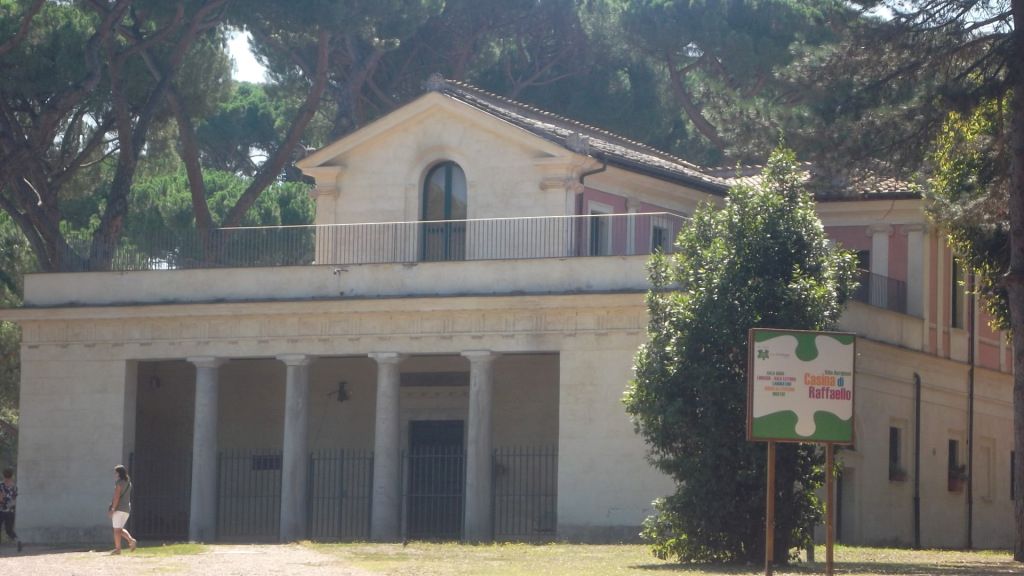
One more sight to see inside Villa Borghese is the Casina di Raffaello at Viale della Casina di Raffaello, 19, Lots of kids activities in a renovated old mansion.La Casina di Raffaello,combines history, culture, and education. Its history dates back to around 1500. Known by various names over the centuries, it owes its current name to a building, once located in the Galoppatoio area and destroyed in 1849 that featured frescoes by Raphael’s school. Until the early 2000s, the Casina served as the residence of the painter Alessandro Poma, who lived there for over forty years, dedicating himself to depicting the Villa. In 2003, the city of Rome purchased the building and initiated a restoration project to revitalize it, Completed in 2006, the project adapted the Casina for a new recreational and educational role, transforming it into a historic gem for the community. A special space dedicated to children and young people aged 2 to 14. La Casina is a center dedicated to art and creativity, where the youngest visitors can experiment with movement and imagination. As part of an “Educating City” initiative, it is committed to combating educational poverty in all its forms, ensuring that children grow into conscious citizens ready to face the future without ever forgetting the importance of play! It features specially designed spaces for family and school activities, free areas accessible even to children under three, and a specialized bookshop where books and toys for children can be purchased. On the ground floor, alongside the bookshop, there are two free-access areas: the *Sala Giani*, featuring soft play equipment ideal for the youngest visitors, and the *Chiostrina*, where a vast array of picture books is arranged at child-height for browsing and reading. This floor is equipped with a baby-changing station and a designated area for stroller parking. The upper floor houses three workshop spaces, a reading room, and a beautiful terrace overlooking Villa Borghese.La Casina di Raffaello is a facility of the Rome Capital Department for Schools, Training, and Employment, managed in collaboration with Zètema Progetto Cultura. The official Casina di Raffaello: https://www.casinadiraffaello.it/
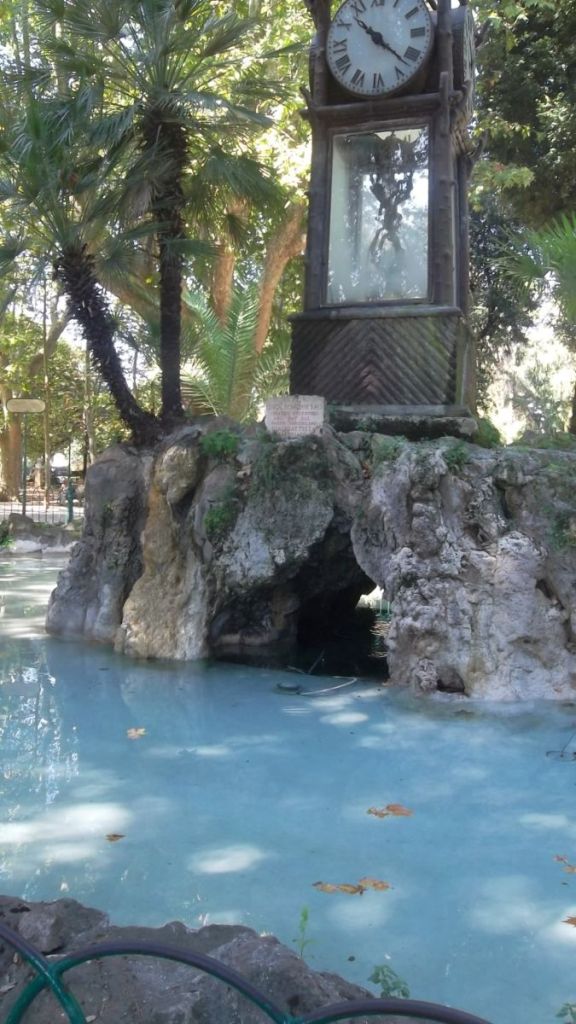
You see the wonderful Pincio Water clock , still going strong from 19C engineering. The Pincio is a hill on the north of the Quirinal that dominates the Campo di Martes with several villas including Villa Borghese where you have the clock. The clock has four quadrants ideally recalling the trunk of a tree and allowing it to show the time in four different directions, to note his hands in the shape of tree branches to make this structure an architectural element almost natural in perfect harmony with Villa Borghese.
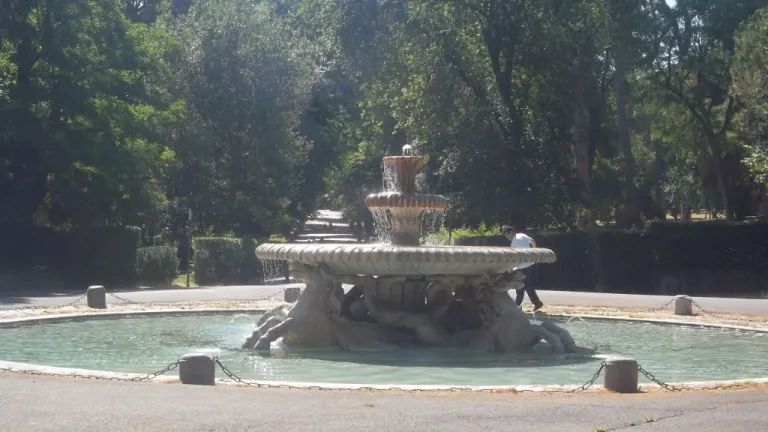
The Fontana dei Cavalli Marini or of the Seahorses fountain has designed fountain features seahorses and nymphs, symbolizing the mythical connection between water and life. Set against a backdrop of tall trees, the fountain’s cascading waters create a soothing ambiance, making it a favorite relaxing spot. Inside a large round basin, four sea horses emerge from the water, with their hooves raised and bodies in the form of fish.The horses support a second, smaller basin with their heads and tails, surmounted by a double chalice finely decorated with acanthus leaves. Other jets of water gush between the horses’ legs and their tails. The fountain is placed in the center of a small square near a junction of four tree-lined paths and was built between 1790 and 1791 to replace the previous fountain of the Mascherone or della Vela, which had been previously destroyed during the transformation of the park. It was commissioned by Prince Marcantonio IV Borghese, the most munificent patron of 18C Rome, who transformed the villa built by Cardinal Scipione Caffarelli Borghese into a fashionable garden. It is said that the inspiration for the theme of sea horses came from an ancient cameo that the sculptor would have received as a gift from the prince.
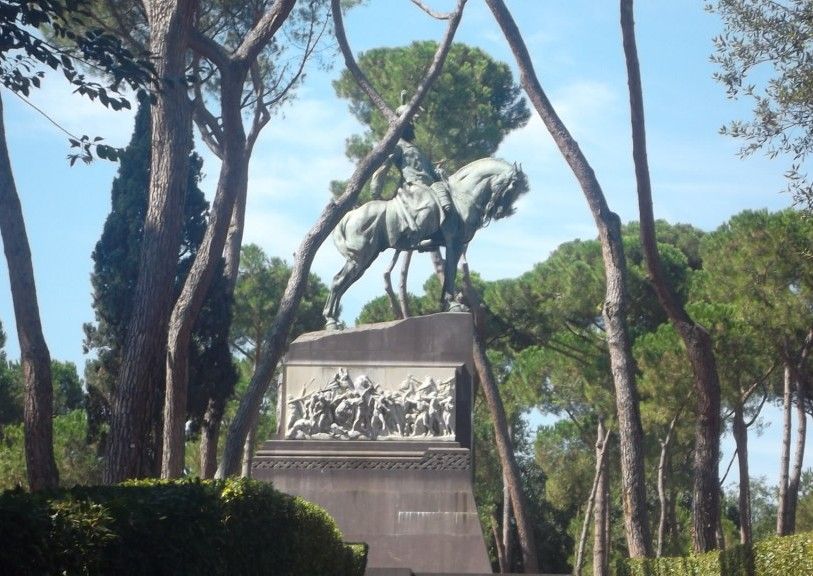
The equestrian monument to Umberto I , the second King of Italy who ruled from 1878 until his assassination in 1900 located in the Villa Borghese gardens. Designed by sculptor Davide Calandra in 1914 and completed by Edoardo Rubino, it was inaugurated in 1926. It is composed of bronze, marble, and porphyry, and adorned with symbolic bas-reliefs. Umberto’s reign saw Italy attempt colonial expansion into the Horn of Africa, successfully gaining Eritrea and Somalia despite being defeated by Abyssinia at the Battle of Adwa in 1896. In 1882, he approved the Triple Alliance with the German Empire and Austria-Hungary. He was especially hated by anarchists, who attempted to assassinate him during the first year of his reign. He was killed by another anarchist.
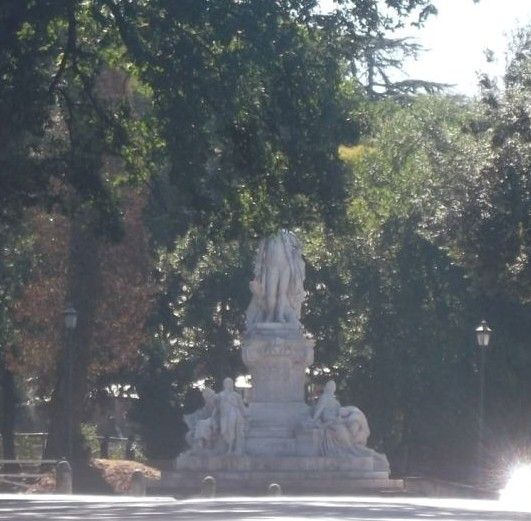
The monument to Goethe, Johann Wolfgang von Goethe depicts him as a young man, commemorating his long and formative journey to Italy. The eight-meter-tall statue features a young Goethe at its center, while three sculptural groups at the base symbolize philosophy, lyric poetry, and dramatic poetry. Created by the German artist Gustav Eberlein, the work was inaugurated in 1904 in the presence of King Victor Emmanuel III. The monument was a gift from the German Kaiser Wilhelm II to the city of Rome in 1902 and was subsequently installed in the Villa Borghese park in 1904.
The temple of Diane is a small circular kiosk in the neo classic style and built in 1789 upon orders of prince Marcantonio IV Borghese. By Viale della Casina di Raffaello. All over the park you find wonderful creeks, and flower decoration, . Also a statue to George Gordon Byron or lord Byron done in the 19C. OF course, not all on pictures. From the French Academy on the viale del Belvedere you have a wonderful view of Rome on the Campo Marzio, and perpendicular to the viale della Magnolia with a nice park for children
The Rome Tourist Office on Villa Borghese park: https://www.turismoroma.it/en/places/villa-borghese-park
The Rome Capital Tourist and Cultural Information Center on Villa Borghese : https://060608.comune.roma.it/green-and-sport/giardini-ville-e-parchi-urbani/villa-borghese-3417
The Archeoroma cultural tourist site of Rome on Villa Borghese: https://www.archeoroma.org/sites/villa-borghese/
There you go folks as said a wonderful park in a huge historically renown city of Rome. I told you, it is huge we could not walked all and came back twice to it while there, so many monuments and buildings to see. Again, hope you enjoy the post on the Villa Borghese of Rome, part II !!! as I.
And , remember for happy travels, good health, and many cheers to all !!!

 Paris1972-Versailles2003