
I continue my journey in my belle France. On our way to Toulouse as many times, we stopped this time by Martel, This is great wonderful village and great family times. I am glad found me more pictures in my cd rom vaults that should be in my blog for you and me, Therefore, here is my take on this is Martel !!! Hope you enjoy the post as I.
The village of Martel is located in the Lot department no 46 , in the Occitanie region of my belle France . It holds the “Les Plus Beaux Villages de France” (Most Beautiful Villages of France) label and is also designated as a “Site Remarquable du Goût” (Remarkable Site of Taste). Known as “the town of seven towers” since the 17C, It is located 22 km from Rocamadour, 18 km from Collonges-la-Rouge, 14 km from Souillac, 36 km from Brive-la-Gaillarde, 18 km from Turenne, 42 km from Sarlat-la-Canéda, 506 km from Versailles, and 587 km from my current home, We came here from Versailles along the N12,A86 N118 all to connect with the A10 autoroute l’Aquitaine dir Bordeaux passing by Orléans it becomes the A71 autoroute L’Arverne continue to around Vierzon connecting with the A20 autoroute L’Occitane dir Toulouse but get off at exit/sortie 54 dir Rocamadour on the D840 road continue entering Martel on the Avenue de Brive to roundabout continue on Avenue du Général de Gaulle then bear right on Bd du Capitani and quick right onto Rue Droite to rue de l’église and the church,We came out on the D803 road to get back on the A20 towards Toulouse,
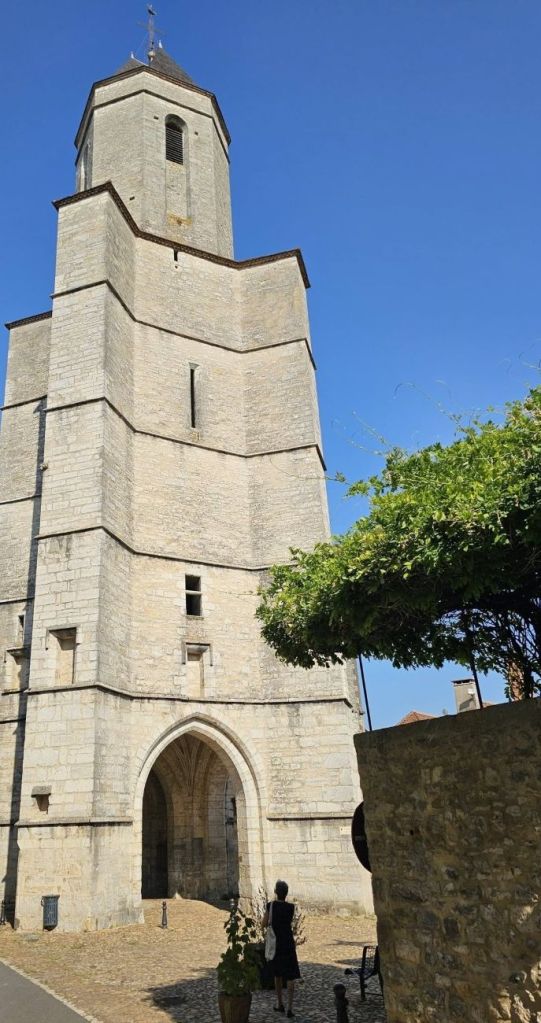
The Church Saint Maur was built during the 13-14C on the site of an earlier Romanesque church, it stands against the ramparts and was an integral part of Martel’s defensive system. Gothic in style and imposing in scale, it measures 56 meters in length and features a 48-meter-high bell tower. It was originally a fortified church, complete with battlements, arrow slits, and wall walks. The stained-glass window in the chancel, dates from the 16C. dedicated to a disciple of Saint Benedict; a fortified church featuring a 12C Romanesque tympanum, and a 14C nave. With its imposing dimensions and character, the church is a fine example of the “Southern Gothic” style. The apse is illuminated by a magnificent early 16C stained-glass window depicting the events of Holy Week in twelve panels. The chancel also houses a beautiful collection of 18C woodwork and paintings.
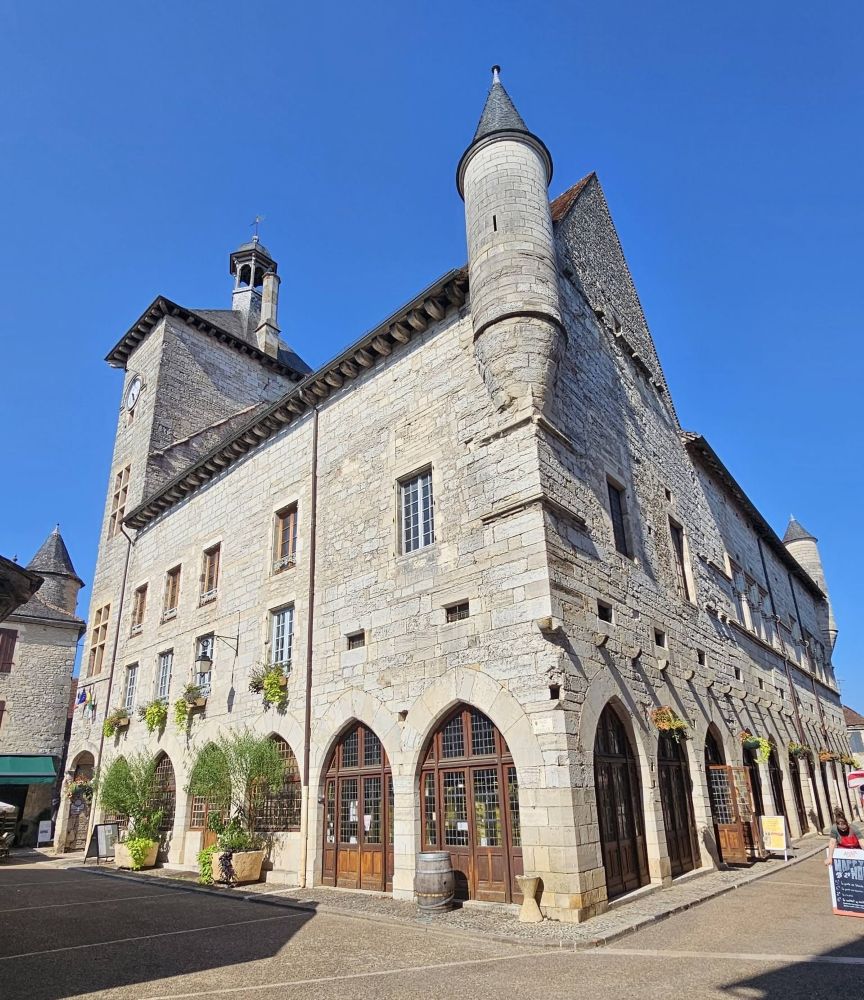
The Hôtel de la Raymondie aka the Palais de la Raymondie was built starting in 1280 at the behest of Bernard Raymond , the French king’s receiver-general of taxes for the Poitou, Limousin, and Gascony regions. Completed around 1330 and known at the time as the *Hospicium de la Ramundia*, the structure comprises a belfry, a north wing, and an east façade. In 1531, the building was subdivided and sold to prominent citizens of Martel: A spiral staircase was added to the eastern section in 1546. The Hôtel de la Raymondie subsequently served as the residence for the lieutenant-generals of the Turenne *Sénéchaussée* (judicial district). A justice of the peace court was established on the upper floor of the north wing, while the ground floor was leased to a dyer named Castan; shops on the ground floor of the south wing were also rented out. In 1903, a girls’ school was installed in the east wing. The building rises three stories high and features small corner turrets on the façades. It served multiple purposes: an upper-floor residence, ground-floor arcades for commerce, and a reception hall for public events. During the French revolution, it became the City/town hall, but its integrity was later compromised by the proliferation of ground-floor shops, the conversion of upper floors into housing, and a lack of maintenance. It was not until the 1970s that the complex returned to public ownership. The second floor of the Hôtel de la Raymondie houses the Uxellodunum Museum, which contains collections of protohistoric and Gallo-Roman artifacts recovered from excavations at Puy-d’Issolud. Interesting collections of apothecary jars (17-18C), and series of antique maps. It is now owned by the village, which houses the City/town hall and the tourist office within the building.
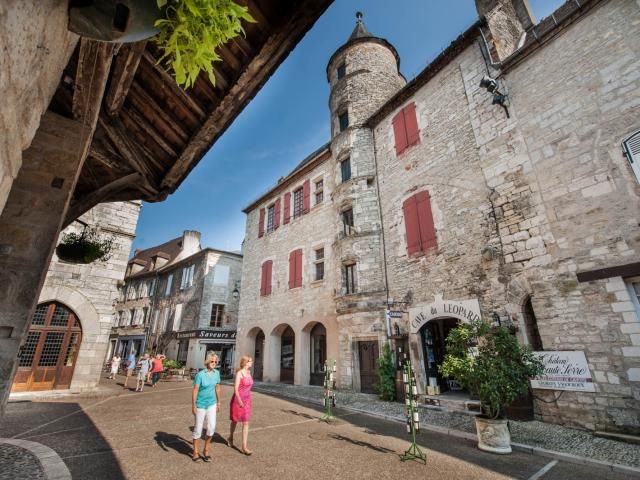
The Hôtel Fabri local tradition holds that a wealthy Martel burgher, Étienne Fabri, built his hôtel particulier on this site at the end of the 12C. Remnants of a medieval structure dating from the 13C or 14C can still be seen on the east and south façades. The current hôtel particulier is a grand residence of medieval origin, remodeled around 1520-1550. A spiral staircase tower on its main façade, facing the Place de la Halle, is partially detached and provides access to the five upper floors. The ground floor was reserved for shops or workshops. At the top of the tower, a second, narrower spiral staircase leads to a small room that was heated by a fireplace built in the 17C, In 1183, the burgher Étienne Fabri welcomed Henry the Young King of England, who was dying after the sacking of Rocamadour by his mercenary band. Henry the Young was the second son and heir of Henry II Plantagenet and Eleanor of Aquitaine, son-in-law of the King of France, and brother of Richard the Lionheart and John Lackland. According to tradition, this King of England, crowned during his father’s lifetime, aka Henry Short-Mantel, died there in 1183, atoning for his crimes, while Henry II was en route to the area around Limoges to reconcile with this troubled son.
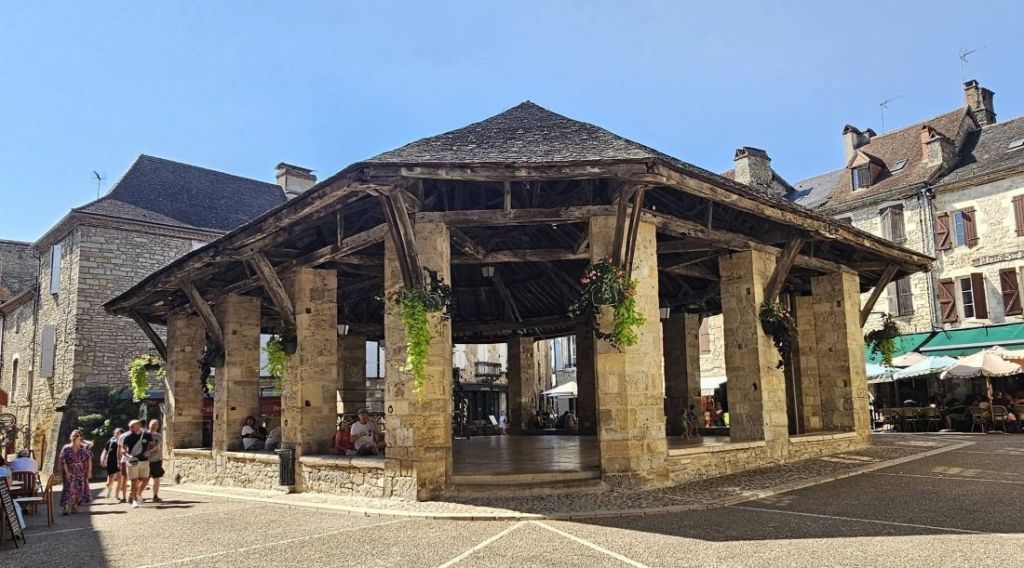
The Halle or covered market A market hall existed from the 14C onwards on the ground floor of the Consuls’ House. Fairs were held there several times a week. After the Hundred Years’ War, a new city/town hall was built in the 16C on the site of the first building, which included a market hall on pillars. A new market hall with a chestnut frame and “conques” (grain measures) was built on the site of the arsenal and the first city/town hall after their demolition in 1792, and rebuilt between 1793 and 1800.
Other things to see here are the Hôtel Condamine was formerly the *Hôtel de la Monnaie* (Mint), this building served as the workshop for minting the currency used in the Viscountcy. It features two adjoining turrets of unequal height. The Hôtel Fabri where in 1183, the townsman Étienne Fabri hosted Henry the Young King then dying after his band of mercenaries had looted Rocamadour. Henry was the second son and heir of Henry II Plantagenet and Eleanor of Aquitaine, son-in-law to the King of France, and brother to Richard the Lionheart and John Lackland. According to tradition, this King of Englan crowned during his father’s lifetime and known as Henry the Young King aka Henry “Short-Coat” died there in 1183 while atoning for his crimes, just as Henry II was traveling near Limoges to reconcile with his wayward son. theTournemire aka Prison Tower, a Romanesque watchtower (12C and 14C); a square tower with covered battlements, standing 25 meters tall including its roof, which served as a prison until the 16C. Tour de Mirandol on Blanchard House 12C, 15C, 18C, and 20C; the noble house of Mirandol and its tall square tower featuring a corner turret , built by the seneschal François Faure (Lord of Mirandol) between 1480 and 1500 on the ruins of “La Faurie” the family home of a line of prosperous blacksmiths dating back to the 12C. The Hôtel de Briance aka Maison Arcambal, and Vergnes de Ferron, a private mansion built in the late 16C by the Lachièze-Briance family over earlier 14C structures; it features a Renaissance doorway, a ceremonial turret, and a tall round tower topped with a small spire .The Maison Grise aka Maison Ramet: formerly the home of a family of jurists, the Judicis (12C, 16C, and 19C). The *Grenier d’Abondance* (or Granary of Abundance is a small 16C Renaissance building adjoining the second defensive wall; it features mullioned windows, one of which is topped by an inscription drawn from Virgil’s *Eclogues*. The Haut Quercy tourist railway line, connecting Martel and Saint-Denis-lès-Martel, was brought back into service in 1997 by an association of enthusiastic volunteers. A new passenger terminal was inaugurated on April 17, 2010. A section of this line, carved into the Mirandol cliff face, overlooks the Dordogne river. Reptiland is a vivarium established in 1990; today, it displays 100 animal species, including snakes, lizards, tortoises, crocodiles, tarantulas, and scorpions. It is one of the largest exhibitions of venomous species in France. Private mansions with or without towers, character homes, humble medieval shop-fronts, medieval gates of the Brive and Souillac districts, rampart ruins, stylish arches and doorways, half-timbered houses, the Maison de la Vidalie on Rue Droite, the former Mirepoises convent with its cloister and coffered ceiling , and the former Sainte-Anne and Saint-Joseph convents all waiting to be discovered from the outside while wandering the old streets, particularly during the torchlight tours usually organized in summer.
Martel, known as the “City of Seven Towers” in local lore since the 17C. The seven towers of tradition are: the bell tower of the Church Saint-Maur ,an octagonal tower with a turret; 14C, 16C, and 19C; 48 meters high; the belfry of the Hôtel de la Raymondie, a rectangular tower featuring a small bell turret, a watch turret, a chimney, and a clock; 13C and 14C; the belfry stands 35 meters high, with additional watch turrets at the palace corners; the Tournemire Tower ,a watchtower that also served as a prison; 12C and 14C; a square tower with covered battlements; 25 meters; the Cordeliers Convent Tower that was truncated during the French revolution; a square tower; 14C; 25 meters high; the Fabri House Tower, a round tower; 16C; 23 meters high; the tower of the Hôtel de Briance aka Vergnes de Ferron ,a round tower with a small bell turret and a watch turret; 14-15C; 23 meters high; includes a 16C turret on the north façade; and the Mirandol Tower 15C, built between 1480 and 1500; a square tower with a watch turret, a remarkable vault keystone, and a watch room; 24.5 meters high.
A bit of history I like tell us that the first documentary mention of Martel appears in the cartulary of the Abbey of Aubazine (dating from 1142) and in the history of the Viscounts of Turenne. Martel was founded in the 11C under the joint protection of the Abbey of Sainte-Marie de Souillac and the Viscounts of Turenne and Brassac; from 1183 onwards, it was held solely by the Viscount of Turenne. The Abbey of Sainte-Marie de Souillac founded a century earlier by the Abbey of Aurillac utilized this crossroads for the salt trade under the protection of the two viscounts. Salt was transported up the Dordogne River by barge crews as far as Souillac, where it was unloaded before traveling along the Martel-Vayrac land route to Auvergne. For over five centuries, Martel served as the capital of the Quercy portion of the Viscountcy of Turenne and as the seat of a royal *sénéchaussée* (judicial district) from the 15C until the French revolution; since the 19C, it has been a small, active hub for the trade of truffles, walnuts, and preserved foods A first church, Sainte Madeleine, which no longer exists was built to the west of the current village in the 11C. In 1183, Martel hosted Henry the Young King co-ruler of England and elder brother of Richard the Lionheart who died in the home of Étienne Faure (Fabri). Martel lay at the heart of the territories affected by the Hundred Years’ War, situated between English-held Aquitaine and the lands of the French king’s vassals. The town had to fortify itself to face these turbulent times; the first defensive wall dates back to the 12C, while the second was built in the 14C at the start of the conflict. However, the Treaty of Brétigny (1360) handed the village over to the English, and the region was not liberated until 1374. The village was home to numerous religious orders and hospices and sided with the Catholic cause during the Wars of Religion, even though the Viscount was a Protestant. When Charles-Godefroy de la Tour d’Auvergne great-nephew of Henri de la Tour d’Auvergne-Bouillon aka “the Great Turenne” ceded the Viscountcy of Turenne to Louis XV on May 8, 1738, to settle his gambling debts, Martel lost some of its autonomy; from then on, the village went into a slow decline that lasted until the French revolution. During the French revolution, the *sénéchaussée* (a royal judicial district)—which had already lost many of its powers to central governments and *parlements* was abolished; this deprived a large portion of the bourgeoisie and the minor nobility of the robe of their offices, prompting them to leave the town. During WWII, the village managed to avoid the turmoil of the era.
The village of Martel on its history/heritage: https://www.martel.fr/martel-son-histoire-son-patrimoine
The official les plus beaux villages de France on Martel : https://www.les-plus-beaux-villages-de-france.org/fr/nos-villages/martel/
The Lot dept 46 tourist office on Martel : https://www.tourisme-lot.com/martel/visiter-martel
The Dordogne valley tourist office on Martel : https://www.visit-dordogne-valley.co.uk/discover/cultural-heritage/villages-to-visit/martel
The Occitanie region tourist office on Martel:
https://www.tourisme-occitanie.com/destinations/destinations-phares/les-plus-beaux-villages-de-france-en-occitanie/martel/
There you go folks, you will love visiting this quant pretty village as we did and always looking forward to be back, eventually. Again, hope you enjoy this post on this is Martel !!! as I.
And remember, happy travels, good health, and many cheers to all !!!

 Paris1972-Versailles2003