
We have driven and walked in my eternal Paris, and would like to have an imprint in my blog on the wonderful family times we had there, There is so much to see , doing my best, and glad found me these pictures in my cd rom vault ,which now transposing in my blog for you and me, This was my former worked city, so glad to post more memorable spots on it, I thank you for your readership over the years and to bear with my rants! After all, Paris is to rant, shout and yelled about, me think. Therefore, here is my take on curiosities of Paris, part LXXI !!! Hope you enjoy the post as I.
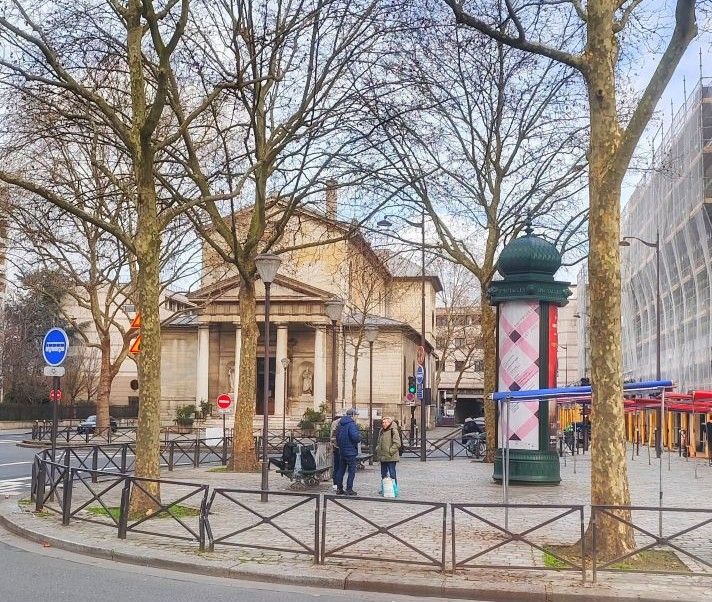
The Place Lachambeaudie is located in the 12éme arrondissement of Paris. It lies at the intersection of Rue de Dijon and Rue de Bercy with Rue Proudhon and Rue Baron-Le-Roy in the Bercy quartier/neighborhood. This street is named after Pierre Lachambeaudie, a French fabulist, poet, songwriter, and member of the Saint-Simonian movement. The site is a former marshy area. It marks the southern boundary of the Fécamp valley. Formerly known as “Place de l’Église”, it became “Place de la Nativité” in 1867, and was renamed Place Lachambeaudie in 1905. Notable buildings include the Church of Notre-Dame-de-la-Nativité in Bercy, located in the center of the square,(see back pic) and the Nativité fire station of the 1st Company of the 2nd Fire Group of the Paris Fire Brigade. The Bercy City/town hall was also located on this site. After the annexation of 1860, it became the first City/town hall of the 12éme arrondissement. It was destroyed in May 1871 during the Bloody Week. The Bloody Week,was from Sunday, May 21 to Sunday, May 28, 1871, was the bloodiest period and the final episode of the Paris Commune, during which the insurrection was crushed and its members executed en masse. The Food market held on Wednesdays 16h to 20h and Sundays.
The Paris tourist office on the 12éme arrondissement de Paris : https://parisjetaime.com/eng/article/explore-paris-s-12th-arrondissement-a824
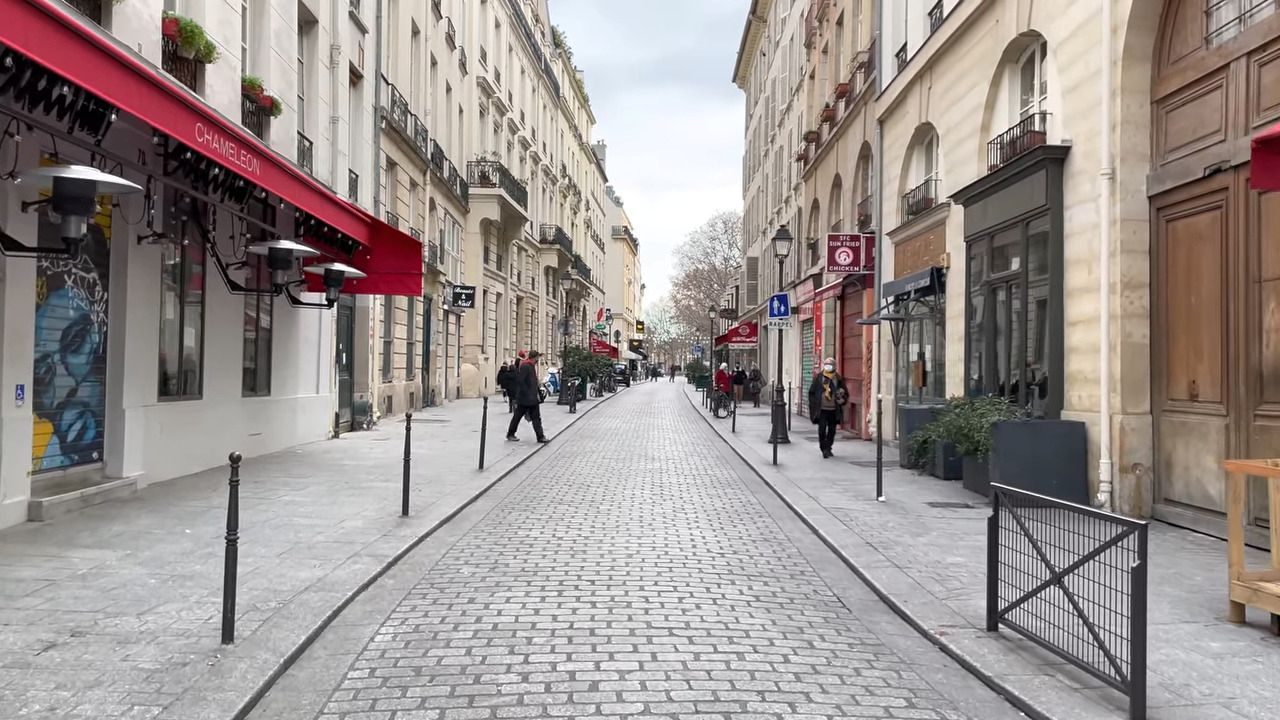
The Rue René-Boulanger is located in the 10éme arrondissement of Paris. It begins at no 16, Place de la République, and ends 500 meters later at no 20, Boulevard Saint-Martin and no 2, Rue du Faubourg-Saint-Martin. The 12-meter-wide road also connects to the Porte Saint-Martin at its end. Since 1944, it has borne the name of the French trade unionist and resistance fighter René Boulanger, who died during WWII, The street originated from the counterscarp path that ran along the outside of the Butte Saint-Martin, a hillock on the edge of the Charles V city wall, originally a refuse dump, which was transformed into a bastion before 1609 during the improvements to the fortifications of Paris in the early 17C. From 1670 onwards, the rampart was demolished and replaced by Boulevard Saint-Martin and Place du Château-d’Eau. The counterscarp path then became Rue Basse-Saint-Martin, later renamed Rue des Fossés-Saint-Martin, running along the lower northern side of the boulevard and square built on the flank of the former bastion. The street’s rounded shape, starting at Porte Saint-Martin, corresponds to the form of the old bastion. Located in the Porte-Saint-Martin quartier or neighborhood, the street originally began as Rue du Faubourg-Saint-Martin and ended at a road that, for a time, led to its being called Chemin de la Voirie. The removal of this road in 1758 allowed its extension under the name Rue Basse-Saint-Martin. In 1770, it was extended once again, in a straight line parallel to the main avenue of the rampart, as far as the Rue du Faubourg-du-Temple. In December 1771, it was renamed “Rue de Bondy.” It was extended to the Rue des Fossés-du-Temple (now Rue Amelot). The street was primarily built up between 1770 and 1840 during the reigns of Louis XVI and Louis-Philippe. The current Place de la République, laid out in the 1860s, incorporates its eastern section, which led to the Rue du Faubourg-du-Temple.
Notable buildings here are at Nos. 1 and 1 bis: building constructed on the site of part of the original Place du Château-d’Eau, itself laid out on the site of the Temple bastion.
No. 22: former residence of the Marquise de Ferrières, then of the Marquis de Folleville, with a beautiful 18C staircase. From 1781 to 1789, the Dihl and Guérhard porcelain factory, also known as the “Duke of Angoulême’s factory,” was located here. No. 26 (and 3, rue du Château-d’Eau): site of the City/town hall of the former 5éme arrondissement of Paris. No. 30: residence of Mademoiselle Laguerre, principal singer of the Paris Opera under Louis XVI. The City/town hall of the former 5éme arrondissement of Paris was located in the building from 1801 to 1811. No. 32: former headquarters of the weekly magazine Marianne (currently 28 rue Broca). It was at this address that the cabinet of curiosities of Michel Ferdinand d’Albert d’Ailly, Duke of Chaulnes, was located. No. 54: Hôtel d’Aligre, whose bas-reliefs representing the four seasons are copies of those created for this private mansion in 1772 by the sculptor Claude Michel, known as Clodion, for the Count of Marans, Marquis d’Aligre, Étienne François d’Aligre. No. 17: Théâtre du Petit-Saint-Martin, which occupies the site of the former École Internationale de Mimodrama de Paris-Marcel-Marceau. No. 56: former Christofle & Cie establishment that was demolished. It was here that Charles Christofle founded the first Christofle silver-plating workshop in 1842, which remained until its relocation to Saint-Denis in 1933. Nos. 62-64: Hôtel de Rosanbo, dating from 1780, residence of Louis Le Peletier de Rosambo, Marquis de Rosanbo. This hôtel is mentioned in Chateaubriand’s *Mémoires d’outre-tombe* (Memoirs from Beyond the Grave). The hôtel was later acquired by Countess Merlin, née Maria de las Mercedes de Santa Cruz y Montalvo (Cuba), a Cuban author, writing primarily in French. wife of General Christophe Antoine Merlin, who held one of the most important salons in Paris there at the beginning of the 19C, notably welcoming George Sand, Prosper Mérimée, Honoré de Balzac, Alfred de Musset, Victor Hugo, Alfred de Musset, Alphonse de Lamartine, the opera singer Maria Malibran, as well as Spanish-Cuban writers such as Domingo del Monte and José Antonio Saco. and the composer Gioachino Rossini. Her most important works are Mis doce primeros años [My First Twelve Years] (Paris, 1831); Histoire de la sœur Inés [The Story of Sister Inés] (1832), fictional memoirs of a nun (a character inspired by a nun who helped her escape at age 12 from the convent where she was a boarder); Mémoires d’une Créole [Memoirs of a Creole Woman] (1835), a continuation of her autobiography; Ocios de una mujer de gran mundo [Leisure of a Woman of the World], a biography of Maria Malibran (1837); and L’esclavage dans les colonies espagnoles [Slavery in the Spanish Colonies] (1840). Havana (3 vols., 1842), with a prologue by Gertrudis Gómez de Avellaneda (19C Cuban writer. A major figure of Cuban Romanticism, she spent the majority of her life in Spain.); The Lionesses of Paris (1845); and The Duke of Athens (1848). Many of her works were translated into several European languages, She died in Paris in 1852. From 1840 onwards, Baron Taylor established his charitable societies there, before moving to no 68 on the street. No 66: Hôtel de Sechtré, built between 1771 and 1776. This private mansion was divided in two by the Count of Sechtré for his two daughters, Madame de Rennepont and Madame de Castéja, governess to the children of the Dauphin of France under Louis XVI and who had been part of the household of the Duchess of Berry. The mansion was then purchased in 1830 by Worms de Romilly, then mayor of the district. No 68: Neoclassical style house from the second half of the 18C; the residence of Baron Taylor, French author, artist, and philanthropist.
The Paris tourist office on the 10éme arrondissement de Paris : https://parisjetaime.com/eng/article/explore-paris-s-10th-arrondissement-a843
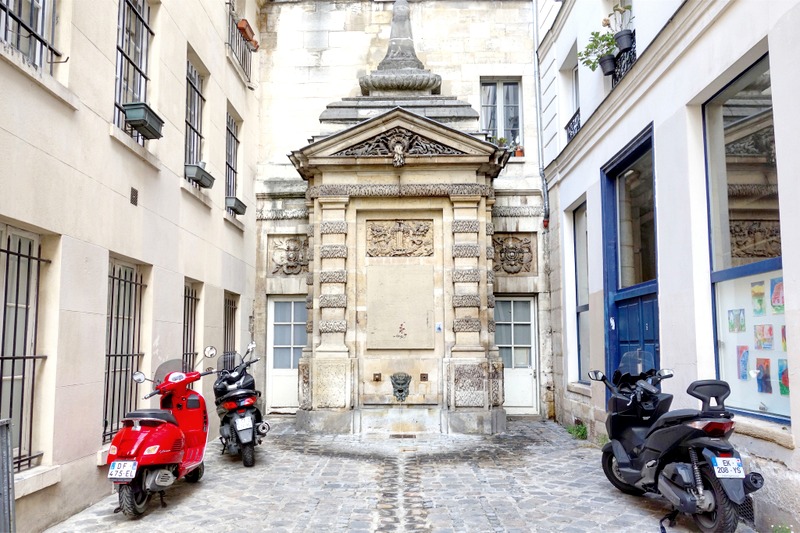
The Impasse de la Poissonnerie is a narrow street located in the Saint-Gervais quartier or neigborhood of the 4éme district or arrondissement of Paris. This small lane, about 15 meters long, opens onto the Rue de Jarente. It begins at no 2 Rue de Jarente and ends in a dead end. The Impasse de la Poissonnerie is served nearby by metro line 1 at the Saint-Paul station. It takes its name from its proximity to the fish market of the Sainte-Catherine market. This lane was opened at the end of the 18C. Notable Buildings: The Jarente Fountain (see below) The fontaine de Jarente, sometimes called the fontaine de la Poissonnerie or fontaine d’Ormesson is located at the end of the Impasse de la Poissonnerie (see above). The fountain was built in 1783, as part of the overall plan for the neighborhood renovated following the destruction, between 1773 and 1774, of the Sainte-Catherine-du-Val-des-Écoliers Priory, which covered most of the block now bordered by Rue de Turenne, Rue de Sévigné, Rue des Francs-Bourgeois, and Rue Saint-Antoine. The fountain is a solid structure set against the end of the alley. Framed by two walls and surmounted by a triangular pediment, it is decorated with a central bas-relief depicting a fasces, dolphins, and cornucopias. Set back on either side, two doorways, each topped with a rosette sculpture, provide access to the rear of the building. Above the pediment, set into the wall, a molded pyramidal architectural composition extends the structure, bringing it to a height of approximately 7 meters. Near the ground, a stream of water flows from a bronze mascaron in the form of a satyr’s head. The overall stonework of the building is decorated in the “frosting” style, evident on the pilasters and lintel. The pediment is adorned with a spout pouring forth a frozen stream.
The Paris tourist office on Paris Centre (arrond 1-4) of Paris : https://parisjetaime.com/eng/article/explore-the-centre-of-paris-a846
There you go folks, a dandy city to explore and enjoy with the family, Memorable moments in my eternal Paris, driving and walking all over in my road warrior trails brings out sublime awesome spots with nice memorable family visits of yesteryear always remember and always looking forward to be back, eventually. Again hope you enjoy the post on curiosities of Paris , part LXXI !!! as I.
And remember, happy travels, good health, and many cheers to all !!!


