
We have driven and walked in my eternal Paris, and would like to have an imprint in my blog on the wonderful family times we had there, There is so much to see , doing my best, and glad found me these pictures in my cd rom vault ,which now transposing in my blog for you and me, This was my former worked city, so glad to post more memorable spots on it, I thank you for your readership over the years and to bear with my rants! After all, Paris is to rant, shout and yelled about, me think. Therefore, here is my take on curiosities of Paris, part LXVI !!! Hope you enjoy the post as I.
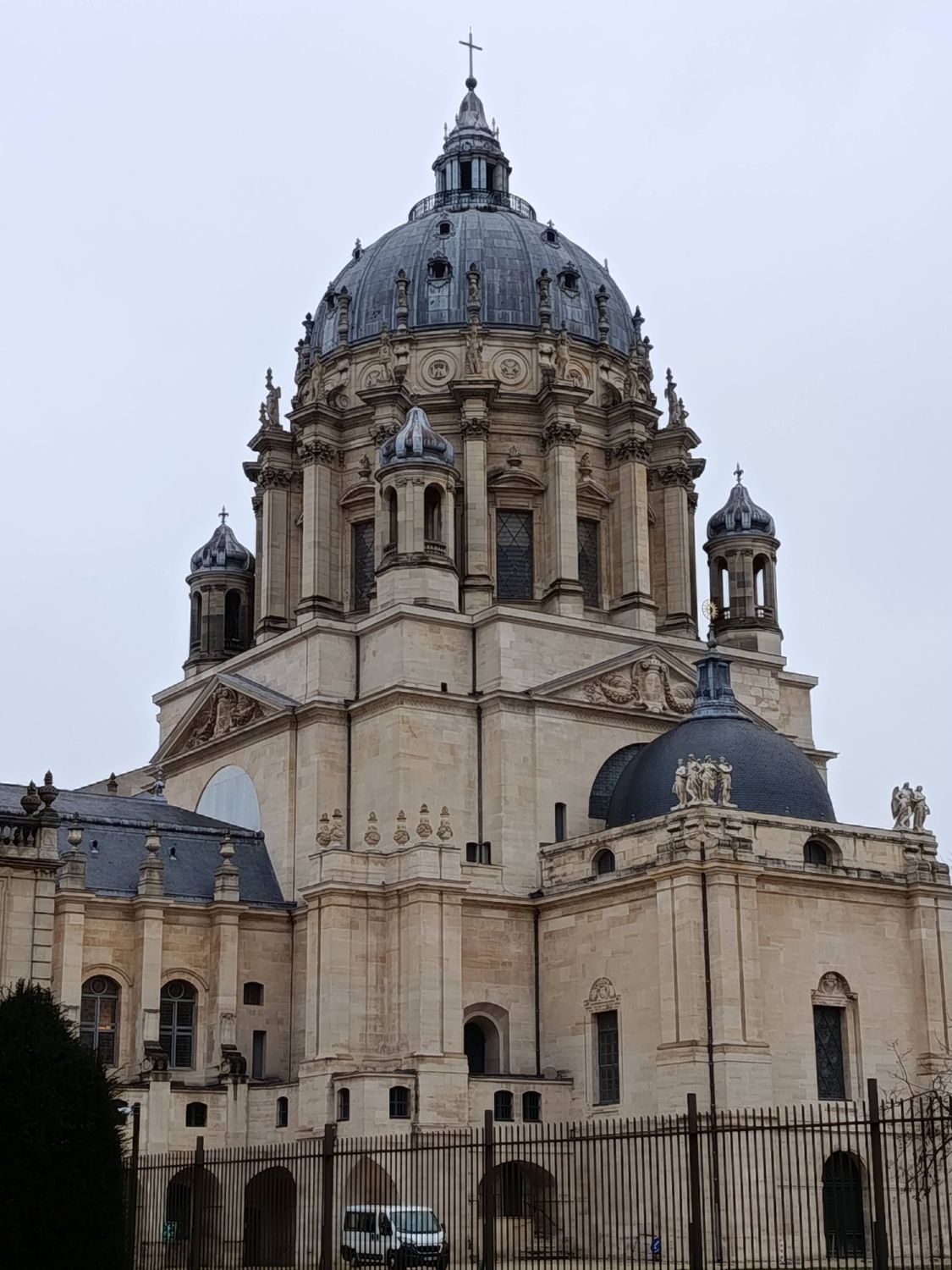
The Church Notre Dame du Val de Grâce, of Baroque classic style in the 5éme arrondissement of Paris,located at Place Alphonse-Laveran. Before the French revolution, it was the church of the Royal Abbey of Val-de-Grâce. The Val de Grace abbey was created in 1621 by Anne of Austria, it then bought a mansion and added additional buildings a few years later. In 1645, the queen, widow of King Louis XIII, asked to add a church and a palace at the Val de Grâce convent. The decision was to create in the form of an oval square in front of the church overlooking rue Saint Jacques. Anne of Austria had built this church in honor of the Virgin Mary, to thank Heaven for granted her a child, after a long period of sterility. The church was finished in 1647, it has a Latin cross plan and a visible dome of the forecourt of the church.
The Paris tourist office on the Royal Abbey Church du Val de Grâce : https://parisjetaime.com/eng/culture/abbaye-royale-du-val-de-grace-et-musee-du-service-de-sante-des-armees-p1013
The Official Diocese of the Armed Forces on Val de Grâce : https://dioceseauxarmees.fr/messes/zone-ile-de-france/eglise-du-val-de-grace/
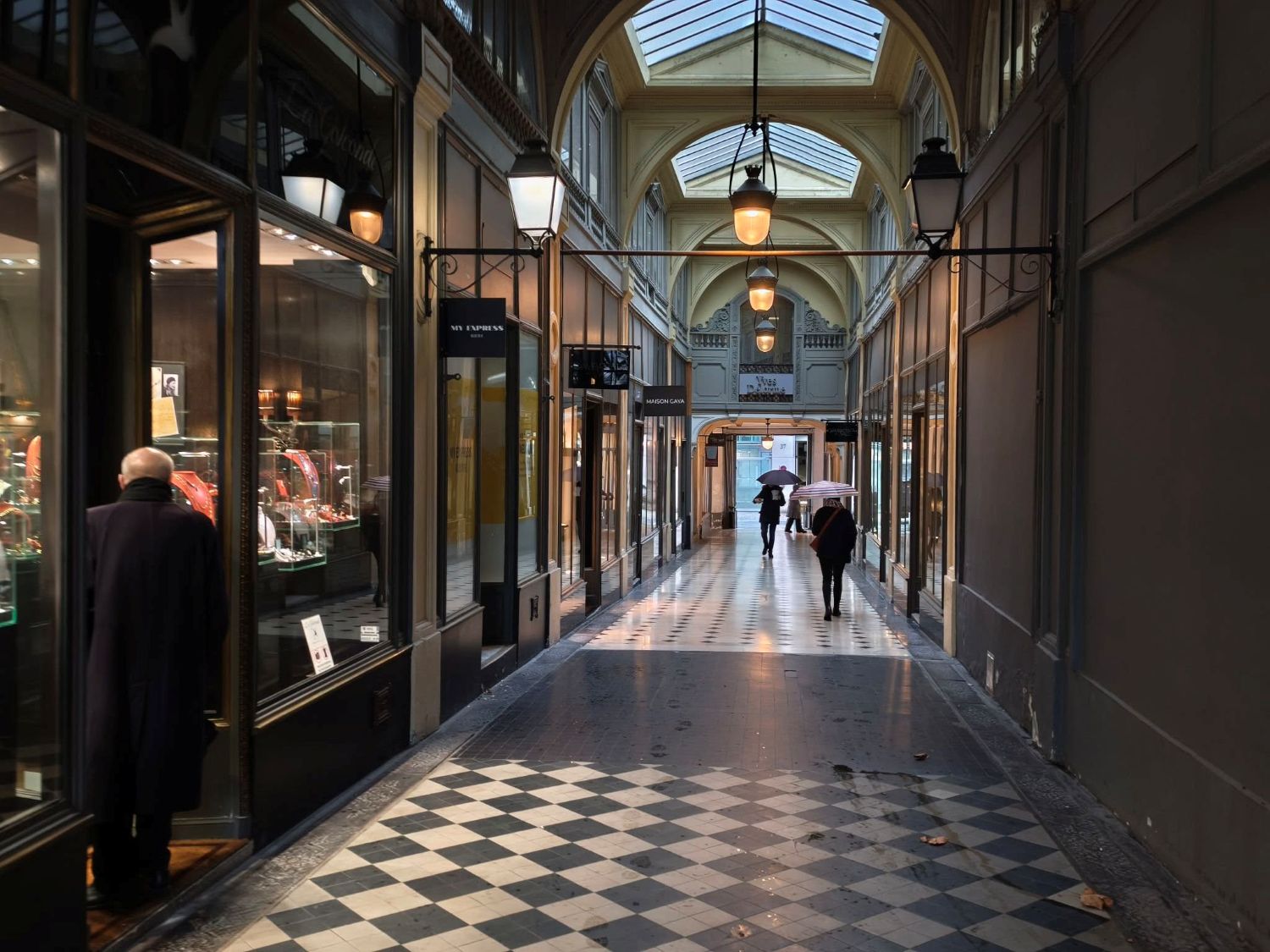
The galerie de la Madeleine or the Madeleine Gallery owes its existence to the construction of the Madeleine Church (see post) and the square of the same name. The Place de la Madeleine (see post) opened in 1825, the church itself wasn’t completed until 1842. The Galerie de la Madeleine was built in 1845. It formed a continuous passageway between the Place de la Madeleine and the Cour du Retiro, which housed a riding school, a bathhouse, and a coach station. On the Place de la Madeleine side, the monumental entrance is framed by caryatids, and the entrance on Rue Boissy d’Anglas features carved wooden decorations. Inside, the stained-glass window rests on elegant flying buttresses. The most famous establishment was undoubtedly the Lucas-Carton restaurant, located at the entrance on the Place de la Madeleine side. Today, it is the highly regarded Sanderens restaurant. Inside, the decorations designed in 1904-1905 are a fine example of Art Nouveau. Despite its exceptional location, the Galerie de la Madeleine never achieved widespread success. Today, luxury boutiques are revitalizing the passage, which is very popular with tourists visiting the area.
The Paris tourist office on the Galerie de la Madeleine : https://parisjetaime.com/eng/culture/galerie-de-la-madeleine-p1589
The official passages et galeries of Paris on the Galerie de la Madeleine : https://passagesetgaleries.fr/galerie-de-madeleine/
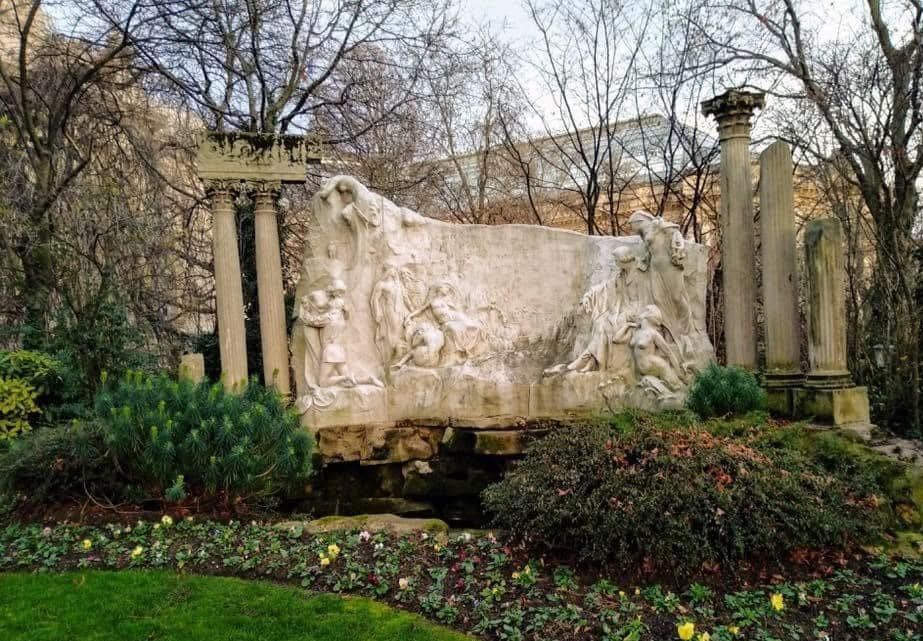
The Jardin de la Nouvelle-France, formerly known as the Jardin de la Vallée-Suisse, is located in the 8éme arrondissement of Paris. This green space is situated at the intersection of Avenue Franklin-D.-Roosevelt and Cours la Reine, on Place du Canada. It borders the Palais de la Découverte (Science Museum-see post). Its design is in the English style, reflecting a romantic imitation of nature with a waterfall, a stream with fish, a footbridge, a rock garden, and a pond. It is served by metro lines 1 and 13 at the Champs-Élysées – Clemenceau station. The site is named after New France, which was a colony, more specifically a viceroyalty of the Kingdom of France, located in North America and which existed from 1534 to 1763. It was part of the first French colonial empire, and its capital was Quebec City. This green space was originally called the “Swiss Valley Garden,” in memory of the Swiss pavilion at the 1900 Universal Exposition. In 1910, a monument to Alfred de Musset, “The Poet’s Dream,” (see pic) was erected in the square. The artist is depicted there beneath ancient ruins. Flowerbeds were laid out in front of it. The garden was renamed following a decision by the council of the 8éme arrondissement of Paris on March 16, 2010. This choice was linked to some of its statuary and to the name of the neighboring Place du Canada. Busts of Jacques Cartier and Samuel de Champlain, the discoverers of Canada, were indeed installed in the corner of the garden. In 1962, a Canadian sugar maple (its leaves are the emblem of the country) was presented by Montreal Mayor Jean Drapeau to the city of Paris; the tree was planted in the garden and a commemorative plaque was installed in front of it. The garden also contains a box elder, a honey locust, and a weeping beech near the stream, a trifoliate orange tree (with inedible fruit), a hackberry, and a black locust.
The City of Paris on the Jardin de la Nouvelle France : https://www.paris.fr/pages/le-jardin-de-la-nouvelle-france-8e-un-espace-arbore-a-redecouvrir-32736
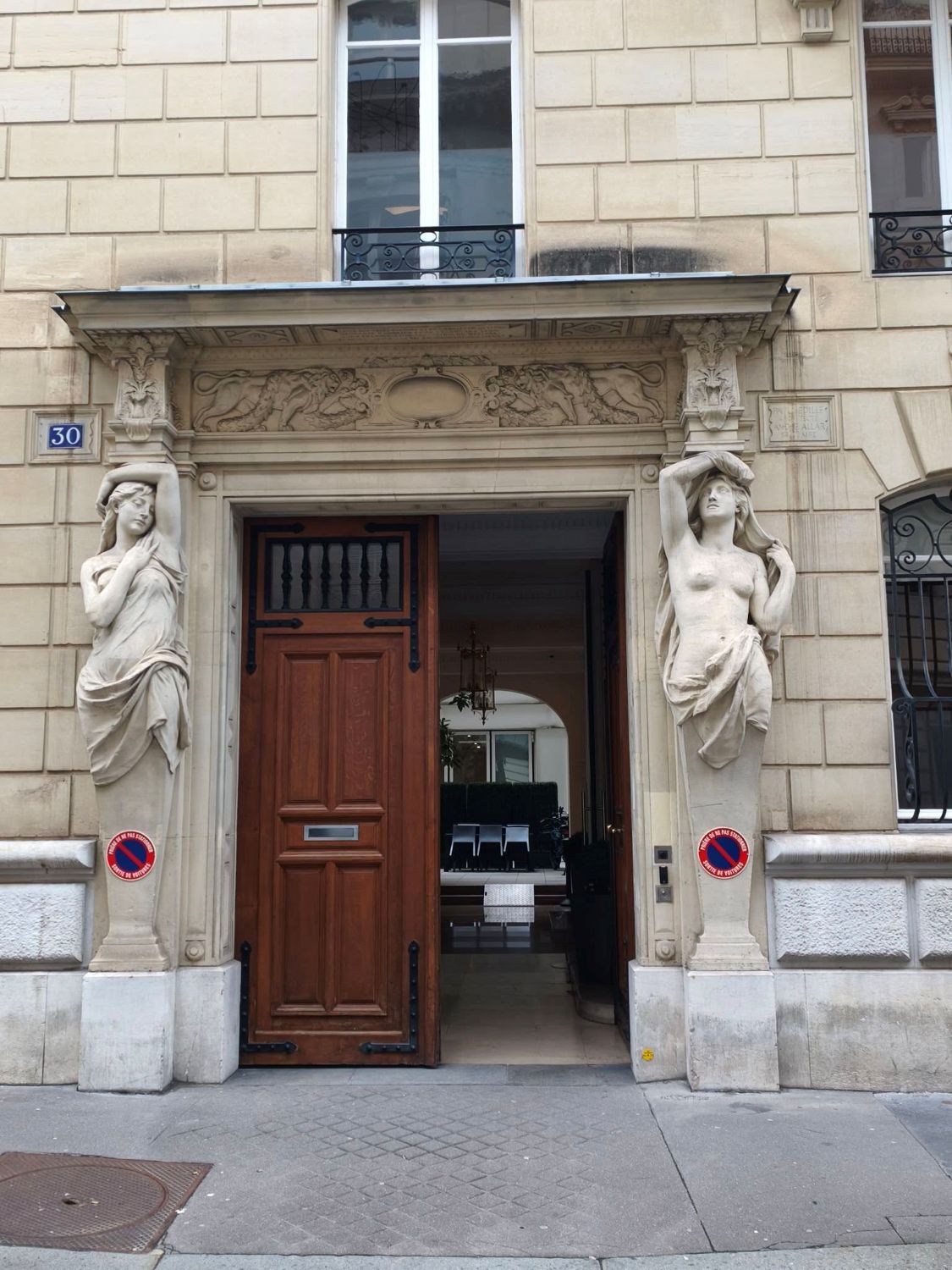
The Rue Galilée is located in the 8éme and 16éme arrondissements of Paris. It begins at 53 Avenue Kléber and ends at 115 Avenue des Champs-Élysées. It is 800 meters long and 13 meters wide, it intersects Avenue d’Iéna and Avenue Marceau. It is served by metro line 6 at Boissière station and line 1 at George V station. It is named after the famous astronomer Galileo Galilei. The oldest section of this street is the one between Place des États-Unis and Rue Vernet, which is shown on Verniquet’s 1789 map as “Chemin de Versailles” ,and then as “Rue du Banquet” from 1849 to 1852, due to a large patriotic banquet held there in 1848. A map from 1790 mentions “Chemin des Bouchers” . It was extended in 1853 to Avenue des Champs-Élysées. The street took its current name on August 24, 1864, the date on which it was extended once again to Avenue Kléber. Notable buildings: No. 6: Aéro-Club de France ,one of the oldest French aviators’ associations still active, founded on October 20, 1898. Following its creation, numerous national associations were established, which federated into the Fédération Aéronautique Internationale (FAI) in 1905. https://aeroclub.com/. No. 30: Neo-Renaissance building (see pic) erected by the architect Paul Sédille in 1895; the caryatids were sculpted by André Allar. However, have an anecdote as I was responsible to organise the welcome of my American Univ (ERAU) for the Paris Air Show dinner held at the Aero Club de France, memories forever !
The Paris tourist office on the 8éme arrondissement de Paris : https://parisjetaime.com/eng/article/explore-paris-s-8th-arrondissement-a826
The Paris tourist office on the 16éme arrondissement de Paris : https://parisjetaime.com/eng/article/a-la-decouverte-du-16e-arrondissement-de-paris-a830
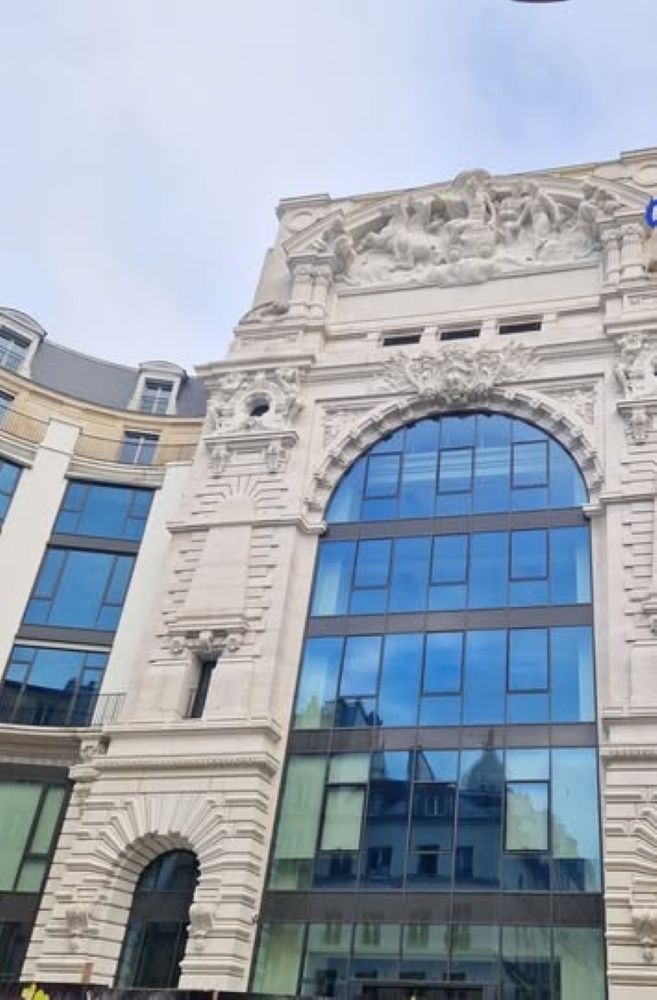
The Rue de Clignancourt is located in the 18éme arrondissement of Paris. This perfectly straight street is 1,325 meters long. It begins at the southern border of the 18 éme arrondissement, Boulevard de Rochechouart, and ends at Rue Championnet, practically at the northern boundary of the same arrondissement. The street crosses a small hill at the foot of Montmartre, the summit of which is near Rue Muller, and it has a break in continuity at its intersection with Boulevard Ornano. The final stretch, straight and flat, ends near the Boulevards des Maréchaux, at Rue Championnet. It takes its name from the former hamlet of Clignancourt, of which it was the main thoroughfare. The hamlet of Clignancourt and the village of Montmartre became the Clignancourt quartier or neighborhood no 70 in 1860, the year the 18éme arrondissement of Paris was created. Until the mid-19C, the village of Clignancourt was connected to Paris by the Clignancourt causeway. After the construction of the Wall of the Farmers-General, the causeway began at the Rochechouart gate. On April 2, 1868, the southern part of the Clignancourt causeway ,and the Rue du Château-Rouge were joined to form the Rue de Clignancourt. Notable buildings here are at No. 26: The former Grands Magasins Dufayel (see pic) originally the Palais de la Nouveauté have occupied the slightly more than one-hectare block bounded by Boulevard Barbès, Rue de Clignancourt, Rue Christiani, and Rue de Sofia since 1856. In 1892, the store’s main entrance, located at 26 rue de Clignancourt, was given a monumental makeover with a pediment by Jules Dalou and sculptures by Alexandre Falguière. In 2023, the entire complex underwent significant transformation and renovation work by the Vinci Immobilier group, with the aim of delivering 11,356 m² of office space. Nos. 42-54: the former Château-Rouge, which gave its name to part of the neighborhood, was a small brick and stone manor house built around 1780. The building was surrounded by a beautiful park that stretched between rue Doudeauville, rue des Poissonniers, rue Christiani, and rue Ramey. In 1814, the Château-Rouge served as the command post for Joseph, Napoleon’s brother, who was tasked with defending Paris. No. 48: Pierre Dac lived here with his parents in 1929. A French humorist and comedian. He was also, during WWII, a figure of the Resistance against the occupation of France by Nazi Germany thanks to his interventions on Radio London. No. 63, on the corner of Rue Custine: former boys’ school built in 1875, where the future President of France, Paul Doumer, was a student. Also attending were Jules Romains, Jean Gabin, Marcel Bleustein-Blanchet, Maurice Gross, and Jean-Louis Giovannoni. Today, it houses the Collège Roland-Dorgelès. No. 140: Notre-Dame-du-Bon-Conseil Church. The parish complex is located at 140 Rue de Clignancourt. At this address, aligned with the street, is a building with a porch leading to an inner courtyard, at the far end of which stands the church itself.
The Paris tourist office on the 18éme arrondissement de Paris : https://parisjetaime.com/eng/article/explore-paris-s-18th-arrondissement-a832
There you go folks, a dandy city to explore and enjoy with the family, Memorable moments in my eternal Paris, driving and walking all over in my road warrior trails brings out sublime awesome spots with nice memorable family visits of yesteryear always remember and always looking forward to be back, eventually. Again hope you enjoy the post on curiosities of Paris , part LXVI !!! as I.
And remember, happy travels, good health, and many cheers to all !!!


