
Oh this is and always will be a sentimental city for me, my first in France really spent time in it. I am thrill to tell you it is my dear sentimental city of Meaux and a place never missed when around the area of Seine et Marne dept 77 of the Île de France region of my belle France. I have written several posts , but this is new pictures from this week trip. Therefore, let me tell you about the Episcopal Palace (Bossuet Museum) of Meaux !!! Hope you enjoy the post as I.
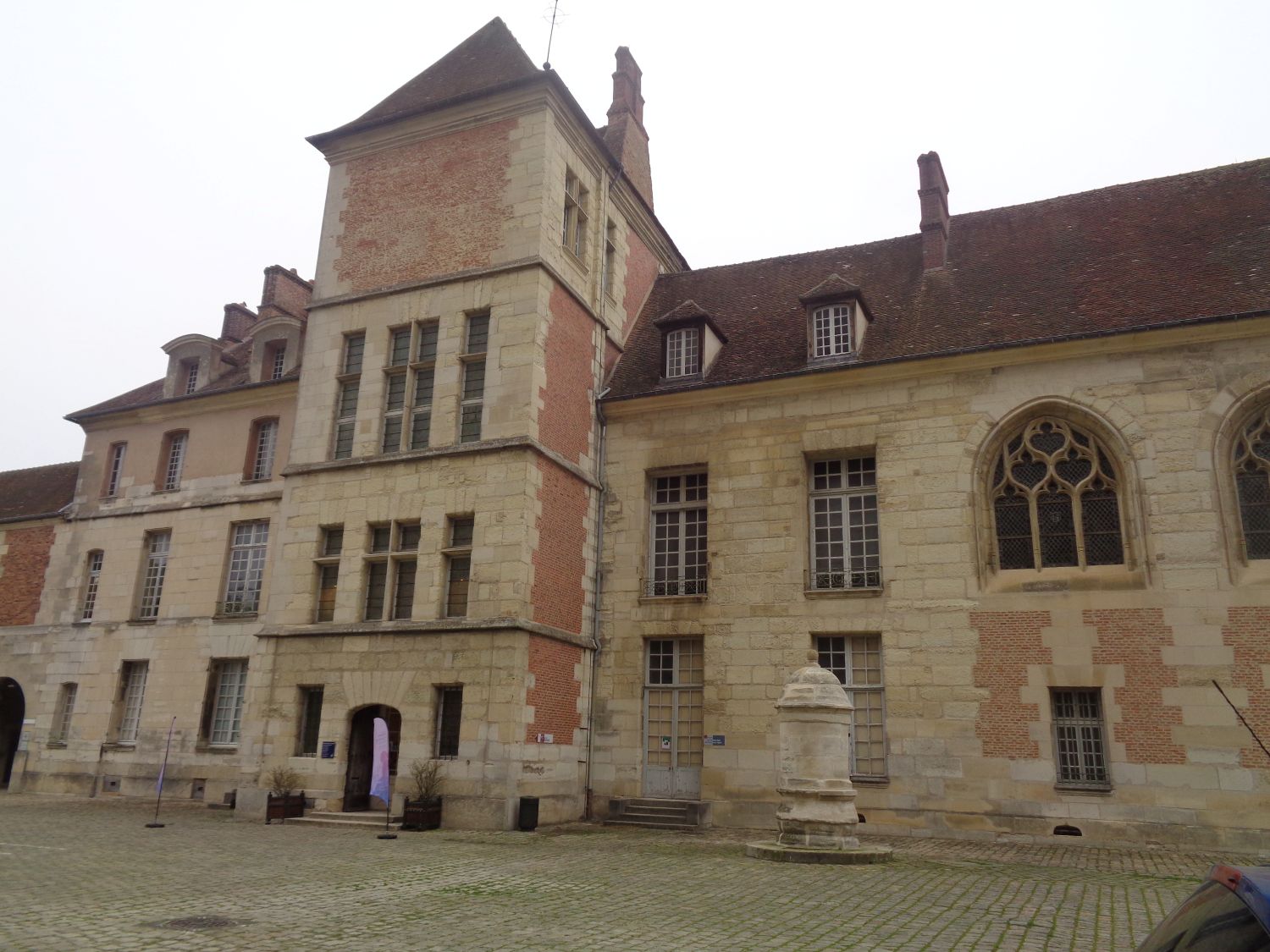
We go now to the Palais Episcopale or Episcopal Palace exteriors : The facade on the courtyard side was carried out at the beginning of the 16C. At the crossroads between medieval and modern, it includes a medieval chapel, remodeled in the 15C and built as an appetizer at the eastern end, and a rectangular brick and stone tower that projects from the middle of the building. The facade on the garden side seen from the garden, presents a harmonious whole that unites the classical building with the Renaissance work in brick. It comprises a vast body bounded at the ends by two corner pavilions. The building opens onto a terrace, supported on the ground floor by a series of seven semi-circular arches, which form a kind of gallery serving to hide the 12C wall. The garden, has been known since the 17C to have been entrusted the expansion of the episcopal garden to the young gardener André Le Nôtre. It is a “French” garden of 8500 m2, composed of a flowerbed evoking the miter of a bishop. It is divided into four alleys lined with greenery which meet around a pond and extend to the ramparts of the city on which a terrace planted with yew and boxwood is laid out.(My first real kiss with my then girlfriend was done here, so much to us and now me forever!!), The Bossuet cabinet, on the terrace of the ramparts had a charming little pavilion built, now called the Bossuet pavilion. According to local tradition, this small construction was greatly appreciated by the Aigle de Meaux who liked to go there to work in peace and meditate. On the occasion of the tercentenary of his death in 2004, a plant was planted in his honor in the garden a new variety of roses called “Bossuet Aigle de Meaux” which recalls by its mauve color, the episcopal habit. It still there and very much appreciated.
The episcopal city of Meaux still retains the appearance it had in the 18C. However, its buildings incorporate a variety of architectural elements from different historical periods. The oldest elements date back to the second half of the 12C like the lower halls of the episcopal palace. Until the French revolution, the episcopal city of Meaux maintained a predominantly religious function, serving as an ecclesiastical quarter adjoining the secular city. This function continued throughout the 19C. In 1905, the law separating Church and State placed this historical heritage under the guardianship of the State. In 1911, under the impetus of the mayor, Georges Lugol , the city acquired the episcopal palace and its outbuildings (garden and ramparts), in order to renovate them and open them to the public.
We go into the interiors of the Palais Episcopale : The rise ramp made up of inclined sections which stop on successive levels, is rare in France, The lower rooms, on the ground floor, two magnificent rooms, separated by a thick wall, occupy the entire length of the building. Each of the rooms is divided into two naves by a row of monolithic columns, confined by four engaged columns which receive the fallout of the warheads, The double chapel, is a chapel oriented on two levels of palatial type dating from the second half of the 12C. On the ground floor, the lower chapel is accessed through the official hall. This chapel, divided into several rooms by partitions, On the second level, the upper chapel has a rib-vaulted nave of two bays separated by a transverse arch and ends with an apsidal choir vaulted in six quarters of ribs and lit by three long windows in tiers-point, The apartments, have a room located to the right of the ramp and known as the Changeux room. Giving access to the upper chapel, it was formerly divided into two spaces occupied by bedrooms. Currently, this space hosts the very first room in the Bossuet Museum dedicated to the end of Mannerism. The Synod Hall, so called because these assemblies were held there in the past, is today a magnificent room with imposing dimensions ,and with a framed ceiling made up of three beams mistresses. Four characteristic 17C windows give light onto the garden and give access to the terrace. To the right of the Synod Hall is the Bishops’ Lounge, known as the Antichamber a noble-looking room adorned with a pretty marble fireplace dating from the time of Louis XIV. Located after the bishops’ lounge, the king’s room or bishop’s room is undoubtedly the most beautiful room in the palace. Forming a forefront on the garden, the Bossuet cabinet or the Queen’s bedroom, following the King’s bedroom, once served as Bossuet’s study. While King Louis XVI occupied the bishop’s room, Queen Marie-Antoinette and the two children occupied the Queen’s bedroom. As in the king’s bedroom, there is a fireplace surmounted by Empire woodwork decorated in the lower part with a mirror and in the upper part with a canvas representing, according to tradition, Henrietta of England , sister-in-law of King Louis XIV. At the western end of the palace is the Renaissance room called Salle Moissan, formerly called the second room of the episcopal palace. To the left of the ramp is the Bishops’ room. It is a large square room decorated with a fireplace illustrated with a representation of the Holy Family.
The L’aile de Brézé or the Brézé wing of the episcopal palace, also incorrectly called “Posterie”, is a longitudinal building which adjoins the episcopal palace on its western side. It was built under the second episcopate of Louis de Brézé in 1586 and had served as a prison under the Ancien Régime (monarchy). The bishops had, in addition to a secular power of the lordship type over a certain number of lands and villages, a temporal ecclesiastical jurisdiction which extended to the majority of the priests and parish priests of the diocese. As such, the episcopate had the authority to intern those among them suspected of heresy or later of sympathy for the Reformation and the Huguenots. The Brézé wing of the episcopal palace served as a place of detention for this specific purpose under the Ancien Régime.
The former episcopal palace now houses the Bossuet Museum, dedicated to the art and history of the city. The fine arts collections are displayed on the first floor. Paintings and objects, brought together in Bishop Bossuet’s former study, bear witness to his influence and legacy. The lower 12C rooms host temporary exhibitions. From the first floor, there is a sweeping view of the Bossuet Garden.

A bit of history I like tell us that in the Middle Ages, the episcopal district of Meaux extended from the north transept of Saint-Etienne Cathedral to the city ramparts. As its name indicates, this district was reserved for the bishop, the chapter of the cathedral canons and their lay or ecclesiastical entourage. The episcopal city still presents the appearance it had in the 18C. However, various architectural elements, belonging to different historical periods, enter into the constitution of its buildings. The oldest elements date back to the second half of the 12C (lower rooms of the episcopal palace). Until the French revolution, the episcopal city of Meaux retained a religious function par excellence, an ecclesiastical district adjoining the secular city. This function still continued during the 19C.. Built in the first half of the 12C, the episcopal palace of Meaux is today made up of two series of buildings joined lengthwise, the bishops’ residence originally included only the building overlooking on the garden and the chapel adjoining it. Under the influence of the stately residences, the palace was then composed on the ground floor of two adjoining rooms with ribbed vaults and a low chapel. Upstairs, a large room opens at one end onto an apartment and a private chapel. It is to the 16-17C that the palace owes its current appearance. Under the French revolution, the episcopal palace was emptied of its furniture and transformed into a prison then into a repository for art objects confiscated from immigrants. Under the Consulate, the building was returned to episcopal authority and from 1800 to 1825 became both the bishop’s residence and sub-prefecture. In 1905, following the law separating church and state, the palace was bought by the city of Meaux in 1911. Today and since 1927, the former residence of the bishops which, with the exception of the upper chapel, has been restored to the state as close as possible to that which was during the episcopate of Jacques Bénigne Bossuet, (the Eagle of Meaux) houses the Bossuet municipal museum.
The local Meaux Marne Ourcq tourist office on the Episcopal City : https://www.meaux-marne-ourcq.com/en/discover/travel-back-in-time/the-episcopal-city-of-meaux/
The city of Meaux on the Cité Episcopale: https://www.ville-meaux.fr/ma-ville-et-actualites/culture/renouveau-de-la-cite-episcopale
The Local Meaux Marne Ourcq tourist office on the musée Bossuet : https://www.meaux-marne-ourcq.com/en/discover/travel-back-in-time/bossuet-museum/728886_musee-bossuet/
There you go folks, always memorable moments that stayed with you no matter what, time does not diminished the sadness of not having my dear late wife Martine who introduce me to this historical city, Meaux. Also,a great inexpensive alternative to Disneyland only about 20 minutes away by car. Do see my other posts on Meaux. I will always remember Meaux, and Seine et Marne dept 77, Again, hope you enjoy this post on the Episcopal Palace (Bossuet Museum) of Meaux !!! as I,
And remember, happy travels, good health, andn many cheers to all !!!

 Paris1972-Versailles2003