
This I know as some of their books ended up with my boys helping their studies and the mom Martine was ademant about it, I know took a ride and visit the library but only found one picture in my cid rom vault so needed to have it in my blog for you and me, especially me, The quant Haussmanian look is rather nice front is rather nice with good taste as in my eternal Paris, This is the story of memories forever of teaching and loving your children even thus in my belle France, much appreciated of them still today very close to me. Therefore, here is my story on the Editions Hatier of Paris !!! Hope you enjoy the post as I.
The reason of this post is the picture found on the Editions Hatier at 8-8bis Rue d’Assas, in the 6éme arrondissement of Paris , Éditions Hatier is a French publishing house specializing in school books, which became a subsidiary of Hachette Livre in 1996. Founded in 1880 by Alexandre Hatier, Éditions Hatier is now the third largest educational publisher in France. This group also carries out 20% of its business abroad via subsidiaries in Brazil, Morocco, Algeria, Ivory Coast and Spain. The Alexandre Hatier Group (GAH) includes, in addition to Hatier: Foucher editions, specialists in technical and professional, industrial and tertiary education, Didier editions, Didier FLE and Didier Jeunesse and Rageot editions, novels for young people and in particular the “Cascade” collection.
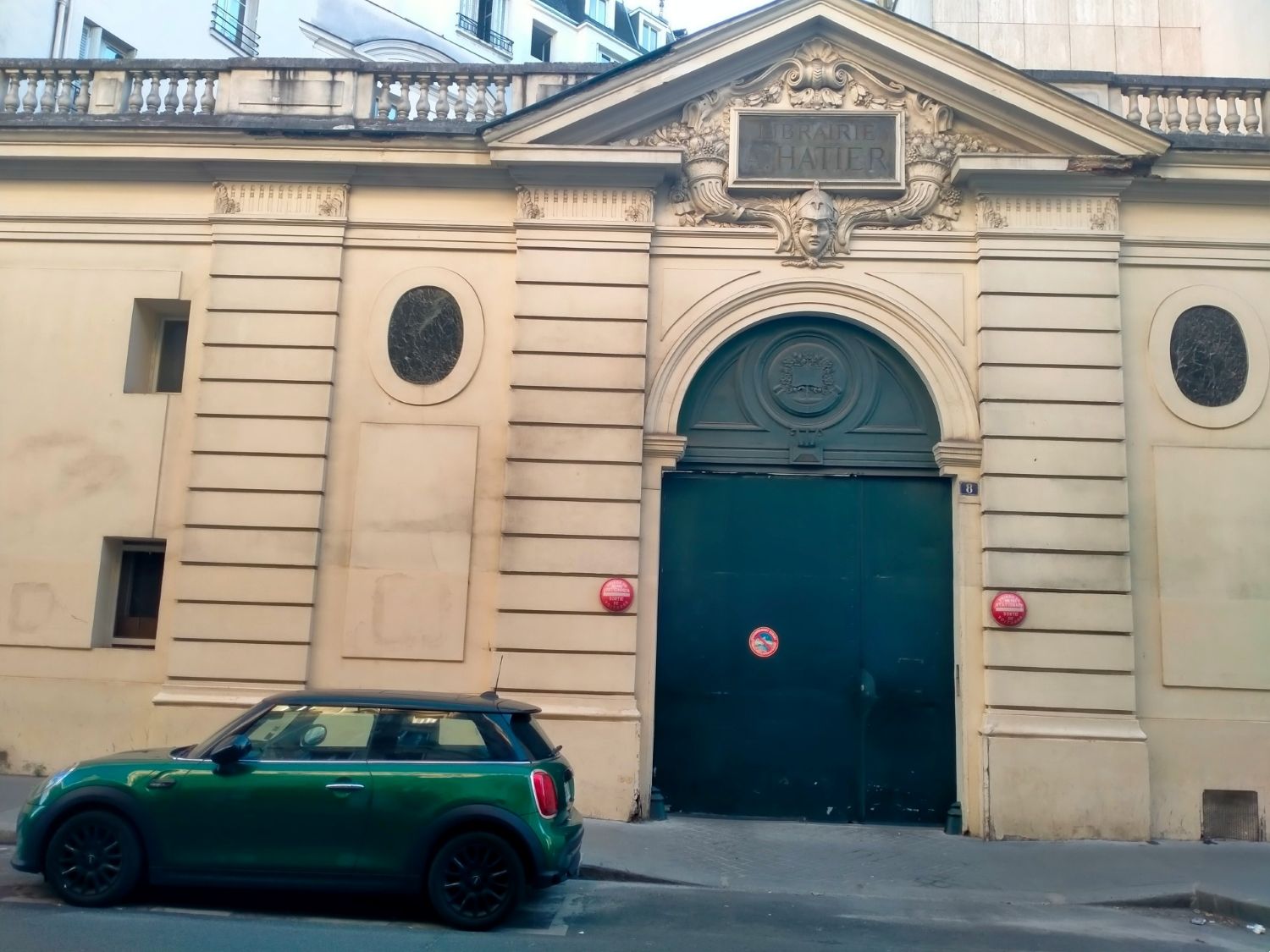
A bit of condense history tell us (taking from their official history) that it was founded by Alexandre Hatier at the end of the 19C, Éditions Hatier published the first Bescherelle book in 1913. Hatier is now one of the leading French educational publishers, offering books from kindergarten to high school, covering all general subjects. A leader in extracurricular activities, it has significantly boosted this segment with its Annabac, Tout savoir, Chouette, and Prépabac collections. In recent years, Hatier has established itself in the youth segment with innovative collections: Tout Mousse, Hatier Poche, and boxed books. A pioneer in the development of digital technology, Hatier continually innovates by expanding the number of ways people access knowledge: the Bescherelle range of mobile apps, interactive textbooks, ebooks, and content websites.
From the end of the 19C, one of the textbooks in the collection contributed to the recognition of Alexandre Hatier’s work among his peers. But fame came in 1913 with the very first publication of the “Dictionary of Eight Thousand Common Verbs in the French Language”; this essential work is better known today as the “Little Red Book,” or Bescherelle, after its author (Louis-Nicolas Bescherelle). And the one my boys used !!During the Seine floods of 1910, the Librairie d’Éducation moved from the Quai des Grands Augustins to Rue d’Assas (the current headquarters), becoming Librairie A. Hatier. Book production intensified and the “Classiques pour tous” collections, presenting in the form of booklets the works of essential French authors, or the most Lilliputian of lexicons, the “Petit Poucet” Dictionary, were created before the Great War or WWI.
In 1927, Alexandre Hatier passed away; his wife Marie and their daughter Blanche ensured the bookstore’s continued existence thanks to the support of Mr. Sylvain Girouard (general secretary) and the author and family friend, Charles-Marc Des Granges. These two women, who had always actively and effectively participated in the bookstore’s life, continued Alexandre Hatier’s work and expanded the contents of the in-house catalog with new school books. Shortly before WWII, Michel and Jean Foulon took over the Hatier business, At the end of WWII, the A. Hatier Bookstore diversified and increased its output for school books, including volumes on natural sciences (Marcel Oria), geography (Jean Brunhes), and history (Louis Genêt). Later, it diversified its activity by distributing its works in many French-speaking foreign countries and created several subsidiaries abroad, notably in black Africa, Switzerland, Belgium and Canada. The year 1970 saw the creation of the Profil d’une œuvre collection under the direction of Georges Décote; this collection was included in every student’s schoolbag. The following decade saw the birth of a collection still available on the market, “Œuvres et Thèmes,” a critical analysis of a work studied in middle school. This collection, which has been revised many times in terms of its layout, still enjoys widespread recommendation from teachers. At the end of the 1970s, Les Editions Hatier incorporated two publishers whose productions differed from its own. These were Editions Foucher, specialized in technical education, and Editions Didier, whose expertise in foreign languages was recognized by prescribers. These three houses would henceforth form the Alexandre Hatier Group and publish across all disciplines and age groups. At the end of the 1970s, Hatier published the very first holiday and revision workbooks for primary school under the direction of Jean and Jeanine Guion. These works were soon followed by a reading learning method whose common thread and main hero was Ratus, the famous green rat. The authors and the illustrator, Olivier Vogel, continued their collaboration with Hatier and the green rat is still as famous as ever among primary school children.
In the 1980s, the Annabac/Annabrevet collections entered the exam revision market.
In 1989, Librairie A. Hatier became Les Éditions Hatier, and the following year, Bernard Foulon, great-grandson of Alexandre Hatier, took over the reins of Éditions Hatier. Present in both the school and extracurricular markets, they developed several collections, including the book English from A to Z, whose concept was later extended to several European languages and then to high school subjects (French, mathematics, economics, etc.). In the 1990s, Editions Hatier entered a new market: the production of fine books on subjects as eclectic as travel, cooking, gardening, sports, and hunting. Children were not forgotten: documentaries, popular works, and various workshop books allowing young readers to develop their imagination, knowledge, and independence now complement a catalog previously dedicated to education. The Youth and General Public catalog expanded, while the general catalog largely covered all disciplines and the path of a student from first grade to final year of high school. In 1996, Editions Hatier was acquired by the Hachette Livre Group. Since then, Editions Hatier has continued its development in two major areas: extracurricular activities, where Hatier is consistently the market leader, and educational activities, where Editions Hatier publishes collections that teachers will love in history-geography, French, English, and mathematics in both primary and secondary schools. In high schools, French books, whether on literature or method, are highly successful and effectively prepare students for the baccalaureate exam. Since 2005, Editions Hatier has expanded into the children’s market by creating Hatier Jeunesse, drawing on its pedagogical expertise and children’s favorite themes. The catalog features renowned children’s authors such as Michel Piquemal, Gérard Moncomble, and Marie-Hélène Place, illustrators such as Frédéric Pillot, Frédéric Rébéna, and Thierry Laval, and includes collections such as Tout Mousse, Hatier Poche, Balthazar, and Barri. Since 2012, Hatier Publishing has launched a publication for the general public, notably with a new collection called “Visual Guides,” or “Everything You Always Wanted to Know About…”, exploring various current topics such as the Israeli-Palestinian conflict, the Big Bang, and De Gaulle. This offering is complemented by holiday workbooks for adults: Casimir, Le Petit Nicolas, and Hello Kitty. The famous Bescherelle even inspires an educational game for learning and reviewing verb conjugations while having fun. Finally, Hatier Publishing has strengthened its digital development since 2009. All school and extracurricular books are now available in print and digital formats, many of which are enhanced. Digital resources are also developed to complement the books. Finally, a range of mobile applications has been successfully developed around the Bescherelle brand. A wonderful tool indeed !!
The Rue d’Assas is located in the quartiers or neighborhoods of Odéon and Notre-Dame-des-Champs of the 6éme arrondissement or district of Paris. This site is served by the Sèvres – Babylone lines 10 and 12, Rennes ,and Notre-Dame-des-Champs line 12 metro stations, as well as by RER line B at Port-Royal station. At its northern end is the Place Alphonse-Deville and at its southern end the Place Camille-Jullian. It is named after the knight Louis d’Assas, captain of the Auvergne regiment under Louis XV, known for his heroic death at the Battle of Kloster Kampen in Westphalia on October 15, 1760. The street opened in 1798 between the streets of Cherche-Midi and Vaugirard, on the grounds of the Carthusian convent of Paris, it took the name of Rue d’Assas in 1803. Notable buildings are at No. 1: Rosa Bonheur, painter and sculptor, leaving after her success at the Salon of 1854 the old rue de l’Ouest (d’Assas since 1868), came to settle here in a large courtyard studio which she still occupied in 1864, Nos 8 and 8bis Editions Hatier (see above) Nos. 19 and 21 (and no. 74 rue de Vaugirard): the Catholic Institute of Paris (ICP), founded in 1875, occupies part of the former enclosure and buildings of the convent of the Discalced Carmelites, the community of which was abolished in 1790. The main entrance to the campus was transferred to 74, rue de Vaugirard in 2019, after the restoration of the main courtyard, No. 28: an inscription engraved on the facade near the corner of rue de Vaugirard states: “Here stood a hotel where the 11 February 1868 Jean Bernard Léon Foucault, member of the Institute, born in Paris on September 19, 1819. It was in this hotel that he carried out in 1851 the famous experiment which demonstrates the rotation of the earth by the observation of the pendulum” The singer Joe Dassin lived there in 1968 , No ?? ,formerly 38, rue de l’Ouest, and rue Notre-Dame-des-Champs no 45 , according to the numbering in force in 1837: unidentified location of the former house of the painter Achille Devéria, accessible by both streets. His studio and salon were frequented by the most illustrious personalities of the time, such as Victor Hugo and Alfred de Musset, who recited his first verses there. No. 76: Jules Michelet lived here for the last years of his life. The building is located at the intersection with Rue Vavin. A plaque pays tribute to him. Not far from there, his name was given to Rue Michelet in 1877 to honor his memory. No. 82: Contemporary apartment building occupying the site of the last home of the sculptor Auguste Bartholdi, a magnificent private mansion acquired in October 1893 thanks to a large indemnity obtained in compensation for the expropriation of his property at 40 Rue Vavin. Bartholdi died there less than a year after moving in. He is buried in the Montparnasse Cemetery (28th division). No. 100 bis: Zadkine Museum, housed in the house-studio that the French sculptor of Russian origin Ossip Zadkine occupied from 1928 to 1967. The Luxembourg Gardens in its western part that Rue d’Assas runs alongside between Rue Guynemer and Rue Auguste-Comte. Where we used to parked on street parking.
The official Editions Hatier : https://www.editions-hatier.fr/
The official Editions Hachette on Hatier : https://www.hachette.fr/editeur/hatier-grand-public
The Paris tourist office on the 6éme arrondissement de Paris : https://parisjetaime.com/eng/article/explore-paris-s-6th-arrondissement-a823
There you go folks, Paris is excellence, good life, good living and class, my eternal Paris has a lot more always more, after all this is the most beautiful City in the world ! Again, hope you enjoy this post on the Editions Hatier of Paris !!! as I.
And remember, happy travels, good health, and many cheers to all !!!

 Paris1972-Versailles2003