
We have driven and walked in my eternal Paris, and would like to have an imprint in my blog on the wonderful family times we had there, There is so much to see , doing my best, and glad found me these pictures in my cd rom vault ,which now transposing in my blog for you and me, This was my former worked city, so glad to post more memorable spots on it, I thank you for your readership over the years and to bear with my rants! After Paris is to rant, shout and yelled about, me think. Therefore, here is my take on curiosities of Paris, part XLV !!! Hope you enjoy the post as I.
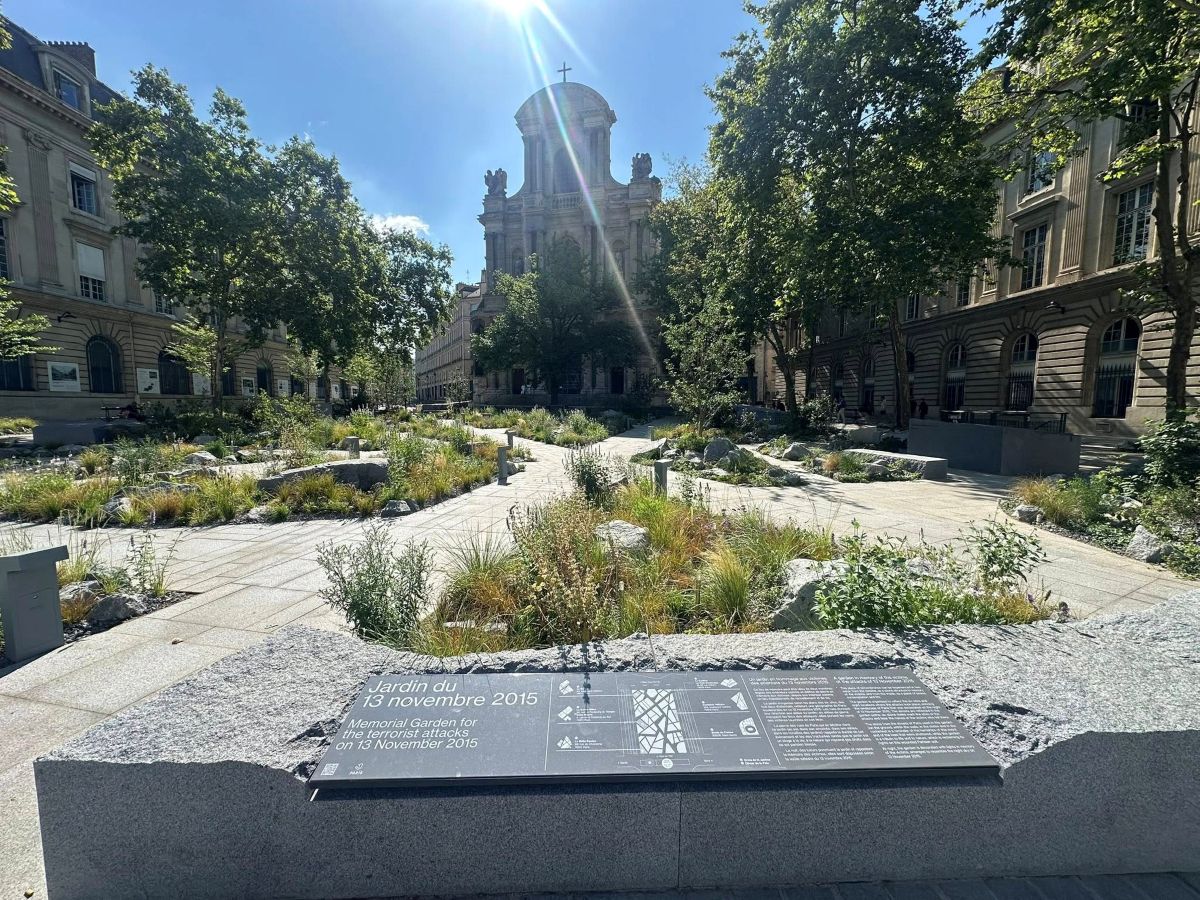
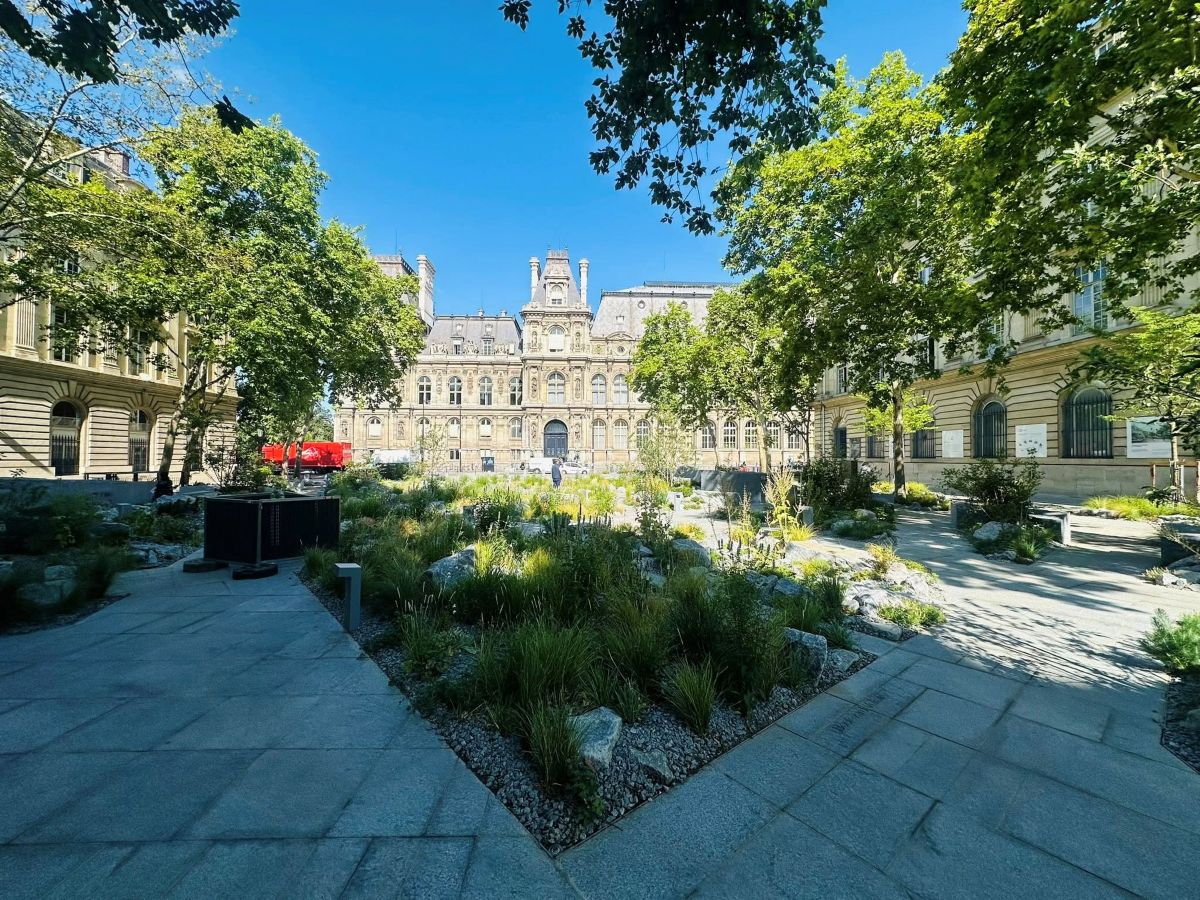
The place Saint-Gervais is located in the quartier or neighborhood of Saint Gervais in the 4éme arrondissement or district of Paris , This trapezoidal square is surrounded by several streets such as rue François-Miron and rue Brosse open onto it, while rue Lobau borders it behind the City/Town Hall. It serves as a forecourt for the Church Saint-Gervais-Saint-Protais (see post). It is so named because it is located opposite the before mentioned church. The square is accessible via metro lines 1 and 11 at the Hôtel de Ville station. Notable buildings here are the Church Saint-Gervais-Saint-Protais, the Saint-Gervais Elm tree At No. 1: House of the Compagnons du Devoir de Paris. It is close to Rue de la Mortellerie (which owes its name to the mortar used by masons) and Place de Grève, where the masons’ market was held every week in the Middle Ages: this is where workers and companions found employment. They were standing under the elm tree in Place Saint-Gervais. The The Vinci Lobau-Rivoli underground car park, whose entrance is on Rue de Lobau, extends beneath Place Saint-Gervais, A bit of history tell us that this small square, was for a long time the crossroads called « carrefour de l’Orme » ou « carrefour de l’Orme-Saint-Gervais » or the Elm crossroads or Elm-Saint-Gervais crossroads. It was once a general custom to plant an elm tree, protected by a chain, in front of the main door of churches. After Mass, people would gather in the shade of this tree, judges would dispense justice there and rents would be paid there. In an account from 1443, mention is made of some vines and pieces of land belonging to the Duke of Guyenne; because of his hotel located near the Bastille, the farmers were obliged to pay the rent to the Saint-Gervais elm tree in Paris, on Saint-Rémi’s day and on Saint-Martin’s day in winter. Around 1790, the tree was uprooted to enlarge and clear the square; it was used for the construction of gun carriages. In the 19C, this square, then called “carrefour de l’Orme”, formed opposite the gate of the Saint-Gervais Church, was positioned in the former 9éme arrondissement, in the quartier or neighborhood Hôtel-de-Ville , and was located at the intersection of the rue du Monceau, rue du Pourtour and rue de Long-Pont. Barracks have lined it since the work of Prefect Haussmann, such as the Napoléon barracks (dating from 1853, first occupied by the Guard and now by the General Directorate of Information of the City of Paris) and, to the south, the Lobau barracks (now occupied by the Human Resources Department of the City of Paris), connected by underground to the Hôtel de Ville. Named place Saint-Gervais since May 9, 1881, it was previously included in rue François-Miron, named before 1838 “rue du Monceau-Saint-Gervais”. The current elm tree was planted in 1935. Since 2025, the square has been home to the November 13, 2015 garden in tribute to the victims of the terrorists attacks of November 13, 2015, The names of the deceased victims appear on steles symbolizing each location affected :Stade de France, Le Carillon / Le Petit Cambodge, La Bonne Bière / Le Casa Nostra, La Belle Équipe, and Le Comptoir Voltaire, Bataclan, The presence of plants helps support the development of biodiversity in the garden, making the tribute both perpetual and vibrant. Nature is an integral part of the tribute: the stone elements recall the harshness of this ordeal and the fractured lives, while the garden allows for the unfolding of life within this memory. The presence of water in the hollows of the rocks and plants will help support the development of biodiversity in the garden, making the tribute both perpetual and vibrant.
The Paris tourist office on Paris Centre (arrondissements 1-4 today) : https://parisjetaime.com/eng/article/explore-the-centre-of-paris-a846
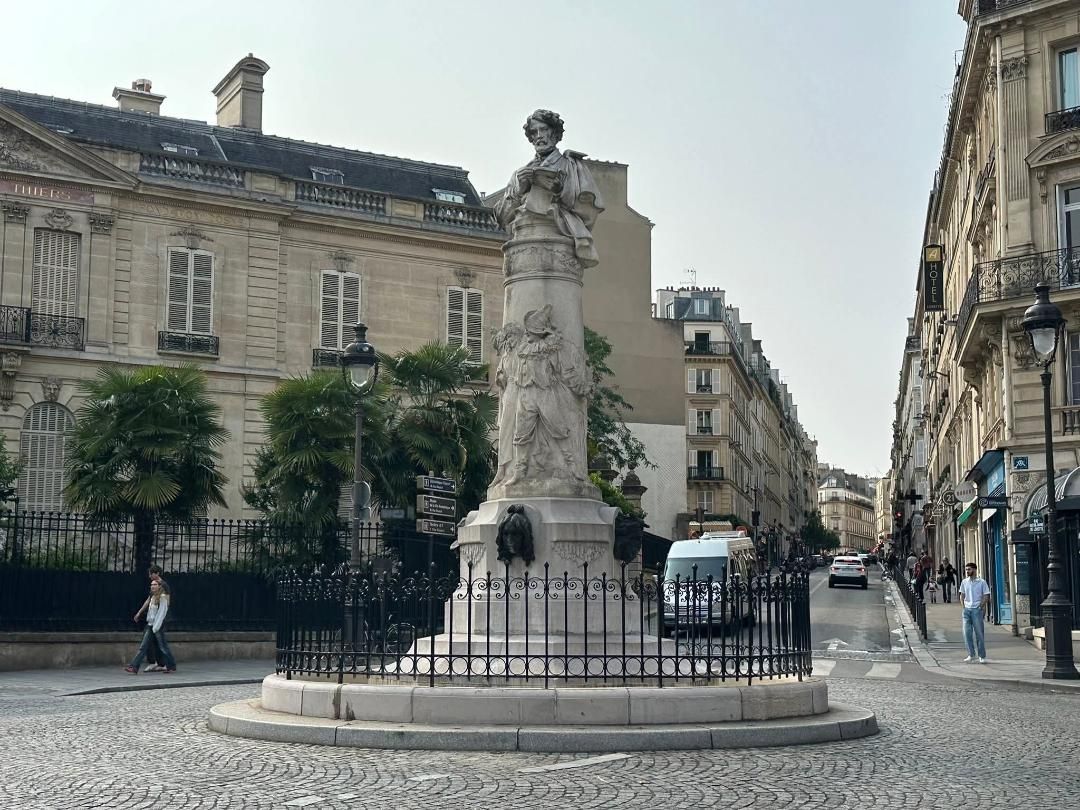
The Place Saint-Georges is located in the 9éme arrondissement or district of Paris and is in the heart of the Saint-Georges quartier or neighborhood, at the junction of Rue Saint-Georges and Rue Notre-Dame-de-Lorette. This circular square, 32.50 meters in diameter, was divided into lots in 1824: the land was then divided up and houses were built on it. Only the rounded gate surrounding the small gardens remains, as the buildings were built later. It takes its name from its proximity to Rue Saint-Georges, the origin of whose name is probably due to a sign. The square was opened, along with Notre-Dame-de-Lorette, Neuve-Saint-Georges, and La Bruyère streets, by order of April 21, 1824. It is served by metro line 12 at the Saint-Gorges station. Notable buildings here and notice pic at the central fountain, originally intended to water horses, gave way in 1904 to a Monument to Gavarni, a satirical cartoonist who died in 1866 and lived in the neighborhood, on Rue Fontaine. It also includes a fountain and is topped with a bust of the cartoonist. The base features a relief scene from the Paris Carnival, with three figures, including a docker in the center. Paul Gavarni specialized in depicting these carnival figures. It is the only Parisian monument directly evoking the Paris Carnival, which disappeared in 1950 after having been a very important event for centuries. At No. 27: Dosne-Thiers Foundation. Alexis Dosne owned land in the neighborhood. In 1824, he obtained permission to extend Rue Saint-Georges and to subdivide and sell this land, carrying out an interesting real estate transaction. On the square, he had a hotel built, which his wife sold to Adolphe Thiers when he married her daughter, Élise Dosne. On December 2, 1851, during Napoleon III’s coup d’état, Adolphe Thiers was arrested in his room. After the Second Empire, Adolphe Thiers was elected President of the French Republic (France) ,and suppressed the Paris Commune. The Minister of Justice of the Paris Commune, Eugène Protot, had the building destroyed on May 11, 1871, but Gustave Courbet saved its property. The building was rebuilt in 1873. Élise Thiers died there in 1880. Thiers’s sister-in-law, Félicie Dosne, bequeathed it and her library to the Institut de France (see post) in 1905. It is now the Dosne-Thiers Foundation. The hotel’s garden, now the Square Alex Biscarre, has been transformed into a freely accessible space. At No. 28: Hôtel de la Marquise de Païva, adorned with cherubs, lions, and statues in the neo-Gothic and neo-Renaissance styles in 1840, is certainly among the most sumptuous buildings in the neo-Renaissance style, popular under the July Monarchy. Designed for a luxurious clientele, it remains famous for having housed the Marquise de Païva from 1851 to 1852. Having settled here in 1851, she later had a new luxurious hotel built bearing her name on the Avenue des Champs-Élysées. At the end of Rue Saint-Georges, at number 51 in 1908, it housed the headquarters of the Société nationale des beaux-arts. Today, it is the Théâtre Saint-Georges, inaugurated on February 8, 1929. It was here that some scenes from the film The Last Metro, by François Truffaut, were filmed in 1980!
The Paris tourist office on the 9éme arrondissement de Paris : https://parisjetaime.com/eng/article/explore-paris-s-9th-arrondissement-a828
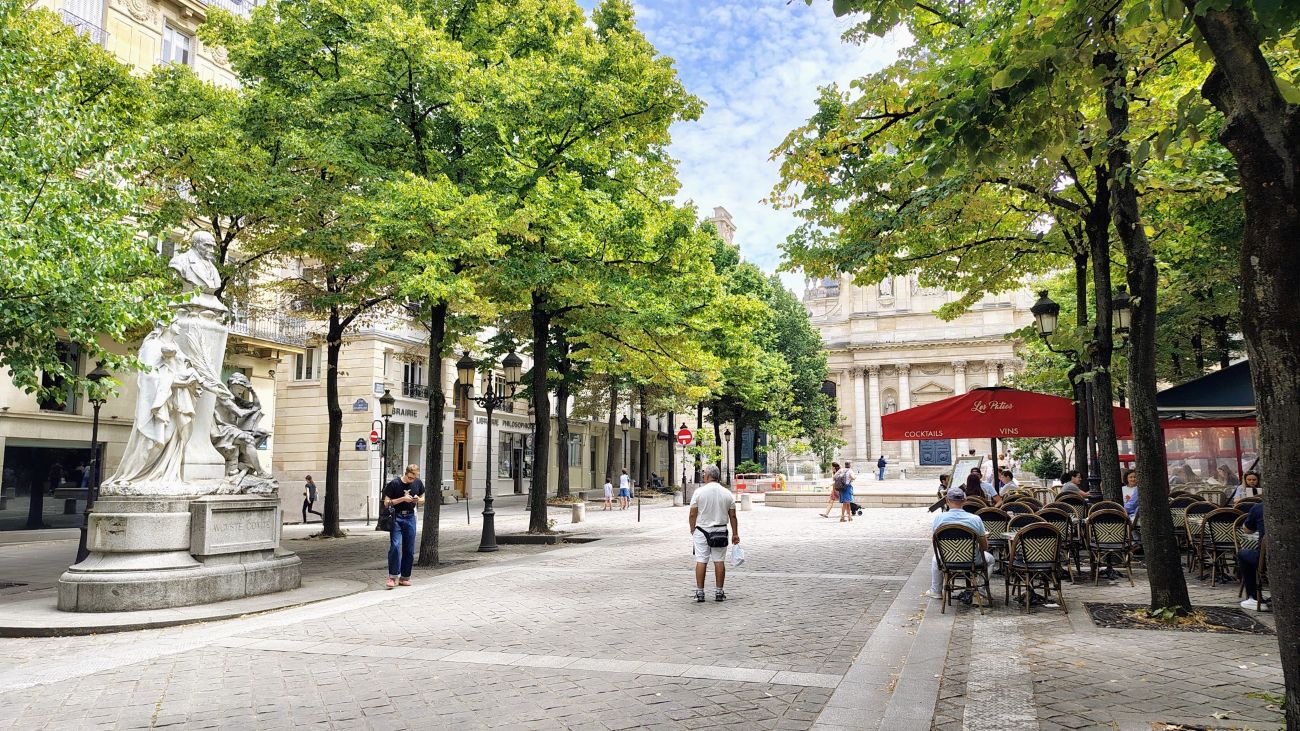
The Place de la Sorbonne islocated in the Sorbonne quartier or neighborhood of the 5éme arrondissement or district of Paris. It is bordered by the rue Victor-Cousin and rue de la Sorbonne; by boulevard Saint-Michel. Rue Champollion leads to the middle of it. The square is accessible by metro line 10 at Cluny – La Sorbonne station and by RER B at Luxembourg station. This square owes its name to the Sorbonne University, which it adjoins it. The square was opened in 1639 under the name of rue Neuve-de-Richelieu. During the French revolution, it was renamed for a short time Place Chalier, and Petit rue Chalier, the aspect of the square was modified in 1980, the plane trees being replaced by silver lime trees, with the installation of a permanent flow fountain, Notable buildings here are;see the western facade of the Chapelle Sainte-Ursule de la Sorbonne (17C) closes the perspective of the square between the rue de la Sorbonne and the rue Victor-Cousin. On either side of this facade are the side entrances that provide access to the Sorbonne University. The one on the left still bears the inscription École nationale des Chartes, founded in 1821 and housed within the Sorbonne until its move in 2014 to the “Quadrilatère Richelieu” (see rue Richelieu no. 65). Nos. 1 to 3: buildings constructed from 1838 on part of the site of the former chapel of the Cluny college. No. 3: the café L’Écritoire, where the lyricist Étienne Roda-Gil and the singer Julien Clerc met, probably in the spring of 1967. No. 6: the Librairie philosophique J. Vrin has been located here since 1911. The Monument to Auguste Comte, (see pic) sculpted by Jean-Antoine Injalbert, was inaugurated in 1902 in the center of the square. The square is bordered by several booksellers, printers, cafés and restaurants.
The Paris tourist office on the 5éme arrondissement de Paris: https://parisjetaime.com/eng/article/explore-paris-s-5th-arrondissement-a820
The official Sorbonne university of Paris: https://www.sorbonne-universite.fr/en/about-us
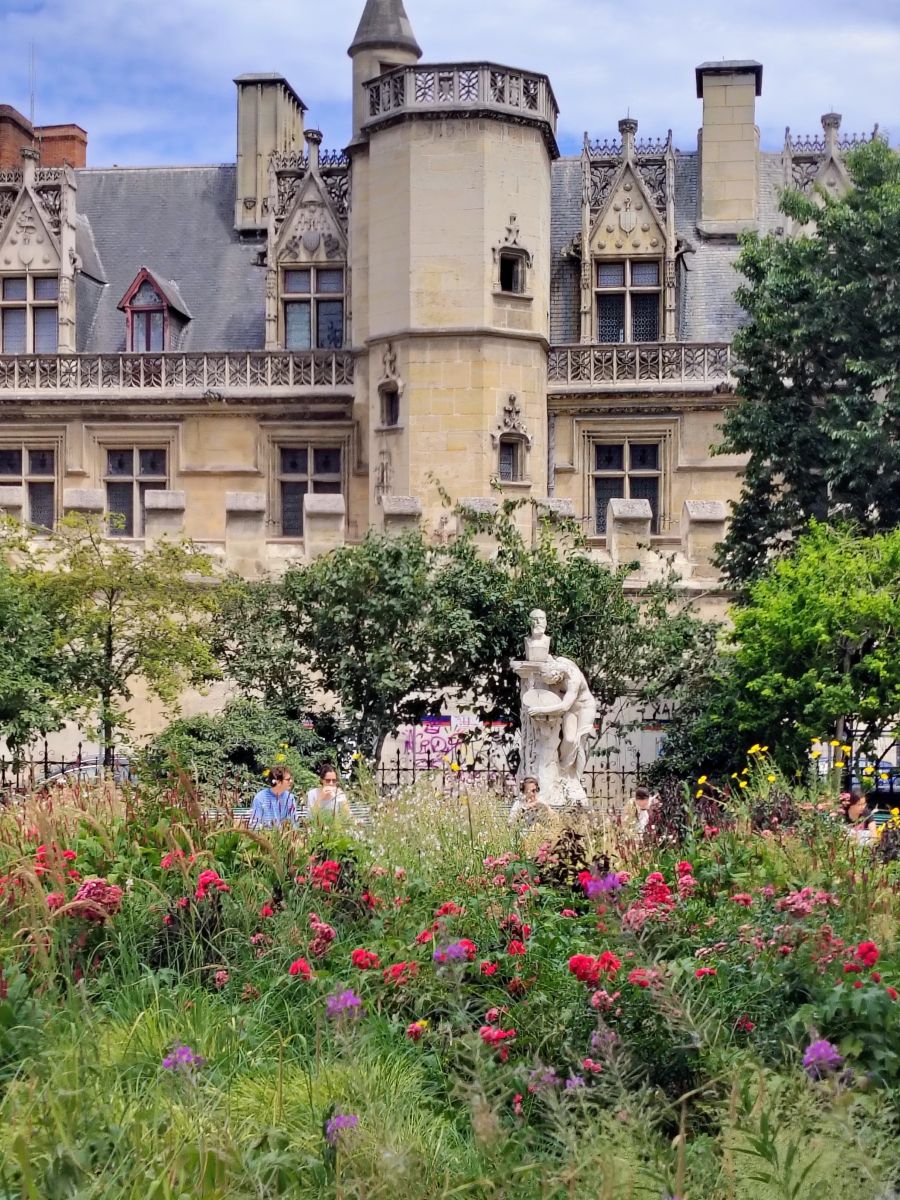
The Square Samuel-Paty is the central green space of Place Paul-Painlevé. It is located in the 5éme arrondissement of Paris, opposite the Sorbonne. Previously known as Square de la Sorbonne, then Square de la Place Paul-Painlevé, it was renamed in 2021 by decision of the Paris Council. Square Samuel-Paty is accessible from 2, Place Paul-Painlevé. It is located between Rue des Écoles where the Sorbonne is located, Rue de Cluny and Rue Du Sommerard where the entrance to the National Museum of the Middle Ages is located in the Hôtel de Cluny.(see pic), It is served by metro line 10 at the Cluny – La Sorbonne station. The site took its name from the proximity of the eponymous square, which pays homage to Paul Painlevé, a French mathematician and politician. Until 1933, it was called “Square de la Sorbonne” renaming the site Square Samuel-Paty in homage to the history and geography teacher assassinated on October 16, 2020 during the terrorist attack in Conflans-Sainte-Honorine. Unanimously approved by the Paris Council during the session of October 12, 2021, the proposal was thus definitively adopted and the square was therefore renamed. It was inaugurated on October 16, 2021, one year after the assassination. The square, with an area of 758 m2, was designed in 1900 and then redesigned with a medieval inspiration in 2000. The transformation of this space was born from the desire to clean up the area and offer a better perspective view of the Hôtel de Cluny, which had been obstructed for too long by parasitic constructions. This square has several public monuments, Montaigne, the work of the sculptor Paul Landowski , offered in 1934 to the city of Paris by Doctor Armengaud. It is accessible not from inside the square but along the rue des Écoles. The Louve capitoline, allaitant Romulus et Rémus or Capitoline She-wolf, suckling Romulus and Remus, is a bronze reproduction of the work kept at the Capitole Museum. It was offered by the city of Rome to the city of Paris during their twinning in 1962. Monument to Puvis de Chavannes (1924), sculpture by Jules Desbois. Monument to Octave Gréard (1909), fountain by the sculptor Jules Chaplain and the architect Henri-Paul Nénot. The Gladiators, marble group by Tony Noël, moved in 1909 and broken by accident, stored in the City of Paris depot.
The Paris tourist office on the square Paul Painlevé (Samuel Paty) : https://parisjetaime.com/eng/culture/square-paul-painleve-p1113
The City of Paris on the square Samuel Paty : https://www.paris.fr/lieux/square-samuel-paty-2444
The Paris tourist office on the 5éme arrondissement de Paris: https://parisjetaime.com/eng/article/explore-paris-s-5th-arrondissement-a820
There you go folks, a dandy city to explore and enjoy with the family, Memorable moments in my eternal Paris, driving and walking all over in my road warrior trails brings out sublime awesome spots with nice memorable family visits of yesteryear always remember and always looking forward to be back, eventually. Again hope you enjoy the post on curiosities of Paris , part XLV !!! as I.
And remember, happy travels, good health, and many cheers to all !!!

 Paris1972-Versailles2003