
I drove by here a lot as was one of my easy entry to Paris from Versailles where we used to live, The area having wonderful historical monuments and restaurants in my eternal Paris, This is my fav 16éme arrondissement with a nice museum palace of great grandeur and beauty, and I glad to find me a new picture in my cd rom vault and another older one to tell you about it in my blog for you and me. Therefore, let me tell you on the musée de l’Homme of Paris !!! Hope you enjoy it as I.
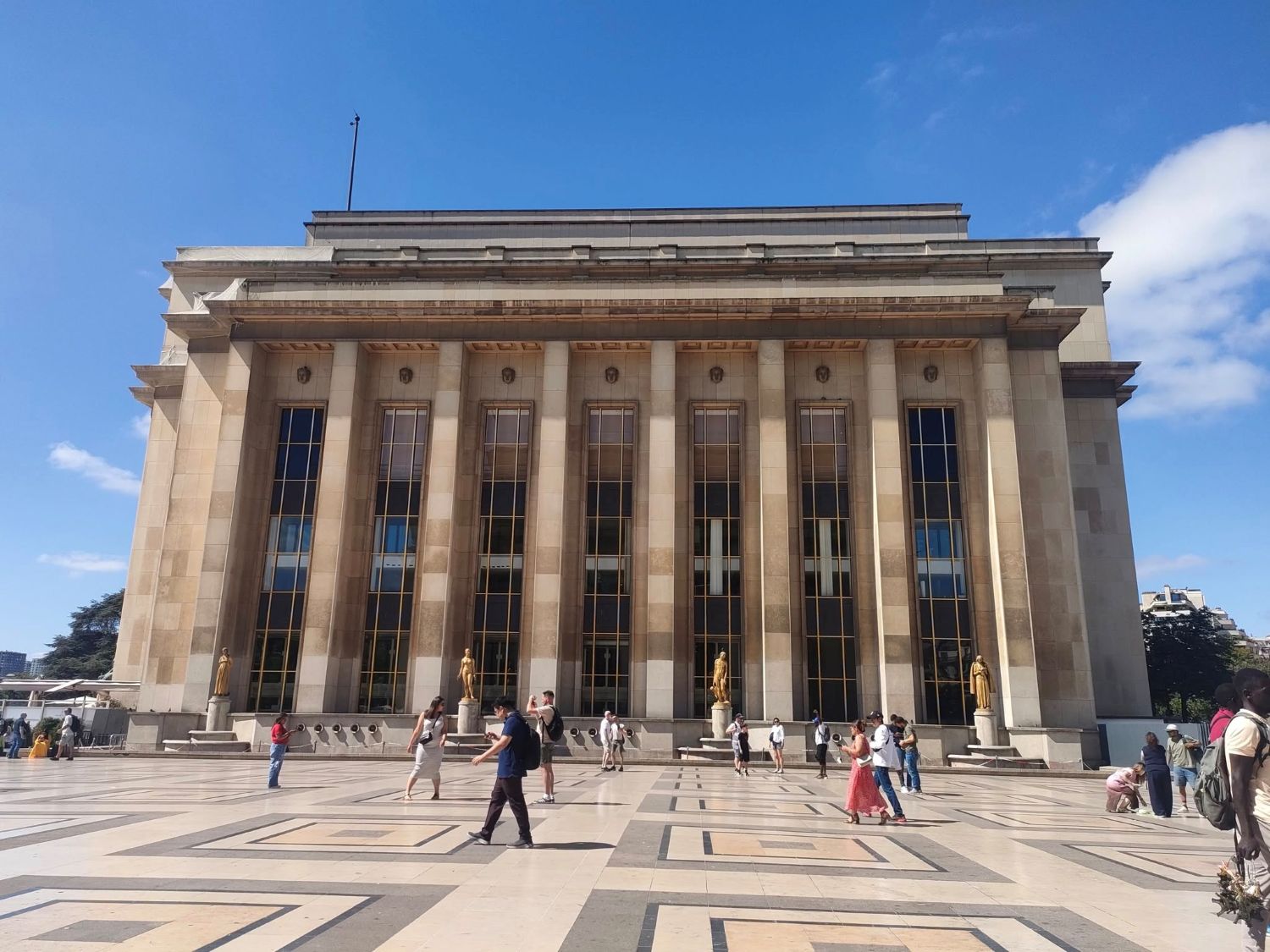
The Musée de l’Homme is a national museum, part of the National Museum of Natural History (MNHN), located since 1937 on the upper floors of the Palais de Chaillot in Paris. Its mission is to present the human race in its anthropological, historical and cultural diversity. It operates under the joint supervision of the Ministry of Higher Education and Research and the Ministry of Ecology, Sustainable Development and Energy. The tall windows, located at the rear of the main pavilion, offer the Café de l’Homme, located on the ground floor, and the Café Lucy, located on the 2nd floor, a panoramic view of the Eiffel Tower and the Champ-de-Mars. The Musée de l’Homme is served by metro lines 6 and 9 Trocadéro station, and by bus lines 22, 30, 32 and 63 arrêt/stop Trocadéro.
The collections of the Musée de l’Homme are among the richest in the world in their field. They include: 700,000 prehistoric pieces of great geographical and chronological diversity; 100,000 ethnobiological pieces encompassing the relationships between humans and the animal and plant worlds; 30,000 anthropological pieces, specimens and representations of the human body testifying to the diversity and unity of modern humans; 6,000 ethnological pieces illustrating the appropriation of nature by human societies, since the majority of this section was transferred to the Musée du Quai Branly. The 1,300 m2 reserves are divided between the 3rd floor, which houses the cultural anthropology collection in fixed shelving, and the garden level where six rooms house the biological anthropology and prehistory collections in metal compacts adapted to their contents (skeletons, skulls, flints, etc.). In addition to the collection study rooms, adjoining the reserves, a treatment room is intended for receiving new pieces, quarantine and preparation of loans, and another for the conservation and restoration of mummies.
A bit of history I like tell us that the Musée de l’Homme is the heir to the Trocadéro Museum of Ethnography, founded in 1882 by Ernest Hamy and housed in the former Trocadéro Palace, built for the 1878 World’s Fair. The museum’s first collection was formed from a donation by the explorer Alphonse Pinart of around 3,000 objects from the Americas, purchased largely from Eugène Boban, and 250 objects from Oceania. From the former Museum of Ethnography, the museum inherited the exceptional historical collections built up from the 16C onwards, originating from cabinets of curiosities and the Royal Cabinet, as well as from the Department of Scientific Missions of the Ministry of Public Instruction. These ethnographic collections were enriched during the 19C and continue to this day thanks to scientific expeditions and missions carried out across the world, to which are added donations or deposits from travelers and private collectors.
The Place du Trocadéro-et-du-11-Novembre is in the 16éme arrondissement of Paris. It is located at the intersection of Avenue du Président-Wilson, Avenue Kléber, Avenue Raymond-Poincaré, Avenue d’Eylau, Avenue Georges-Mandel, and Avenue Paul-Doumer. It opens onto the Human Rights Square and the Palais de Chaillot . Located on the heights of Chaillot, its diameter is 164 meters. It is planted with trees and decorated in its center with an equestrian statue of Marshal Foch, surrounded by a lawn. The square opens onto the Palais de Chaillot and its forecourt overlooking the Seine and offering a clear view of the Eiffel Tower.It is mainly home to cafés and brasseries, from east to west: the Café du Trocadéro, Le Malakoff, the Pâtisserie Carette,(a must), the Café Kléber and Le Coq. On New Year’s Eve, the square is a gathering place for Parisians and tourists. Created in 1869 under the name of Place du Roi-de-Rome, it was renamed in 1877 in memory of the Battle of Trocadéro which took place on August 31, 1823, during which a French expeditionary force took Fort Louis, which defended the port of Cadiz in Spain, from the hands of the Spanish liberal revolutionaries and restored the authority of King Ferdinand VII. The November 11 corresponds to the armistice of November 11, 1918, which marked the end of the fighting in the Great War or WWI, In everyday language, however, it remains called Place du Trocadéro or is abbreviated to “Troca”. The square is located on the upper part of the former grounds of the Visitandine convent of Chaillot, previously the park and Château de Chaillot. Its land was sold as national property in the 1790s during the French revolution, and then acquired by the Imperial State in 1811-1813 for the project of the Palais du Roi de Rome, which never saw the light of day. The Place du Roi-de-Rome, in homage to Charles Joseph Bonaparte, son of Emperor Napoleon I, was created in 1869 under the Second Empire (Napoléon III) as a large round square in the center of avenues radiating out in a star shape. It took the name Place du Trocadéro in 1877. For the 1878 World’s Fair, the Palais du Trocadéro was built on the curve of the square. For the 1937 World’s Fair, the old palace, the structure of which was partly preserved, was replaced by the Palais de Chaillot. You see here and wonderful walks the Trocadéro Fountain located in the Trocadéro Gardens at the foot of the Palais de Chaillot. Built in 1937, it has a rectangular basin topped with small basins and twenty oblique water cannons, 56 jets, and 12 water columns. The gardens of the Palais de Chaillot, which replaced the Palais du Trocadéro, have an area of 93,930 square meters and slope gently towards the Seine towards the Pont d’Iéna opposite the Eiffel Tower. The Palais de Chaillot, formed by two curved wings that descend towards the Seine, was built for the International Exhibition of Arts and Technology in 1937 and replaced the former Palais du Trocadéro, whose site has retained its name. The old dome will give way to a forecourt that will extend the axis formed by the Champ de Mars and the Pont d’Iéna, on the one hand, and the Place du Trocadéro on the other. The whole is immense and the central hemicycle has a radius of 80 meters, the palace today covers 55,000 square meters of museum. Named Place des Droits de l’Homme, the upper terrace is bordered along its length by basins and gilded bronze statues representing seven women and a man. You find here my favorites, the National Theatre of Chaillot, the National Maritime Museum, the Musée de l’Homme or Museum of Man, the City of Architecture and Heritage (or Museum of Architecture), and the Palais de Tokyo. (See posts).

The Paris tourist office on the Place du Trocadéro : https://parisjetaime.com/eng/transport/le-trocadero-et-son-esplanade-p1900
The official musée de l’Homme : https://www.museedelhomme.fr/en
The official musée national d’histoire naturelle on the musée de l’Homme : https://www.mnhn.fr/en/musee-de-l-homme-museum-of-mankind
There you go folks, you are set to go. And a lovely area of Paris for walks and wonderful Haussmannien architecture, and very much knowledge of the world places such as the museum. Again, hope you enjoy the Musée de l’Homme of Paris !!! as I.
And remember, happy travels, good health, and many cheers to all !!!

 Paris1972-Versailles2003