
The town of Port Marly is very nice residential with beautiful properties we enjoyed a lot, This is of course in my memorable Yvelines dept 78 of the Île de France region of my belle France, I again, found me pictures in my cd rom vault that should be in my blog for you and me, This was believe or not, where my dear late wife Martine came for the nearby clinic and we saw finally the castle !!! It’s great for the culture and historical in me, and glad found me more pictures to do this post, do read the original post in my blog, Therefore, here is my take on the Château d’If of Port Marly !!! Hope you enjoy it as I
The Château d’If was Alexandre Dumas‘s (father) former estate at Port-Marly, opposite the Château de Monte-Cristo, the writer had set up the Château d’If as his study. The pavilion was surrounded by a moat and accessed via a drawbridge. A highly elaborate neo-Gothic architecture. It was named Château d’If because it sits in the middle of a small body of water, symbolizing the writer’s isolation, hidden behind the moat and accessed, at the time, via a drawbridge. He would shut himself away for long hours to write in peace, far from the hustle and bustle of his guests and the staff at the Château de Monte-Cristo, literally across the street . A picturesque miniature castle also stands in the park: the Château d’If is a Gothic troubadour-style fantasy that serves as a work lodge for the writer. Engraved on stones for eternity, the names of the works published by Dumas adorn the facades.
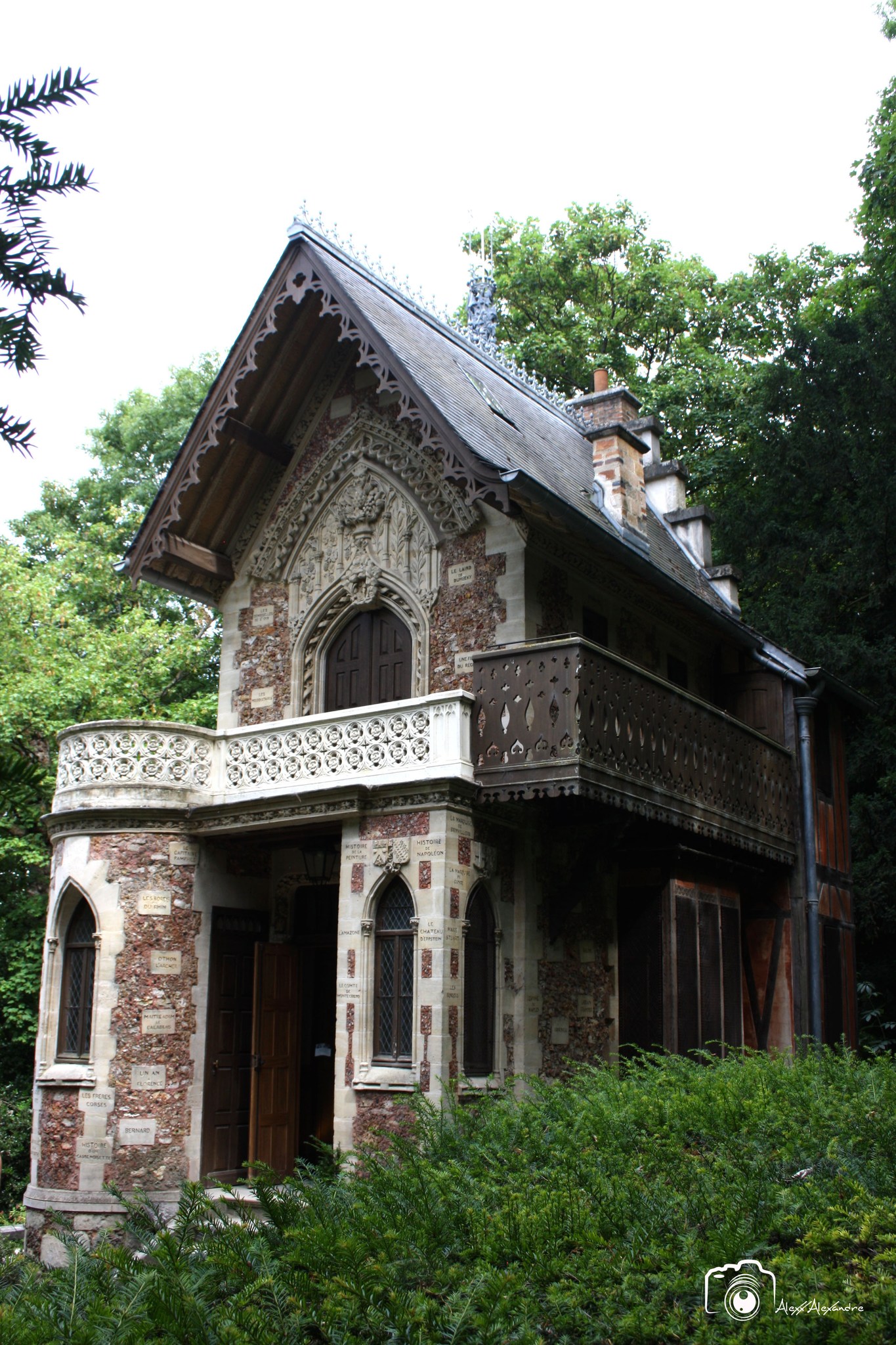
Alexandre Dumas left his lasting mark on the estate, 88 plaques adorn the exterior. These are all the titles of his works! The façade is also decorated with bas-reliefs depicting scenes from his novels. The bas-reliefs adorning its façades express an entire literary universe. Here, Edmond Dantès discovers the treasure (The Count of Monte Cristo); there, above a window, appears the monk Gorenflot riding a donkey (The Lady of Montsoreau); there, Henry III’s Duke of Guise appears on the turret (Henry III); there is the famous, exuberant Anglo-Japanese garden with its waterfalls and grottoes.
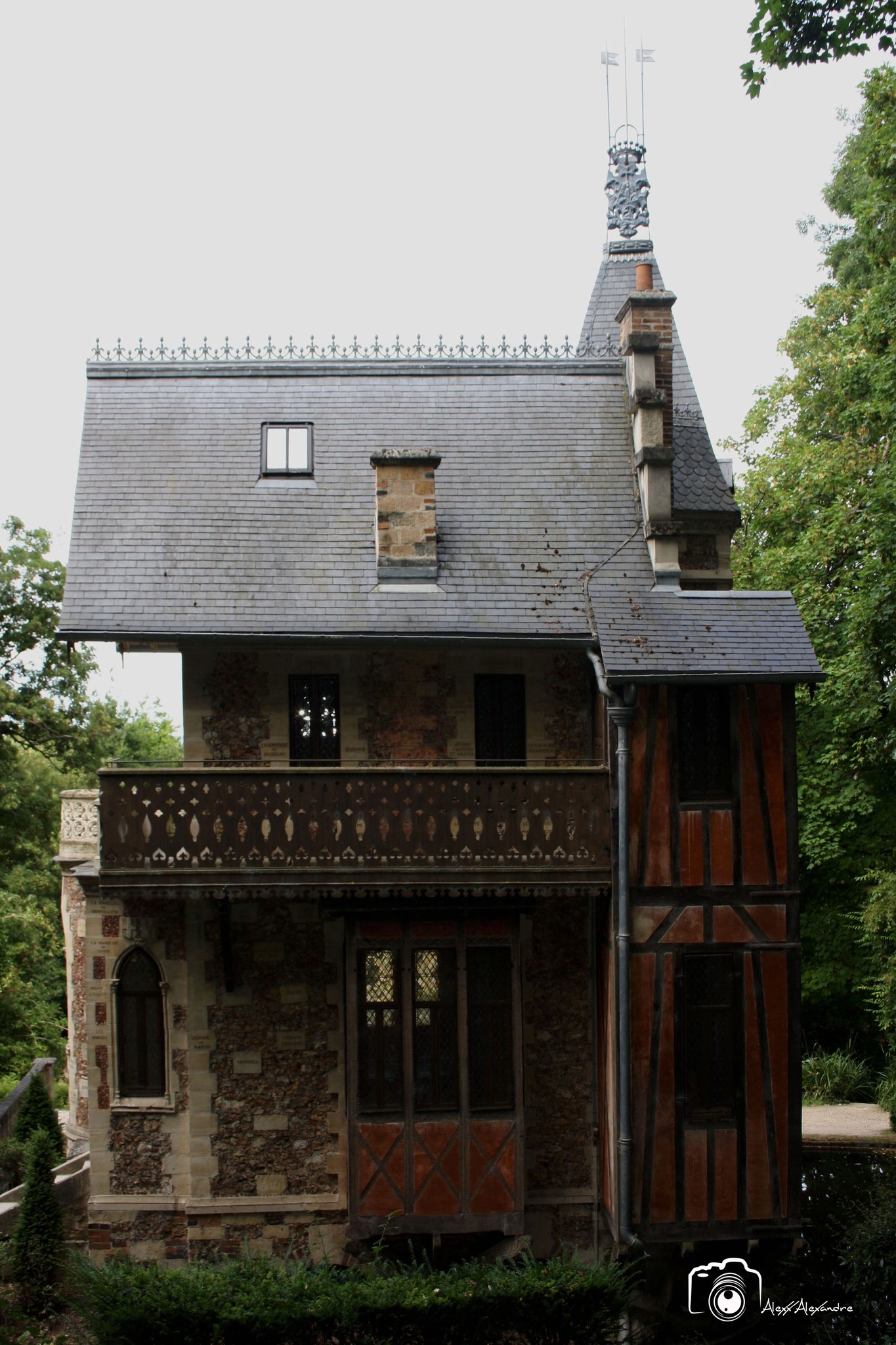
The Château d’If has an English-style park planted with the most beautiful species of trees (larches, firs, oaks, birches, hornbeams, etc.). Thanks to the presence of springs, it is embellished with waterfalls, ponds, rivers and decorated with rockeries and grottoes. On July 25, 1847, after two years of work, Alexandre Dumas inaugurated the estate, in the presence of numerous guests who crowded into the grounds, admiring the Renaissance château and the Gothic pavilion, the waterfalls, the rockeries, and the water features. In debt, Dumas had to sell the entire estate on March 22, 1849.
I have always come here by car but if in public transports they tell us that with the SNCF trains you take it from Gare Saint-Lazare station toward Saint-Nom la Bretèche. Get off at Marly-le-Roi station, then take bus line 10 and get off at the “Les Lampes” stop. The entrance is a five-minute walk away. Or by RER A: Get off at Saint-Germain en Laye. Take bus line 10 toward “Marly-le-Roi” and get off at the “Les Lampes” stop. The entrance is a five-minute walk away. By car, I came from Versailles, I took rue de la Paroisse right to Rue des Reservoirs whicn continues becomes the Bd du Roi (D186) ,at the trafic circle of Place de la Loi turn left into Bd Saint Antoine same D186 road ,same road becomes the Route de Saint Germain en Laye crossing under the A13 autoroute de Normandie continue becomes the N186 road or route de Versailles, then after the trafic circle de la Grille Royale becomes the D386 or route de Marly ,continue around the circle by the Domaine de Marly (see post) and the road becomes the D8 for a short meters turn right becomes the D7 road or Avenue Jean Bérenger continue same road becomes Allée des Epines, continues as all is the same D7 road, but change name to Avenue de l’Europe, just after trafic circle de l’Europe turn right into Chemin du Hauts des Ormes you see the parking lot on your right, The access is via the Clinique de l’Europe parking lots. An automatic barrier with ticket issuance is in place. Present this ticket at reception and a counterfoil will be issued. Parking at the Château de Monte-Cristo remains free for the visitors.
A bit on this great writer, one of my favorites ! Alexandre Dumas (father) was born in Villers-Cotterêts in the Aisne department no 02 on July 24, 1802. His father, Alexandre Dumas Davy de la Pailleterie, was a general in the Grande Armée. His mother, Marie-Louise Labouret, was the daughter of a local innkeeper. Alexandre was raised by his maternal grandparents after his father died in 1806, leaving him, his mother, and his sister destitute. In 1840, he married an actress, Ida Ferrier, only to divorce four years later. He enjoyed considerable success with women, seducing multiple mistresses. Four children were born from his various relationships: Alexandre (1824) with a seamstress, Laure Labay; Marie-Alexandrine (1831) with the beautiful actress Krelsamer. Henry with Anna Bauër (1851), a writer and journalist; Micaëlla (1860) with the actress Émélie Cordier.
His father was indeed mixed race or mulatto, the fruit of a union between a white man and a black woman or vice versa. He was also the first general of the French revolution to have Afro-Caribbean origins. His grandfather was called Antoine Alexandre Davy de la Pailleterie. Of noble birth, he was the owner of a plantation in Santo Domingo (now Dominican Republic). He fell in love with his slave, Marie Cessette Du mas. He married her and freed her from her enslavement. Alexandre Dumas therefore had African roots. Note that, proud of his origins, he took his grandmother’s name Dumas. The French playwright died on December 5, 1870 in Puys, near Dieppe, in his son’s villa, surrounded by his grandchildren. He is buried in Neuville-lès-Pollet, now called Neuville-sur-Dieppe. After the Franco-Prussian War in 1872, he was transferred to Villers-Cotterêts, his hometown. But his second resting place would not be his last! Indeed, his remains were transferred to the Panthéon on November 30, 2002, on the occasion of the bicentenary of his birth. I don’t know about you, but I often confuse Dumas fils (son), and Dumas père (father). To remember, note this! Alexandre Dumas (father) is the author of The Three Musketeers; The Count of Monte Cristo; and Queen Margot. To name only the most famous works. Alexandre Dumas, fils (son) is the author of: The Lady of the Camellias, his most famous work.
The official Château de Monte Cristo : https://www.chateau-monte-cristo.com/main/en/
The official association of Friends of Alexandre Dumas on the castle : https://www.dumaspere.com/pages/vie/lieux/chateau.html
The town of Port-Marly on the castle: https://www.port-marly.fr/Patrimoine%20historique/2093/35
The local Seine Saint Germain tourist office on the castle: https://www.seine-saintgermain.fr/en/beautiful-escapes/great-stories/a-journey-to-the-heart-of-alexandre-dumass-imagination/
The Yvelines dept 78 tourist office on the castle: https://www.destination-yvelines.fr/visites-et-decouvertes/le-chateau-de-monte-cristo-havre-de-paix-dalexandre-dumas/
The¨Île de France region tourist office on the castle : https://www.visitparisregion.com/en/chateau-de-monte-cristo
There you go folks, another dandy in off the beaten path Port Marly, worth the detour indeed. There are plenty other goodies by it and near it, a wonderful area see my post on the town in my blog, Again, hope you enjoy this post on the Château d’If of Port Marly !!! as I.
And remember, happy travels, good health, and many cheers to all !!!

 Paris1972-Versailles2003